
Outdoor plant
Delphinium
Delphinium elatum
Also known as Candle larkspur, Alpine delphinium
How to grow delphinium, Delphinium elatum. Staking the spires before they need it, keeping slugs off the spring shoots, and the toxicity that has killed livestock.
At a glance
- Difficulty
- Difficult
- Water
- Regular through the growing season
- Light
- Full sun, with shelter from wind
- Temperature
- Fully hardy, and the crown rots in a wet winter
- Hardiness
- USDA 3-7, RHS H7, hardy to -35 C
- Type
- Herbaceous perennial, short lived and dying back each winter
- Height
- 1.2-2 m
- Native to
- Mountain grassland across Europe and central Asia, from the Pyrenees to Siberia
- Best month
- July in the Northern Hemisphere, January in the Southern Hemisphere
Heat rather than cold sets the southern limit. Delphiniums need cool summers and cool nights, and through zone 8 and warmer they are short-lived or grown as annuals from seed. Slugs and snails take the new shoots in spring and can destroy an established plant in a week. Every stem needs staking before it needs it, because a spike snapped by wind does not come back.
Hardiness zones describe winter cold alone. Summer heat, humidity, rainfall and the length of the growing season decide as much, so treat the range as the outer limit rather than as a recommendation.
Every month named in this guide is for the temperate Northern Hemisphere. If you garden in the Southern Hemisphere, shift each one by six months, so July becomes January. Closer to the equator the wet and dry seasons matter more than the calendar, and the shift stops being a useful guide.
Poisonous if eaten
- Do not eat
- All parts, and the seeds and young growth most of all
- Harm from
- Eating it and handling it
- Affects
- People, cats, dogs and horses
Delphinium contains diterpenoid alkaloids including methyllycaconitine, which are related to the aconitine of monkshood and act in a comparable way on nerve and muscle. Eating any part causes burning of the mouth, vomiting, abdominal pain, muscle weakness, a slow or irregular heartbeat and in serious cases paralysis and death. The seeds and the young spring growth carry the highest concentrations. Larkspur poisoning is a significant cause of cattle deaths on rangeland in the western United States, running to thousands of animals a year, which is the clearest measure of how toxic the genus is. The RHS lists delphinium as harmful if eaten, and the ASPCA lists it as toxic to cats, dogs and horses. Handling the plant causes skin irritation in some people, so wear gloves when cutting or dividing it. Treat any ingestion by a person or an animal as a call to a doctor or vet rather than something to watch, and never dispose of delphinium foliage or cut spires anywhere livestock can reach them.
Sources: RHS potentially harmful garden plants, ASPCA toxic and non-toxic plants
About
A row of delphiniums two metres high in a blue that no other hardy perennial produces is the reason people put up with everything else about them.
Everything else is considerable. Slugs and snails find the emerging shoots in March irresistible and will strip a crown to nothing in a wet week. The spires are top-heavy and snap in the first summer gale unless every one is individually staked. The crown rots over a wet winter on heavy soil. Powdery mildew arrives in August. The plants are short-lived and want replacing every four or five years.
None of that is difficult in itself. It is a plant that rewards attention paid at exactly the right moments and punishes a season of inattention completely.
The blue is rare. Deep gentian blue, sky blue, violet and lavender all occur in the elatum hybrids, along with white, cream and pink, and the strain of the Blackmore and Langdon nursery in Somerset has been the British standard for a century.
Cut it after the first flush and many cultivars give a second, smaller flowering in September.
It is also one of the more dangerous plants in an ordinary garden, in the same chemical family as monkshood.
Appearance and character
A herbaceous perennial reaching 1.2 to 2 m in flower, forming a basal clump that dies back completely each winter.
Leaves are palmate, deeply cut into five to seven toothed lobes, mid-green, and largest at the base of the plant.
Flower spires are the whole point. They rise unbranched from the clump in June and July, 40 to 80 cm of densely packed florets on a single stem.
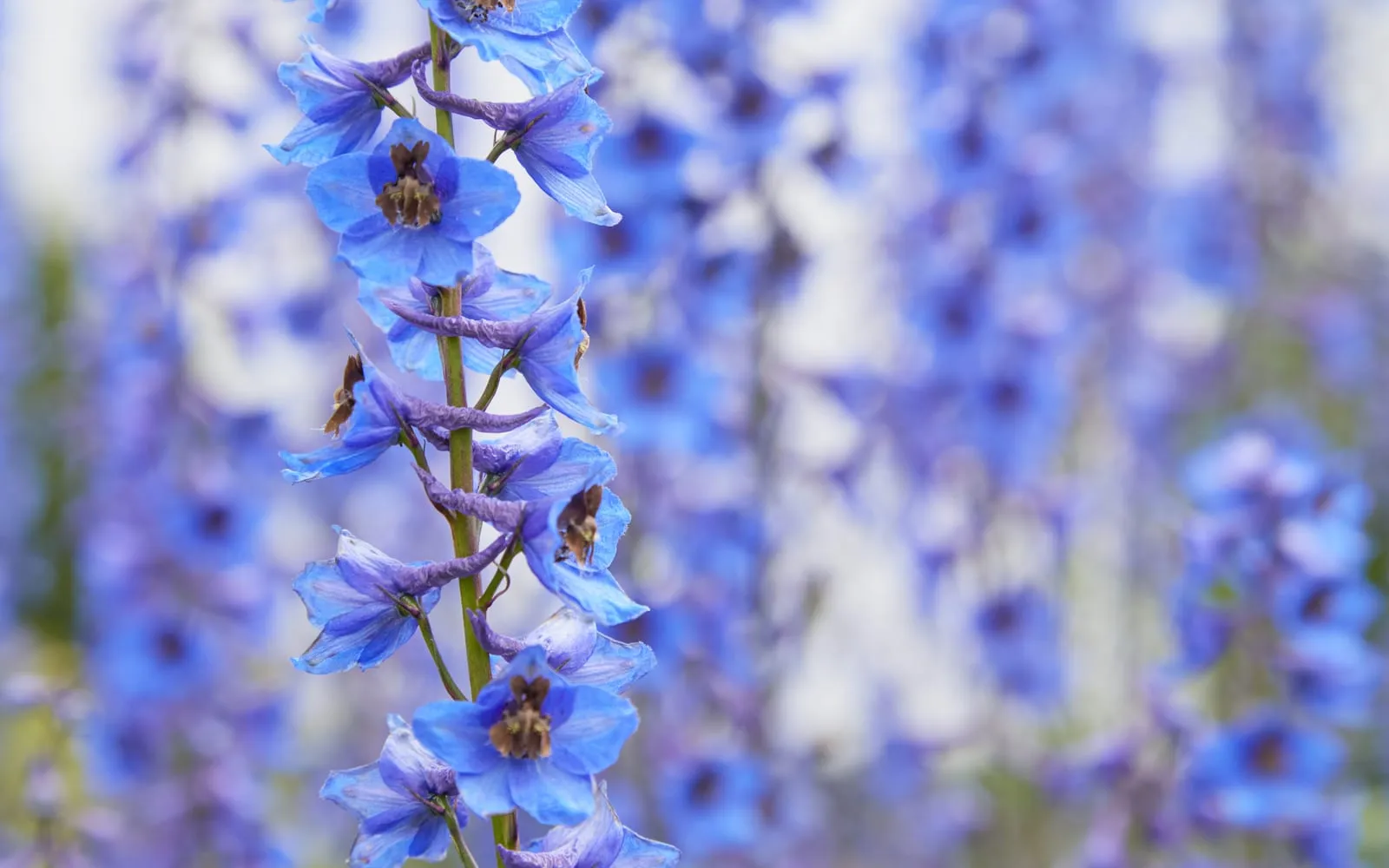
Each floret is 4 to 6 cm across with five petal-like sepals and a backward-pointing spur, and a central cluster of small petals in a contrasting colour known as the bee. The bee is often black, white or brown and is what gives a delphinium spire its texture.
Colours run through the blues, from deep gentian to pale sky, along with violet, lavender, mauve, white, cream and pink.
The Pacific Giant strain is taller and shorter-lived, the elatum hybrids from British breeding are sturdier, and the Belladonna group is shorter at around 1.2 m with branched airy spikes that need less staking.
Seed pods follow and split to release flat black seed, which should be removed unless you want it.
Where it is from
Mountain grassland across Europe and central Asia, from the Pyrenees and the Alps east through Russia into Siberia and Mongolia.
That habitat sets the conditions. Cool summers, full sun, deep soil with plenty of moisture in the growing season, and sharp drainage in winter.
The garden delphinium is a complex hybrid group derived largely from Delphinium elatum along with several other species, developed through the nineteenth and twentieth centuries.
British breeding has been central to it. Blackmore and Langdon in Somerset began raising delphiniums in 1901 and their strain remains the reference point.
The name is Greek, from delphis for dolphin, describing the shape of the unopened flower bud.
Larkspur is the annual relative, now separated into Consolida, and it carries the same alkaloids.
Delphinium petals have been used as a blue dye and are still used dried in confetti, where they hold their colour better than almost any other flower.
How it grows
Plant in spring rather than autumn, which avoids a young crown sitting through a wet winter.
Choose full sun with shelter from wind. A position against a wall or a hedge with sun for most of the day is ideal, and open exposure guarantees broken spires.
Prepare the soil deeply, working in a generous quantity of compost or well-rotted manure. Delphinium is a hungry plant and the soil does most of the work.
Improve drainage on heavy ground by adding grit, or plant on a slight ridge. Winter wet around the crown is what kills them.
Protect the emerging shoots from slugs from the moment they appear in March. This is the single most important job of the delphinium year. Use whatever method you trust, apply it before the shoots break the surface, and keep applying it through April.
Stake every spire individually. Put a cane beside each stem when it reaches 30 cm and tie it in at intervals as it grows, taking the tie up to just below the flower spike. Rings and grow-through supports are not enough for a two-metre stem.
Thin the shoots on an established clump in spring, reducing to five or seven of the strongest on a mature plant. This gives better spires than leaving fifteen weak ones.
Water generously through the growing season and feed twice.
Cut the spent spires back to a low leaf as soon as the flowers fade. Many cultivars then produce a second flush in September.
Cut the whole plant to the ground in late autumn and clear the debris.
Divide every three or four years in spring, taking the outer sections and discarding the old centre.
Propagate from basal cuttings in April, taking new shoots at 8 cm with a sliver of the crown attached.
Through the seasons
Winter is dormant, and the risk is the crown sitting in wet soil. Sharp drainage matters more than frost protection.
Spring brings the shoots up in March, which is when slug control begins and when the clump is thinned and staked.
Summer flowers in June and July, and the spires are cut back immediately afterwards for a second flush.
Autumn may give a second smaller flowering in September, and the plant is cut down and cleared once it dies back.
Care difficulty
Difficult, and specifically demanding rather than temperamental.
The plant grows readily. The problem is that four separate things go wrong at four separate points in the year, and missing any one of them costs the display.
Slugs in March, staking in May, drought in June, and winter wet on heavy soil are the four. A gardener who does all four gets a spectacular result and a gardener who does three gets a mess.
The plants are also short-lived, wanting division every three or four years and replacement every five or six.
Watering
Water generously through spring and summer. Delphinium is a thirsty plant and drought gives short spires and early mildew.
Soak thoroughly rather than sprinkling, and water at the base rather than over the foliage, which encourages mildew.
Mulch in spring with compost to hold moisture and feed the plant at the same time.
Sharp drainage in winter is the other half of the requirement. Waterlogged ground in January kills where dryness in July only disappoints.
Warning signs, diseases and pests
Shoots eaten to stumps in March and April is slugs and snails, and it is the commonest cause of a delphinium disappearing entirely. Protect the crown before the shoots emerge.
Spires snapped near the base after wind or heavy rain is inadequate staking. Cane and tie each stem individually from 30 cm upwards.
White powdery coating on leaves and stems from July is powdery mildew, which follows dry roots and poor air movement. Water, mulch, thin the shoots in spring and remove affected foliage.
The crown failing to reappear in spring after a wet winter is crown rot. Improve drainage, add grit, and plant on a raised ridge on heavy soil.
Black blotches spreading on the leaves and stems in wet weather is bacterial black spot. Remove affected growth and clear all debris in autumn.
Distorted growth with fine white specks is cyclamen mite, which is uncommon and untreatable in a garden. Destroy affected plants.
Fewer and thinner spires each year on an old clump is congestion. Divide it in spring and discard the woody centre.
Chewed leaves with ragged edges alongside slug damage may be earwigs, which do minor harm.
Growing environment
Full sun with shelter from wind. Both parts matter, since a delphinium in an exposed border breaks whatever you do.
Deep, rich, moist, free-draining soil with plenty of organic matter. Heavy clay works if drainage is improved and thin dry sand does not.
Fully hardy in terms of cold. The winter risk is wet rather than frost.
Allow 45 to 60 cm per plant, and plant in groups of three or five for a proper display.
It suits the back of a herbaceous border, a cottage garden, a cutting bed or a traditional double border.
Grow the Belladonna group at around 1.2 m instead if staking every stem is too much work, since the branched spikes take wind far better.
Plant something in front of it. Delphinium foliage looks tired by August and the base of the plant needs hiding.
Its wildlife value is good while flowering. Bumblebees work the spurred florets heavily, and they are one of the few flowers long-tongued species can reach easily.
Keep it away from any boundary where livestock could reach it, and never throw cut spires into a field.
Feeding
Feed in early spring as the shoots emerge, with a balanced general fertiliser.
Feed again immediately after cutting back the first flush, which is what drives the September flowering.
Mulch in spring with compost or well-rotted manure, keeping it clear of the crown.
Delphinium is a hungry plant and poor soil shows as short thin spires, so generous soil preparation at planting pays for years.
Avoid heavy nitrogen alone, which gives soft growth that flops and mildews. A balanced feed with potash is better.
Troubleshooting
Everything came up and then vanished. Slugs and snails ate the young shoots. Protect the crown from March, before the shoots break the surface, and keep it up through April.
The flower spikes snapped in the wind. They need individual staking. Cane each stem at 30 cm and tie it up to just below the flower spike as it grows. Grow-through rings are not enough.
Will it flower twice? Often, yes. Cut the spent spires back to a low leaf as soon as the flowers fade and feed the plant, and many cultivars give a second smaller flush in September.
The leaves have gone white and powdery. Powdery mildew, which follows dry roots and crowded growth. Water and mulch, thin the shoots in spring, and remove affected leaves.
It did not come back after the winter. Crown rot from waterlogged soil. Improve drainage with grit or plant on a low ridge, and plant in spring rather than autumn.
How many stems should I leave? Five to seven on an established clump. Thin the weak shoots out in spring for better spires.
How poisonous is it? Seriously. It contains alkaloids related to those in monkshood, and larkspur kills cattle by the thousand on American rangeland. Wear gloves when handling it, keep it away from livestock, and call a doctor or vet if any is eaten.
How often should I divide it? Every three or four years in spring, taking the outer sections and throwing the old centre away. Replace the plants entirely after five or six years.
Which type needs least staking? The Belladonna group, which reaches around 1.2 m with branched airy spikes and stands wind far better than the tall elatum hybrids.