
Outdoor plant
English Oak
Quercus robur
Also known as Pedunculate oak, Common oak, Truffle oak
How to identify and grow Quercus robur. The one check that separates it from sessile oak, why a single tree supports over 2,300 other species, and why acorns kill horses.
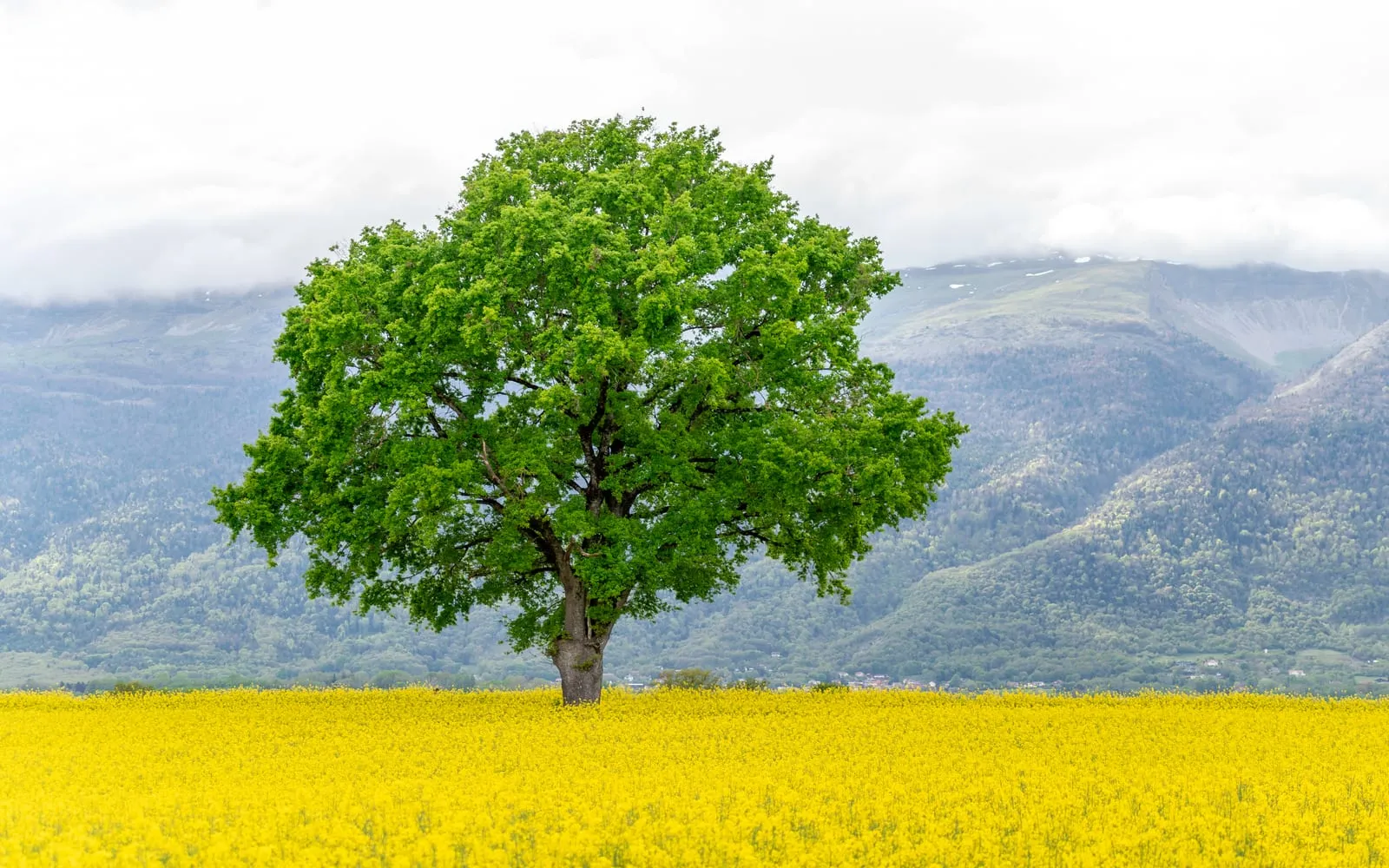
At a glance
- Difficulty
- Easy
- Water
- Through the first two or three summers only
- Light
- Full sun. It grows poorly under a canopy
- Temperature
- Fully hardy, to about -30 deg C
- Hardiness
- USDA 4-8, RHS H6, hardy to -30 C
- Type
- Deciduous tree, extremely long-lived
- Height
- 20-40 m, spreading as wide
- Native to
- Lowland woodland across Europe, from Ireland to the Caucasus
- Best month
- November in the Northern Hemisphere, May in the Southern Hemisphere
Waterlogging rather than cold sets the limit, and oak grows poorly where water stands through winter. It takes summer heat well and is planted successfully across the American midwest, though powdery mildew is worse in humid summers. Oak wilt, a fungus spread through root grafts and beetles, kills red oaks quickly across the eastern United States and affects white oaks including this one more slowly. Do not prune in spring anywhere oak wilt is present.
Hardiness zones describe winter cold alone. Summer heat, humidity, rainfall and the length of the growing season decide as much, so treat the range as the outer limit rather than as a recommendation.
Every month named in this guide is for the temperate Northern Hemisphere. If you garden in the Southern Hemisphere, shift each one by six months, so November becomes May. Closer to the equator the wet and dry seasons matter more than the calendar, and the shift stops being a useful guide.
Toxic if eaten
- Do not eat
- Acorns and young leaves, the acorns most of all
- Harm from
- Eating it
- Affects
- Horses and people
Acorns and young oak leaves contain high levels of tannins, and the risk falls almost entirely on grazing animals. Horses and cattle that eat quantities of green acorns, which happens most often in a heavy mast year when a gale brings them down into a paddock, develop colic, bloody diarrhoea and kidney damage, and cases are sometimes fatal. Pigs and deer eat acorns without harm. The RHS notes oak as harmful if eaten. For people, raw acorns are bitter and unpleasant and will cause stomach upset in quantity, and they have been eaten as famine food across Europe after prolonged leaching in running water to remove the tannins. There is no reason to eat them untreated. If you keep horses, fence them away from oaks through autumn or clear the acorns, since this is one of the more common plant poisonings in livestock. Oak is entirely safe to plant, sit under and climb.
Sources: RHS potentially harmful garden plants, NC State Extension, Quercus robur
About
A single mature oak supports more other living things than any other tree in Europe. Research published for the Woodland Trust in 2019 catalogued over 2,300 species using oak, from lichens and fungi to beetles, moths, birds and mammals, and found more than 300 of them found on oak and nowhere else.
That number is a consequence of time. An oak can stand for five hundred years and sometimes more, long enough for whole communities to assemble in its bark crevices, its rot holes and its dead limbs. The old forester’s saying gives it three hundred years growing, three hundred standing and three hundred dying, and the dying centuries are the richest for wildlife.
Britain and much of northern Europe have two native oaks and most people never learn to separate them. The check takes five seconds and is set out below.
Appearance and character
Leaves 7 to 14 cm long with four or five rounded lobes each side, widest above the middle, and almost no stalk. At the base of each leaf sit two small ear-like flaps called auricles that clasp the twig.
Acorns sit in a scaly cup on a long stalk, or peduncle, of 3 to 8 cm, often several to a stalk. That stalk gives the tree its other name, pedunculate oak.
Here is the whole identification. Quercus robur has long-stalked acorns and short-stalked leaves. Quercus petraea, the sessile oak, has the reverse, with stalkless acorns sitting tight against the twig and leaves on stalks of 1 to 2 cm with no auricles. Remember that the stalks swap over and you will never confuse them again.
The two hybridise freely where their ranges meet, producing Quercus x rosacea with intermediate characters, so some trees will not key out cleanly.
Bark is grey-brown, deeply fissured into vertical plates on a mature trunk.
Open-grown trees make a short thick trunk and an enormously wide spreading crown. Woodland trees run tall and straight with the crown high up.
Where it is from
Lowland woodland across Europe from Ireland eastward to the Caucasus, and native throughout Britain.
Its preference is deep, heavy, fertile soil, and it tolerates clay better than almost any other large tree, which is why English oak dominates the lowland clays of southern and central England while sessile oak takes the thinner acid soils of the west and north.
Oak is light-demanding. Acorns germinate readily in shade and the seedlings languish there, so oaks regenerate in gaps and on open ground rather than under a closed canopy. Jays are the main agent, burying acorns in grassland and forgetting a proportion of them.
Cold is no constraint down to about -30 deg C. Waterlogging is, and oak grows poorly on permanently wet ground.
Mast years, when the trees fruit heavily in unison, come every few years and are thought to be a strategy for overwhelming the animals that eat acorns.
How it grows
A deciduous tree growing 30 to 60 cm a year when young in good conditions, slowing markedly with age.
Young oaks put a great deal into a deep taproot before making height, which is why a small transplanted whip overtakes a large expensive specimen within a few years. Plant oaks small.
Leaves emerge in late April or May, often bronze-tinted, and many trees produce a second flush of growth in midsummer known as Lammas growth.
Flowers are inconspicuous. Male catkins hang in loose yellow-green tassels in spring and the female flowers are tiny and easily missed.
Acorns ripen in a single season and fall in September and October. They lose viability quickly on drying, so sow them fresh.
Oaks respond well to being cut. Coppicing and pollarding both extend the life of the tree considerably, and many of the oldest oaks in Britain are former pollards.
Through the seasons
Spring brings the catkins in April and the leaves in late April or May. This is when to check young trees for powdery mildew and to keep the base clear of competing grass.
Summer is the main growing season, often with a second Lammas flush in July or August. Water young trees in drought.
Autumn brings the acorn fall in September and October, and leaf colour in russet and brown through November. Clear acorns from any paddock.
Winter is the planting and pruning season. Plant bare-root trees between November and March, and prune only when necessary, in winter while dormant.
Care difficulty
Easy in the sense that an oak requires nothing once established, and demanding in the sense that the decision to plant one is close to permanent.
Size is the honest difficulty. A mature English oak reaches 20 to 40 metres with a crown as wide, and it will outlive everyone reading this. It is a poor choice for a small garden and an outstanding one for a field corner, a large lawn or a hedgerow.
Establishment is the only period needing effort. Keep a metre of ground around a young tree free of grass, which competes hard for water, and water through the first two or three summers.
After that the tree needs no feeding, no pruning and no attention.
Watering
Water young trees weekly through their first two or three summers, giving a deep soak rather than a sprinkle.
Keep a clear circle of at least a metre around the trunk, mulched with bark or compost. Grass growing to the stem is the commonest cause of a young tree failing to thrive, and it does more damage than drought.
Established oaks need no watering at all.
Avoid piling mulch against the trunk, which encourages rot at the collar.
An oak draws a great deal of water from heavy clay soil, which is a consideration when siting one near a building on shrinkable clay.
Warning signs, diseases and pests
Acute oak decline is the serious current threat. It shows as dark weeping patches on the trunk oozing a black fluid, with cracks in the bark between the plates, and it can kill a mature tree within five years. Report suspected cases through Forest Research’s Tree Alert.
Chronic oak decline is slower, showing as thinning crowns and dieback of the outer twigs over many years, usually driven by a combination of drought, defoliation and root damage.
Oak processionary moth is established in London and parts of the south-east. The caterpillars move in nose-to-tail processions and build white silken nests on the trunk. Their hairs cause skin rashes, eye irritation and breathing problems in people and animals. Do not touch nests or caterpillars, and report them to the Forestry Commission.
Powdery mildew coats young oak leaves with white bloom, mostly on the summer flush. It looks worse than it is on an established tree and can weaken a seedling.
Knopper galls turn acorns into sticky ridged distortions. They are caused by a gall wasp, reduce the acorn crop, and do the tree no harm.
Oak apples, marble galls and spangle galls on the leaves are all gall wasps and all harmless.
Bracket fungi at the base indicate heart rot, which is normal in a veteran tree and only a concern where the tree might fall on something.
Growing environment
Full sun. Oak seedlings survive in shade and never make good trees there.
Deep, heavy, fertile soil suits it best, and it handles clay well. It grows on most soils apart from permanently waterlogged ground and very thin chalk.
Fully hardy to about -30 deg C, and tolerant of exposure once established, though young trees do better with some shelter.
Give it room. Twenty metres from a building is a sensible minimum, and further on shrinkable clay where root water uptake can affect foundations.
Plant bare-root whips between November and March. A 60 cm whip establishes faster and grows away better than a semi-mature tree, and costs a fraction as much.
Protect young trees from deer and rabbits with a guard, and keep the base free of grass for the first few years.
Growing from an acorn works well. Collect fresh acorns in autumn, discard any that float, and sow them 5 cm deep in a deep pot or straight into the ground.
Feeding
Established oaks need no feeding.
Young trees benefit from an annual mulch of garden compost or well-rotted manure in a circle around the base, kept clear of the trunk. That improves the soil, holds moisture and suppresses grass all at once.
Avoid fertiliser, which encourages soft growth prone to mildew.
Do not cultivate or dig under the crown of an established oak. The feeding roots are shallow and spread well beyond the branch tips, and root damage is a leading cause of decline in mature trees.
Avoid compacting the ground under the canopy with vehicles or heavy traffic.
Troubleshooting
Is this an English oak or a sessile oak? Look at the stalks. English oak has acorns on long stalks and leaves with almost none. Sessile oak has stalkless acorns and leaves on obvious stalks. If it looks halfway between the two, it is probably the hybrid.
Can I plant one in a normal garden? Only if the garden is large. A mature English oak reaches 20 to 40 metres with a crown as wide. In a small garden, an ornamental crab or rowan gives you wildlife value at a workable size.
How long until it produces acorns? Around forty years, and sometimes longer. Oaks are planted for other people.
The acorns have turned into sticky ridged lumps. Knopper galls, caused by a gall wasp. They spoil the acorn crop and do the tree no harm.
There is black fluid weeping from the trunk. Possible acute oak decline. Report it through Forest Research’s Tree Alert service.
There are white silky nests on the trunk and caterpillars in a line. Oak processionary moth. Do not touch them. The hairs cause rashes and breathing problems. Report it to the Forestry Commission.
Can horses graze under an oak? Not in autumn. Acorns cause serious and sometimes fatal poisoning in horses and cattle. Fence them out or clear the acorns after a gale.
How do I grow one from an acorn? Collect fresh in autumn, discard any that float in water, and sow 5 cm deep in a deep pot or in the ground. They need no special treatment and germinate in spring.