
Outdoor plant
Catmint
Nepeta x faassenii
Also known as Faassen's catmint, Garden catmint
How to grow catmint, Nepeta x faassenii. The long-flowering edging plant for dry sun, why cats roll on it, and cutting it back for a second flush.
At a glance
- Difficulty
- Easy
- Water
- Rarely once established
- Light
- Full sun, and it flops and flowers poorly in shade
- Temperature
- Fully hardy, and the crown rots in wet winter soil
- Hardiness
- USDA 4-9, RHS H7, hardy to -35 C
- Type
- Herbaceous perennial, long lived and dying back each winter
- Height
- 30-60 cm depending on cultivar
- Native to
- A garden hybrid of two species from the Caucasus, Iran and Turkey
- Best month
- June in the Northern Hemisphere, December in the Southern Hemisphere
Poor dry alkaline soil suits it and rich damp ground gives soft growth that flops open in the middle. It takes drought and heat as well as it takes cold, which makes it one of the few border perennials equally at home in Montana and Provence. Cats roll on it and can flatten a young plant, so a few twiggy sticks through the crown in its first season are worth the trouble.
Hardiness zones describe winter cold alone. Summer heat, humidity, rainfall and the length of the growing season decide as much, so treat the range as the outer limit rather than as a recommendation.
Every month named in this guide is for the temperate Northern Hemisphere. If you garden in the Southern Hemisphere, shift each one by six months, so June becomes December. Closer to the equator the wet and dry seasons matter more than the calendar, and the shift stops being a useful guide.
Not known to be toxic
Catmint is not listed by the RHS as a potentially harmful garden plant and is not recorded by the ASPCA as toxic to cats, dogs or horses. It is one of the few garden plants the ASPCA explicitly identifies as non-toxic to cats, which matters because cats seek it out. The active compound is nepetalactone, which binds to receptors in the cat's nasal tissue and produces the rolling, rubbing, drooling and brief excitement familiar from catnip toys. Roughly two thirds of cats respond and the rest are genetically indifferent, and the effect wears off within about fifteen minutes. Eating the leaves tends to sedate a cat rather than excite it and causes nothing worse than occasional vomiting if a large quantity is eaten. For people the leaves are used as a herbal tea in some traditions and are safe in ordinary amounts, and the strong smell puts most people off. Where a plant is unlisted rather than positively assessed, read that as no hazard recorded, and here the ASPCA has actively assessed it as non-toxic.
Sources: RHS potentially harmful garden plants, ASPCA toxic and non-toxic plants
About
Catmint flowers from late May until the frosts if you cut it back once, which is more than almost any other hardy perennial manages.
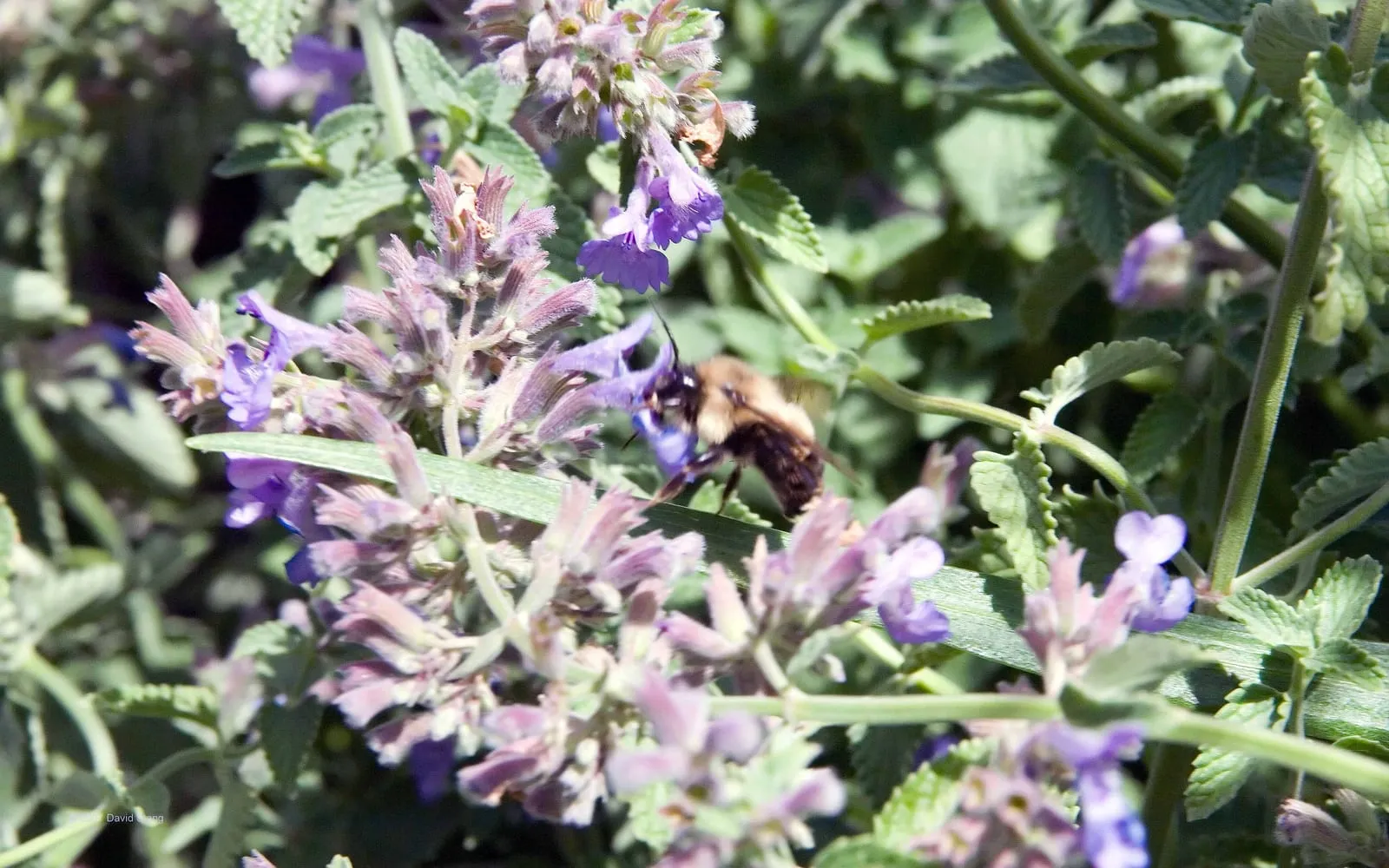
It is grey-green, soft, low and spreading, it looks right spilling over a path edge or along the front of a border, and it grows in the poor dry sunny ground where most perennials struggle. Bees work it constantly for four months.
The one job is the midsummer cut. Around late June or July the first flush finishes and the plant opens out in the middle and looks tired. Shear the whole thing back by two thirds, water it, and it regrows fresh and flowers again from August into October.
It is a substitute for lavender in positions where lavender fails. Both want sun and sharp drainage, and catmint tolerates heavier soil, colder gardens and more shade, and it flowers far longer.
The cats are real. Nepetalactone in the foliage sends about two thirds of cats into a brief rolling euphoria, and a newly planted catmint in a neighbourhood with cats gets flattened. Protect young plants with a few twigs or a low cage until they are big enough to take it.
Appearance and character
A herbaceous perennial reaching 30 to 60 cm depending on cultivar, spreading into a soft mound wider than it is tall.
Leaves are small, 1 to 3 cm, oval to heart-shaped, with a scalloped edge, grey-green and downy on both sides. Crushed foliage smells strongly, somewhere between mint and thyme with a sharp edge.
Stems are square in cross section, which is the mint family signature.
Flowers open from late May in loose whorled spikes along the upper stems, small, two-lipped and lavender-blue, with darker spotting in the throat.
Flowering runs into July, then again from August to the first frosts after a midsummer cut.
Cultivars vary in size. ‘Walker’s Low’ reaches 60 cm despite the name, ‘Six Hills Giant’ reaches 90 cm and is the largest commonly grown, and Nepeta racemosa ‘Little Titch’ stays under 25 cm.
The whole plant dies back to a woody crown in winter and reappears in April.
It is sterile, so it sets no seed and never becomes a nuisance.
Where it is from
A garden hybrid rather than a wild plant, raised from Nepeta racemosa and Nepeta nepetella, both from dry rocky ground in the Caucasus, Iran, Turkey and southern Europe.
Those origins explain the requirements. Full sun, sharp drainage, poor soil and tolerance of drought.
It is named after Faassen, the Dutch nurseryman in whose nursery the cross appeared around 1930.
Being a hybrid, it is sterile, which is why it flowers so long and why it never seeds itself around.
Catnip, Nepeta cataria, is the different plant that the strongest cat response is associated with. It is taller, coarser and white-flowered, an ancient introduction to Britain, and it has naturalised widely across North America on roadsides and waste ground.
Nepetalactone is an iridoid, chemically related to compounds several plants use to deter insects, and it repels mosquitoes and some aphids as well as attracting cats.
The genus name may come from Nepete, an Etruscan town, and the derivation is not settled.
How it grows
Plant in spring, which lets it establish before facing a wet winter.
Choose full sun. Catmint in shade grows lax, flops open and flowers thinly.
Poor free-draining soil is what it wants. Sandy ground, gravel, a raised bed and the strip beside a path all suit it, and rich border soil makes it soft and floppy.
Improve drainage on clay with grit, or plant it on a slight ridge.
Space plants 45 to 60 cm apart. It spreads sideways and looks best in a run of three or five along an edge.
Protect new plants from cats. Push a few twiggy sticks through the crown or put a low wire cage over it for the first season, since a cat rolling on a young plant can kill it.
Shear it back hard in midsummer, in late June or July when the first flush fades, taking off two thirds of the growth. Water afterwards and it regrows and flowers again from August.
Leave the dead growth standing over winter rather than cutting it in autumn, since it protects the crown and gives insects shelter.
Cut the old stems down in March as the new shoots appear.
Divide every three or four years in spring if the clump goes bare in the middle.
Propagate from softwood cuttings in late spring, which root readily, or by division. It sets no seed.
Do not feed it. Rich conditions produce soft growth that flops open and flowers less.
Through the seasons
Winter is dormant, with the old stems left standing to protect the crown.
Spring brings new grey-green shoots in April, and the old growth is cut down then.
Summer flowers from late May, is sheared back in late June or July, and starts again in August.
Autumn carries the second flush through to the first hard frosts, often into November.
Care difficulty
Easy. Catmint is among the most forgiving perennials for a sunny border.
It needs no feeding, no staking, no deadheading and no watering once established, and it tolerates drought, poor soil, cold and coastal wind.
The only regular job is the midsummer shear, and skipping it costs the second flowering rather than the plant.
Cats flattening a young plant and crown rot in wet winter clay are the two ways one dies.
Watering
Water through the first summer after planting.
Established catmint needs no watering in a temperate climate and is one of the more drought-tolerant perennials available.
Water once after the midsummer shear, which speeds the regrowth.
Sharp drainage in winter matters far more than summer moisture. A crown sitting in cold wet clay through January rots.
Skip the mulch, or use gravel rather than compost, which suits it better and keeps the crown dry.
Warning signs, diseases and pests
The plant opening out and going bare in the middle by midsummer is normal, and it is what the summer shear fixes. Cut it back by two thirds.
Lax floppy growth with few flowers is shade, rich soil or too much feeding. Move it into sun and stop feeding it.
Flattened crushed growth with a depression in the middle is a cat. Protect young plants and accept it on established ones, which recover.
White powdery coating on the leaves in a dry summer is powdery mildew, which follows drought. Cut the plant back and water.
The crown failing to reappear in spring is rot from winter wet. Add grit, improve drainage, and plant on a ridge on heavy soil.
Bare woody centre with growth only around the edges on an old plant is congestion. Divide it in spring.
Very few pests attack it, and slugs and aphids both largely leave it alone, which is one of its virtues.
Growing environment
Full sun. This is not negotiable for good flowering.
Poor, free-draining soil. Sand, gravel and thin ground all suit it. Avoid rich border soil and heavy wet clay.
Fully hardy to about -35 deg C, and tolerant of drought, coastal wind and cold. The winter risk is wet rather than frost.
Allow 45 to 60 cm of spread per plant.
It suits a path edge, the front of a sunny border, a gravel garden, a rose bed, a dry bank, a wall top or a large container.
Plant it in a run rather than singly, since the effect comes from the mass.
Grow it with the plants that share dry sun. Lavender, salvia, achillea, sedum, alliums, roses and grasses all work, and catmint under roses is a long-standing combination that hides the bare rose legs.
Its wildlife value is high and sustained. Bees of many kinds work it constantly from May to October, which is a longer nectar season than almost anything else in a border, and it is one of the best plants to add for pollinators.
Choose ‘Six Hills Giant’ for a large border, ‘Walker’s Low’ for general use, and ‘Little Titch’ for a small space or a trough.
Feeding
None. Catmint grows better in poor soil than in rich.
Feeding produces soft lax growth that flops open, flowers less and mildews more.
Skip the compost mulch as well, and use gravel around the crown if you want to mulch at all.
A plant flowering poorly is short of sun rather than nutrients.
Troubleshooting
It has gone bare in the middle and stopped flowering. Normal by midsummer. Shear the whole plant back by two thirds in late June or July, water it, and it regrows and flowers again from August into October.
When should I cut it back? Hard in midsummer after the first flush. Leave the old stems standing over winter and cut them down in March.
Cats keep flattening it. They are responding to nepetalactone in the foliage. Protect a young plant with twiggy sticks or a low cage for the first season. Established plants recover.
Is it safe for cats? Yes. The ASPCA lists it as non-toxic to cats, and about two thirds of cats respond to it with rolling and rubbing that wears off in fifteen minutes.
It is floppy and hardly flowers. Too much shade, soil that is too rich, or feeding. Move it into full sun and stop feeding it.
Is this the same as catnip? No. Catnip is Nepeta cataria, a taller coarser white-flowered plant. Garden catmint is a sterile hybrid with a milder effect on cats and a far better garden performance.
Will it seed itself around? No. Nepeta x faassenii is sterile and sets no seed.
It did not come back in spring. Crown rot from winter wet. Improve drainage with grit and plant on a slight ridge on heavy soil.
Which one should I grow? ‘Six Hills Giant’ for a big border at 90 cm, ‘Walker’s Low’ for general use at 60 cm, and ‘Little Titch’ for a trough or a small edge.