
Outdoor plant
Sunflower
Helianthus annuus
Also known as Common sunflower
How to grow sunflowers, Helianthus annuus. Sowing, staking, why young plants follow the sun and mature ones face east, and the spirals in the seed head.
At a glance
- Difficulty
- Easy
- Water
- Deeply and regularly, especially as buds form
- Light
- Full sun, six to eight hours. There is no substitute
- Temperature
- Frost tender. Sow after the last frost, grows fast at 20-30 deg C
- Hardiness
- USDA 2-11, RHS H2, hardy to 2 C
- Type
- Hardy annual
- Height
- 40 cm to 3 m depending on variety
- Native to
- North America
- Best month
- June in the Northern Hemisphere, December in the Southern Hemisphere
It is an annual killed by the first frost, so hardiness never applies and the useful number is soil temperature. Seed germinates above about 10 C and sulks below it. Heliotropism belongs to the bud rather than the flower. Young plants track the sun and a mature head stops moving and faces east, which warms it earlier and brings more pollinators. Give it shelter, since a tall stem in wind snaps at the base.
Hardiness zones describe winter cold alone. Summer heat, humidity, rainfall and the length of the growing season decide as much, so treat the range as the outer limit rather than as a recommendation.
Every month named in this guide is for the temperate Northern Hemisphere. If you garden in the Southern Hemisphere, shift each one by six months, so June becomes December. Closer to the equator the wet and dry seasons matter more than the calendar, and the shift stops being a useful guide.
Not known to be toxic
Non-toxic. The ASPCA lists Helianthus as non-toxic to dogs, cats and horses, and sunflower does not appear on the RHS list of potentially harmful garden plants. Sunflower seeds are food for people, birds and livestock, and the oil is one of the most widely used cooking oils in the world. Sprouted sunflower shoots are sold as a salad leaf. There is nothing here to keep away from a child or a pet. Two small practical notes rather than toxicity warnings. Sunflower seeds in shell can cause a blockage if a dog eats a large quantity of husks, so shelled seeds are safer for sharing. And the plant is mildly allelopathic, releasing compounds that suppress the growth of some neighbours, which affects potatoes and beans nearby rather than anything that eats it.
Sources: ASPCA (Sunflower, Helianthus species), RHS potentially harmful garden plants
About
Young sunflowers track the sun across the sky and mature ones stop, locked facing east. Research in the last decade has explained why they do each, and the answers are stranger than the folklore.
The tracking is growth rather than movement. The east side of the stem elongates during the day and the west side elongates at night, swinging the head west through the afternoon and back east overnight. It runs on a circadian rhythm, so a plant in constant light keeps swinging for a while on its own.
The east-facing habit of mature plants is a pollination strategy. An east-facing head warms faster in the morning sun, and warm flowers attract markedly more bees than cold ones.
Appearance and character
A tall single stem, rough and hairy, carrying broad heart-shaped leaves that are sandpapery to touch. Height runs from 40 cm dwarf varieties to giants over 3 m.
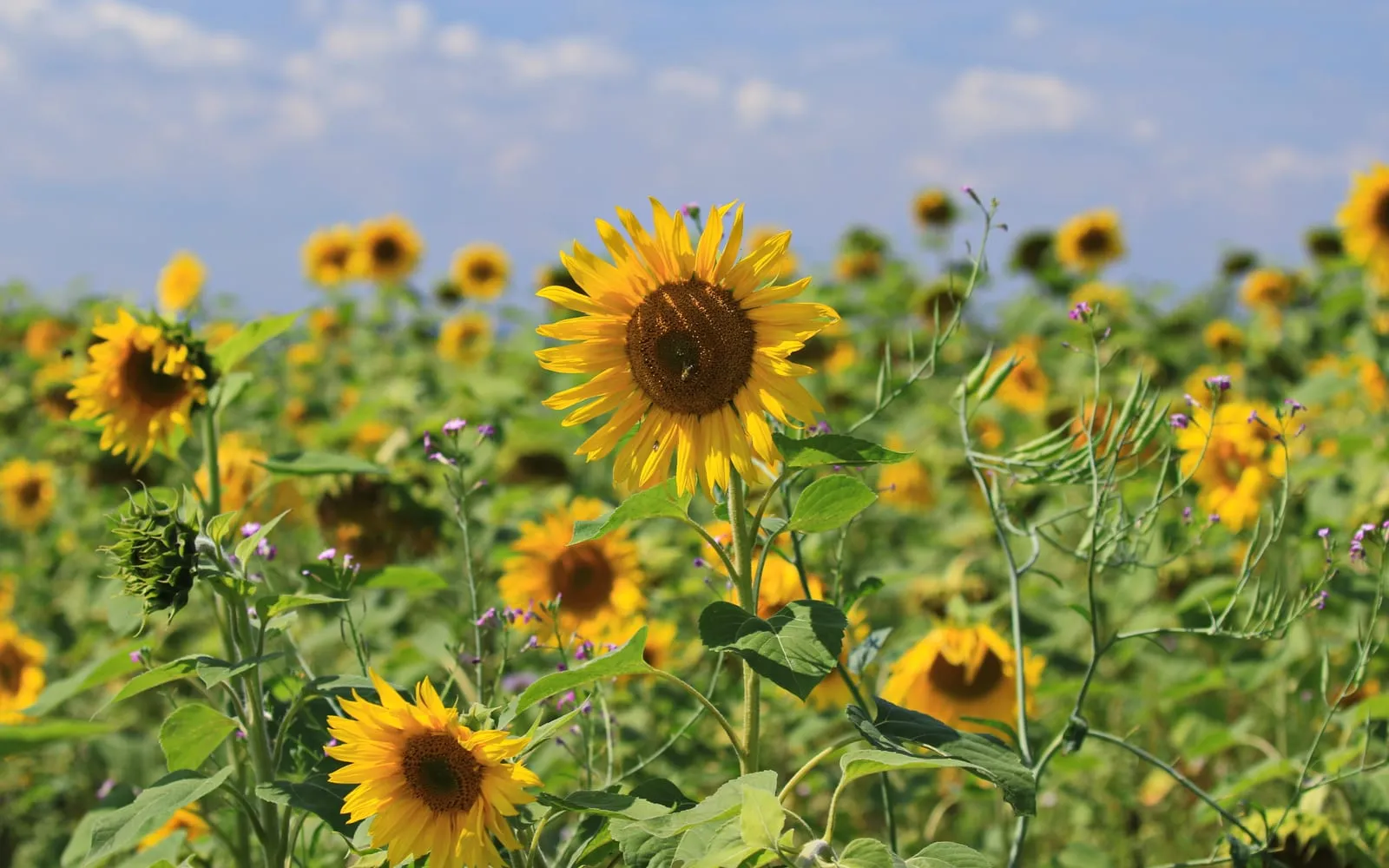
What looks like one enormous flower is a head of hundreds of small ones. The outer yellow “petals” are ray florets, each a single sterile flower, and the dark centre is packed with fertile disc florets that each become a seed.
Those disc florets are arranged in two sets of interlocking spirals, and the number of spirals in each direction is almost always a pair of consecutive Fibonacci numbers, commonly 34 and 55, or 55 and 89 on a large head. The arrangement packs the maximum number of seeds into the space available.
Multi-headed varieties branch and carry dozens of smaller flowers over a longer period, which suits cutting far better than one giant bloom.
Where it is from
North America, where it was domesticated by indigenous peoples in what is now the eastern United States around 3000 BC, making it one of the few major crops originating north of Mexico.
It grew wild on open prairie and disturbed ground, which is the habitat of a fast annual. Full sun, deep soil and no competition, with one short season to complete everything in.
Spanish explorers took it to Europe in the sixteenth century, and it became a major oilseed crop in Russia, partly because sunflower oil was not on the Orthodox church’s list of foods restricted during Lent.
How it grows
A hardy annual that germinates, flowers, sets seed and dies in a single season. Seed sown in late April or May germinates in a week or so and the plant flowers from July.
Growth is remarkably fast, and a tall variety can put on 5 cm a day in warm weather. That speed comes at a cost in stem strength, which is why staking matters.
The taproot goes deep, often over a metre, which makes established plants notably drought-tolerant and also makes them resent transplanting. Sowing directly where they are to grow gives better plants than raising them in trays.
Flowering lasts two to three weeks per head. Once the back of the head turns yellow-brown and the petals drop, the seeds are filling.
Seed is ripe when the back of the head has gone brown and the seeds loosen. Cut the head with a length of stem and hang it somewhere dry and airy, in a paper bag if birds have access.
Through the seasons
Spring is sowing. Direct-sow from late April to May once the soil has warmed and frost has passed, 2 to 3 cm deep. Protect the seedlings from slugs, which are the main cause of failure. Successional sowings a fortnight apart extend the display.
Summer is growth and flowering. Stake tall varieties before they need it. Water deeply as the buds form, which is when the flower size is decided.
Autumn is seed. Leave heads standing for goldfinches and tits, or cut and dry them for your own use. Cut the stems down once they have finished.
Winter leaves nothing behind, since the plant is an annual. Self-sown seedlings often appear the following spring where birds have dropped seed.
Care difficulty
Easy, and two things account for nearly every failure.
Slugs eat the seedlings. A sunflower seedling is large, soft and appealing, and a row can vanish overnight. Protect with a cut-off bottle cloche until the stem toughens at about 20 cm.
Wind snaps the stems. A 2 m plant with a heavy head acts as a sail. Put a stake in at sowing rather than trying to add one later, tie loosely at intervals as the plant grows, and choose a sheltered spot or a shorter variety on an exposed site.
Watering
Water deeply and regularly. Sunflowers are large plants that move a great deal of water, and the period when the buds are forming decides the size of the flower.
Give a thorough soak twice a week in dry weather rather than a daily sprinkle. The deep taproot rewards watering that reaches down.
Water at the base and keep it off the large hairy leaves, which hold moisture and invite fungal problems.
Mulch around the base once the plants are established.
Established plants tolerate drought better than most annuals, and the cost shows in a smaller flower rather than a dead plant.
Warning signs, diseases and pests
Slugs and snails are the main threat and they are only a threat at the seedling stage. Cloches, copper tape, nematodes or an evening patrol all work. Once the stem toughens the danger passes.
Birds take sown seed and then take ripening seed. Cover fresh sowings with mesh, and net or bag the heads in autumn if you want the seed yourself. Feeding goldfinches is the pleasanter alternative.
Stem collapse from wind is the commonest disappointment with tall varieties. Stake early.
Grey mould rots the flower head in a wet summer, showing as brown patches with a fuzzy grey growth. Improve air movement and avoid overhead watering.
Downy mildew stunts seedlings and shows pale patches with grey growth beneath. Remove affected plants.
Sunflower rust produces orange-brown pustules on the leaves late in the season. It rarely matters, since the plant is finishing anyway.
Drooping heads once flowering has finished are normal and structural rather than a sign of trouble.
Growing environment
Full sun. Six to eight hours of direct light is the minimum, and shade produces tall thin plants that lean and flower poorly.
Frost tender, so nothing goes in the ground until the last frost has passed. Growth is rapid between 20 and 30 deg C, and a cold wet spring stalls it.
Soil should be deep, reasonably fertile and free-draining. Sunflowers tolerate poor ground better than most large annuals, and very rich soil produces tall soft stems that fall over.
Shelter matters as much as sun for the tall varieties. A fence, a hedge or a wall behind them takes the worst of the wind.
Space at 45 to 60 cm apart for large varieties. Crowded plants compete for water and produce small heads.
The allelopathy is worth planning around. Sunflowers suppress some neighbours, so keep them away from potatoes and beans.
Feeding
Dig compost or well-rotted manure into the site before sowing. On decent ground that is the whole feeding programme.
On poor or sandy soil, a balanced liquid feed fortnightly during the rapid growth phase helps.
Avoid high-nitrogen fertiliser. It produces tall soft stems that snap and delays flowering.
A high-potassium feed as the buds form supports flower size on hungry soils.
Troubleshooting
Seedlings vanished overnight. Slugs. Cloche the next sowing until the stems toughen.
Plant snapped in the wind. Staked too late, or a variety too tall for the site. Stake at sowing next year, or choose a shorter multi-headed type.
Very tall with a small flower. Too much nitrogen, too little sun, or plants too close together. Space them further apart and stop feeding nitrogen.
Head drooping after flowering. Normal. The seeds are filling and the head is heavy.
Birds stripped the seed head. Bag the head in paper or net it once the back starts turning brown, or leave it for the goldfinches.
Brown fuzzy patches on the flower head in a wet August. Grey mould. Improve airflow and remove affected heads.
Nothing nearby is growing well. Sunflowers are mildly allelopathic. Keep potatoes and beans away from them.