
Disease
Leaf spot
Also called Leaf spots, Fungal leaf spot, Bacterial leaf spot, Septoria, Cercospora, Anthracnose, Shot hole
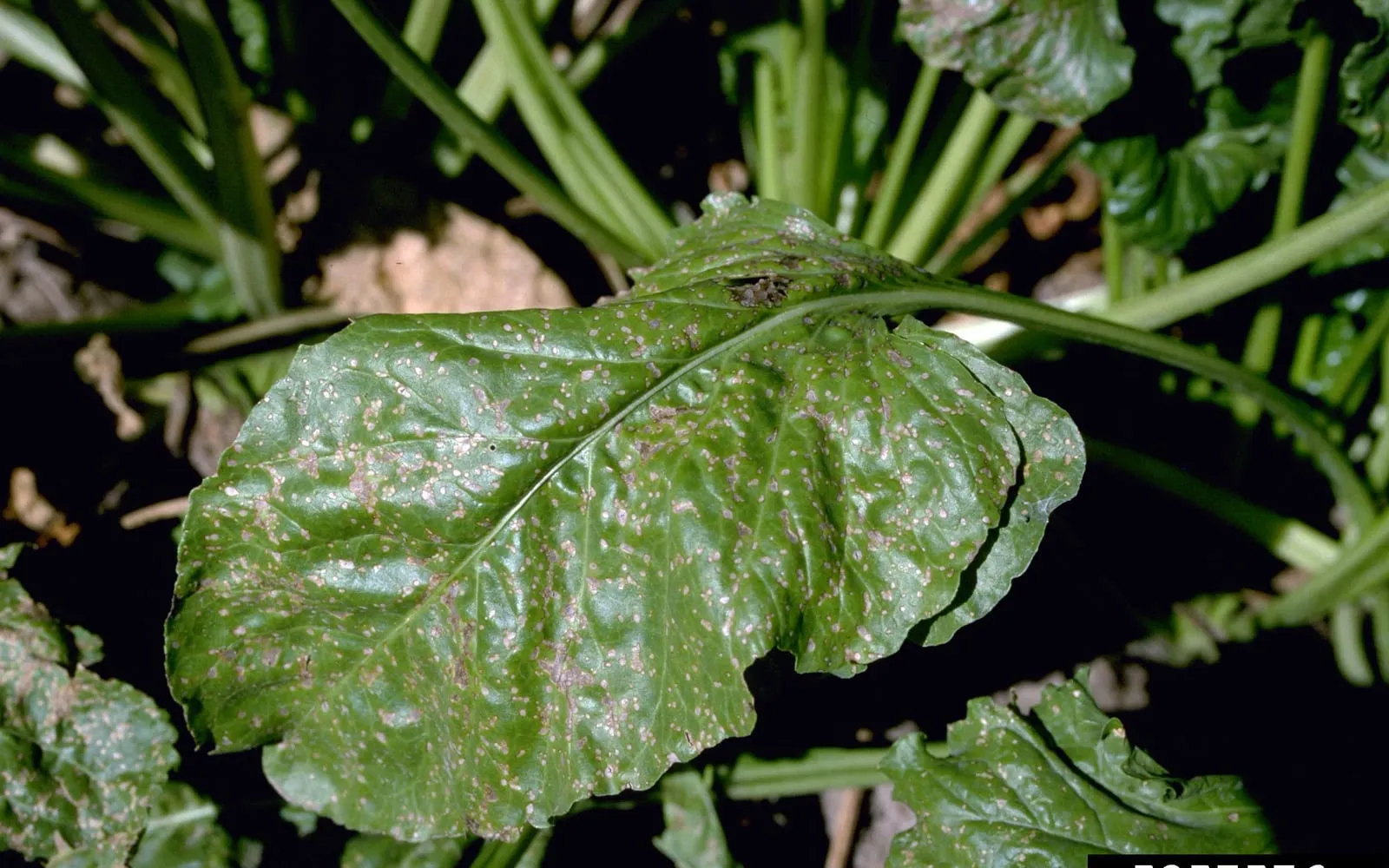
Leaf spot causes dark marks with defined edges, often spreading through wet weather. Hold the leaf to the light to separate fungal spots from bacterial ones, and remove badly affected foliage where needed.
At a glance
- Type
- Disease
- Cause
- Fungus
- Severity
- Weakens the plant
- Affects
- Houseplants, Garden plants, Herbs and edibles
- Active
- April to October
- Established in
- Worldwide
What you are seeing
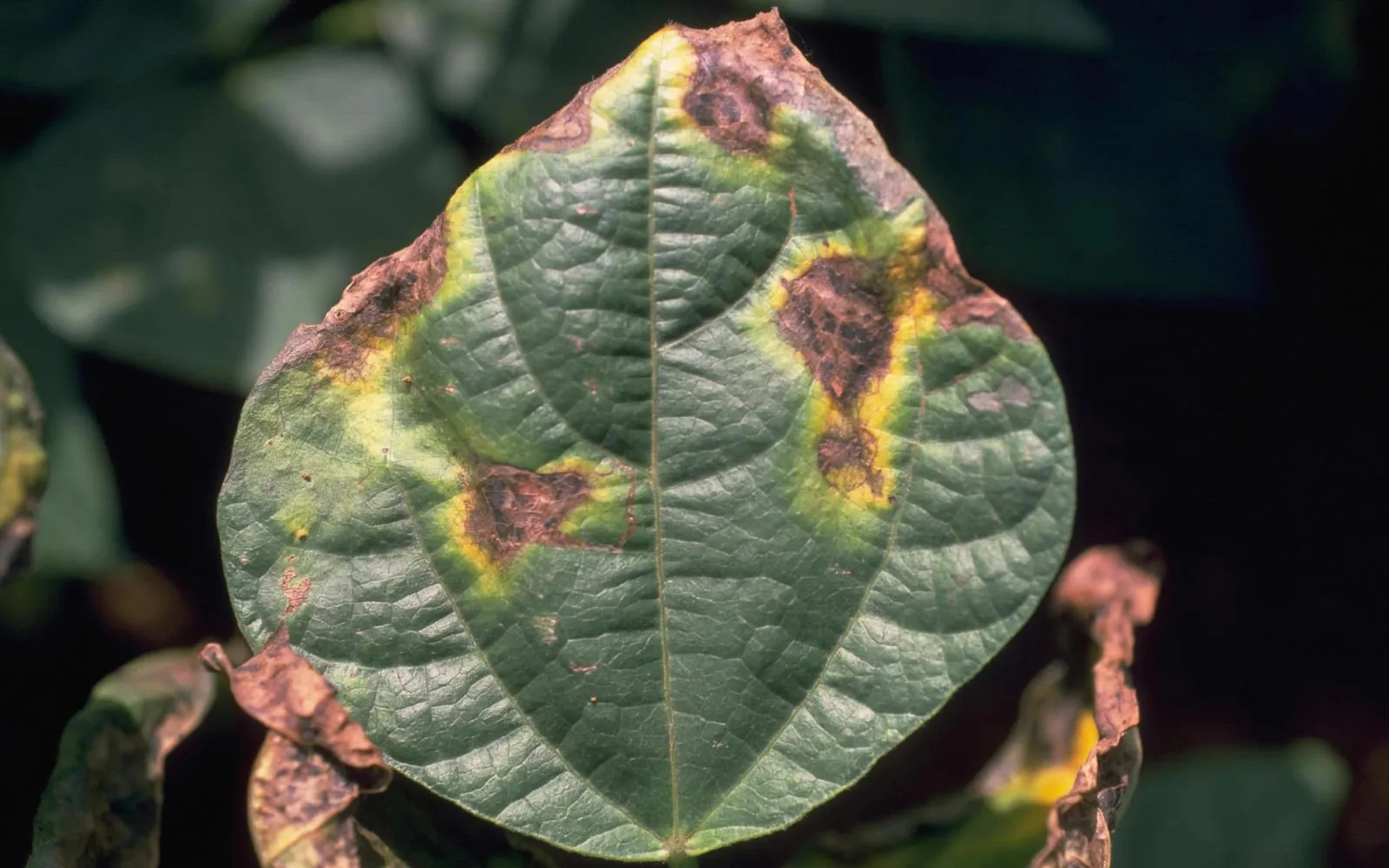
- Brown, black or purple spots with an edge that stops rather than fading out
- A yellow halo around each spot, on some hosts and not others
- Spots merging into large dead patches as a wet season goes on
- Tiny black dots visible in the middle of an older spot through a hand lens
- Spots that go angular and stop at the leaf veins rather than staying round
- Dead centres falling out and leaving the leaf peppered with holes
- Lower leaves affected first, with the damage climbing the plant week by week
- Leaves yellowing and dropping early, leaving stems bare from the bottom up
What you are looking at
Spots on the leaves, brown or black or purple, and the edge of each one is the thing to look at first. A leaf spot has a rim. The dead tissue stops and the green begins, and you could trace the boundary with a pencil. Damage that fades out gradually into the surrounding leaf is usually something else.
Around each spot there may be a yellow halo, wider than the spot itself. Some hosts show it strongly and others not at all, so its absence rules nothing out.
As the season goes on the spots multiply, run together, and the leaf gives up. Older leaves at the bottom of the plant go first, because they have been exposed longest and sit closest to the soil the spores splash up from. A tomato stripped to bare stem for the first two feet in September has usually had Septoria.
Fungus or bacterium, and how to tell
Two quite different groups of organisms make spots that look alike at arm’s length. Separating them takes a hand lens and a window.
Hold the leaf up with the light coming through it. A bacterial spot looks water-soaked and slightly translucent at its margin, as though that ring of tissue were greasy, and it will often be angular, with straight sides, because the bacteria spread through the soft tissue until they reach a vein and stop. Squared-off spots in a mosaic pattern between the veins are close to proof.
A fungal spot stays round. It expands outwards from where the spore landed and takes no notice of the veins, so it makes circles, sometimes with concentric rings inside them like a target. Look at the centre of an older one through a hand lens and you may see a scatter of black pinpricks, which are the fruiting bodies pushing up through the dead tissue. Nothing bacterial produces those.
Anthracnose is a fungal group with its own habit, sinking rather than staying flat, and it moves off the leaf onto stems and fruit, where it makes dark sunken lesions that go soft. Beans, mangoes and avocados show it most.
Shot hole is not a separate disease so much as a late stage of several. The dead centre of each spot dries, shrinks, loses its grip and drops out, leaving the leaf riddled. Cherries, laurels and plums do this readily, and a laurel hedge peppered with holes in June has usually been misdiagnosed as caterpillars.
Why the answer is usually water
The organisms differ, and the way they arrive is the same for nearly all of them. A spore or a bacterial cell lands on the leaf in a splash of water, and it then needs the leaf surface to stay wet for a stretch of hours while it germinates and forces its way in. Dry the leaf inside that window and the infection fails.
Everything in the control list follows from that. Watering at the base rather than over the top, spacing plants so air moves between them, thinning a congested shrub, growing tomatoes under cover, and not walking through wet beds all work on the same mechanism, which is the length of time a leaf spends wet.
Last season’s leaves are the other source. Most of these fungi spend the winter in the fallen leaves under the plant and start again from there in spring, which is what makes autumn tidying a treatment rather than housekeeping. A few of the bacterial ones skip that entirely and come in on the seed.
How much it costs the plant
Less than it looks, on most ornamentals. A shrub that loses a third of its leaves in late summer has already banked most of the year’s growth, and it will leaf out again in spring looking untouched. Spotted leaves on a mature hawthorn, an ivy or a rudbeckia are a cosmetic problem and treating them is effort spent for nothing.
The exceptions are worth naming. Celery leaf spot ruins the crop, because the part you eat is the part that spots. Septoria on outdoor tomatoes takes enough canopy that the fruit stops ripening. Hellebore leaf spot moves off the leaves into the flower stems and kills them, so a clump can be reduced to nothing over a few years. Photinia drops leaves so freely in response that a hedge can be left bare-legged and unrecoverable. On those five, act early.
What to do about it
Water the soil and keep it off the foliage.
Take the first spotted leaves off and bin them, rather than waiting until half the plant is marked.
Rake up and remove the fallen leaves in autumn, and cut hellebores back to the ground before the flower buds show.
Thin, space and stake so that the leaves dry by the middle of the morning.
Keep out of the beds while the plants are wet, especially among beans, tomatoes and brassicas.
Rotate affected vegetables on a three-year gap and buy fresh treated seed rather than saving your own.
Leave a mature shrub or a border perennial alone if it spots every August and grows away happily every May.
What it gets mistaken for
Rose black spot is a leaf spot, and it earns a page of its own because the edge of the mark is fringed and feathered rather than clean, and because roses get it year after year in a way that responds to cultivar choice.
Apple and pear scab makes olive-black velvety blotches with soft, indefinite edges, on apple and pear only.
Rust pustules are raised, they break open, and they leave orange or brown powder on a fingertip. Leaf spots are flat and leave nothing behind.
Downy mildew shows a pale patch on the upper surface with grey or violet growth on the underside directly opposite. Turn the leaf over before deciding.
Leaf scorch browns tips and margins first and works inwards, because those are the last places the water reaches.
Cold or frost damage on a houseplant makes large, irregular, sunken brown areas within a day or two of a cold night, and it does not spread afterwards.
What to do, in order
Start here
Prevention, and the changes that stop the problem returning. Most of these pages should end at this tier.
- Water the soil, never the leaves
- Both the fungi and the bacteria that cause these spots move in splashing water and need the leaf to stay wet for hours to infect it. A can held at the base of the plant breaks that chain. Overhead watering in the evening is the single most reliable way to spread a leaf spot through a bed.
- Pick off and bin the spotted leaves as they appear
- Each spot is producing spores for the leaves above it. Taking the first few off in May is worth more than stripping half the plant in August. Bin them or burn them, since most of these fungi survive the winter on dead leaves and a cool compost heap will not kill them.
- Clear the fallen leaves in autumn
- Under a photinia, a hellebore or a hawthorn, the leaf litter is next spring's infection. Rake it up and take it away. On hellebores, cut every old leaf off at the base in late autumn before the flower buds show, which is standard practice for the plant and controls the disease as a by-product.
- Give the plant room to dry
- Spores need several hours of surface wetness. Thinning a congested shrub, spacing seedlings properly and lifting the pots apart on a greenhouse bench all shorten that window. A photinia hedge clipped hard into a dense wall holds water in its centre for most of the morning.
- Stay out of the beds while the foliage is wet
- Bacterial spots enter through the pores and through small wounds, and brushing past a wet plant both wounds it and carries the bacteria on your sleeve to the next one. Pick beans and tomatoes in the afternoon.
- Rotate the affected vegetables and start with clean seed
- Celery leaf spot and the bacterial spots of tomato, pepper and brassicas travel on the seed itself, which is why an outbreak can arrive in a greenhouse that has never had it. Buy treated seed from a reputable supplier, and do not save seed from an affected crop. Three years before the same family returns to that ground.
- Feed and mulch rather than reaching for a treatment
- A plant that loses a quarter of its leaves in August has already made most of its food for the year. Watering it through a dry spell and mulching in spring puts back more than any spray would, and a shrub that defoliates every year is usually telling you it is in the wrong place.
- Replace a host that spots every year
- Photinia 'Red Robin' in a damp, still, shaded position will carry Entomosporium leaf spot for as long as it stands there. Where a plant has been cut back, fed and thinned and still loses its leaves each summer, the site is the problem and a different shrub is the answer.
Then reach for a barrier
Netting, hand removal and water. Nothing here harms anything except the target.
- Cut out the worst-affected stems entirely
- On blackberry and other cane fruit, cane spot and the leaf spots that come with it live on last year's wood. Remove the fruited canes at ground level after picking and burn them.
- Put a roof over the crop that keeps getting it
- Tomatoes under glass or in a polytunnel escape Septoria leaf spot almost entirely, because the leaves never get rained on. The same applies to outdoor pot plants moved under an eave for a wet fortnight.
- Space and stake so air moves through
- Tying a tomato in to a single stem and taking the sideshoots out, or thinning a clump of phlox to five or six stems, dries the foliage hours earlier in the day.
In pictures
Plants affected
Guides that name it among the problems to watch for. The list is the plants it is characteristic of rather than everything it will feed on.