
Houseplant
String of pearls
Curio rowleyanus
Also known as String of beads, Senecio rowleyanus, Rosary vine
How to care for Curio rowleyanus. Bright light, careful watering, shallow pots, propagation and signs of stress in the beads.
At a glance
- Difficulty
- Moderate
- Water
- Only when the compost is completely dry, and less in winter
- Light
- Bright indirect light with some direct morning sun
- Temperature
- 18-24 deg C in summer, and 10-13 deg C in winter
- Humidity
- Low. It dislikes humid air and needs good ventilation
- Hardiness
- USDA 10-12, RHS H1c, hardy to 10 C
- Type
- Evergreen trailing succulent, moderately long-lived
- Height
- 60-90 cm of trailing growth
- Native to
- The dry south-west of Africa, in Namibia and South Africa
- Best month
- August in the Northern Hemisphere, February in the Southern Hemisphere
Arid south-west Africa, where the beads grow half-buried in the shade of rocks rather than in full sun. It rots faster than almost any other succulent in wet compost. Outdoors year round in USDA 10 and warmer, in bright shade rather than blazing sun.
Hardiness zones describe winter cold alone. Summer heat, humidity, rainfall and the length of the growing season decide as much, so treat the range as the outer limit rather than as a recommendation.
Every month named in this guide is for the temperate Northern Hemisphere. If you garden in the Southern Hemisphere, shift each one by six months, so August becomes February. Closer to the equator the wet and dry seasons matter more than the calendar, and the shift stops being a useful guide.
Toxic if eaten
- Do not eat
- Every part, and the sap in the stems and beads
- Harm from
- Eating it and handling it
- Affects
- People, cats and dogs
String of pearls is poisonous, and the shape of it is part of the problem. The beads look like small green sweets or peas, which is a considerable temptation to a small child, and a trailing plant on a shelf puts them within reach. The ASPCA lists string of pearls as toxic to cats and dogs. Eating the beads causes drooling, vomiting, diarrhoea and lethargy, and the sap causes skin irritation and a rash on contact, so wear gloves when taking cuttings or handling long strands. The plant belongs to a group formerly classified in Senecio, many of which contain pyrrolizidine alkaloids that damage the liver with repeated exposure. That matters more for grazing livestock than for a houseplant, and it is a reason to treat any ingestion as worth a call to a vet rather than something to wait out. Cats are drawn to the dangling strands as something to bat at, which puts this plant in the awkward position of being both attractive to a cat and harmful to one. Hang it high, well clear of a shelf a cat can reach, or choose another trailing plant for a household with a determined chewer.
Sources: ASPCA (String of Pearls, Senecio rowleyanus), RHS potentially harmful garden plants
About
The beads are a solution to a problem. A sphere holds the most water for the least surface area, which is exactly what a plant in the dry south-west of Africa needs, and each pearl carries a narrow translucent stripe down one side. That stripe is a window, letting light through to photosynthetic tissue inside while the rest of the leaf stays sealed against water loss.
Understanding that explains why so many of these plants die within a year. They are built for drought, they are usually sold in a deep pot of water-retentive compost, and they are then watered like a foliage houseplant.
The beads also tell you what the plant needs, which is unusually helpful. Firm and plump means content. Shrivelled and wrinkled means thirsty. Soft, translucent or bursting means overwatered.
Appearance and character
An evergreen trailing succulent with thin wiry stems, hanging 60 to 90 cm from a pot.
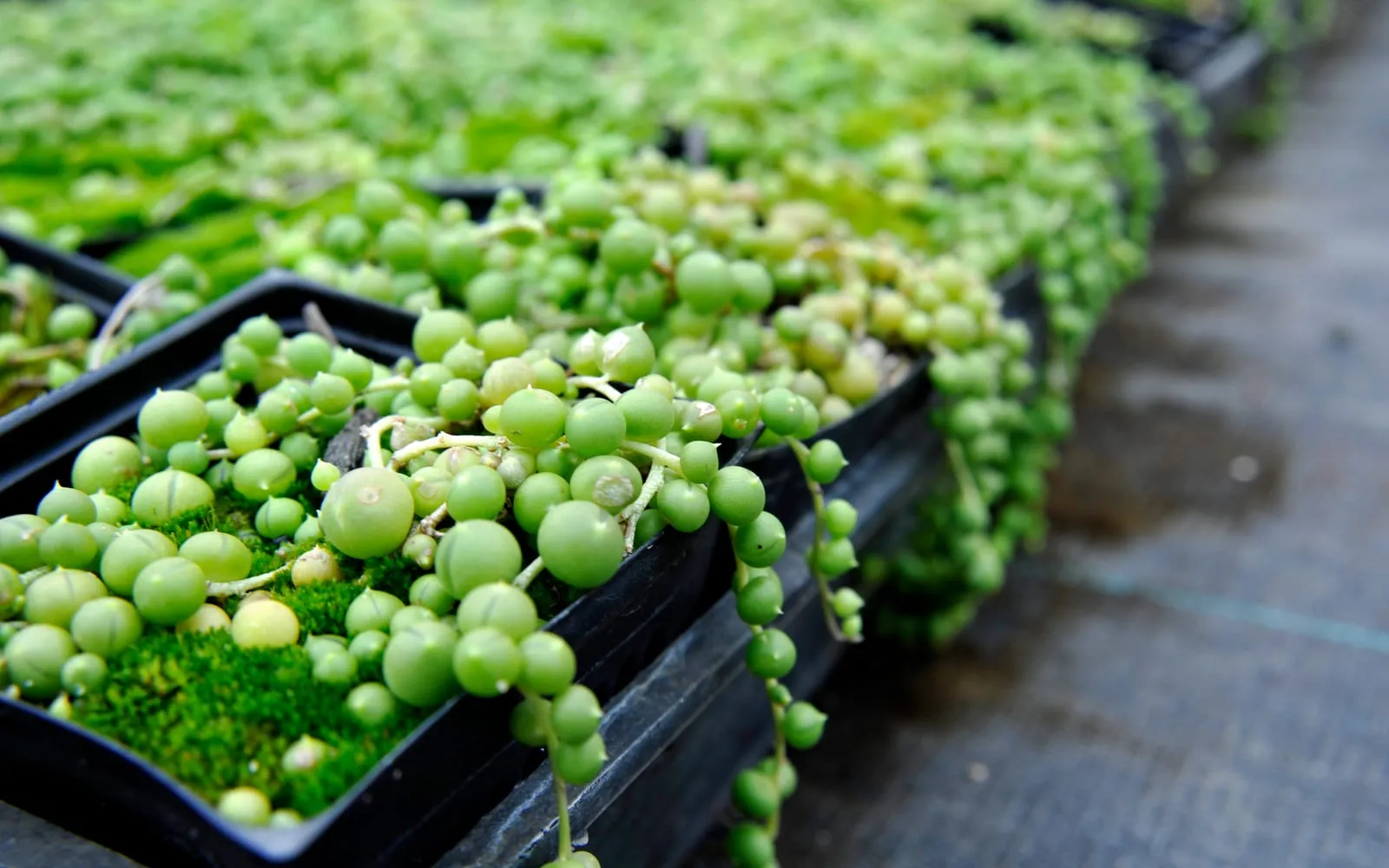
Leaves are the feature. Each is a green sphere 6 to 8 mm across, spaced along the stem at intervals of a centimetre or two, and each carries a fine translucent stripe down one side.
That stripe is an epidermal window, an adaptation that admits light into the interior of the leaf while keeping the exposed surface area to a minimum.
Stems are pale green, thread-fine, and produce roots where they touch compost, which is what makes propagation so easy.
Flowers appear in autumn on a well-grown plant, small white brush-like heads about 1 cm across with long protruding stamens, and they smell distinctly of cinnamon.
Roots are shallow and fine, spreading sideways rather than down, which is why a deep pot suits it so badly.
Related plants are grown in the same way. String of bananas has crescent-shaped leaves, string of tears has pointed teardrop beads, and string of dolphins has leaves shaped like leaping dolphins.
Where it is from
The dry south-west of Africa, in Namibia and the western Cape of South Africa, where it grows in the shade of rocks and larger shrubs on arid ground.
Growing in the shade of rocks rather than in the open is a detail worth holding on to. This is a succulent that wants bright light rather than full desert sun, and it scorches in a hot south-facing window in July.
The stems creep across the ground and root as they go, forming dense mats that shade the soil beneath and reduce evaporation, which is how the plant survives between rains.
Rainfall in its range is low, seasonal and unreliable, which is the whole explanation for the watering regime.
It was formerly classified in the genus Senecio, alongside groundsel and ragwort, and has been moved to Curio along with several other succulent relatives. Both names remain in use in the trade.
The species honours Gordon Rowley, a British botanist who specialised in succulents.
How it grows
Use a shallow wide pot rather than a deep one. The roots are fine and shallow, and a deep pot holds a reservoir of wet compost below them that never dries.
Plant into gritty free-draining cactus compost, or ordinary compost with a third added grit and perlite.
Position it in bright indirect light with an hour or two of direct morning sun. Deep shade produces long thin stems with widely spaced beads.
Water only when the compost is completely dry all the way through, then water thoroughly and let it drain fully.
Water far less in winter, perhaps once a month, and keep it cooler at 10 to 13 deg C.
Feed sparingly, every six to eight weeks in the growing season with a dilute cactus feed.
Propagate by laying strands on the surface of damp compost and pinning them down. Roots form at the nodes within a few weeks, and this is how you thicken a sparse plant.
Fill the top of the pot with cuttings rather than letting it stay thin. A full-looking string of pearls is usually many plants in one pot.
Trim long straggly strands and use them as cuttings.
Through the seasons
Winter is the rest. Move it somewhere cool and bright, water perhaps monthly, and stop feeding entirely. Cold wet compost in winter is the single commonest killer.
Spring is when it restarts. Increase watering gradually, resume feeding, take cuttings, and repot if needed.
Summer is growth. Water when the compost dries fully, feed occasionally, and protect from scorching midday sun in a south-facing window.
Autumn brings the cinnamon-scented flowers on a mature plant, and the start of the wind-down in watering.
Care difficulty
Moderate, and it has a poor reputation that comes almost entirely from one mistake.
Overwatering kills these plants more often than everything else combined. The beads store water, the roots are fine and shallow, and compost that stays damp rots them within weeks.
The pot is part of the problem, since plants are commonly sold in deep pots that hold wet compost below the root zone.
Reading the beads makes it manageable. Plump means content, wrinkled means thirsty, and soft or bursting means too much water.
Sparse growth is a presentation issue rather than a health one, and laying cuttings on the surface fixes it.
Watering
Water only when the compost is dry all the way through. Push a finger or a chopstick right to the bottom to check, since the surface dries long before the base does.
Water thoroughly when you do, until it runs out of the drainage holes, then let it drain completely.
In summer this usually means every two to three weeks, and in winter perhaps once a month or less.
Read the beads. Firm and round means the plant is fine. Wrinkled and slightly deflated means water it. Soft, yellowing, translucent or splitting means it has had too much.
Water the compost rather than the strands, and avoid leaving water sitting among the beads, which encourages rot.
Never leave the pot standing in water, and use a pot with drainage holes.
Warning signs, diseases and pests
Mushy translucent beads that burst or drop off mean overwatering, and by the time they show the roots are often already rotting. Stop watering, let the compost dry out completely, and if the stems at the base are soft, cut off the healthy strands and start again as cuttings. Recovery from advanced root rot is unusual.
Shrivelled wrinkled beads mean thirst, which is the easy problem. Water thoroughly and they plump up within a couple of days.
Bare stems with beads only at the ends usually mean too little light, or the older growth dying back at the crown as the plant ages. Lay cuttings on the compost surface to thicken it up.
Long stretched stems with widely spaced beads mean insufficient light. Move it somewhere brighter.
Mealybug hides among the beads and in the crowns, where it is easy to miss until the infestation is large. Check regularly by lifting the strands, and treat with a cotton bud dipped in alcohol.
Scorched brown or bleached beads mean too much direct sun, usually in a south-facing window in summer.
A plant that thins out from the centre while the trailing strands stay healthy is ageing normally. Restart it from cuttings.
Growing environment
Bright indirect light with some direct morning sun. An east-facing window is ideal, and a south-facing one needs a sheer curtain in summer.
Warmth of 18 to 24 deg C in summer and a cool rest at 10 to 13 deg C in winter.
Low humidity and good air movement. Unlike most houseplants, this one dislikes humid stagnant air, so a steamy bathroom is the wrong place for it.
A shallow wide pot with drainage holes. Depth is actively unhelpful.
Gritty free-draining compost. Cactus compost, or ordinary compost with a third grit and perlite.
Hanging high, both to show the trailing strands and to keep the beads out of reach of cats and children.
Avoid a windowless room, a humid bathroom and any pot without drainage.
Feeding
Feed every six to eight weeks from April to September with a dilute cactus or succulent fertiliser at half the stated strength.
Stop feeding entirely from October to March.
Repot every two or three years into fresh gritty compost, moving to a wider rather than a deeper pot.
Avoid rich feeding and high-nitrogen fertiliser, which produce soft growth that rots.
A sparse-looking plant needs more cuttings laid on the surface rather than more feeding.
Troubleshooting
The beads have gone soft and mushy. Overwatering. Stop watering, let the compost dry out completely, and check the base of the stems. If they are soft, take cuttings from the healthy strands and start again.
The beads are wrinkled and shrivelled. Thirst. Water thoroughly and they will plump up within a day or two.
How often should I water it? Only when the compost is dry all the way to the bottom, roughly every two to three weeks in summer and monthly or less in winter. Check with a finger rather than by the calendar.
The stems are long and thin with gaps between the beads. Not enough light. Move it somewhere brighter, with an hour or two of direct morning sun.
It has gone bare at the top of the pot. Normal ageing combined with low light. Lay cuttings on the compost surface and pin them down, and they root within a few weeks.
What sort of pot should I use? A shallow wide one with drainage holes. The roots are fine and shallow, and a deep pot holds wet compost where the roots cannot reach it.
White cottony bits among the beads. Mealybug. Lift the strands to check regularly and dab them with a cotton bud dipped in alcohol.
Is it safe with a cat? No, and it is exactly the sort of dangling plant a cat will play with. Hang it well out of reach or choose something else.
String of pearls problem guides
Not sure what is wrong? See the common houseplant pests guide.