
Houseplant
Coleus
Plectranthus scutellarioides
Also known as Painted nettle, Flame nettle, Solenostemon
How to grow coleus, Plectranthus scutellarioides. Pinching out the flowers to keep the leaves, taking cuttings that root in a week, and overwintering it.
At a glance
- Difficulty
- Easy
- Water
- Regular, and it wilts dramatically when dry
- Light
- Bright indirect light, and morning sun with afternoon shade outdoors
- Temperature
- 18 to 26 deg C, and it collapses below about 10 deg C
- Hardiness
- USDA 10-11, RHS H1b, hardy to 10 C
- Type
- Tender perennial, usually grown as an annual outside USDA 10
- Height
- 30-75 cm
- Native to
- South-east Asia and Australia, from India through Indonesia to the Philippines
- Best month
- April in the Northern Hemisphere, October in the Southern Hemisphere
South-east Asia. Grown as a tender bedding annual across the temperate world and a perennial subshrub in USDA 10 and 11. Colour is driven by light rather than by feeding, and flowering exhausts the plant, so pinch out the spikes.
Hardiness zones describe winter cold alone. Summer heat, humidity, rainfall and the length of the growing season decide as much, so treat the range as the outer limit rather than as a recommendation.
Every month named in this guide is for the temperate Northern Hemisphere. If you garden in the Southern Hemisphere, shift each one by six months, so April becomes October. Closer to the equator the wet and dry seasons matter more than the calendar, and the shift stops being a useful guide.
Toxic to pets if eaten
- Do not eat
- All parts, and the essential oil in the foliage
- Harm from
- Eating it and handling it
- Affects
- Cats, dogs and horses
Coleus contains essential oils including diterpenes, and the ASPCA lists Plectranthus scutellarioides as toxic to cats, dogs and horses. Eating the foliage causes vomiting, diarrhoea, depression and in some cases blood in the vomit or stool, and the effect is more pronounced in cats than dogs. That is a genuine reason to keep it away from an animal that chews plants, and that matters because coleus is sold as a cheerful and apparently harmless bedding and houseplant. The RHS does not list it among harmful garden plants, and the sap causes mild skin irritation in some people, so wear gloves if you are pinching out and taking cuttings in quantity. For people the plant is not a significant poisoning hazard and the usual outcome of chewing a leaf is an unpleasant taste. The related Plectranthus barbatus, sometimes sold as forskohlii, is the species used medicinally, and that use does not transfer to the ornamental coleus.
Sources: RHS potentially harmful garden plants, ASPCA toxic and non-toxic plants
About
Coleus is grown for the leaves, and letting it flower is what ruins it.
The plant produces spikes of small blue-mauve flowers from midsummer, and they are unremarkable. Once flowering starts the plant redirects its energy, the stems stretch, the foliage thins and the whole thing goes downhill within a few weeks.
Pinching the flower spikes off as soon as they appear, and pinching the growing tips regularly from the start, keeps a coleus bushy and colourful for a whole season and beyond.
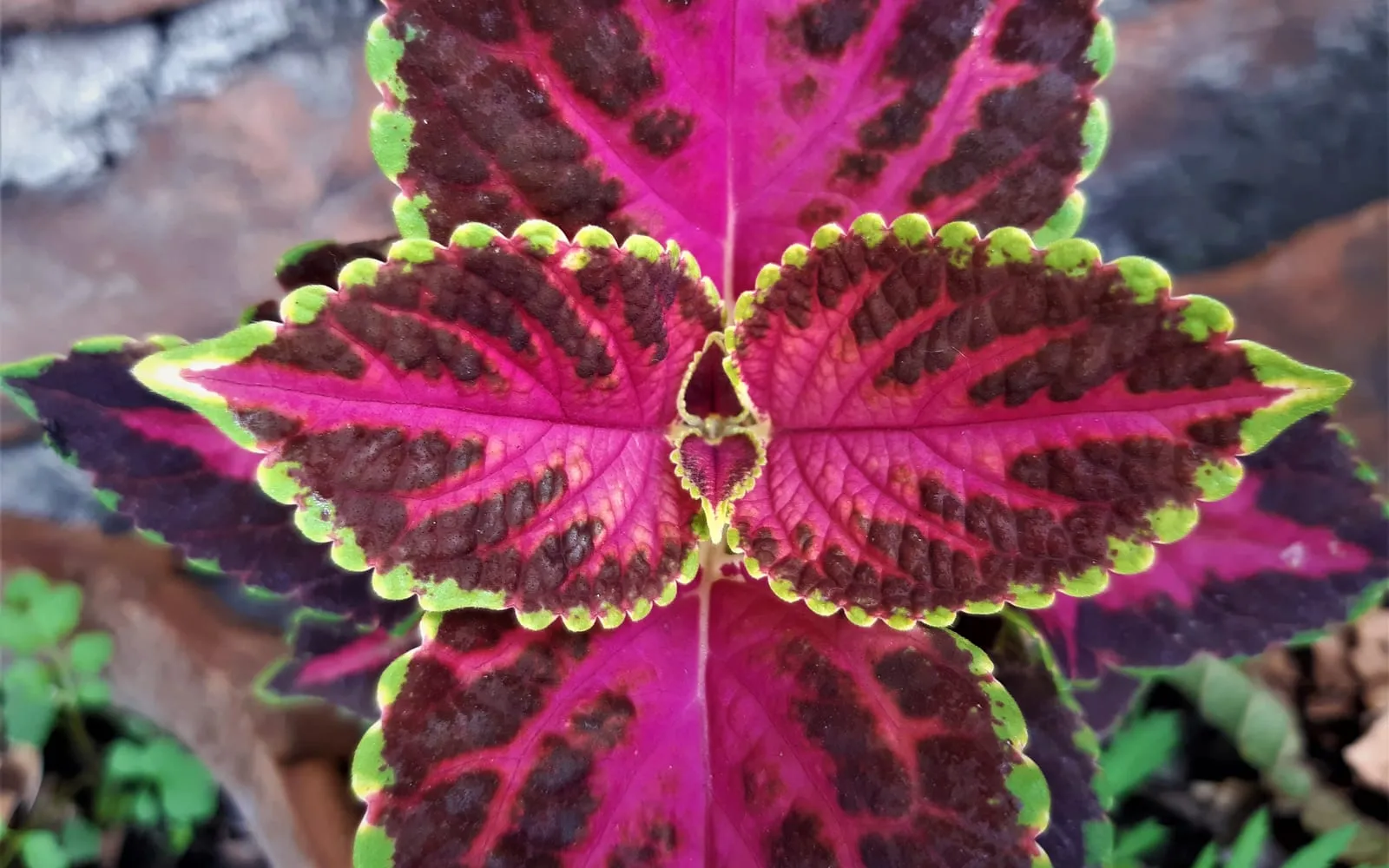
The colours are the reason to bother. Leaves come in crimson, scarlet, magenta, chartreuse, copper, near-black and cream, often several at once with contrasting margins, veins and centres, and the range is enormous.
It is also the easiest houseplant to propagate. A cutting taken in September and stood in a glass of water roots within a week, which is how a favourite plant is carried through a winter that would otherwise kill it.
Treat it as a summer plant that you renew from cuttings every year, rather than as a permanent specimen, and it becomes very easy indeed.
Appearance and character
A tender perennial reaching 30 to 75 cm depending on cultivar, grown as a bedding annual outdoors in cool summers and as a houseplant indoors.
Stems are square in cross section, which is the mint family signature, upright and branching.
Leaves are the point of the plant. Oval to heart-shaped with a scalloped or toothed edge, 5 to 15 cm long, held in opposite pairs, and often deeply lobed or frilled in modern cultivars.
Colour runs through crimson, scarlet, burgundy, magenta, pink, salmon, orange, copper, chartreuse, lime, near-black and cream, usually in combinations with contrasting margins, veins, blotches and centres.
The velvet texture and the pattern vary as much as the colour, and the range of named cultivars runs into the hundreds.
Flowers are small, two-lipped, blue-mauve, on upright spikes from midsummer, and they are undistinguished and should be pinched off.
Sun-tolerant series such as the Coleus Sun cultivars are bred to hold their colour outdoors in full light, where older types bleach.
Growth is fast, and a rooted cutting makes a full plant in a few months.
Where it is from
South-east Asia and Australia, from India through Sri Lanka, Indonesia, Malaysia and the Philippines to northern Australia, growing in warm humid conditions in open woodland and scrub.
It was introduced to European horticulture in the 1850s and became an immediate Victorian fashion, with hundreds of cultivars raised and bedding schemes built around it.
Interest declined through the twentieth century and revived strongly from the 1990s with new breeding, including sun-tolerant series and vegetatively propagated named cultivars.
The botanical name has moved repeatedly. It has been Coleus blumei, then Solenostemon scutellarioides, and is now Plectranthus scutellarioides, with the common name coleus surviving all of it.
It is in Lamiaceae alongside mint, sage, thyme and lemon balm, which the square stems, opposite leaves and aromatic foliage all reflect.
In parts of south-east Asia and Mexico some coleus relatives have traditional uses, and the ornamental plant is grown purely for its foliage.
How it grows
Sow seed in February or March at 20 deg C, surface sown and not covered since it needs light to germinate. Seedlings show their colours within a few weeks and the weak ones can be discarded.
Take cuttings at any point in the growing season, which is far easier and reproduces a named cultivar exactly.
Grow it in bright indirect light indoors, or in a position outdoors with morning sun and afternoon shade unless you have a sun-tolerant cultivar.
Colour depends on light. Too little and the leaves go green and dull, too much direct sun on an older cultivar and they bleach and scorch. Bright indirect light is the balance.
Use a rich free-draining peat-free compost in a pot with drainage holes.
Water regularly, keeping the compost damp without waterlogging. Coleus wilts dramatically and completely when dry and recovers within an hour of watering, which is alarming and rarely fatal.
Feed fortnightly from April to September with a balanced liquid feed at half strength.
Pinch out the growing tips every few weeks from the moment the plant has three or four pairs of leaves. This is what makes the difference between a bushy plant and a leggy one.
Pinch out every flower spike as soon as it appears. Flowering exhausts the plant and ends the display.
Plant out after the last frost if growing it outdoors, in late May or early June, and lift or discard it before the first autumn frost.
Take cuttings in late summer to carry a favourite through the winter. Cut a shoot 8 to 10 cm long below a node, remove the lower leaves, and stand it in a glass of water on a windowsill. Roots appear within a week, and it can then be potted up.
Overwinter the parent plant indoors at above 12 deg C in bright light, watering sparingly, and expect it to look tired by spring. Cuttings are usually better than keeping old plants.
Repot in spring if keeping a plant on, and cut it back hard to force fresh bushy growth.
Through the seasons
Winter is a difficult period indoors. Keep it above 12 deg C in the brightest light available, water sparingly and stop feeding, and expect it to look poor.
Spring is sowing and cutting season, and this is when to cut an overwintered plant back hard.
Summer is the display, needing regular water, fortnightly feeding and constant pinching of tips and flower spikes.
Autumn is when to take cuttings for next year, before the plant is lost to cold.
Care difficulty
Easy in summer and awkward in winter, which is why most people treat it as an annual.
The growing season needs nothing complicated. Bright indirect light, regular water, fortnightly feeding and regular pinching.
The winter is the problem. Coleus needs warmth and light that a cool winter does not provide, and an overwintered plant is usually leggy and tired by March.
Taking cuttings in September, rooting them in water and growing on the young plants is far easier than keeping the old one, and it costs nothing.
Watering
Water regularly, keeping the compost damp without waterlogging.
Coleus wilts completely and dramatically when the compost dries, and recovers within an hour of a good watering. Repeated wilting weakens it and a single episode does no lasting harm.
Water container plants outdoors daily in hot weather, since they dry out fast.
Reduce watering considerably through the winter, when growth has stopped.
Never let it stand in a saucer of water, since the stems rot readily.
Water at the compost rather than over the foliage, particularly in cool conditions.
Warning signs, diseases and pests
Flower spikes appearing and the plant stretching and thinning is normal flowering, and it ends the display. Pinch every spike off as soon as it shows.
Long bare stems with leaves only at the tips is legginess from too little light or no pinching. Move it into brighter light and pinch the tips out regularly, or cut the whole plant back hard.
Colours fading to green is insufficient light. Move it somewhere brighter.
Bleached, scorched or crisp patches on the leaves is too much direct sun on a cultivar not bred for it. Move it into morning sun with afternoon shade, or grow a sun-tolerant series.
Complete collapse with the plant flat is drought. Water thoroughly and it recovers within an hour.
Soft blackened stems at the base is stem rot from overwatering or cold. Take cuttings from the healthy top growth and discard the plant.
A cloud of tiny white insects rising when disturbed is whitefly, which is common under glass. Use sticky traps and a biological control.
White cottony masses in the leaf axils is mealybug. Wipe them off with a cotton bud dipped in alcohol.
Fine mottling with webbing is red spider mite in dry indoor air.
Sudden collapse after a cold night outdoors is frost, and coleus is killed outright by it.
Growing environment
Bright indirect light indoors. Outdoors, morning sun with afternoon shade for most cultivars, and full sun for the sun-tolerant series.
A rich, free-draining peat-free compost in a pot with drainage.
18 to 26 deg C. It suffers below about 12 deg C and is killed outright by frost.
Allow 30 to 45 cm of spread per plant.
It suits a bright windowsill, a summer container, a bedding scheme, a hanging basket with the trailing cultivars, a conservatory or a shady patio pot.
Plant it in a container rather than the ground if you want to bring it in, and treat it as an annual otherwise.
Keep it away from cats and dogs. The ASPCA lists it as toxic to cats, dogs and horses, causing vomiting and diarrhoea. That matters because it is sold as a cheerful bedding plant.
Group several cultivars together for a bold effect, or use one strong colour repeated, which reads better than a mixture in a small space.
Grow it with other summer container plants that want the same conditions. Fuchsia, begonia, impatiens and heuchera all share the light and water requirements.
Feeding
Feed fortnightly from April to September with a balanced liquid feed at half strength.
Do not feed from October to March.
Half strength is enough. Heavy feeding produces soft lush growth with weaker leaf colour.
Repot a plant being kept on into fresh compost each spring, and cut it back hard at the same time.
Container plants outdoors need feeding throughout the summer, since they exhaust the compost quickly.
Troubleshooting
It has started flowering and looks worse. Flowering exhausts a coleus and ends the display. Pinch every flower spike off as soon as it appears, and pinch the growing tips regularly to keep it bushy.
How do I keep it bushy? Pinch out the growing tips every few weeks from the moment the plant has three or four pairs of leaves, and remove every flower spike.
The colours have faded to green. Not enough light. Move it into brighter indirect light.
The leaves have bleached and scorched. Too much direct sun on a cultivar not bred for it. Give it morning sun with afternoon shade, or grow one of the sun-tolerant series.
It collapsed completely. Drought. Coleus wilts dramatically and recovers within an hour of a thorough watering. One episode does no lasting harm.
How do I keep it over winter? Take cuttings in late summer. Cut a shoot 8 to 10 cm long below a node, remove the lower leaves and stand it in a glass of water, and roots appear within a week. That is far easier than keeping the old plant.
Can it live outdoors? Only through the summer. Plant out after the last frost and lift or discard it before the first autumn frost, since frost kills it outright.
Is it safe around pets? No. The ASPCA lists it as toxic to cats, dogs and horses, causing vomiting and diarrhoea. Keep it out of reach.
Should I grow it from seed or cuttings? Cuttings for a named cultivar, since they root in a week and reproduce the plant exactly. Seed gives a mixture and is fine if you want variety and are prepared to discard the dull ones.
Coleus problem guides
Not sure what is wrong? See the common houseplant pests guide.