
Houseplant
Bird of Paradise
Strelitzia reginae
Also known as Crane flower, Strelitzia
How to grow Strelitzia reginae. Light, watering, the cool winter rest, slow flowering and the bird-pollinated flower structure.
At a glance
- Difficulty
- Moderate
- Water
- When the top 5 cm dries, roughly weekly in summer
- Light
- Bright direct sun, five to six hours, for any chance of flowers
- Temperature
- 10-30 deg C. A cool winter rest at 10-13 deg C triggers flowering
- Humidity
- Average room air is fine
- Hardiness
- USDA 9-11, RHS H1c, hardy to 5 C
- Type
- Evergreen perennial, clump-forming
- Height
- 1-1.5 m indoors
- Native to
- The Eastern Cape of South Africa
- Best month
- June in the Northern Hemisphere, December in the Southern Hemisphere
A subtropical coast rather than the tropics, which is why it takes a light frost and a cool winter. Plants flower only once mature and pot-bound, which is why a well-treated specimen can stay green for a decade. Outdoors year round in USDA 9 and warmer.
Hardiness zones describe winter cold alone. Summer heat, humidity, rainfall and the length of the growing season decide as much, so treat the range as the outer limit rather than as a recommendation.
Every month named in this guide is for the temperate Northern Hemisphere. If you garden in the Southern Hemisphere, shift each one by six months, so June becomes December. Closer to the equator the wet and dry seasons matter more than the calendar, and the shift stops being a useful guide.
Harmful to pets if eaten
- Do not eat
- Chiefly the fruit and seeds
- Harm from
- Eating it
- Affects
- Cats, dogs and horses
The ASPCA lists Strelitzia reginae under the name bird of paradise flower as toxic to dogs, cats and horses, with mild nausea, vomiting and drowsiness caused mainly by the fruit and seeds rather than the leaves. Severity is low, and an indoor plant almost never fruits, so in practice the risk to a household pet is small. The important part of this entry is the name. The ASPCA also carries a separate listing for Caesalpinia gilliesii, sold as bird of paradise in the United States, which is a far more dangerous plant causing intense oral burning, vomiting, diarrhoea and incoordination, and which has killed rabbits. The ASPCA page for that species warns explicitly against confusing the two. If you are checking a pet safety list, confirm which species you actually own before drawing any conclusion, because the shared common name covers plants of very different severity.
Sources: ASPCA (Bird of Paradise Flower, Strelitzia reginae), ASPCA (Bird of Paradise, Caesalpinia gilliesii)
About
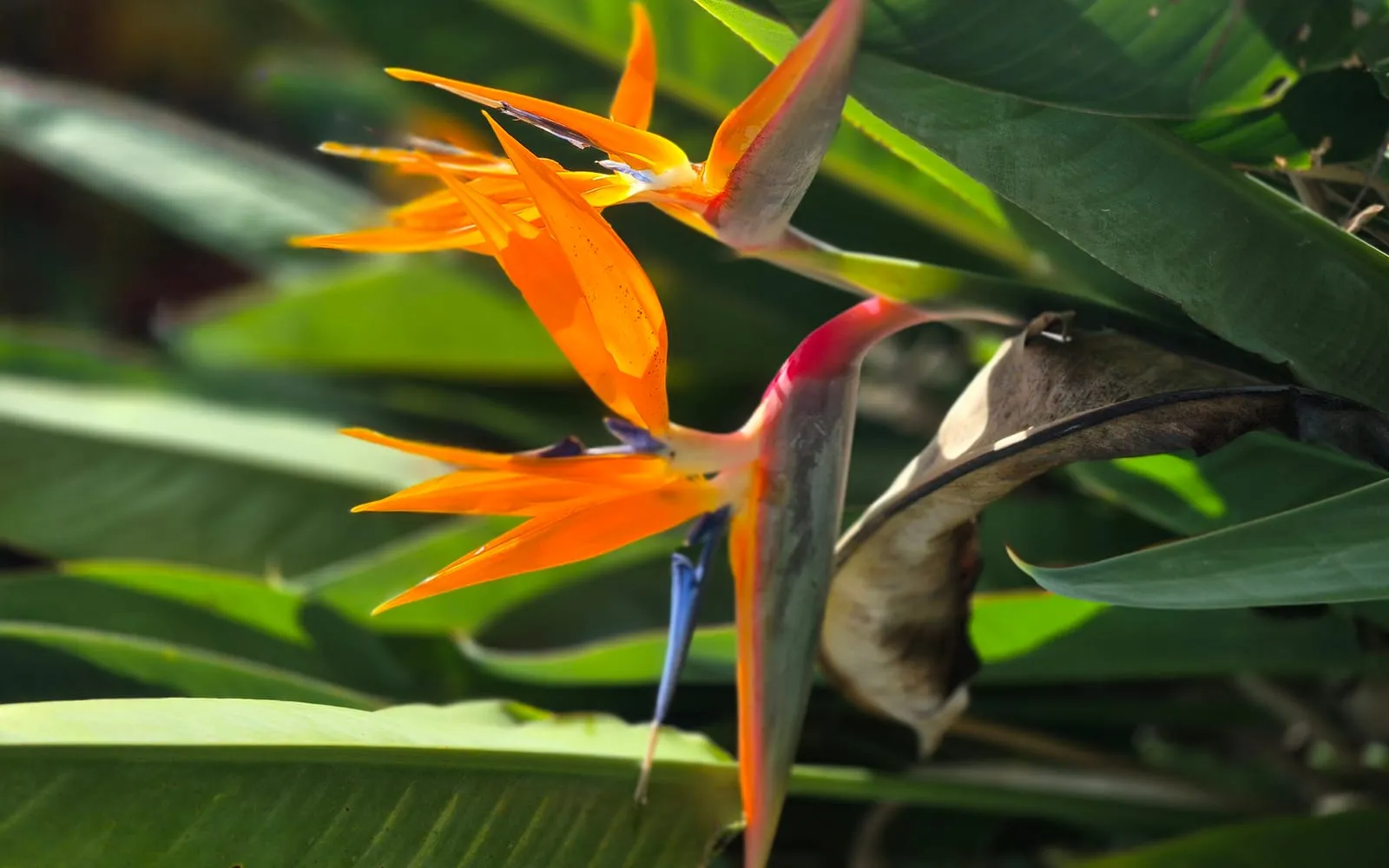
The flower is a machine built for one bird. A horizontal boat-shaped bract holds the bloom sideways, orange sepals stand up like a crest, and two blue petals are fused into a stiff arrow-shaped perch. A sunbird lands on that perch, its weight parts the fused petals, and the anthers hidden inside smear pollen onto its feet. The bird flies to the next flower and delivers it.
None of that works indoors, and none of it matters, because the flower is extraordinary whether or not anything pollinates it.
Getting one is the hard part. A bird of paradise grown from seed takes four to six years before it flowers at all, and plenty of houseplants sold as flowering size never produce a bloom because they are given the wrong winter.
Appearance and character
A clump of large, leathery, paddle-shaped leaves in grey-green, held on long stiff stalks that rise directly from the base in a flat fan. Indoors it reaches 1 to 1.5 m; outdoors in a frost-free climate, twice that.
The leaves split along the veins as they age, which alarms new owners and is entirely normal. It is the same adaptation bananas use, letting wind pass through a large leaf rather than tearing it off the plant. Strelitzia and banana are related, both in the order Zingiberales.
Flowers appear from spring to autumn on mature plants, one at a time from each bract, with several emerging in succession from the same boat-shaped sheath over a few weeks. Each individual bloom lasts about a week and the whole display can run for a month.
The plant makes no scent and needs none, since it is selling to birds rather than insects.
Where it is from
The Eastern Cape of South Africa, along river banks and in coastal scrub, in a climate with warm wet summers and mild dry winters.
Full sun is the norm in that habitat, which is why this plant behaves so differently from the shade-tolerant tropicals most people keep. A bird of paradise in a north-facing room will live for years and never flower.
The cool dry winter is the other half of it. The plant reads several weeks of cooler temperatures as the end of one year and the start of the next, and without that signal it stays in permanent vegetative growth.
It was named for Queen Charlotte, wife of George III, who came from Mecklenburg-Strelitz, and reached Kew in 1773.
How it grows
An evergreen perennial forming a dense clump from a thick fleshy rootstock. New leaves emerge rolled like a scroll from the centre of the fan and unfurl over several days.
Growth runs from spring to autumn and stops over winter. Roots are thick, fleshy and vigorous, and they will crack a plastic pot given time.
Flowering requires three things together, and missing any one of them is why most plants fail to bloom. The plant must be mature, at four or five years old and with several fans of leaves. It must have bright direct sun through the growing season. And it needs six to eight weeks of cool rest at around 10 to 13 deg C over winter.
Being pot-bound helps rather than hinders. A plant moved into a much larger pot puts its energy into roots and leaves, and flowering stops for a year or two.
Division is possible in spring but sets the plant back badly, so it is worth doing only to propagate rather than to control size.
Through the seasons
Spring restarts growth. Move the plant back into warmth and full sun, resume watering and begin feeding in April. Repot only if the roots are pushing the plant out of its container, and go up one size at most.
Summer is the main growing period and the main flowering period. Water freely, feed fortnightly, and put the plant outside in a sheltered sunny spot once nights are reliably above 12 deg C.
Autumn is for bringing it back indoors before the first cold nights, and tapering the feeding from the end of September.
Winter is the rest that makes the flowers. Keep it bright, cool at 10 to 13 deg C, and nearly dry. An unheated but frost-free porch or conservatory is ideal. A warm living room gives you leaves and nothing else.
Care difficulty
Moderate, and the plant itself is easy. Keeping it alive takes very little. Making it flower takes deliberate effort in a direction most houseplant advice points away from.
Give it more direct sun than feels right for a houseplant. South-facing glass in summer is correct.
Give it a cold, dry winter rather than a comfortable one, and resist repotting it into something roomier.
Watering
Water when the top 5 cm of compost is dry, which is roughly weekly through summer in a warm bright room.
Water thoroughly until it runs from the base, then drain. The fleshy roots store water, so the plant tolerates a short dry spell far better than a wet one.
Cut right back in winter to every two or three weeks, keeping the compost barely moist. A cool plant sitting in wet compost rots at the crown.
Tap water is acceptable, though brown leaf edges in a hard-water area point to mineral build-up, and a periodic flush through with rainwater helps.
Warning signs, diseases and pests
Scale insects are the commonest pest, appearing as small brown limpet-like bumps along the leaf stalks and midribs, with sticky honeydew below them. The tough leaves take firm treatment, so scrape them off with a fingernail or a cloth dipped in soapy water and repeat weekly until they stop appearing.
Spider mites arrive in hot dry rooms, stippling the leaves and webbing the leaf joints. Increase humidity and rinse the plant thoroughly.
Mealybugs hide in the crown where the leaf stalks meet, showing as white cottony fluff. Dab them with a cotton bud dipped in alcohol.
Root rot follows overwatering, particularly in winter, and shows as yellowing leaves and a soft crown. Unpot, cut away black mushy roots, and repot into fresh gritty compost.
Curling leaves with dry compost indicate underwatering. Brown crisping at the leaf edges usually points at mineral salts or very dry air.
Splitting leaves are normal and need no action.
Growing environment
Bright direct sunlight, five to six hours a day. This is one of the few houseplants in these guides that belongs directly in a south-facing window. Bright indirect light keeps it alive and healthy as a foliage plant and will not produce flowers.
Warmth of 18 to 30 deg C through the growing season, dropping to 10 to 13 deg C for six to eight weeks in winter. It survives brief dips to about 5 deg C and frost damages it.
Ordinary room humidity is fine. This is a Cape plant rather than a rainforest one, and misting achieves nothing.
Compost should be loam-based with added grit, both for drainage and for weight. A large plant in light peat-free compost becomes top-heavy and falls over.
Choose a sturdy pot and resist going up in size. Snug roots flower sooner.
Feeding
A balanced liquid feed fortnightly from April to September.
Switch to a high-potassium feed, such as tomato food, once the plant is mature enough to bloom and buds start forming. Potassium supports flowering; nitrogen supports leaves.
Stop feeding entirely from October to March. Feeding through the cool rest undoes the point of the rest.
Feed at half strength if the compost is fresh, since new compost carries its own nutrients for the first couple of months.
Troubleshooting
Healthy for years and has never flowered. Almost always one of three things. Too little direct sun, no cool winter rest, or too young. It also needs to be somewhat pot-bound, so avoid moving it into a bigger container.
Leaves splitting along the veins. Normal and structural. It is how large leaves in this family cope with wind.
Brown crispy leaf edges. Dry air, mineral salts from tap water, or underwatering. Flush the compost through and check your routine.
Yellowing lower leaves. A few is ageing. Widespread yellowing with wet compost means root rot.
Small brown bumps on the leaf stalks with sticky residue. Scale insects. Scrape them off and repeat weekly.
Flower bud formed and then dried up. Usually a sudden change in temperature or a dry spell while the bud was developing. Keep conditions steady once a bud appears.
Leaves growing but staying small. Not enough light or not enough feed during the growing season.
Bird of Paradise problem guides
Not sure what is wrong? See the common houseplant pests guide.