
Houseplant
String of hearts
Ceropegia woodii
Also known as Chain of hearts, Rosary vine, Sweetheart vine
How to care for Ceropegia woodii. Watering a semi-succulent trailer, getting tight leaf spacing rather than bare threads, and propagating from the beads on the stems.
At a glance
- Difficulty
- Easy
- Water
- When the compost has dried out completely
- Light
- Bright indirect light with an hour or two of direct sun
- Temperature
- 18-24 deg C in summer, and no lower than 10 deg C
- Humidity
- Low to moderate. Ordinary room air suits it
- Hardiness
- USDA 10-12, RHS H1c, hardy to 10 C
- Type
- Evergreen trailing perennial from an underground tuber
- Height
- 1-2 m of trailing growth
- Native to
- South Africa, Eswatini and Zimbabwe
- Best month
- July in the Northern Hemisphere, January in the Southern Hemisphere
Southern Africa, growing from tubers that store water through a dry season. It takes more light than most trailing houseplants and colours purple with it. Outdoors year round in USDA 10 and warmer.
Hardiness zones describe winter cold alone. Summer heat, humidity, rainfall and the length of the growing season decide as much, so treat the range as the outer limit rather than as a recommendation.
Every month named in this guide is for the temperate Northern Hemisphere. If you garden in the Southern Hemisphere, shift each one by six months, so July becomes January. Closer to the equator the wet and dry seasons matter more than the calendar, and the shift stops being a useful guide.
Not known to be toxic
Non-toxic. The ASPCA lists Ceropegia woodii among plants that are not harmful to cats, dogs or horses, and the RHS does not include it in its list of potentially harmful garden plants. String of hearts is often bought as an alternative to string of pearls and hung in the same sort of position, and string of pearls is toxic to both cats and dogs. For a household with a cat that bats at dangling stems, string of hearts is the safer of the two by a clear margin. Two small practical points remain. The stems exude a little milky latex when broken, as many members of the milkweed family do, and it can irritate sensitive skin, so wash your hands after taking cuttings. The strands are also extremely fine and tangle easily, so a cat playing with a hanging plant will pull it apart even without eating any of it. Hang it high enough that the trailing growth is out of reach and the plant will stay intact.
Sources: ASPCA (Rosary Vine, Ceropegia woodii), RHS potentially harmful garden plants
About
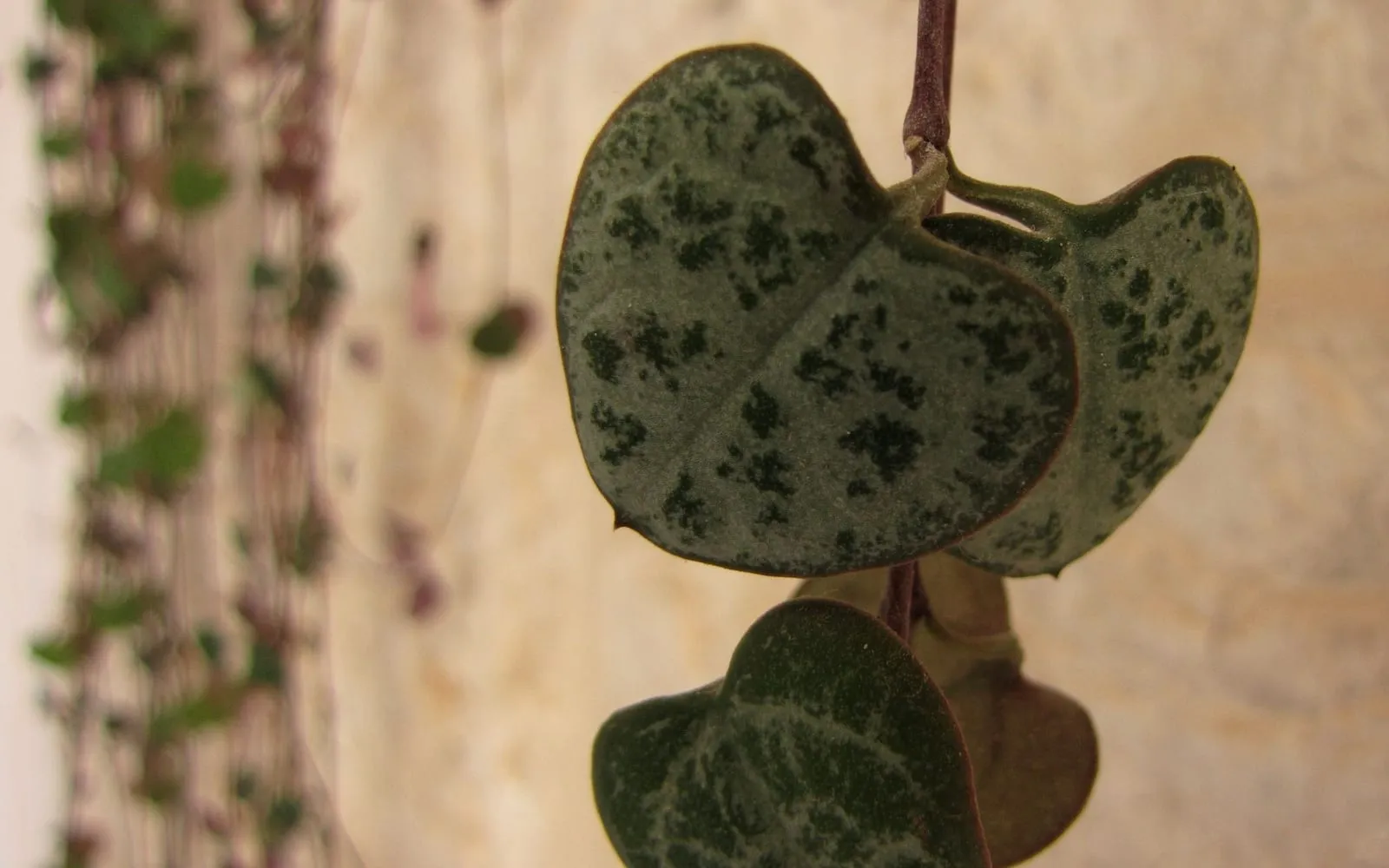
String of hearts does the same job as string of pearls without any of the risk to a cat, and it is considerably easier to keep alive. The leaves are small silver- marbled hearts in opposite pairs along fine purple threads, and a well-grown plant hangs in a dense curtain a metre or more long.
The difference between a good one and a disappointing one is light. In a bright position the leaves sit close together and the stems stay short and purple. In a dim corner the plant produces long bare threads with a pair of leaves every ten centimetres, and no amount of watering or feeding corrects it.
It also grows its own propagation material. Small grey tubers form along the stems at intervals, and pressing one onto damp compost gives you a new plant without cutting anything.
Appearance and character
A trailing perennial growing from an underground tuber, with thread-fine stems hanging 1 to 2 m.
Stems are wiry, purple-brown and no thicker than string.
Leaves are the feature. Heart-shaped, 1 to 2 cm across, thick and semi-succulent, carried in opposite pairs, deep green marbled with silver on the upper surface and a rich purple beneath.
Spacing along the stem indicates the light. Close-set pairs mean a happy plant, and long gaps mean too little light.
Aerial tubers form along the stems at the nodes, grey-green and pea-sized, and each one will grow into a new plant. They are the origin of the name rosary vine.
Flowers appear in summer on a well-grown plant and are extraordinary. Each is a slender tube 2 to 3 cm long, pale pink at the base, swelling into a bulb and opening at the top into five dark hairy lobes fused into a small cage.
The flower works as a temporary trap. Downward-pointing hairs inside hold a small fly for a day or so until the hairs wither, releasing the insect covered in pollen. The plant does not digest anything.
Where it is from
South Africa, Eswatini and Zimbabwe, where it grows in rocky places, scrambling over stones and through low scrub in dry conditions with seasonal rain.
Growing among rocks rather than in open ground explains the light requirement. This is a plant of bright but broken light rather than of full desert sun.
The underground tuber is a drought store, which is why the plant survives long dry periods and why it rots so readily in wet compost.
The semi-succulent leaves do the same job, and the silver marbling reflects some of the light that falls on them.
It was collected by John Medley Wood, curator of the Natal Botanic Gardens, in 1881, and the species honours him.
The genus name comes from the Greek for wax fountain, referring to the flowers.
How it grows
Position it in bright indirect light with an hour or two of direct morning sun. This single decision governs how the plant looks.
Plant into gritty free-draining compost, either a cactus mix or ordinary compost with a third added grit and perlite.
Use a pot only slightly larger than the tuber and rootball, with drainage holes. A large pot of wet compost is the usual way these are lost.
Water only when the compost has dried out completely, then water thoroughly and let it drain fully.
Reduce watering sharply in winter, to perhaps once a month, and keep it above 10 deg C.
Feed lightly every six to eight weeks in the growing season, and not at all from October to March.
Propagate from the aerial tubers. Press one onto the surface of damp compost while still attached to the parent, keep it lightly moist, and cut the connecting stem once it has rooted.
Alternatively lay a length of stem on damp compost and pin it down at the nodes, which roots readily.
Thicken a sparse plant by coiling the strands back over the surface of the pot and pinning them down, so they root and fill out the top.
Handle the strands as little as possible, since they tangle and break easily.
Through the seasons
Winter is the rest. Keep it bright, cool but above 10 deg C, water perhaps monthly, and stop feeding.
Spring is when growth restarts. Increase watering, resume feeding, repot if the pot is full, and take cuttings.
Summer is growth and flowering. Water when the compost dries fully, feed occasionally, and watch for the strange lantern flowers.
Autumn is the wind-down. Reduce watering and feeding from October and move it to the brightest available spot as the days shorten.
Care difficulty
Easy, and noticeably more forgiving than string of pearls.
Overwatering is still the main risk, since the tuber and stems rot in compost that stays wet.
Light governs the appearance rather than the survival. A plant in poor light lives perfectly well and looks thin and straggly.
The strands tangle, which makes moving and repotting fiddly rather than difficult.
Mealybug hides where the leaf pairs meet the stem and needs looking for.
Otherwise it grows steadily, propagates itself and lives for many years.
Watering
Water only when the compost has dried out completely, which in summer usually means every ten to fourteen days.
Water thoroughly until it drains from the bottom, then empty the saucer.
Cut back to roughly monthly in winter, giving just enough to stop the leaves shrivelling.
Soft translucent leaves and blackening stems mean overwatering. Shrivelled thin leaves mean thirst, and the plant recovers within a day or two of a good soak.
Water the compost rather than the strands.
The tuber holds a reserve, so a fortnight of neglect does far less harm than a fortnight of enthusiasm.
Warning signs, diseases and pests
Long bare threads with widely spaced leaves are the commonest complaint, and the cause is almost always too little light. Move the plant somewhere brighter with some direct morning sun. The existing bare stems will not fill in, so cut them back and let the new growth come in tighter.
Faded markings with the silver marbling and purple undersides turning plain green also mean insufficient light.
Soft blackening stems at the base and mushy leaves mean overwatering and rotting. Cut off any healthy strands as cuttings, let the compost dry out, and start again if the tuber has gone.
Mealybug gathers where the leaf pairs join the stem and among the tubers, where it is easy to miss. Lift the strands and check regularly, and dab the insects with a cotton bud dipped in alcohol.
Yellowing leaves scattered through the plant are usually overwatering. Yellowing of the oldest growth only is normal ageing.
Scorched pale patches on the leaves mean too much direct midday sun in summer.
A plant that is bare at the top of the pot with all the growth hanging down needs strands coiled back over the surface and pinned to root.
Growing environment
Bright indirect light with an hour or two of direct morning sun. An east-facing window is close to ideal.
Warmth of 18 to 24 deg C in summer, and no lower than 10 deg C in winter.
Ordinary room humidity, which makes it easy to place. It does not want a steamy bathroom.
Gritty free-draining compost in a pot only slightly larger than the rootball, with drainage holes.
A hanging pot, a high shelf or a mantelpiece, so the strands can hang freely.
Somewhere the strands will not be brushed past or pulled at, since they tangle and break easily.
Avoid a dim corner, which produces the straggly bare-threaded plant that disappoints most owners.
Feeding
Feed every six to eight weeks from April to September with a dilute cactus feed or a balanced houseplant fertiliser at half strength.
Stop feeding from October to March.
Repot every two or three years in spring into fresh gritty compost, moving up only one pot size.
Avoid rich or high-nitrogen feeding, which produces soft growth that rots.
A sparse plant needs more light and more cuttings rooted into the pot rather than more fertiliser.
Troubleshooting
The stems are long and bare with big gaps between the leaves. Not enough light. Move it somewhere brighter with some direct morning sun. Cut the bare stems back, since they will not fill in.
The silver markings have faded. Also insufficient light. The marbling and the purple undersides both develop in bright conditions.
The stems have gone soft and black at the base. Overwatering. Take cuttings from any healthy strands, let the compost dry out completely, and check whether the tuber has rotted.
How often should I water it? Only when the compost is completely dry, roughly every ten to fourteen days in summer and monthly in winter.
What are the little grey balls on the stems? Aerial tubers. Press one onto damp compost while still attached to the parent, and it roots into a new plant within a few weeks.
How do I make it fuller at the top? Coil the strands back over the surface of the compost and pin them down. They root at the nodes and thicken the plant.
Is it safe for cats? Yes. Ceropegia woodii is listed by the ASPCA as non-toxic, which makes it a better choice than string of pearls for a household with a cat.
The flowers look like small cages. They are. Downward-pointing hairs inside hold a fly for a day until they wither, releasing it dusted with pollen.
String of hearts problem guides
Not sure what is wrong? See the common houseplant pests guide.