
Houseplant
Christmas Cactus
Schlumbergera truncata
Also known as Thanksgiving cactus, Crab cactus, Holiday cactus, Zygocactus
How to grow and reflower a Christmas cactus. Why it is not a desert cactus, how to tell it from a Thanksgiving cactus, and what causes bud drop.
At a glance
- Difficulty
- Easy
- Water
- Every 7-10 days, when the top 2 cm is dry
- Light
- Bright indirect light. No direct sun
- Temperature
- 15-24 deg C in growth, 12-15 deg C to set buds
- Humidity
- Ordinary room humidity is fine
- Hardiness
- USDA 10-12, RHS H1b, hardy to 10 C
- Type
- Evergreen perennial epiphyte
- Height
- 30 cm tall, spreading wider with age
- Native to
- The coastal mountains of south-east Brazil
- Best month
- December in the Northern Hemisphere, June in the Southern Hemisphere
Coastal Brazilian rainforest, growing in leaf litter in tree forks rather than in desert. That origin explains the care: it wants shade, humidity and regular water, and it is not drought adapted. Flower buds need six weeks of long nights and cool temperatures around 12 to 15 deg C, which a cool room in autumn supplies and a heated one does not.
Hardiness zones describe winter cold alone. Summer heat, humidity, rainfall and the length of the growing season decide as much, so treat the range as the outer limit rather than as a recommendation.
Every month named in this guide is for the temperate Northern Hemisphere. If you garden in the Southern Hemisphere, shift each one by six months, so December becomes June. Closer to the equator the wet and dry seasons matter more than the calendar, and the shift stops being a useful guide.
Not known to be toxic
The ASPCA lists Christmas cactus as non-toxic to dogs, cats and horses, and it does not appear on the RHS list of potentially harmful garden plants. That makes it one of the safest flowering plants you can keep in a house with animals or small children. A cat that eats a lot of any plant material can still be sick from the fibre alone, and the segments are brittle enough that a determined cat will break them, so it is worth keeping out of reach for the plant's sake rather than the cat's.
Source: ASPCA
About
The Christmas cactus is a cactus that lives in trees. It comes from cloud forest on the coastal mountains behind Rio de Janeiro, where it grows perched in branch forks and rock crevices with its roots in a pocket of leaf litter, in shade, in humid air, and rained on regularly.
Almost every way people get this plant wrong follows from the word cactus. It is put on a hot windowsill, potted into gritty desert mix and watered once a month, and it slowly shrivels while its owner assumes they are being kind. Treat it as a shade-loving forest plant that happens to store water and it will live for decades. Plenty of the ones in old houses were inherited.
Appearance and character
There are no leaves and no spines. What you see are flattened green stem segments joined end to end, arching upward at first and then trailing as they lengthen. Flowers open from the tip of the final segment in a long tube of swept-back petals.
The name on the label is usually wrong, and the two plants it covers flower a month apart. Look at the edges of the segments. Schlumbergera truncata, the Thanksgiving or crab cactus, has two to four sharp forward-pointing teeth down each side, and it flowers from late October into December. The true Christmas cactus, Schlumbergera x buckleyi, has scalloped segments with rounded edges, and it flowers from December into January. Most plants sold as Christmas cactus are truncata.
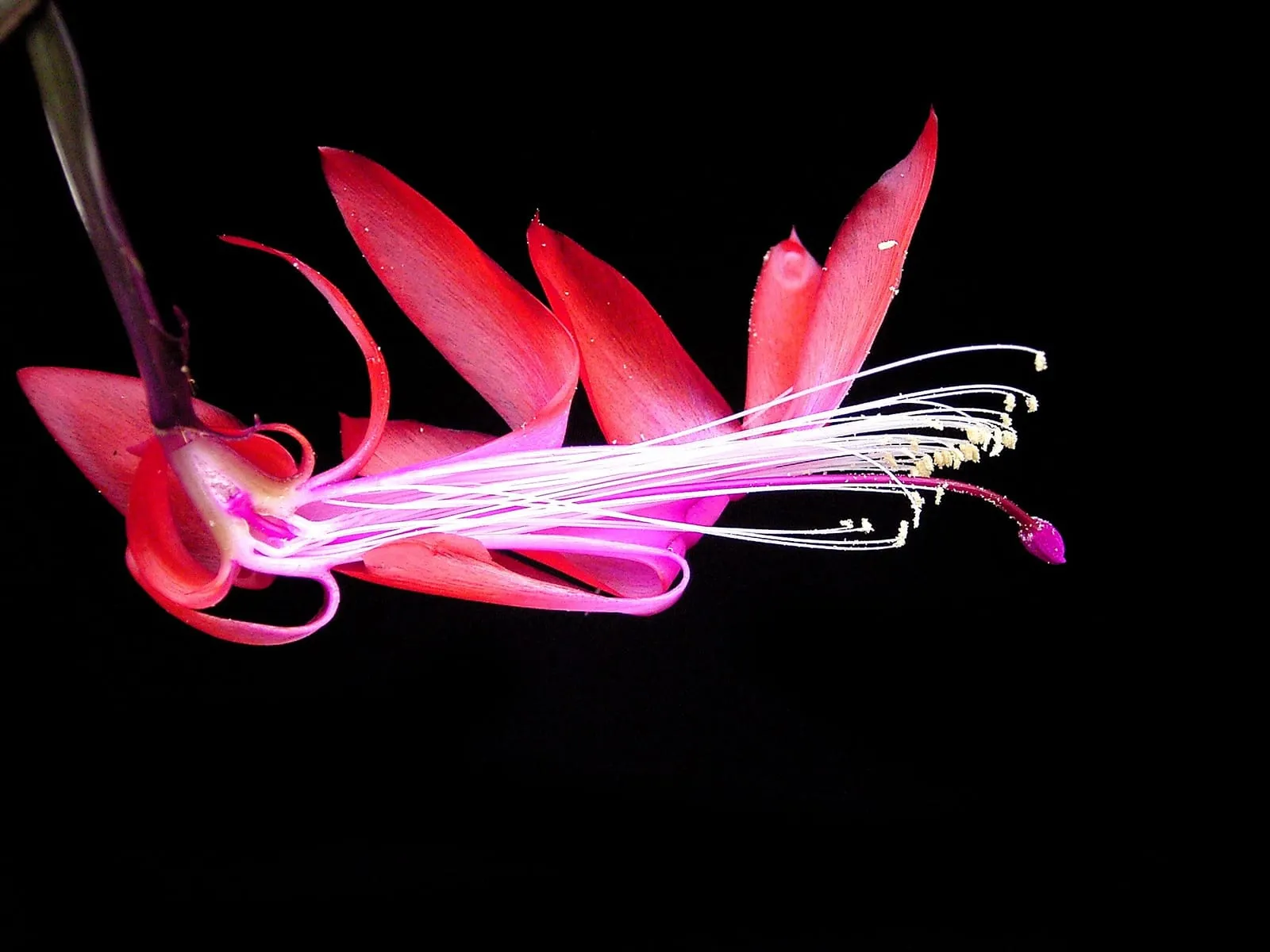
Flower colour runs from white through pink, red, orange and salmon. In the wild the flowers are shaped for hummingbirds, which is why the tube is long and the stamens hang clear of the petals.
Where it is from
The Serra dos Orgaos and neighbouring ranges of south-east Brazil, at 700 to 1800 metres, growing on tree branches and shaded rock.
Cloud forest at that altitude is cool, wet and dim. Nights drop sharply. That combination is what the plant is built for, and it is why the flowering trigger described below is about cold nights rather than about summer heat.
How it grows
An evergreen epiphyte. In the wild its roots grip bark and take what they can from trapped debris, so in a pot it wants an open, airy mix rather than dense compost, and it flowers better slightly pot-bound.
Growth happens in spring and summer, when new segments appear at the tips. Flower buds form in autumn in response to the environment, and the plant then rests through late winter after flowering.
Propagation is embarrassingly easy. Twist off a piece two or three segments long, leave it a day or two for the wound to dry, and push it a centimetre into damp compost.
Through the seasons
Autumn is the part that decides whether you get flowers. From late September the plant needs either long nights, around 13 to 14 hours of darkness, or cool nights below about 15 deg C, for six to eight weeks. Either one on its own usually works, and cold is the easier lever to pull. An unheated spare room, a porch or a cool windowsill with the curtains drawn does it.
Winter is the display. Once buds appear, stop feeding, keep watering lightly, and leave the plant exactly where it is.
Spring is recovery. After the last flower drops, give it a few quieter weeks with less water, then repot if it needs it and start feeding.
Summer is growth. Feed fortnightly. It can go outside in a shaded, sheltered spot once nights are reliably above 12 deg C, which often produces the best growth of the year.
Care difficulty
Easy to keep, and easy to get flowers from once you know the trigger. The plant tolerates a wide range of treatment and recovers well.
The one thing it will not forgive is being moved while in bud. Everything else is negotiable.
Watering
Water when the top 2 cm of compost is dry, which in a warm room is usually every seven to ten days. Water thoroughly, let it drain, and empty the saucer.
This is where the desert cactus assumption does its damage. A Schlumbergera left bone dry for weeks drops its buds, and its segments go limp and wrinkled. It is drought-tolerant in the sense that it will survive, not in the sense that it enjoys it.
Ease back after flowering and through its late-winter rest, then increase again in spring. Waterlogging still causes root rot, so free drainage matters as much as regular watering.
Warning signs, diseases and pests
Bud drop is the complaint you will have, and it is nearly always mechanical rather than a disease. Once buds have set, the plant orients them to the light, and turning the pot, moving it to another room, a draught from a door or a swing in temperature will make it shed the lot. Decide where it is going to flower before the buds form, and then leave it alone.
Mealybugs hide in the joints between segments as small white waxy blobs. Dab them off with a cotton bud. Scale insects appear as flat brown discs on the stems.
Root rot from wet compost shows as segments going soft and dull, often starting near soil level, and the plant lifts out with blackened roots. Take healthy segments as cuttings and start again rather than trying to save it.
Fungus gnats mean the surface is staying too wet.
Growing environment
Bright indirect light, and no direct sun at all. An east or north window is ideal. Direct summer sun through glass bleaches the segments to a hard reddish purple and then scorches them.
Keep it between 15 and 24 deg C through the growing season, and let it drop to 12 to 15 deg C in autumn to set buds. It survives brief cold but not frost.
Ordinary room humidity suits it. It comes from humid forest, but it holds water in its segments and does not need a humidifier.
Feeding
A balanced liquid feed at half strength every fortnight from April to September. In early autumn switch to a high-potassium feed, the sort sold for tomatoes, which supports bud formation rather than more leafy growth.
Stop feeding entirely once buds appear. Fertiliser at that point encourages the plant to push new segments instead of flowers, and it contributes to bud drop.
Troubleshooting
Buds forming, then dropping off. The plant was moved, turned, or caught a draught. Also caused by letting it dry out, or by feeding once buds set.
No flowers at all. It did not get its autumn trigger. From late September give it six to eight weeks of nights below 15 deg C, or 13 to 14 hours of uninterrupted darkness, and stop feeding.
Segments limp and wrinkled. Usually thirst. If the compost is damp and the segments are still limp, it is root rot instead.
Segments turning reddish purple. Too much light, and sometimes cold. Move it out of direct sun.
Leggy, with long thin growth. Not enough light.
Which one do I have? Sharp pointed teeth on the segment edges means truncata, flowering from late October. Rounded, scalloped edges means x buckleyi, flowering from December.
Christmas Cactus problem guides
Not sure what is wrong? See the common houseplant pests guide.