
Houseplant
Jade Plant
Crassula ovata
Also known as Money plant, Money tree, Friendship tree
How to grow a jade plant, Crassula ovata. Watering a succulent properly, pruning it into a tree, getting red leaf edges, and why it breathes at night.
At a glance
- Difficulty
- Easy
- Water
- Every two to three weeks in summer, monthly in winter
- Light
- Bright light with several hours of direct sun
- Temperature
- 5-30 deg C. A cool winter rest at 10-13 deg C brings flowers
- Humidity
- Ordinary room air. Dry air suits it
- Hardiness
- USDA 10-11, RHS H2, hardy to 7 C
- Type
- Evergreen succulent shrub, very long-lived
- Height
- 60-150 cm indoors over many years
- Native to
- The Eastern Cape and KwaZulu-Natal, South Africa
- Best month
- August in the Northern Hemisphere, February in the Southern Hemisphere
South Africa, from a summer-rainfall region with dry winters. It is a landscape shrub outdoors in USDA 10 and 11, reaching 2 m, and a slow pot plant everywhere colder. A cool dry winter rest is what triggers the white flowers most indoor plants never produce.
Hardiness zones describe winter cold alone. Summer heat, humidity, rainfall and the length of the growing season decide as much, so treat the range as the outer limit rather than as a recommendation.
Every month named in this guide is for the temperate Northern Hemisphere. If you garden in the Southern Hemisphere, shift each one by six months, so August becomes February. Closer to the equator the wet and dry seasons matter more than the calendar, and the shift stops being a useful guide.
Toxic to pets if eaten
- Do not eat
- Leaves and stems
- Harm from
- Eating it
- Affects
- Cats, dogs and horses
The ASPCA lists the jade plant, under the older name Crassula argentea, as toxic to dogs, cats and horses, gives the toxic principle as unknown, and lists vomiting, depression and incoordination as the effects. Jade plant does not appear on the RHS list of potentially harmful garden plants. The incoordination is what distinguishes this from a simple stomach upset, since it suggests something acting beyond the gut, and cases in cats have included unsteadiness and a slowed heart rate. Nobody has identified the compound responsible, which makes it harder to say how much is too much, and the sensible response to that uncertainty is to treat any ingestion as worth a phone call to a vet rather than something to wait out. The plant is a common windowsill succulent with fleshy leaves at cat height, so placement matters more here than with a plant kept out of reach.
Sources: ASPCA (Jade plant, Crassula argentea), RHS potentially harmful garden plants
About
A jade plant will outlive most of the furniture in the room. Specimens of a hundred years are documented, and a plant passed down two generations is common, which is where the friendship tree name comes from.
It also breathes on a different schedule from most houseplants. Jade uses crassulacean acid metabolism, opening its stomata at night to take in carbon dioxide and storing it as an acid until daylight, when it closes up tight and photosynthesises using the store. The point is water conservation, since the plant does its gas exchange when the air is coolest and loses far less moisture doing it.
That mechanism is why a jade plant tolerates weeks of neglect and dies within days of being over-watered.
Appearance and character
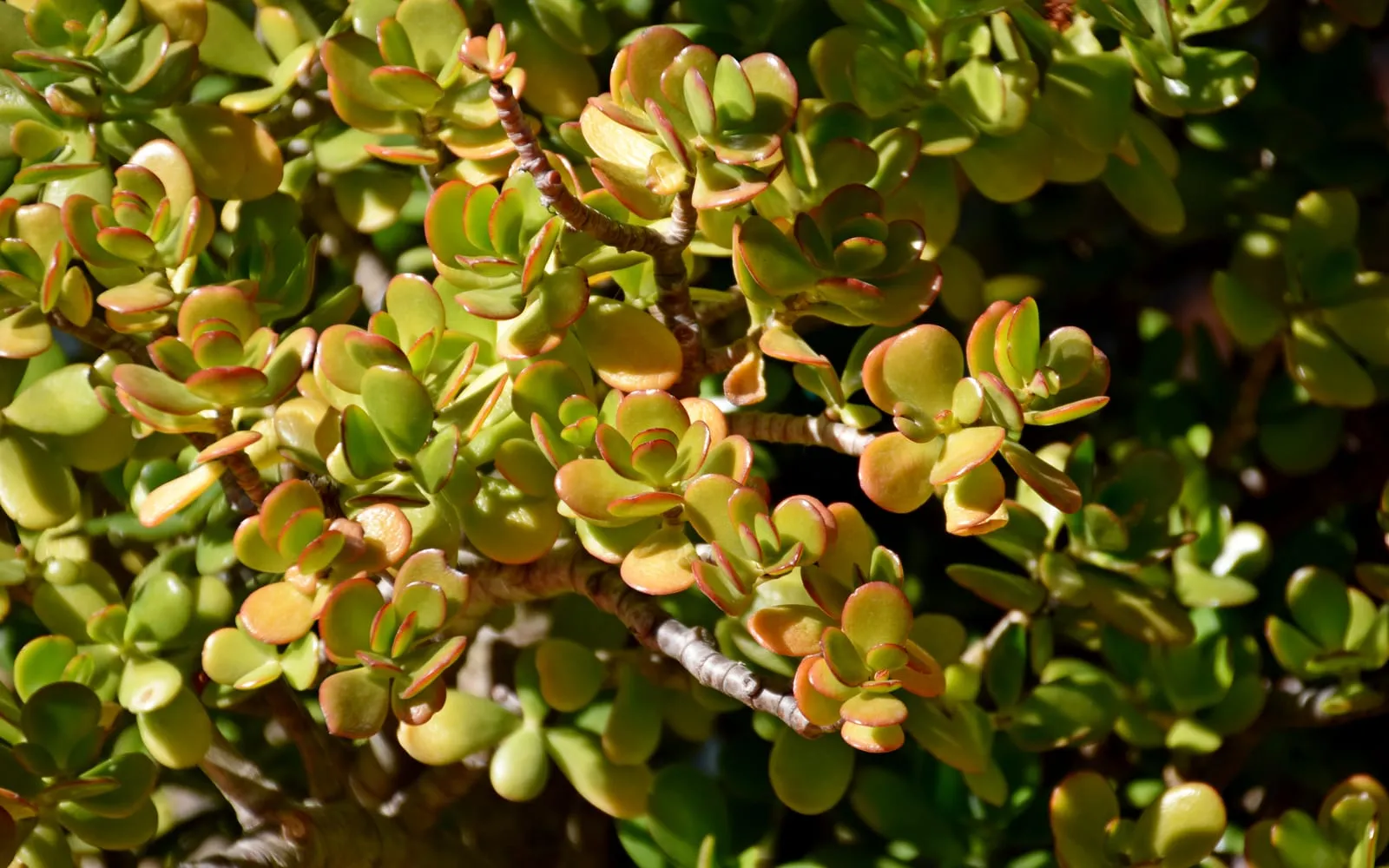
Thick, fleshy, glossy oval leaves in deep green, held in opposite pairs on stems that thicken and go woody with age. A mature plant has a stout trunk and a branching crown, and looks like a miniature tree.
In strong light the leaf margins flush red or bronze. This is the plant producing pigment as sunscreen, and it is a sign of good conditions rather than stress. A jade with uniformly green leaves has probably not had enough light.
Flowers are small, white to pale pink, star-shaped and borne in clusters in winter. They appear on mature plants only, and only after a cool dry rest, so most indoor jades never bloom.
The leaves snap off cleanly and root where they fall, which is how the plant propagates itself in the wild and the easiest possible way to make new ones.
Where it is from
The Eastern Cape and KwaZulu-Natal in South Africa, on rocky hillsides and in dry scrub, with hot dry summers and cool winters with occasional rain.
Rainfall there is low and unpredictable, which is what the fleshy leaves and stems are for. They are water tanks, and the plant lives off them between downpours.
The soil is thin, stony and free-draining, so the roots never sit in moisture.
Cool winters are part of the cycle rather than a hardship, and that seasonal change is what triggers flowering. A jade kept at a steady 20 deg C all year has no reason to bloom.
How it grows
An evergreen succulent shrub, slow-growing and effectively unlimited in lifespan. Growth happens in spring and summer and stops almost completely from November to March.
Stems thicken and lignify with age, and the plant becomes top-heavy as the crown fills out. Repotting into a heavy pot, or into a wide shallow one, keeps it stable.
Pruning shapes it. Cutting a stem just above a pair of leaves usually produces two new shoots below the cut, which is how the tree form is built. Prune in spring, and cut with clean secateurs rather than tearing.
Propagation is close to effortless. Break off a healthy leaf or take a stem cutting 8 to 10 cm long, leave it somewhere dry for a few days until the cut surface calluses over, then press it into barely damp gritty compost. Skipping the callusing step is why cuttings rot.
Roots are shallow and fine relative to the size of the plant, so a modest pot is correct.
Through the seasons
Spring restarts growth. Prune to shape now, repot if the plant is unstable or the compost is exhausted, and begin feeding from April.
Summer is the growing season. Water every two to three weeks, feed monthly, and put the plant outside in a sheltered sunny spot once nights stay above 10 deg C, which deepens the leaf colour considerably.
Autumn slows it down. Bring it in before the first cold nights, stop feeding at the end of September, and reduce watering.
Winter is the rest. Keep it bright, cool at 10 to 13 deg C, and water roughly monthly. This is what produces flowers, and it is also the period when overwatering does the most damage.
Care difficulty
Easy, and the failure mode is almost always the same.
Water it too often and the stem rots at the base. A jade plant given a weekly drink like a normal houseplant will be dead within a season. The correct rhythm is a thorough soak followed by complete drying, and in winter that means about once a month.
The second issue is light, and it disfigures rather than kills. In a dim corner the stems stretch, the gaps between leaves lengthen, and the plant becomes sparse and floppy. This is called etiolation and it cannot be reversed, only pruned out.
Watering
Drench thoroughly, then let the compost dry out completely before watering again. This mimics the downpour-then-drought cycle the plant is built for.
In summer that is roughly every two to three weeks. In winter, monthly at most, and less if the plant is somewhere cool.
Water the compost rather than the plant, and never leave water sitting in a saucer.
Judge by the leaves rather than the calendar. Slightly soft or wrinkled leaves mean the plant has used its reserves and is ready for water. Plump firm leaves mean it needs nothing.
Soft, translucent, mushy leaves mean the opposite, and they indicate overwatering that has already begun to rot the roots.
Warning signs, diseases and pests
Overwatering causes nearly every serious problem. It shows as soft yellowing leaves that drop, a stem that goes soft and dark at compost level, and a plant that collapses. Once the main stem has rotted the plant cannot be saved, so take healthy cuttings from the top immediately, callus them and start again.
Mealybugs are the common pest, appearing as white cottony patches in the leaf joints and under the leaves. Dab them with a cotton bud dipped in alcohol and check weekly, since they hide well on a densely branched plant.
Etiolation, meaning stretched pale growth with long gaps between the leaves, is a light problem rather than a pest. Move the plant somewhere brighter and prune back the stretched sections in spring.
Sudden leaf drop usually follows cold shock or a sharp change in conditions rather than underwatering. Stabilise the position and temperature.
Wrinkled shrivelled leaves mean underwatering, and they plump back up within a few days of a good soak.
Black spots on the leaves generally indicate fungal problems from damp still air. Improve ventilation and water less.
Growing environment
Bright light with several hours of direct sun. A south or west-facing windowsill is ideal, and this is one of the few houseplants that wants the sun full on it. The red leaf margins are the signal that the light is right.
Temperatures from 5 to 30 deg C are tolerated. A cool winter rest at 10 to 13 deg C for several weeks encourages flowering. Frost damages it, so it comes indoors before the cold.
Dry air suits it. Do not mist, and do not group it with humidity-loving plants.
Compost must be gritty and free-draining. A cactus and succulent mix, or a general compost cut with a third sharp sand or perlite, works. Ordinary multipurpose compost holds far too much water.
Use a snug pot with drainage holes, and prefer terracotta, which breathes and dries. A heavy pot also stops a mature plant toppling.
Summering it outdoors in a sheltered sunny spot improves colour and compactness noticeably.
Feeding
A cactus and succulent fertiliser at half strength, monthly from April to September.
Stop entirely from October to March. Feeding a resting plant builds salts and encourages soft growth that rots.
Jade plants are light feeders and over-fertilising produces weak stretched growth that cannot support its own leaves.
Repot into fresh compost every three or four years rather than increasing the feed.
Troubleshooting
Soft yellow leaves dropping, stem dark at the base. Overwatering and stem rot. Take cuttings from healthy top growth now. The parent is unlikely to recover.
Wrinkled shrivelled leaves. Underwatering. A thorough soak plumps them up within a few days.
Stretched, leggy, big gaps between the leaves. Not enough light. Move it to a sunny window and prune out the stretched growth in spring.
Leaves all uniformly green, never red at the edges. Not enough direct sun. The red margins are a good sign rather than a warning.
Sudden leaf drop. Cold shock or a sharp change in position. Stabilise conditions.
White cottony patches in the leaf joints. Mealybugs. Dab with alcohol on a cotton bud and repeat weekly.
Never flowers. Needs to be mature and to have a cool, dry, bright winter rest at around 10 to 13 deg C. A warm living room all year gives leaves only.
Cutting rotted instead of rooting. It was planted before the cut surface callused. Leave cuttings to dry for several days first.
Top-heavy and falling over. Repot into a heavier, wider pot and prune the crown back in spring.
Jade Plant problem guides
Not sure what is wrong? See the common houseplant pests guide.