
Houseplant
Noble dendrobium
Dendrobium nobile
Also known as Dendrobium, Noble rock orchid
How to grow Dendrobium nobile. The cool dry winter rest that makes it flower, why the old canes must be kept, and the keikis that grow instead of buds.
At a glance
- Difficulty
- Difficult
- Water
- Regular in growth, and almost none during the winter rest
- Light
- Bright indirect light with some direct morning sun
- Temperature
- 18 to 27 deg C in growth, and 10 to 13 deg C during the winter rest
- Hardiness
- USDA 9-12, RHS H1c, hardy to 5 C
- Type
- Evergreen epiphytic orchid, long lived and flowering on year-old canes
- Height
- 30-60 cm
- Native to
- The Himalayas and south-east Asia, from India and Nepal to southern China
- Best month
- February in the Northern Hemisphere, August in the Southern Hemisphere
The Himalayan foothills and southern China, at altitude, with a monsoon summer and a cold dry winter. It flowers only after a rest of six to eight weeks that is cool, bright and almost completely dry, down to 5 deg C at night. A plant kept warm and watered through winter grows keikis instead of flowers.
Hardiness zones describe winter cold alone. Summer heat, humidity, rainfall and the length of the growing season decide as much, so treat the range as the outer limit rather than as a recommendation.
Every month named in this guide is for the temperate Northern Hemisphere. If you garden in the Southern Hemisphere, shift each one by six months, so February becomes August. Closer to the equator the wet and dry seasons matter more than the calendar, and the shift stops being a useful guide.
Not known to be toxic
Orchids are among the safest houseplants and Dendrobium is no exception. The ASPCA lists Dendrobium as non-toxic to cats, dogs and horses, and it is not listed by the RHS as a potentially harmful garden plant. No part of it is a recognised poisoning hazard. The wider family Orchidaceae has an extremely good safety record, and vanilla, which is an orchid, is a food. Dendrobium nobile has a long history of use in traditional Chinese medicine as shi hu, where the stems are dried and used as a tonic, which is a prepared extract rather than the plant on a windowsill. The conservation position is worth knowing. Wild orchids are heavily collected and all orchids are listed under CITES, which regulates international trade, so buy nursery-propagated plants from a reputable supplier and never buy wild-collected stock. Plants sold in garden centres are laboratory propagated.
Sources: RHS potentially harmful garden plants, ASPCA toxic and non-toxic plants
About
A Dendrobium nobile that never flowers again after the first year has almost always been kept too warm and too wet through the winter.
This is not a moth orchid. Phalaenopsis, the orchid in every supermarket, wants steady warmth and regular water all year. Dendrobium nobile comes from the Himalayan foothills, where the winter is cool and dry, and it needs that rest to set flower buds.
The rest is specific. From about November to February, keep it at 10 to 13 deg C at night, in good light, and give it almost no water at all. The canes will wrinkle slightly and the leaves may yellow and drop, which is normal. Then in late winter the buds form along the length of the canes and it flowers.
Kept warm and watered through the winter it produces leaves and keikis, which are baby plants, instead of flowers.
The second thing people get wrong is cutting off the old bare canes. Dendrobium nobile flowers on canes made the previous year, and it flowers along their whole length after the leaves have dropped. A leafless cane is next year’s display, and removing it removes the flowers.
Get those two things right and it is one of the most spectacular orchids you can grow, with flowers wreathed along every cane.
Appearance and character
An evergreen epiphytic orchid reaching 30 to 60 cm, growing as a clump of upright canes.
Canes are the pseudobulbs, jointed, fleshy, upright and cane-like, 30 to 60 cm tall, and each one lives for several years.
Leaves are strap-shaped, 7 to 10 cm long, held in two ranks along the canes, and they are shed from older canes over a year or two.
Flowers appear in late winter and spring, in ones, twos and threes from the joints along the whole length of a year-old cane, so a well-flowered plant is wreathed in blooms.
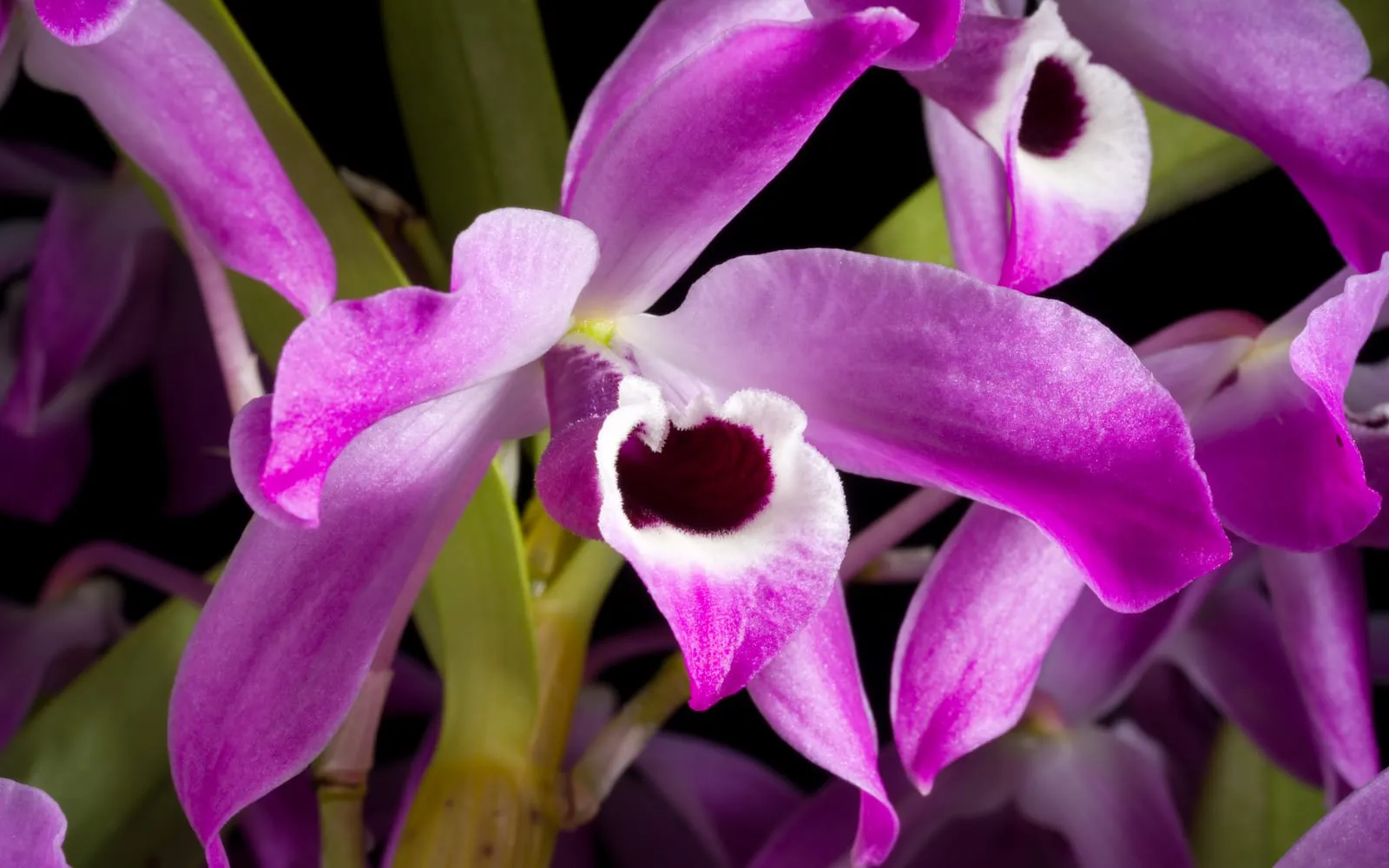
Each flower is 6 to 8 cm across, waxy, usually white to rose-pink with deeper tips and a dark maroon blotch in the throat of the lip. Modern hybrids extend the range through yellow, apricot and deep purple.
Flowers are scented, and they last four to six weeks, which is far longer than most orchids of that size.
Keikis are small plantlets that form at the joints instead of flowers, complete with their own roots, and they can be detached and grown on.
The plant flowers on canes made the previous season, and a cane usually flowers once and then persists as a food store.
Where it is from
The Himalayas and south-east Asia, from northern India, Nepal and Bhutan through Myanmar, Thailand, Laos and Vietnam to southern China.
It grows as an epiphyte on tree trunks and branches, and sometimes on rocks, in monsoon forest at 200 to 2,000 m.
The climate there is the key to growing it. A warm wet summer monsoon drives the growth, and a cool dry winter with a substantial drop in night temperature triggers flowering. Reproducing that cycle is the whole of the cultivation.
It was introduced to Britain in the 1830s and became one of the most popular orchids of the Victorian orchid craze.
Dendrobium means tree-living, from Greek, and the genus contains around 1,800 species, one of the largest in the orchid family.
Dendrobium nobile is shi hu in traditional Chinese medicine, where the dried stems are used as a tonic, and it is one of the more heavily traded medicinal orchids.
Wild collection for horticulture and medicine has depleted populations across its range, and all orchids are listed under CITES.
Modern nobile-type hybrids, largely bred in Japan, are more compact, more free-flowering and somewhat more forgiving than the species.
How it grows
Grow it in bright indirect light with some direct morning sun. An east-facing windowsill is ideal, and it needs more light than a moth orchid.
Use a coarse bark-based orchid compost in a small pot with generous drainage. Dendrobiums flower better when tight in the pot.
Follow the annual cycle, which is the whole of growing this plant.
Spring and summer, March to September. Growth. Water thoroughly whenever the compost has almost dried, roughly weekly, and feed every second or third watering with a balanced orchid feed. Keep it at 18 to 27 deg C in bright light. New canes grow during this period.
Late summer, August and September. Switch to a high-potash orchid feed, which helps the new canes ripen.
Autumn and winter, November to February. The rest. Move it somewhere cool and bright, ideally 10 to 13 deg C at night, and stop watering almost completely. Give a light misting every two or three weeks if the canes wrinkle badly, and no more.
Do not feed at all during the rest.
Expect the leaves on the older canes to yellow and drop during the rest. That is normal.
Buds appear along the canes in late winter. Once they show, move the plant back into warmth and resume watering gradually.
Never cut off a leafless cane. The old bare canes are where next year’s flowers come from, and they also store water and food. Remove a cane only when it has gone brown, shrivelled and completely dead.
Cut the flower stems off after flowering, leaving the cane.
Repot every two or three years in spring, immediately after flowering, into fresh bark. Do it when new roots are just starting.
Detach keikis once they have roots 5 cm long, cutting them off with a short piece of the parent cane, and pot them into fine bark.
A plant producing keikis instead of flowers is being kept too warm and too well fed in winter.
Through the seasons
Winter is the rest, from November to February. Cool at 10 to 13 deg C at night, bright, almost no water and no feed. Leaves yellow and drop, which is normal, and buds form towards the end of it.
Spring is the flowering season, from February into April, followed by repotting and the start of new growth.
Summer is the main growth period, watering weekly and feeding every second or third watering.
Autumn ripens the new canes on a high-potash feed, and the rest begins in November.
Care difficulty
Difficult, and specifically because the winter treatment is counterintuitive.
Everything about the growing season is straightforward. Bright light, weekly watering, regular feeding and warmth.
The winter rest is the hard part. Keeping an orchid cool, dry and unfed for three months while it drops its leaves feels like neglect, and it is what makes it flower.
The other error, cutting off the bare canes, is entirely understandable and removes the whole display.
Getting both right produces one of the most striking orchids in cultivation, and a plant that lives and flowers for decades.
Watering
Water thoroughly during the growing season, roughly weekly, whenever the bark has almost dried. Soak the pot, let it drain completely, and never let it stand in water.
Stop watering almost completely from November to February. A light misting every two or three weeks if the canes wrinkle badly is all it should get.
Resume watering gradually once flower buds appear, rather than all at once.
Use rainwater or filtered water where you can, since orchids are sensitive to the salts in hard tap water.
Use tepid water rather than cold.
Water in the morning so the crown and leaf axils dry before nightfall.
Overwatering, particularly in winter, rots the roots and the cane bases.
Warning signs, diseases and pests
No flowers, with plenty of healthy growth, is nearly always a missing or inadequate winter rest. The plant needs three months at 10 to 13 deg C at night, in good light, almost dry and unfed.
Keikis forming along the canes instead of flower buds is the same problem, and it means the plant was kept too warm, too wet or too well fed through the winter. Detach the keikis once they have roots and grow them on, and give the parent a proper rest next year.
Leaves yellowing and dropping from the older canes in winter is normal during the rest.
Leaves yellowing in summer is usually overwatering or too much direct sun.
Shrivelled canes in winter is normal to a degree, and severe wrinkling means it needs a light misting.
Soft blackening cane bases with brown mushy roots is rot from overwatering. Repot into fresh bark, cutting away all dead roots.
Brown limpet-like bumps on the canes and leaves is scale insect, which is the commonest orchid pest. Wipe them off with a cotton bud dipped in dilute alcohol.
White cottony masses in the leaf axils is mealybug.
Fine silvery mottling with faint webbing is red spider mite in dry air.
Bud drop before opening is usually a sudden change of temperature, a draught or dry air.
Growing environment
Bright indirect light with some direct morning sun. An east-facing windowsill, or a south- facing one with light shading in summer. It wants more light than a moth orchid.
A coarse bark-based orchid compost in a small pot with generous drainage. Never in ordinary potting compost.
18 to 27 deg C during growth, and 10 to 13 deg C at night from November to February. A cool bright bedroom, a porch, an unheated conservatory or a frost-free greenhouse all work for the rest.
Moderate humidity. A pebble tray or grouping with other plants helps.
Allow 30 cm of spread, and dendrobiums stay compact and tall rather than spreading.
It suits an east-facing windowsill, a cool conservatory, a porch or a bright bedroom, and the key is somewhere that gets cool in winter.
Grow it with other orchids that want a winter rest. Many Dendrobium species, Cymbidium and some Cattleya all need cool dry winters, and grouping them means one regime. Moth orchids want the opposite and should be kept separately.
The ASPCA lists Dendrobium as non-toxic to cats, dogs and horses, which makes orchids generally among the safer houseplants.
Feeding
Feed every second or third watering from April to September with a balanced orchid feed at the stated strength.
Switch to a high-potash orchid feed in August and September, which ripens the new canes and supports flower bud formation.
Do not feed at all from October to February. Feeding through the winter is one of the things that produces keikis instead of flowers.
Flush the pot through with plain water every few months to wash out accumulated salts.
Repot every two or three years in spring into fresh bark, since old bark breaks down and holds too much water.
Troubleshooting
It flowered once and never again. The winter rest is missing. Dendrobium nobile needs three months from November to February at 10 to 13 deg C at night, in good light, almost dry and completely unfed. Without it the plant grows and does not flower.
Should I cut off the bare canes? No. The old leafless canes are where next year’s flowers come from, and they store water and food. Remove a cane only when it is brown, shrivelled and completely dead.
Small plants are growing along the canes instead of flowers. Those are keikis, and they mean the plant was kept too warm, too wet or too well fed over the winter. Detach them once they have roots 5 cm long and pot them up, and give the parent a proper rest next year.
The leaves are yellowing and dropping in winter. Normal during the rest. The plant sheds leaves from the older canes and it is not dying.
How is it different from a moth orchid? Almost entirely. Phalaenopsis wants steady warmth and regular water all year. Dendrobium nobile needs a cool dry winter rest to flower, and treating it like a moth orchid is why so many never flower twice.
How much water in winter? Almost none. A light misting every two or three weeks if the canes wrinkle badly, and no more, from November until buds appear.
When should I repot it? Every two or three years in spring, immediately after flowering, when new roots are just starting. Use fresh coarse bark and keep the pot small.
Is it safe for pets? Yes. The ASPCA lists Dendrobium as non-toxic to cats, dogs and horses, and orchids generally have a very good safety record.
The buds dropped before opening. Usually a sudden change of temperature, a draught or very dry air. Keep it in one place once buds appear.
Noble dendrobium problem guides
Not sure what is wrong? See the common houseplant pests guide.