
Outdoor plant
Garden privet
Ligustrum ovalifolium
Also known as Oval-leaved privet, California privet
How to grow privet, Ligustrum ovalifolium. The suburban hedge that takes any abuse, when to cut it, why the berries are poisonous, and its reputation for starving a border.
At a glance
- Difficulty
- Easy
- Water
- Rarely once established
- Light
- Full sun to deep shade
- Temperature
- Fully hardy, though it drops more leaves in a hard winter
- Hardiness
- USDA 5-9, RHS H6, hardy to -25 C
- Type
- Semi-evergreen shrub, long lived and very fast growing
- Height
- 3-5 m unclipped, and any height as a hedge
- Native to
- Japan, and introduced to Britain in 1885
- Best month
- January in the Northern Hemisphere, July in the Southern Hemisphere
Cold, drought, shade, pollution and hard clipping are all taken, which is what made it the suburban hedge of the twentieth century. Birds spread the berries and privets are among the worst woody invaders in the warm parts of the world. Chinese privet, Ligustrum sinense, covers more than a million hectares of the American south-east, and tree privet is a notifiable pest in Auckland because the pollen triggers asthma. Clip before it flowers where that matters.
Hardiness zones describe winter cold alone. Summer heat, humidity, rainfall and the length of the growing season decide as much, so treat the range as the outer limit rather than as a recommendation.
Every month named in this guide is for the temperate Northern Hemisphere. If you garden in the Southern Hemisphere, shift each one by six months, so January becomes July. Closer to the equator the wet and dry seasons matter more than the calendar, and the shift stops being a useful guide.
Toxic if eaten
- Do not eat
- The berries above all, and the leaves
- Harm from
- Eating it
- Affects
- People, cats, dogs and horses
Privet is poisonous and it is planted in more temperate front gardens than almost anything else, which is a combination worth taking seriously. The berries are the main hazard. They are small, black, glossy and produced in clusters at a child's eye level on an unclipped hedge, and they contain glycosides including ligustrin along with terpenoid compounds. Eating them causes vomiting, abdominal pain, diarrhoea and in larger quantities low blood pressure and incoordination. Fatal human poisoning is rare and recorded, and children have been hospitalised after eating handfuls. The leaves are also toxic and are the usual route for animals. Horses and ponies are the most frequently affected, generally after eating hedge clippings thrown over a fence into a paddock, and privet poisoning in horses can be fatal. Never dispose of privet prunings anywhere livestock can reach them. The ASPCA lists Ligustrum as toxic to cats, dogs and horses. A clipped hedge produces no berries at all, which is the simplest control where children use the garden.
Sources: RHS potentially harmful garden plants, ASPCA toxic and non-toxic plants
About
Privet is the hedge that surrounded most of suburban Britain when it was built, and it is still there because nothing else takes that much abuse and keeps going.
It grows on any soil, in sun or deep shade, through pollution, drought, salt wind and root competition. It regrows from bare wood after being cut to the ground. It holds a crisp clipped face better than almost any other plant. It is cheap.
The trade-off is the amount of cutting. Privet grows fast, and a hedge kept sharp needs three cuts a year rather than one. Left alone for a season it looks shaggy, and left alone for five it becomes a row of small trees with bare legs.
Check two risks before planting it. The berries are poisonous, which matters where children are in the garden, and a clipped hedge never sets any. The roots are aggressive and shallow and strip a border alongside it of everything, which is why the strip next to an old privet hedge is usually dust.
Wild privet, Ligustrum vulgare, is the European native and is a different plant. It is semi-evergreen too, has narrower leaves, and it belongs in a hedgerow rather than a garden boundary.
Appearance and character
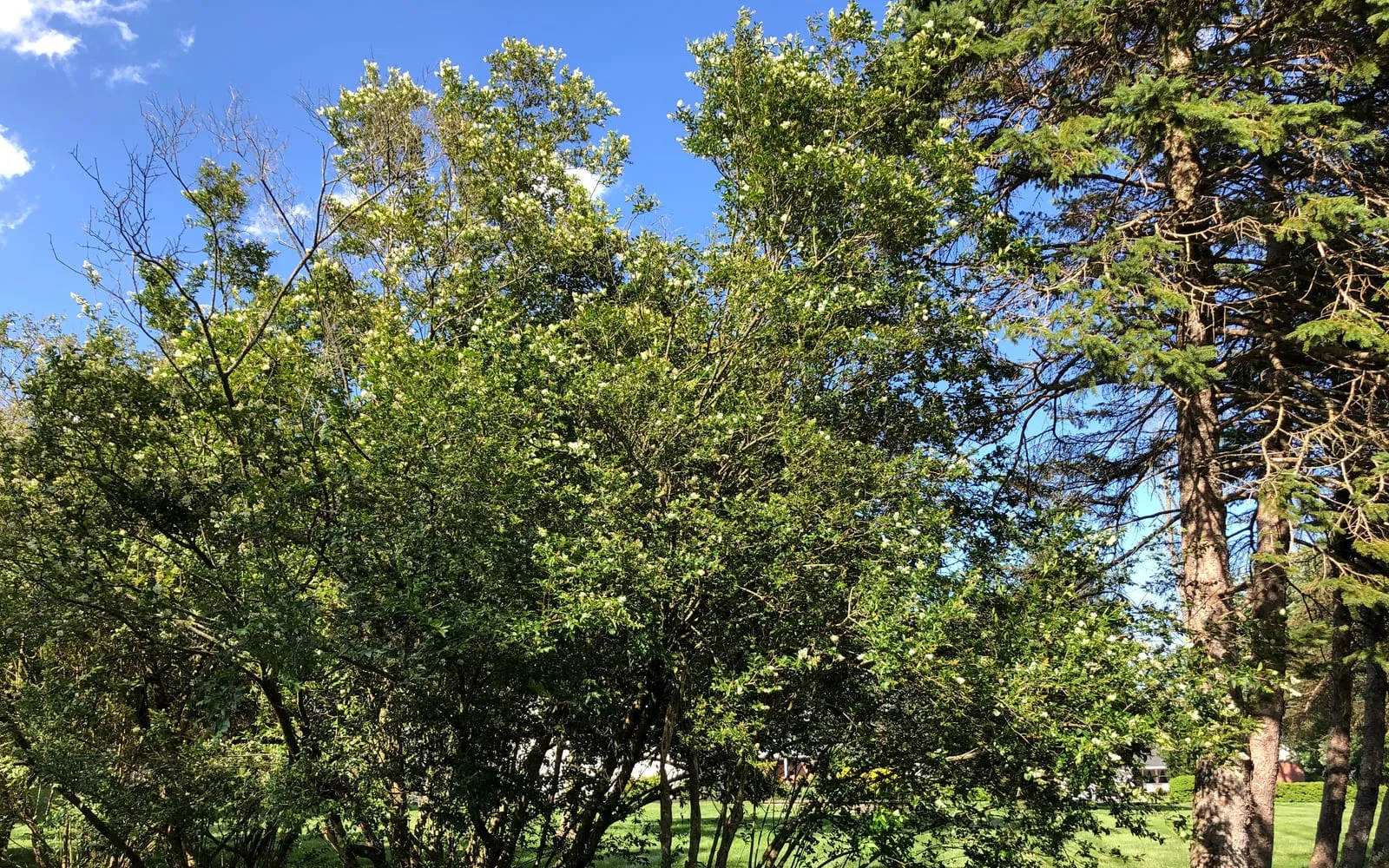
A semi-evergreen shrub reaching 3 to 5 m unclipped, dense and upright, and it can be kept at any height from half a metre upwards as a hedge.
Leaves are oval, 3 to 6 cm long, glossy mid-green, untoothed, and held in opposite pairs. It holds most of them through a mild winter and drops a good proportion in a cold one, which is what semi-evergreen means in practice.
The golden form, ‘Aureum’, has leaves broadly margined or fully suffused in yellow and is the more widely planted of the two in modern gardens.
Flowers appear in June and July on unclipped growth, in dense creamy-white panicles about 5 to 10 cm long. The scent is heavy, sweet and divisive, and hay fever sufferers in particular tend to object to it.
Berries follow from autumn, small, round, glossy black, in tight clusters, and they persist into winter.
A clipped hedge produces neither flowers nor berries, because both come on growth that has been left to extend.
Bark is pale grey-brown, and old stems go gnarled and twisted.
Where it is from
Japan, where it grows in coastal thickets and woodland edges, and it reached Britain in 1885.
It naturalised widely in Britain, Ireland, western Europe and North America, and it is a recognised invasive species in parts of the eastern and southern United States and in New Zealand.
The Victorian and Edwardian suburb is where it took hold in Britain. Privet was the standard front garden hedge of speculative housing from the 1880s onwards, and the density of privet in a suburban street is a reasonable guide to when the street was built.
Wild privet, Ligustrum vulgare, is native across Europe on chalk and limestone and is the plant the name originally described. It is the food plant of the privet hawk moth, Britain’s largest resident moth, whose caterpillar is bright green with lilac stripes and reaches the size of a finger.
Garden privet supports the same moth, so a hedge is worth checking in late summer.
The name has been in English since at least the fifteenth century and its origin is unknown.
How it grows
Plant bare-root between November and March for a hedge, which is much cheaper than container stock, or container-grown at any frost-free time.
For a hedge, plant a single row at 30 to 45 cm spacing, or a double staggered row for a thicker result.
Cut every plant back by a third to a half after planting, and cut the sides in the first two years, which is what builds density at the base.
Feed and mulch a new hedge, which is the one time privet benefits from it, because a row of plants at close spacing is competing with itself.
Trim two or three times a year between May and September to keep a sharp face. Once in late spring, once in midsummer and once in early autumn is the usual rhythm.
Cut a taper, wider at the base than the top, so light reaches the bottom and the hedge stays furnished.
Avoid cutting between March and August where birds are nesting in it, which in practice means checking the hedge before each cut rather than avoiding the season entirely.
Renovate an overgrown hedge by cutting it hard back to the main stems in late winter. Privet regrows readily from old wood, and it can be taken down to 30 cm and will come back. Do one face one year and the other the next if you want to keep some cover.
Feed and mulch after hard renovation, which speeds the regrowth considerably.
Never leave clippings where horses, ponies or livestock can reach them.
Propagate from hardwood cuttings in autumn, which root almost without fail.
Through the seasons
Winter is planting season and the time for hard renovation. The hedge holds most of its leaves in a mild winter and thins in a cold one.
Spring breaks into fresh growth in April and the first trim falls in late May.
Summer is the fast growth period, with flowers in June and July on anything unclipped, and two more trims.
Autumn carries the black berries on unclipped growth, and takes the last cut of the year.
Care difficulty
Easy to grow and demanding of time.
Nothing kills it short of honey fungus. It takes any soil, any light level, drought, pollution, salt and hard cutting.
The work is the cutting. Two or three trims a year is what a crisp hedge costs, and a long boundary is a real commitment.
The other cost is what it does to the ground around it. Privet roots are shallow, dense and greedy, and the border alongside an established hedge is dry and starved.
Watering
Water through the first summer after planting, particularly a bare-root hedge going in during a dry spring.
Established privet needs no watering in a temperate climate and tolerates drought well.
Water and mulch after hard renovation to push the regrowth.
Mulch a new hedge to suppress grass, which competes with young plants harder than dry weather does.
Warning signs, diseases and pests
A bare gappy base is the commonest complaint. It is caused either by not cutting the plants back after planting, or by clipping the sides vertically so light never reaches the bottom. Cut a taper, and renovate hard if the base is already bare.
Leaves dropping heavily in a cold winter is normal for a semi-evergreen and not a problem.
Fine pale mottling and a bronze cast across the foliage in summer is privet thrips. It is disfiguring rather than damaging and a hedge grows through it.
Yellow-brown blotches on the leaves is privet leaf spot, which follows wet weather. Clear fallen leaves and improve air movement.
Sudden death of a section of hedge, with white fungal sheets under the bark at ground level, is honey fungus. Privet is susceptible and there is no treatment.
Nothing growing in the border beside the hedge is root competition rather than disease. Cut a vertical slit trench alongside with a spade each spring to sever surface roots, or plant tough things such as hardy geranium, epimedium and Japanese anemone.
Black berries within reach of children on an unclipped hedge is the safety point to act on. Clip it, and a clipped hedge sets no fruit.
Growing environment
Full sun to deep shade. It is one of the few hedging plants that makes a decent hedge on a north-facing boundary.
Any soil, including chalk, clay, sand, dry ground and compacted urban soil.
Fully hardy to about -25 deg C, and it tolerates pollution and coastal salt wind well.
Allow 45 to 60 cm of width for a hedge, and remember it can be kept at any height from half a metre upwards.
Keep it away from a border you care about, or accept that the strip beside it will be dry and hungry.
It suits a boundary hedge, a screen, a front garden, topiary, a dividing hedge inside a garden, and any position where the growing conditions are poor.
Its wildlife value is moderate and better than its reputation. The dense growth is good nesting cover, the flowers feed insects if you leave a section unclipped, the berries feed thrushes and blackbirds, and it hosts the privet hawk moth.
Consider yew, beech, hornbeam or a mixed native hedge if you want something with more character and can accept slower growth. Privet’s advantages are speed, price and tolerance.
Feeding
None needed for an established hedge on ordinary soil.
Feed and mulch a newly planted hedge in its first two or three springs, using a general balanced fertiliser, because closely spaced plants compete with each other.
Feed after hard renovation to drive the regrowth.
Feed an old hedge that is thin and yellowing, which does happen where it has been clipped for decades in poor soil without anything going back in.
Avoid high-nitrogen feeds on a mature hedge, which produce soft growth and more cutting.
Troubleshooting
Are the berries poisonous? Yes. Privet berries contain glycosides and cause vomiting, abdominal pain and diarrhoea, and children have been hospitalised after eating them. A clipped hedge produces no berries, which is the simplest answer where children use the garden.
Is it dangerous to pets and horses? The ASPCA lists Ligustrum as toxic to cats, dogs and horses. Horses are the most frequently poisoned, usually from clippings thrown into a paddock. Never dispose of privet prunings near livestock.
How often do I cut it? Two or three times between May and September for a crisp face. Once a year gives a shaggy hedge.
Nothing will grow next to the hedge. Privet roots are shallow and greedy. Slit the soil alongside with a spade each spring to cut surface roots, and plant tough things such as epimedium, hardy geranium or Japanese anemone.
Can I cut an overgrown privet hedge hard back? Yes. It regrows from old wood better than most hedging plants and can be taken to 30 cm in late winter. Feed and mulch afterwards.
The bottom of the hedge is bare. Either it was never cut back after planting or the sides are clipped vertically. Cut a taper, and renovate hard if it is already bad.
It dropped a lot of leaves this winter. Normal. Privet is semi-evergreen and thins in a cold winter.
Is my hedge privet or wild privet? Garden privet has oval glossy leaves 3 to 6 cm long. Wild privet, Ligustrum vulgare, has narrower duller leaves and is the native hedgerow species.
What is the huge green caterpillar on it? Privet hawk moth, Britain’s largest resident moth. Bright green with lilac and white stripes and a horn at the tail. Leave it alone.