
Outdoor plant
Leatherleaf mahonia
Mahonia bealei
Also known as Beale's barberry, Oregon grape
How to grow mahonia, Mahonia bealei. Scented yellow flowers in the middle of winter, blue berries for jelly, and where to put a plant with spines like holly.
At a glance
- Difficulty
- Easy
- Water
- Rarely once established
- Light
- Partial to full shade, and it tolerates sun in moist soil
- Temperature
- Fully hardy, to about -15 deg C
- Hardiness
- USDA 6-9, RHS H5, hardy to -15 C
- Type
- Evergreen shrub, long lived and slow to moderate
- Height
- 2-3 m
- Native to
- Central and western China
- Best month
- January in the Northern Hemisphere, July in the Southern Hemisphere
Dry shade is taken better than by almost any other evergreen, which is the reason to plant it. It flowers in the depths of winter, so it feeds bumblebees in weeks when nothing else offers nectar. Mahonia aquifolium, the Oregon grape, is native to western North America and is invasive across central Europe, so the direction of the problem depends on which side of the Atlantic you are on.
Hardiness zones describe winter cold alone. Summer heat, humidity, rainfall and the length of the growing season decide as much, so treat the range as the outer limit rather than as a recommendation.
Every month named in this guide is for the temperate Northern Hemisphere. If you garden in the Southern Hemisphere, shift each one by six months, so January becomes July. Closer to the equator the wet and dry seasons matter more than the calendar, and the shift stops being a useful guide.
Skin irritant
- Safe to eat
- The ripe berries, once cooked
- Do not eat
- The roots and stems, which contain concentrated berberine
- Harm from
- Eating it and handling it
- Affects
- People, cats and dogs
Mahonia contains berberine and related isoquinoline alkaloids, concentrated in the roots and inner bark, which are bright yellow and were used as a dye for that reason. Berberine in quantity causes vomiting, diarrhoea, lowered blood pressure and lethargy, and it is the reason the ASPCA lists Mahonia as toxic to cats and dogs, where chewing the stems or roots is the likely route. The ripe berries are a different matter and are edible. They are sharp, seedy and low in alkaloid, and Oregon grape jelly made from the related Mahonia aquifolium is a long-standing preparation in North America. Cook them and strain out the seeds. Eating a few raw berries causes nothing worse than a puckered mouth. The commoner injury from mahonia is physical, since every leaflet ends in a stiff spine and mature plants carry their foliage at face height, so eye protection is sensible when pruning. Wear gloves and long sleeves.
Sources: RHS potentially harmful garden plants, ASPCA toxic and non-toxic plants
About
Mahonia flowers in January, in dense yellow spikes, and it is scented of lily of the valley from several metres away.
Very little else does that. A temperate garden in the first weeks of the year has winter jasmine, a few hellebores, maybe a witch hazel, and mahonia is the one that carries scent across a whole corner. Bumblebee queens out on a mild January day work it, and it is one of the few nectar sources available to them.
It also grows in dry shade, which is the hardest position in most gardens to plant. A north-facing corner under a wall, the base of a hedge, the shade of a large tree, all of which defeat most flowering shrubs, suit mahonia.
The trade-off is the spines. Each leaflet ends in a stiff point like a small holly leaf, the leaves are held in rosettes at the top of the stems, and on a mature plant that puts them at face height. Do not plant one beside a path.
Its other habit is going bare at the base. Left uncut, a mahonia becomes a set of bare stems with a tuft of foliage on top, and the remedy is to cut some of the stems right down every few years.
Appearance and character
An evergreen shrub reaching 2 to 3 m, made of stiff upright stems with the leaves clustered in rosettes towards the tips.
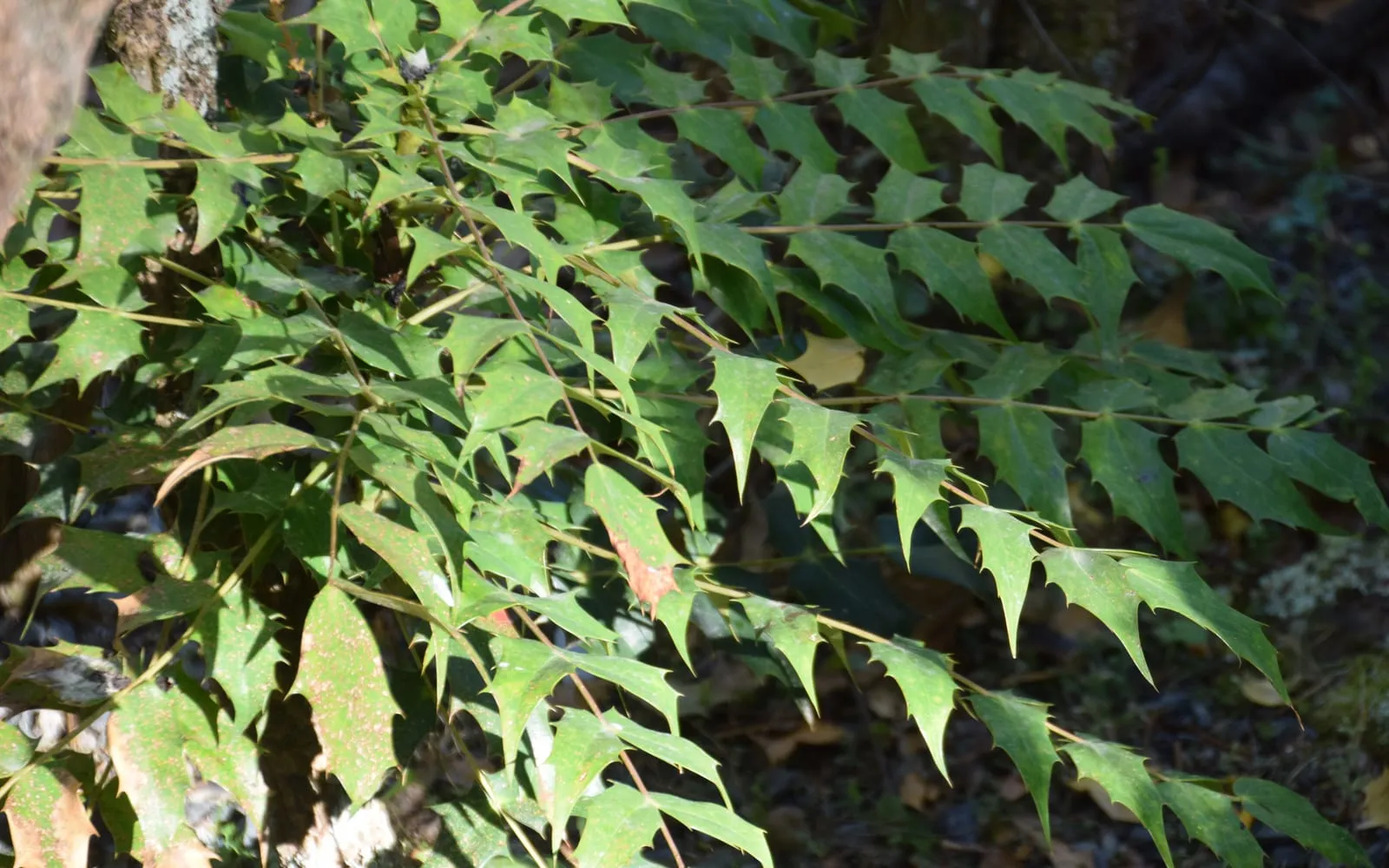
Leaves are pinnate and large, 30 to 45 cm long, made of nine to fifteen leathery blue-green leaflets. Each leaflet is holly-like, with several stiff spines around the margin and a sharp point at the tip.
Flowers open from November to March depending on the season, in dense erect or slightly spreading racemes 10 to 20 cm long, bright lemon-yellow, and strongly scented of lily of the valley.
Berries follow in spring, oval, 1 cm long, blue-black with a grey waxy bloom, in hanging bunches that look like small grapes.
Stems are stout, sparsely branched, and yellow inside when cut, which is the berberine.
New growth in spring is often flushed bronze or red before hardening to blue-green.
Mahonia x media cultivars such as ‘Charity’ and ‘Winter Sun’ are more widely planted than the species and carry longer, more spreading flower spikes.
Where it is from
Central and western China, growing in woodland, on shaded slopes and in ravines.
It was collected in the 1840s and named after Thomas Beale, a merchant in Shanghai whose garden supplied a number of Chinese plants to Britain.
The genus is named after Bernard McMahon, an Irish-American nurseryman who grew plants brought back by the Lewis and Clark expedition.
Mahonia aquifolium, Oregon grape, is the North American species and the state flower of Oregon. It is lower, spreads by suckers and makes better ground cover than bealei.
Berberine has a long history of use as a yellow dye across Asia and Europe, taken from the roots and inner bark of Mahonia and the related Berberis.
Mahonia bealei has naturalised and become invasive in the south-eastern United States, spread by birds eating the berries. In Britain it self-seeds in gardens and has not become a problem in the wild.
Botanists now often place Mahonia inside Berberis, which is why nursery labels vary.
How it grows
Plant in autumn or spring in partial or full shade, into any reasonable soil.
Dry shade is where it earns its place. It grows under trees, at the base of a north wall and behind a hedge, positions that defeat most flowering shrubs.
Improve the soil at planting with compost or leaf mould, particularly in dry shade, and water for the first two summers while it roots in.
Position it away from paths, gates, doorways and anywhere people brush past. The spines are at face and hand height on a mature plant.
Prune after flowering, in spring, once the display is over and before the berries would form if you want them.
Cut a leggy plant by taking one third of the oldest stems right down to 30 cm every year for three years. This is what keeps it furnished at the base, and mahonia regrows readily from old wood.
Cut the whole plant to 30 cm in spring to renovate one that has gone completely bare underneath. It comes back within two seasons.
Deadhead if you do not want seedlings, since birds spread the berries around the garden and mahonia self-seeds freely.
Mulch every spring with compost or leaf mould, which matters most in dry shade.
Wear gauntlets, long sleeves and eye protection when cutting it. The leaflet spines go in rather than scratching.
Propagate from semi-ripe cuttings in late summer, or lift a self-sown seedling.
Through the seasons
Winter is the whole reason to grow it. Yellow scented flowers from November through to March, working through the dead months.
Spring ripens the blue berries, and this is pruning and mulching season once flowering ends.
Summer puts on the new growth from the tips of the stems.
Autumn sets the flower spikes and is the better planting time.
Care difficulty
Easy. Mahonia is among the most tolerant evergreen shrubs available.
It takes shade, dry soil, clay, chalk, cold, wind, pollution and neglect, and it flowers reliably in the middle of winter without being asked.
The two jobs are cutting the oldest stems down every few years to stop it going bare underneath, and siting it where nobody will walk into it.
Diseases are minor. Mahonia rust and powdery mildew both occur and neither threatens the plant.
Watering
Water through the first two summers after planting, particularly in dry shade under a tree where the competition for moisture is severe.
Established mahonia needs no watering in a temperate climate and tolerates dry shade better than almost any flowering evergreen.
Mulch generously every spring, which does more for a plant in dry shade than watering does.
Warning signs, diseases and pests
Bare leggy stems with foliage only at the top is normal ageing rather than disease. Cut a third of the oldest stems to 30 cm each spring for three years.
Small orange-brown spots on the upper leaf surface with matching pustules underneath is mahonia rust. It is disfiguring and rarely serious. Remove and bin affected leaves and improve air movement.
White powdery coating on the leaves in a dry summer is powdery mildew, which follows drought at the roots. Mulch and water.
Purple-red leaf colour in winter is normal in some cultivars and in cold exposed positions, and it is not a nutrient problem.
Seedlings appearing all over the garden is birds spreading the berries. Deadhead after flowering if it bothers you.
Yellowing between the veins on very chalky soil is chlorosis, which is uncommon since mahonia tolerates alkaline ground well.
Honey fungus attacks mahonia and is fatal.
Poor flowering is usually deep shade combined with drought, or pruning at the wrong time. Prune after flowering rather than in autumn.
Growing environment
Partial to full shade for preference. It tolerates full sun where the soil stays moist, and the foliage bleaches in hot dry sun.
Any reasonable soil, including clay and chalk. It prefers ground that does not bake and copes with dry shade better than most.
Fully hardy to about -15 deg C, and tolerant of wind, cold and urban pollution.
Allow 1.5 to 3 m of spread.
It suits a shady border, a north-facing corner, the base of a wall, a woodland edge, a boundary where a spiny barrier is useful, or a position under a large tree.
Keep it away from paths, seats, gates and washing lines.
Grow it with the plants that share dry shade. Epimedium, hardy geranium, Euphorbia amygdaloides var. robbiae, bergenia and hellebore all work beneath it.
Its wildlife value in winter is out of proportion to its size. Bumblebee queens and early flies work the January flowers when nothing else is open, and blackbirds and thrushes take the berries in spring.
Choose Mahonia x media ‘Winter Sun’ or ‘Charity’ for the best flower spikes, or Mahonia aquifolium for low suckering ground cover under 1 m.
Feeding
None needed on ordinary soil.
Mulch every spring with compost or leaf mould, which matters more than fertiliser because it holds moisture in dry shade.
Feed a plant in poor dry soil under a tree with a general slow-release fertiliser in spring, where competition from tree roots is severe.
Avoid high-nitrogen feeds, which produce soft growth and more legginess.
Troubleshooting
It has gone bare at the bottom with leaves only at the top. Normal for mahonia. Cut one third of the oldest stems down to 30 cm each spring for three years, or cut the whole plant to 30 cm to start again. It regrows from old wood.
When do I prune it? After flowering in spring. Pruning in autumn removes the flower spikes.
Are the berries edible? The ripe berries are edible cooked and make a sharp jelly. The roots and stems contain concentrated berberine and are not. Strain out the seeds.
Is it safe for pets? The ASPCA lists Mahonia as toxic to cats and dogs, mainly through the alkaloids in the stems and roots. A dog chewing the stems may vomit. The spines are the more likely injury.
Where should I plant it? Shade, including dry shade under trees or at the base of a north wall, and well away from any path or doorway because of the spines.
Seedlings are coming up everywhere. Birds spread the berries. Deadhead after flowering to stop it.
The leaves have orange spots. Mahonia rust. Pick off affected leaves and improve air movement. It rarely does lasting harm.
Which one should I buy? Mahonia x media ‘Winter Sun’ or ‘Charity’ for the longest scented flower spikes, and Mahonia aquifolium if you want low suckering ground cover instead of a tall shrub.
It barely flowers. Deep shade with dry soil, or pruning at the wrong time of year. Mulch it, and prune only after flowering.