
Outdoor plant
Saucer magnolia
Magnolia x soulangeana
Also known as Chinese magnolia, Tulip magnolia
How to grow saucer magnolia, Magnolia x soulangeana. Goblet flowers on bare wood in April, why frost ruins them, and where to plant one so it does not happen.
At a glance
- Difficulty
- Moderate
- Water
- Regular through dry spells for the first few years
- Light
- Full sun to light shade, sheltered from early morning sun
- Temperature
- Fully hardy, though the flowers are ruined by spring frost
- Hardiness
- USDA 5-9, RHS H6, hardy to -25 C
- Type
- Deciduous shrub or small tree, long lived and slow to moderate
- Height
- 5-9 m
- Native to
- A garden hybrid raised near Paris in the 1820s, from two Chinese species
- Best month
- April in the Northern Hemisphere, October in the Southern Hemisphere
The wood is hardier than the flowers by a wide margin. Buds open before the leaves and a single frost at minus two turns an open flower brown overnight, so the useful question is not whether your winter is cold enough but whether your spring frosts stop before mid-spring. Plant it away from morning sun so frosted buds thaw slowly, and choose a later-flowering cultivar such as Magnolia x loebneri or the Little Girl hybrids where late frosts are routine.
Hardiness zones describe winter cold alone. Summer heat, humidity, rainfall and the length of the growing season decide as much, so treat the range as the outer limit rather than as a recommendation.
Every month named in this guide is for the temperate Northern Hemisphere. If you garden in the Southern Hemisphere, shift each one by six months, so April becomes October. Closer to the equator the wet and dry seasons matter more than the calendar, and the shift stops being a useful guide.
Not known to be toxic
Saucer magnolia is not listed by the RHS as a potentially harmful garden plant and is not recorded by the ASPCA as toxic to cats, dogs or horses. No part of it is a recognised poisoning hazard, and it is a sound choice for a garden used by children and pets. Magnolia petals are edible and have a hot gingery flavour, and pickled magnolia buds are a traditional preparation in parts of Japan that a handful of modern restaurants have taken up. Magnolia bark from related Asian species is used in traditional medicine and sold as a supplement, which is a concentrated extract rather than the garden plant and carries its own cautions that do not transfer to a tree in a border. Where a plant is unlisted by both sources rather than positively assessed, read that as no hazard recorded rather than a hazard ruled out, so there is no reason to encourage anybody to eat it in quantity.
Sources: RHS potentially harmful garden plants, ASPCA toxic and non-toxic plants
About
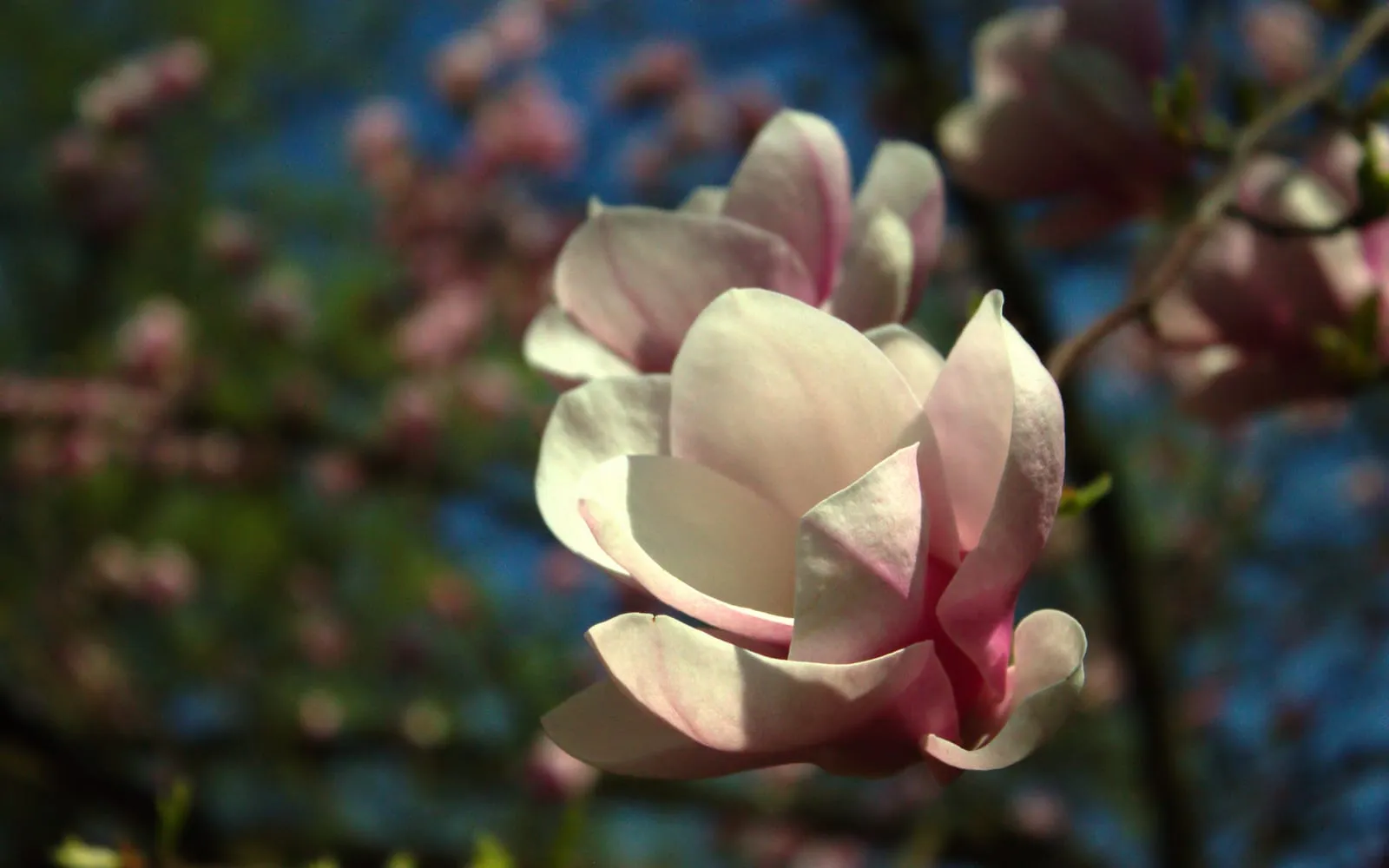
A saucer magnolia in April is large pale goblets standing on bare grey wood, with no leaves anywhere to soften them.
That is the whole appeal and also the whole problem. Flowering before the foliage means nothing competes with the display, and it also means the flowers open into the part of spring when frost is still arriving. A clear cold night at the wrong moment turns every open goblet to brown tissue paper by breakfast, and the tree does not produce a second flush.
Where you plant it decides how often that happens. A position that stays out of early morning sun lets frosted buds thaw slowly, which is what saves them, and shelter from the north and east keeps the cold air moving past rather than settling.
The genus is ancient. Magnolias were flowering before bees existed and are pollinated by beetles, which is why the flower parts are thick and tough enough to survive being walked on by something with jaws.
This particular plant is a hybrid, raised by Etienne Soulange-Bodin outside Paris in the 1820s from two Chinese species, and it is the magnolia in most temperate front gardens.
Appearance and character
A deciduous shrub or small tree reaching 5 to 9 m, usually broader than it is tall, branching low into a wide spreading crown.
Flowers open in April before the leaves, 10 to 20 cm across, goblet-shaped at first and opening to a saucer. The colour runs from white through pink to deep purple-pink depending on the cultivar, and most are stained darker at the base of the petals and paler towards the tips.
There are no true petals. The nine tepals are undifferentiated between petal and sepal, which is one of the primitive features of the family.
Buds through winter are large, pointed and covered in soft grey fur, and they are one of the better things about the plant in January.
Leaves follow the flowers, obovate, 10 to 20 cm long, mid-green and slightly leathery, and they cast heavy shade.
Autumn colour is an undistinguished yellow-brown and the leaves fall late.
Bark is smooth and pale grey, and the winter outline of low spreading branches is handsome enough to earn the tree its space out of season.
Fruits are knobbly cone-like structures that split to show orange-red seeds on fine threads, and they appear only occasionally where summers are cool.
Where it is from
A garden hybrid rather than a wild plant, raised in France around 1820 by crossing Magnolia denudata, the yulan of central China, with Magnolia liliiflora.
Both parents are Chinese, and the yulan has been cultivated in Chinese temple gardens for more than a thousand years, where its white flowers stood for purity.
The genus itself is spread across east Asia and the Americas, with a fossil record reaching back around 95 million years, which places it before the evolution of bees.
Beetle pollination explains the flower. The tepals are thick and fleshy, the carpels are tough enough to resist chewing, and the scent is fruity rather than sweet.
Named after Pierre Magnol, a French botanist who worked at Montpellier and who proposed the idea of grouping plants into families.
The hybrid reached Britain within a few years of being raised and has been in continuous cultivation since.
How it grows
Plant in autumn or in spring, avoiding midwinter, into deep moist soil enriched with leaf mould or composted bark.
Choose the position with more care than you would give most trees, because it is the single decision that controls whether you see flowers most years.
Avoid an east-facing wall or any spot that catches the first sun of the morning. A frosted bud that thaws slowly in shade often recovers, and the same bud hit by direct sun at dawn is destroyed.
Avoid frost pockets, which means the bottom of a slope and any hollow where cold air collects behind a hedge or wall.
Provide shelter from north and east winds, from a wall, a hedge or other planting.
Plant at the depth it was growing before and no deeper. Magnolia roots are fleshy, shallow and easily rotted.
Do not dig around it afterwards. The root system runs wide and near the surface, and forking a border under a magnolia does real damage. Mulch instead of cultivating.
Mulch every spring with leaf mould, composted bark or garden compost, keeping it clear of the trunk.
Prune as little as possible and only after flowering in late spring or in midsummer. Magnolia heals badly and does not reliably regrow from old wood, so a hard cut leaves a permanent gap.
Remove dead, damaged or crossing branches and reduce the occasional over-long shoot back to a side branch. Leave the natural spreading shape alone.
Expect to wait. A young plant may take three to five years to flower properly, and grafted stock flowers sooner than seed-raised.
Through the seasons
Winter shows the grey furry buds and the low branch structure. Do not prune now.
Spring is the whole point. Buds swell through March and open in April, and this is the month when a frost forecast matters.
Summer puts on the leaves and the extension growth, and this is the window for any pruning.
Autumn is the better planting season, and the leaves turn a plain yellow-brown before falling.
Care difficulty
Moderate. Nothing about the routine care is demanding and two things go wrong often enough to matter.
The first is frost on the flowers, which is a siting problem rather than a care problem and cannot be fixed after planting.
The second is soil. Magnolia wants deep, moist, organic, neutral to slightly acid ground. Shallow chalk causes yellowing that no feed corrects, and dry sand causes stunting.
Given the right site it is long-lived, needs no pruning, has few pests and asks for a mulch once a year.
Watering
Water regularly through dry spells for the first three or four years after planting. The shallow root system dries out faster than a deep-rooted tree.
An established magnolia in reasonable soil manages, and it still benefits from watering in a long drought, showing stress by scorching at the leaf edges.
Never let it stand in water. Fleshy roots rot in waterlogged ground.
Use rainwater in a hard-water area where the soil is already marginal on pH.
Mulch to hold moisture rather than watering more often, which suits the plant better.
Warning signs, diseases and pests
Brown limp flowers the morning after a cold clear night are frost damage. There is no treatment and no second flush. Fleece a small plant if a frost is forecast while it is in flower, and site the next one out of the morning sun.
Yellow leaves with green veins is lime-induced chlorosis on chalky or alkaline soil. Sequestered iron and an ericaceous feed help for a season and do not solve it.
Brown scorched leaf edges in summer is drought or wind. Water and mulch, and check for root disturbance.
Pink-orange pustules on dead twigs is coral spot, which enters through wounds and dead wood. Cut affected wood back into clean growth and burn it.
Brown limpet-like bumps on the stems with sticky leaves and black mould below is scale insect. Treat in midsummer when the young crawlers are active.
Honey fungus attacks magnolia and is fatal, showing as white fungal sheets under the bark at the base.
No flowers on a young plant is usually age. Give a grafted plant three to five years and a seed-raised one considerably longer.
No flowers on an established plant that used to flower is nearly always frost taking the buds, or pruning done at the wrong time and removing them.
Growing environment
Full sun to light shade, sheltered from early morning sun and from north and east winds.
Deep, moist, fertile soil, neutral to slightly acid, with plenty of organic matter. It tolerates mildly alkaline ground and fails on shallow chalk.
Fully hardy as a plant. The vulnerability is the flowers rather than the wood.
Allow 5 to 8 m of width. This is a spreading tree and pruning it to fit is the way to ruin the shape.
It suits a lawn specimen, a sheltered courtyard, a woodland edge or a large border, and it works well underplanted with spring bulbs that flower with it.
Nothing much should be planted directly beneath it. The shallow roots resent competition and the summer shade is heavy.
Consider Magnolia stellata for a small garden. It reaches around 3 m, flowers with narrow strap-like tepals in March, and is far more tolerant of a tight space.
Consider a later-flowering cultivar such as ‘Susan’ or another of the Kosar hybrids where frost is a regular problem, since flowering in May avoids most of it.
Feeding
An ericaceous or balanced slow-release feed in spring is enough, applied over the root area rather than at the trunk.
Mulch every spring with leaf mould, composted bark or garden compost. This does more than fertiliser for a magnolia, because it feeds slowly and keeps the shallow roots cool.
Avoid high-nitrogen feeds, which produce leaf growth at the expense of flower buds.
Yellowing on alkaline soil calls for sequestered iron as a holding measure, and the real answer is to grow it in a large container of ericaceous compost instead.
Troubleshooting
All the flowers went brown overnight. Spring frost. Nothing can be done for that year, and there is no second flush. Fleece a small plant when frost is forecast during flowering, and site any future one away from early morning sun.
Where should I plant it? Somewhere sheltered from north and east wind, out of the first sun of the morning, and not in a hollow where cold air collects. That siting is the difference between flowering most years and flowering occasionally.
The leaves are yellow with green veins. Lime-induced chlorosis. The soil is too alkaline. Sequestered iron and ericaceous feed buy a season, and a container of ericaceous compost is the durable answer.
When can I prune it? After flowering in late spring, or in midsummer, and as little as possible. Magnolia heals badly and does not regrow reliably from old wood.
It has never flowered. Age is the usual reason on a young plant. Grafted stock takes three to five years and seed-raised takes far longer. Check also that you are not pruning in winter and cutting the buds off.
Can I move it? Only while young and only in early spring, with as large a root ball as you can lift. The fleshy shallow roots take badly to disturbance.
It is getting too wide for the space. Cutting it back spoils the shape permanently. Replace it with Magnolia stellata, which stays around 3 m.
Are the flowers edible? The tepals are edible and taste hot and gingery, and pickled magnolia buds are a traditional Japanese preparation. It is not listed as harmful, and that is different from being recommended as food.
Something is making the leaves sticky and black. Scale insects feeding on the stems, with sooty mould growing on their honeydew. Treat in midsummer when the crawlers are moving.