
Outdoor plant
Hazel
Corylus avellana
Also known as Common hazel, Cobnut, Filbert
How to grow hazel, Corylus avellana. Coppicing on a seven-year cycle, planting two for a crop of cobnuts, the catkins in February, and losing the lot to squirrels.
At a glance
- Difficulty
- Easy
- Water
- Rarely once established
- Light
- Full sun for a crop, and it tolerates partial shade
- Temperature
- Very hardy. Late frost damages the female flowers
- Hardiness
- USDA 4-8, RHS H6-H7, hardy to -29 C
- Type
- Deciduous shrub or small tree, effectively immortal when coppiced
- Height
- 4-8 m, and kept at 2-3 m by coppicing
- Native to
- Europe and western Asia, from Scandinavia to northern Iran
- Best month
- February in the Northern Hemisphere, August in the Southern Hemisphere
Cool to cold temperate. Winter cold is never what limits hazel. It needs a proper winter to break bud evenly, so it crops badly in mild-winter regions, and it resents the hot dry summers of Mediterranean and continental interiors unless it is irrigated. That combination, rather than any lack of cold tolerance, is what stops it above USDA 8.
Hardiness zones describe winter cold alone. Summer heat, humidity, rainfall and the length of the growing season decide as much, so treat the range as the outer limit rather than as a recommendation.
Every month named in this guide is for the temperate Northern Hemisphere. If you garden in the Southern Hemisphere, shift each one by six months, so February becomes August. Closer to the equator the wet and dry seasons matter more than the calendar, and the shift stops being a useful guide.
Not known to be toxic
- Safe to eat
- The nuts
Non-toxic. The ASPCA does not list Corylus among plants harmful to cats, dogs or horses, and the RHS does not include hazel in its list of potentially harmful garden plants. Leaves, bark and catkins present no poisoning risk, and the nuts are a food crop. One genuine caution has nothing to do with the plant's chemistry. Hazelnut is a declarable allergen under food labelling law in the UK, the EU, the United States, Canada and Australia, tree nut allergy is common and reactions can be severe, so a household with a nut allergy should think carefully before planting a tree that scatters nuts across a garden every autumn. Handling the shells and leaves is not a realistic trigger, and eating a nut is. Dogs eat fallen nuts without harm beyond the risk of stomach upset or, with a whole shell, an obstruction, and the shells are hard enough to break a tooth. Sweep up under a cropping tree if a dog is inclined to hoover the ground. Catkin pollen is a minor hay fever trigger in late winter, early enough that people often mistake it for a cold.
Sources: ASPCA toxic and non-toxic plants, RHS potentially harmful garden plants, NC State Extension, Corylus avellana
About
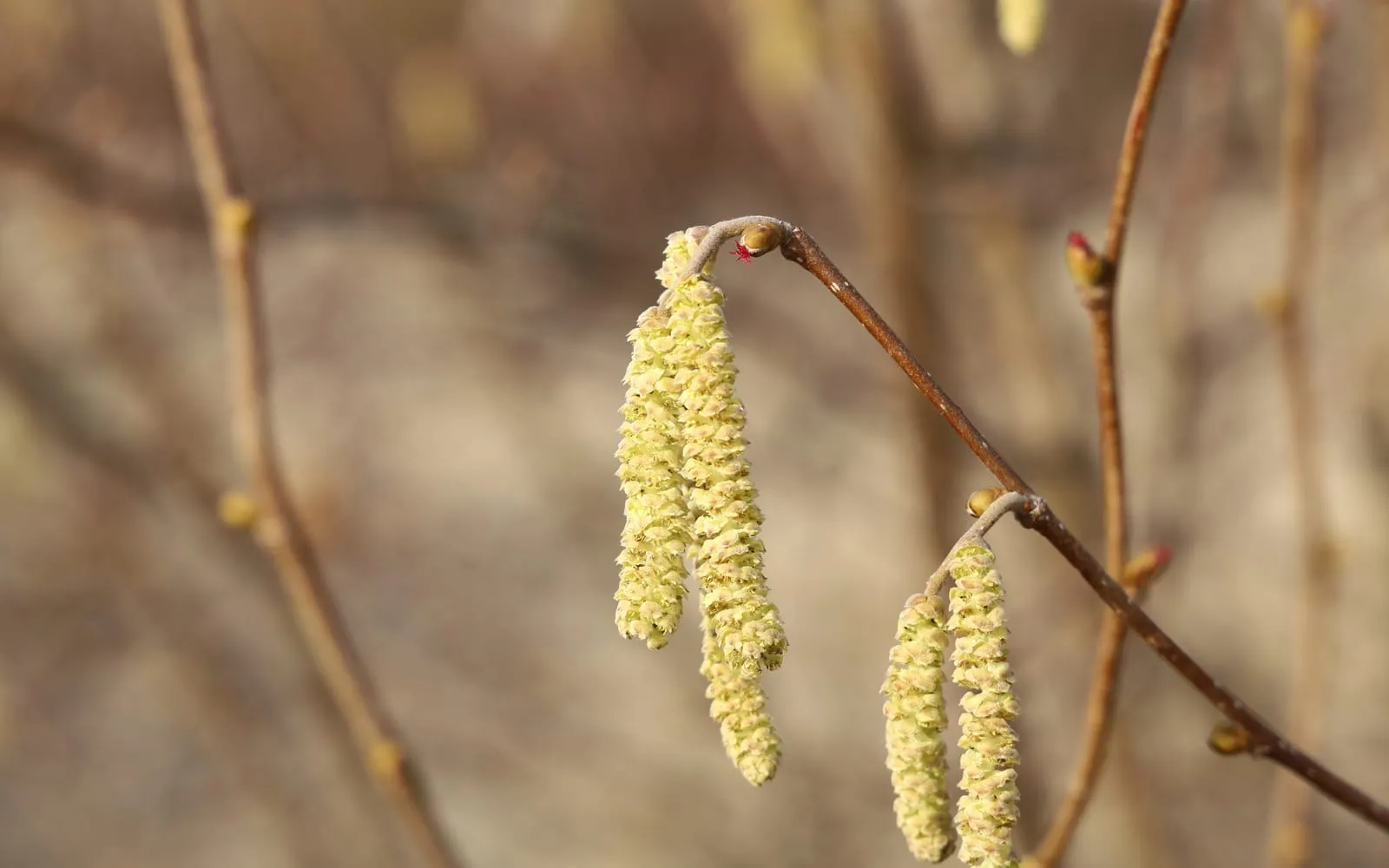
Late winter is when hazel does something almost nothing else does. The catkins lengthen and open into yellow lamb’s tails on bare twigs, and if you look closely at the same branch you will find the female flowers, which are the size of a grain of rice and are the most vivid crimson thing in the whole winter garden. Expect it in February across most of temperate Europe, earlier in a mild maritime winter and as late as April where the cold holds on.
Hazel is also the plant that built rural Europe. Coppiced on a seven to ten year cycle, it supplied the poles, hurdles, thatching spars, bean sticks and hedge binders that farms needed from Ireland to the Caucasus, and it responds to being cut to the ground by growing back faster and living indefinitely. Some coppice stools in ancient woodland are thought to be over a thousand years old.
For a garden it gives catkins in February, a crop of nuts in September if the squirrels leave any, and an endless supply of pea sticks.
Appearance and character
A deciduous multi-stemmed shrub or small tree, 4 to 8 m if left alone and kept far smaller by coppicing.
Stems are straight, smooth and grey-brown when young, and a coppiced stool throws up dozens of them from ground level.
Leaves are rounded, 6 to 12 cm across, with a heart-shaped base, a sharp point and a doubly toothed edge, soft and hairy to the touch.
Male catkins form in autumn as small hard green tails, hang on all winter and lengthen in January and February to 5 to 8 cm of pale yellow, releasing clouds of pollen in the wind.
Female flowers are the thing to look for. Tiny buds on the same twig that open into a tuft of brilliant crimson styles just a few millimetres long, easy to walk past and remarkable close up.
Nuts ripen in September, held in groups of one to four in a ragged leafy husk, and the shell is pale brown and hard.
Twisted hazel, ‘Contorta’, is the corkscrew form grown for winter stems, and purple filbert, Corylus maxima ‘Purpurea’, has dark leaves and purple husks.
Where it is from
Native across almost the whole of Europe, from Scandinavia south to Sicily and east through Turkey and the Caucasus into northern Iran. It grows in woodland, on woodland edges and in hedgerows on almost any soil, and it has been planted well beyond that range in North America, Chile, Australia and New Zealand.
It was one of the first trees to recolonise northern Europe after the last ice age, spreading ahead of oak and lime, and pollen records show it dominating the woodland of Britain and Ireland for centuries.
Its history with people is unusually deep. Coppicing has been practised since the Neolithic, and hazel rods from the Somerset Levels in south-west England have been dated to around 3800 BC, showing a managed coppice cycle already in use.
Coppicing works because hazel is adapted to regrow from the base after damage, and cutting resets the plant so completely that a managed stool outlives an unmanaged one many times over.
Commercial nut growing has moved a long way from that woodland origin. Turkey grows the majority of the world crop along the Black Sea coast, Italy grows the Piedmont crop that goes into confectionery, and the Willamette Valley in Oregon accounts for nearly all of the North American harvest. In Britain the crop is called a cobnut and the orchards are known as plats, and Kent is where the remaining commercial plats are.
Hazel coppice is one of the richest habitats in European woodland and is the classic home of the dormouse.
How it grows
Plant bare-root while the tree is dormant and the ground is not frozen, which runs from November to March across cool temperate Europe and shifts with your own leaf fall and bud break. Almost any soil suits it, and hazel is untroubled by clay or chalk.
Plant two different varieties if you want nuts. Hazel is monoecious, carrying both sexes on the same plant, and it is largely self-incompatible, so a lone plant sets very few nuts.
Space plants 4 to 5 m apart for nut growing, or 45 cm apart in a hedge.
Coppice on a seven to ten year cycle for poles, cutting all the stems to within 5 to 10 cm of the ground between November and March. Cut on a slight slope so water runs off.
Coppice in rotation rather than all at once. Taking a third of the stems every few years keeps a continuous supply and keeps the plant looking like something.
Prune a nut-growing plant differently. Aim for an open goblet on a short leg, and in August brut the strong side shoots by breaking them half through and leaving them hanging, which is the traditional method and encourages fruiting buds.
Remove suckers around the base of a plant grown as a tree.
Harvest nuts in September when the husks yellow. Picked slightly early they store better and the squirrels get fewer.
Expect nuts from year four or five, and a full crop from about year eight.
Through the seasons
Winter is catkins and cutting. The lamb’s tails open through January and February, and coppicing runs from November to March.
Spring brings the leaves in April, after the flowers. Late frosts can kill the tiny female flowers and cost the year’s crop.
Summer is growth. Brut the side shoots of a nut plant in August, and cut pea sticks and bean poles from earlier coppice growth.
Autumn is harvest. Nuts ripen through September, and this is when the squirrel problem becomes obvious.
Care difficulty
Easy. Hazel grows in any soil, in sun or shade, and it recovers from being cut to the ground.
Getting nuts is harder than growing the plant. A single specimen crops poorly, squirrels take what does set, and a late frost can remove the crop before it starts.
Coppicing is straightforward and the main decision is remembering to do it in rotation.
There is very little disease worth planning for.
Watering
Water new plantings through their first summer.
Established plants need no watering where summer rainfall is reliable and spread through the season. In a Mediterranean or continental summer they do need it, and a hazel grown for nuts in a dry-summer climate wants irrigation from flowering until the husks yellow.
A dry summer reduces the size of the nut crop, and watering a young nut plant while the kernels are filling, through August in the Northern Hemisphere, makes a visible difference to what you pick.
Mulch a new planting to suppress grass.
Hazel tolerates damp ground better than beech and dislikes standing water.
Warning signs, diseases and pests
Grey squirrels are the reason most people never eat a hazelnut from their own tree. They take the nuts while still green, weeks before they are ripe, and they will clear a mature tree in a few days. There is no practical defence for a garden tree. Picking early, as soon as the husks begin to yellow, and ripening the nuts indoors is the only approach that reliably gets you a crop.
Nut weevil lays in the developing nut, and the grub eats the kernel and bores out through a neat round hole. Collect and destroy fallen nuts with holes, and cultivate the ground beneath in winter.
No nuts at all on a healthy mature plant usually means there is only one hazel. Plant a second, different variety.
Hazel big bud mite swells the buds into round galls that fail to open. Pick off affected buds in winter on a small plant.
Late frost in March kills the tiny female flowers and removes the crop for that year, and nothing can be done about it.
Powdery mildew and leaf spot both occur without threatening the plant.
Honey fungus and Phytophthora both affect hazel, and neither is common.
Growing environment
Full sun gives the heaviest nut crop. Hazel grows well in partial shade and crops lightly there.
Almost any soil, including clay and chalk. It prefers moist, well-drained ground and dislikes waterlogging.
Space of 4 to 5 m each way for a nut plant, or 45 cm apart in a hedge.
Shelter improves the crop, since the female flowers are wind-pollinated in February and a sheltered site holds the pollen where it is needed.
A hedgerow, a woodland edge, a boundary or the back of a large border all suit it.
It is one of the best wildlife plants available. Catkins feed early insects, nuts feed dormice, squirrels and jays, and coppiced hazel creates the light and shade that woodland flowers need.
Avoid a small formal garden, where the size and the suckering make it a nuisance.
Feeding
Hazel needs no feeding on ordinary soil.
A potassium-rich feed such as sulphate of potash in early spring helps a plant grown for nuts.
Avoid nitrogen, which produces long soft growth and fewer nuts.
Mulch with compost in spring on poor ground.
A newly coppiced stool regrows vigorously without any feeding at all.
Troubleshooting
Where are the female flowers? Tiny crimson tufts a few millimetres across on the same twigs as the catkins, in February. They are easy to miss and worth looking for.
My tree produces catkins but no nuts. Hazel is largely self-incompatible. Plant a second, different variety nearby.
The squirrels take everything. They do, and weeks before the nuts are ripe. Pick as soon as the husks start to yellow and ripen the nuts indoors.
Small round holes in the nuts. Nut weevil. Collect and destroy affected nuts and cultivate the ground beneath in winter.
How do I coppice it? Cut all the stems to within 5 to 10 cm of the ground between November and March, on a slight slope so water runs off. Do a third of the plant at a time to keep a continuous supply.
Will it regrow if I cut it right down? Yes. Hazel is built for it, and a coppiced stool outlives an uncut one many times over.
Swollen round buds that never open. Hazel big bud mite. Pick them off in winter.
Can I grow it in shade? Yes, and it will crop lightly. Full sun gives far more nuts.