
Outdoor plant
Forsythia
Forsythia intermedia
Also known as Border forsythia, Golden bell
How to grow forsythia, Forsythia x intermedia. Pruning straight after flowering, renewing a leggy bush, stopping bullfinches stripping the buds, and taking free cuttings.
At a glance
- Difficulty
- Easy
- Water
- Rarely once established
- Light
- Full sun for the heaviest flowering, tolerating partial shade
- Temperature
- Very hardy, to -20 deg C
- Hardiness
- USDA 5-8, RHS H6, hardy to -25 C
- Type
- Deciduous shrub, long-lived and fast-growing
- Height
- 2-3 m
- Native to
- A garden hybrid of two species from China
- Best month
- March in the Northern Hemisphere, September in the Southern Hemisphere
The wood survives colder winters than the flower buds do. Buds are killed at roughly -20 C while the stems take -30, so in a hard continental winter you get a green shrub that flowers only on the stems that spent winter under snow. Where that happens, buy a bud-hardy cultivar such as Northern Sun or Meadowlark. It flowers on last summer wood, so pruning after flowering rather than in winter is what keeps it blooming.
Hardiness zones describe winter cold alone. Summer heat, humidity, rainfall and the length of the growing season decide as much, so treat the range as the outer limit rather than as a recommendation.
Every month named in this guide is for the temperate Northern Hemisphere. If you garden in the Southern Hemisphere, shift each one by six months, so March becomes September. Closer to the equator the wet and dry seasons matter more than the calendar, and the shift stops being a useful guide.
Not known to be toxic
Non-toxic. The ASPCA does not list forsythia among plants harmful to cats, dogs or horses, and the RHS does not include it in its list of potentially harmful garden plants. Neither the flowers, the leaves nor the stems present a poisoning risk. The fruits of a related species, Forsythia suspensa, have a long history in Chinese herbal medicine under the name lianqiao, and Forsythia x intermedia rarely sets fruit in cultivation in any case. It is a reasonable choice for a garden used by children and animals, and the flowers are among the first substantial sources of nectar for early bumblebees, although the modern doubles are less use to insects than the older single forms.
Sources: ASPCA toxic and non-toxic plants, RHS potentially harmful garden plants
About
Forsythia is how most people know spring has started. Bare stems covered in hard yellow flowers appear in March before a single leaf, and for two or three weeks it is the brightest thing in most suburban streets.
It is also one of the easiest shrubs to grow and one of the most commonly ruined. The flowers form on wood made the previous summer, so a bush trimmed tidily in autumn or winter has had next spring cut off it. Prune within a fortnight of the last flower and the problem never arises.
The other habit worth building is renewal. Left alone, forsythia turns into a thicket of old stems with flowers only along the top, and taking out a share of the oldest wood each year keeps it furnished to the ground.
Appearance and character
A vigorous deciduous shrub with upright stems that arch over as they lengthen, reaching 2 to 3 m each way.
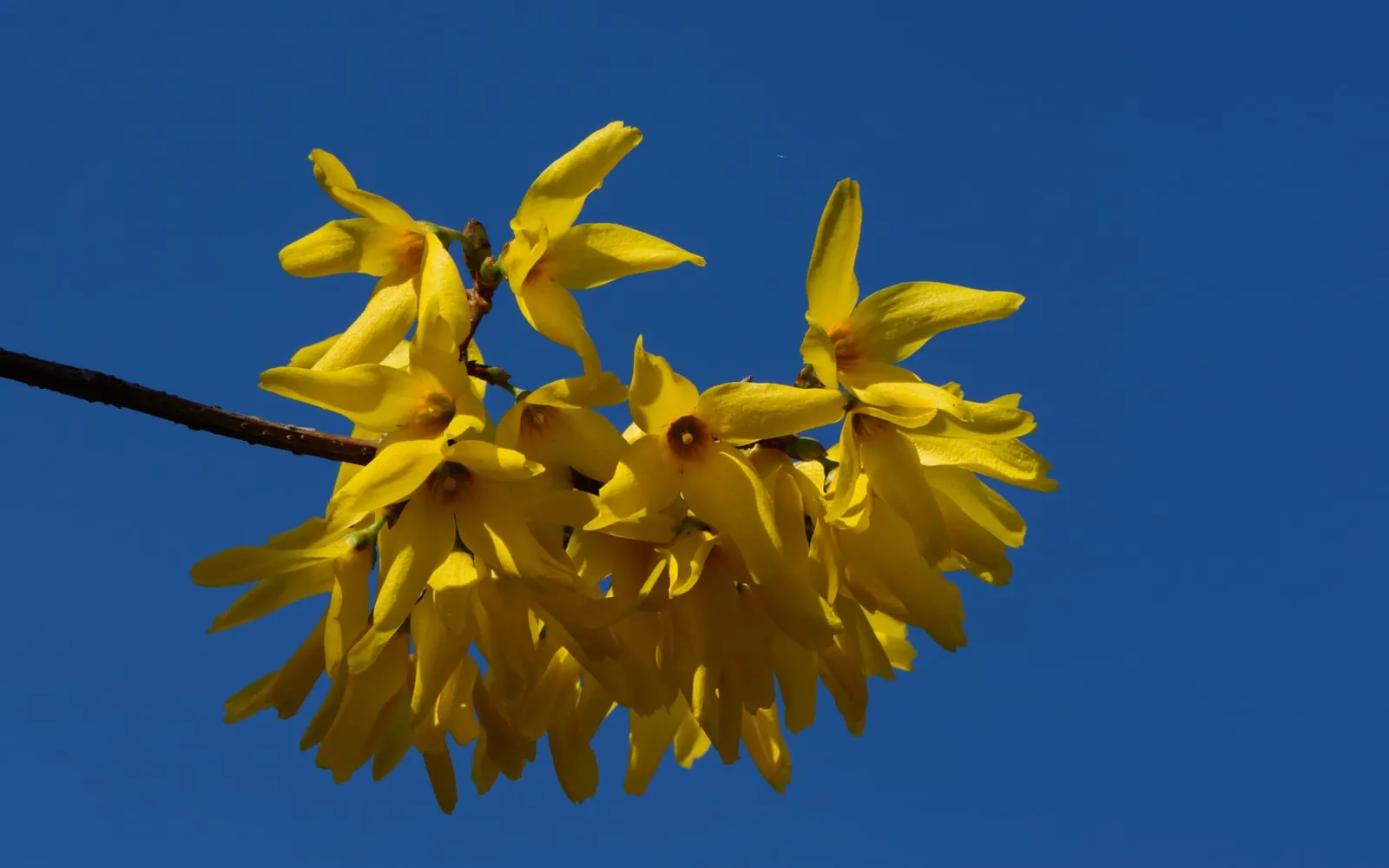
Flowers open in March and April, before the leaves, in dense clusters along the whole length of the previous year’s stems. Each is about 2 to 3 cm across with four narrow strap-shaped petals in a strong egg-yolk yellow.
Leaves follow the flowers, simple, oval and toothed, mid-green and unremarkable, turning a dull purplish or yellow in autumn without much of a display.
Stems are square-ish in section, olive-brown, hollow or chambered inside, and they root wherever a low branch touches the ground.
Bark on old stems is grey and flaking, and an unpruned bush becomes a mass of these bare limbs with all the flower held out of reach.
Named varieties differ mainly in intensity. ‘Lynwood Variety’ is the widely grown form with broad petals, ‘Week End’ is more upright, and ‘Mini Gold’ stays under 1.5 m for smaller gardens.
Where it is from
A garden hybrid rather than a wild plant. Forsythia x intermedia arose in cultivation in Germany around 1880 as a cross between Forsythia suspensa and Forsythia viridissima, both Chinese species.
Forsythia suspensa was brought from Chinese gardens by Carl Peter Thunberg in the eighteenth century, and Robert Fortune later collected Forsythia viridissima during his plant-hunting expeditions to China.
The genus honours William Forsyth, a Scottish gardener who became superintendent of the royal gardens at Kensington and was among the founders of what became the Royal Horticultural Society.
Its parents grow in scrub and on rocky slopes in a climate of cold winters and warm summers, which is why the plant is hardy to -20 deg C and flowers reliably after a temperate winter.
One species is native much further west. Forsythia europaea grows wild in Albania and Kosovo, and it is the only member of the genus found outside east Asia.
How it grows
Plant in autumn or spring into almost any soil that is not waterlogged. Forsythia is untroubled by clay, chalk or poor ground.
Choose full sun for the heaviest flowering. Partial shade gives a looser bush with fewer blooms.
Prune immediately after flowering, within two or three weeks of the last petal falling. Cut the stems that have just flowered back to a strong new shoot or bud lower down.
Take out one in four or one in five of the oldest stems at the same time, cutting them right to the base. That single habit is what stops the bush going bare at the bottom.
Never prune in autumn or winter. Every flower bud for spring is already on the plant by then.
Renovate a neglected bush by cutting the whole thing to 30 cm from the ground after flowering. It regrows strongly and flowers again in the second or third spring.
Take hardwood cuttings in late autumn, pushing 25 cm lengths of the current year’s wood two thirds of the way into a slit trench of gritty soil. They root over winter with no further attention.
Layer a low branch by pegging it to the soil, and it will have rooted within a year.
Through the seasons
Winter is when the buds are vulnerable. Bullfinches strip them from December onward in rural gardens, and netting is the only real defence.
Spring is the flowering and the pruning. Flowers open from early March, and pruning follows the moment they fade in April.
Summer is when next year’s flowers are made. Leave the new growth alone, water a young plant through a drought, and take no shears to it.
Autumn brings a modest leaf colour and the hardwood cuttings. Resist tidying the shrub.
Care difficulty
Easy, and among the most forgiving shrubs in cultivation. It will survive drought, frost, hard pruning, poor soil and neglect.
Pruning at the wrong time is the only mistake that causes real disappointment, and it costs a whole season of flower.
Legginess develops slowly on an unpruned bush and takes a couple of seasons of renewal pruning to reverse.
Bullfinch damage is a genuine problem in country gardens and is nothing to do with how the plant is grown.
There is very little disease to worry about beyond honey fungus, which affects many shrubs.
Watering
Established plants need no watering except in a prolonged drought.
Water new plantings through their first summer while the roots spread.
Container-grown forsythia needs regular summer watering and is less satisfactory than a plant in the ground, since the shrub is large and thirsty.
Mulch in spring with compost to hold moisture and suppress weeds.
Waterlogged ground is the one condition it dislikes.
Warning signs, diseases and pests
Bare stems with no flowers in spring, on a bush that looked healthy, usually means one of two things. Either it was pruned between summer and late winter, which removes the buds, or bullfinches have eaten them. Bullfinch damage leaves small scars and scattered bud casings under the bush, and it is heaviest in rural areas from December to March. Netting or fleece over a small plant works, and there is no practical answer for a large one.
Flowers only at the top of long bare stems means the bush has not been renewed. Cut a quarter of the oldest stems to the base each year after flowering.
Forsythia gall produces rough woody swellings on the stems. It is a bacterial problem, largely harmless, and cutting out the affected stems tidies it.
Honey fungus kills forsythia, showing as sudden dieback with white fungal sheets under the bark at the base and black bootlace strands in the soil.
Leaf spot marks the foliage in wet summers without threatening the plant.
Weak spindly growth on an old bush usually means it is congested and starved rather than diseased.
Growing environment
Full sun gives the best flowering. Forsythia grows perfectly well in partial shade and flowers noticeably less.
Any reasonable soil, including heavy clay and chalk. It has no pH preference worth worrying about.
Free drainage is the one requirement, since it dislikes standing wet.
Give it room. A mature bush is 2 to 3 m across and the arching stems need space to show.
It makes a good informal hedge or screen, and clipping it formally into a box removes most of the flower.
Shelter is unnecessary. Forsythia stands wind, cold and exposure without complaint.
For a small garden, choose a compact variety rather than trying to keep a full-size one small by clipping.
Feeding
Forsythia needs almost no feeding on reasonable soil.
Apply a general-purpose fertiliser in spring only where growth is visibly weak.
A mulch of garden compost in spring does more than fertiliser.
Avoid high-nitrogen feeds, which produce long soft stems and fewer flowers.
A renovated bush cut hard to the ground benefits from a feed and a mulch to help it regrow.
Troubleshooting
It did not flower this spring. Either it was pruned after midsummer, which removes the buds, or bullfinches ate them over winter. Prune only in the fortnight after flowering.
Something has eaten the buds off over winter. Bullfinches. They are a serious nuisance in rural gardens. Netting protects a small plant.
All the flowers are at the top and the base is bare. The bush needs renewal pruning. Take a quarter of the oldest stems to ground level each year after flowering.
When exactly do I prune it? Within two or three weeks of the last flower fading, usually late April.
Can I cut the whole thing down? Yes. Cut it to 30 cm after flowering and it regrows vigorously, flowering again in the second or third spring.
Rough woody lumps on the stems. Forsythia gall. Cut out the affected stems. The plant is not seriously harmed.
How do I get more plants? Hardwood cuttings in November root almost without fail, and a low branch pegged to the ground layers itself within a year.
Will it grow in shade? It survives and flowers thinly. Full sun is what produces the display people plant it for.