
Edible
Cherry
Prunus avium
Also known as Sweet cherry, Wild cherry, Gean
How to grow cherries, Prunus avium. Choosing a dwarfing rootstock, netting against birds, why the fruit splits in rain, and pruning only in summer to avoid silver leaf.
At a glance
- Difficulty
- Moderate
- Water
- Steadily through the fruit-swelling period
- Light
- Full sun, ideally against a south or west-facing wall
- Temperature
- Very hardy. The blossom is vulnerable to April frost
- Hardiness
- USDA 4-8, RHS H6, hardy to -30 C
- Type
- Deciduous tree, productive for several decades
- Height
- 3-4 m on Gisela 5, and 15-20 m on its own roots
- Native to
- Europe and western Asia, including native Britain
- Best month
- July in the Northern Hemisphere, January in the Southern Hemisphere
Sweet cherry asks 800 to 1200 chill hours and flowers early enough to meet frost. Rain at ripening is the harder limit, since water taken up through the skin splits the fruit within hours, which is why the commercial crop concentrates in dry-summer districts and why garden trees are worth covering.
Hardiness zones describe winter cold alone. Summer heat, humidity, rainfall and the length of the growing season decide as much, so treat the range as the outer limit rather than as a recommendation.
Every month named in this guide is for the temperate Northern Hemisphere. If you garden in the Southern Hemisphere, shift each one by six months, so July becomes January. Closer to the equator the wet and dry seasons matter more than the calendar, and the shift stops being a useful guide.
Toxic if eaten
- Safe to eat
- The flesh of the ripe fruit
- Do not eat
- The stones, leaves, bark and wilted foliage
- Harm from
- Eating it
- Affects
- People, cats, dogs and horses
The fruit is food and the rest of the tree is not. Cherry stones, leaves and bark contain cyanogenic glycosides, chiefly amygdalin and prunasin, which release hydrogen cyanide when the tissue is crushed or chewed. A swallowed stone passes through intact and is harmless, and a crushed or chewed one is not, which matters most for children and for dogs that crunch fallen fruit. The ASPCA lists cherry as toxic to cats, dogs and horses for this reason, and a dog that eats a quantity of stones can be seriously unwell, quite apart from the risk of intestinal obstruction. Wilted leaves are considerably more dangerous than fresh ones, because the wilting process releases the cyanide, and this is the classic cause of livestock death. A branch blown into a paddock, or prunings thrown over a fence, will kill a horse or a cow that eats them. Fresh leaves on the tree are far less of a risk because animals rarely eat enough. Never leave cherry prunings where stock can reach them. Sweep up fallen fruit where a dog patrols, and teach children to spit the stones out rather than crunch them. Ripe cherry flesh itself is entirely safe and is one of the best things a temperate garden produces.
Sources: ASPCA (Cherry, Prunus avium), RHS potentially harmful garden plants
About
Cherries were once impossible in a small garden because every tree grew to fifteen metres and the birds ate the fruit fifteen metres up. Two things changed that. Dwarfing rootstocks, particularly Gisela 5, keep a tree to three or four metres, and self-fertile varieties such as ‘Stella’ and ‘Sunburst’ removed the need for a pollination partner.
At that size a cherry can be netted, and netting is the whole difference between eating cherries and watching blackbirds eat them. An unnetted tree loses the entire crop, usually in the two or three days between the fruit ripening and your deciding it is ready.
Pruning carries a rule of its own. Never prune a cherry in winter. Every cut is made between late spring and late summer, when the wounds heal fast and the spores of silver leaf are not about.
Appearance and character
A deciduous tree, upright and vigorous on its own roots and kept to 3 to 4 m on a dwarfing rootstock.
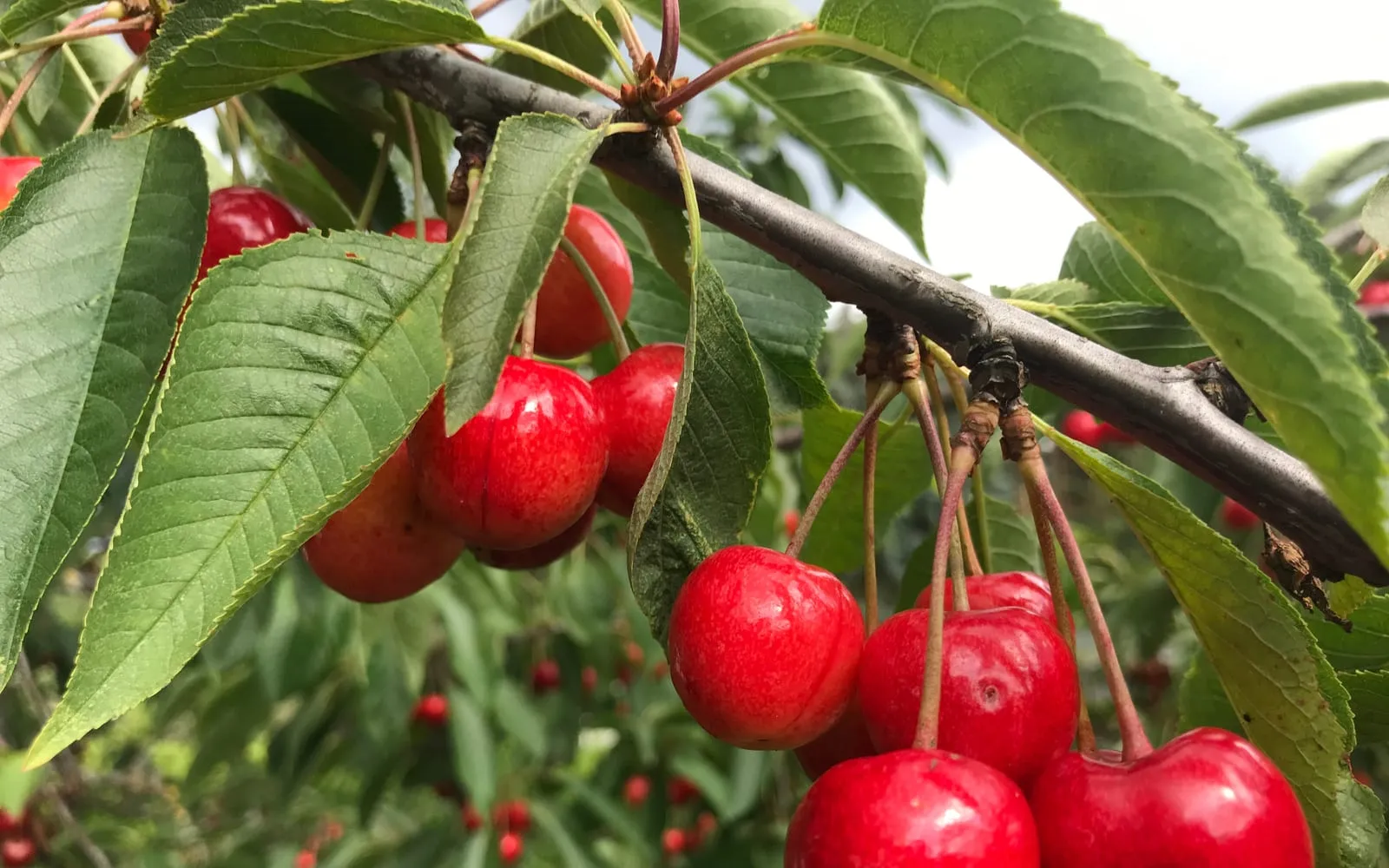
Bark is one of the best features of any temperate tree. Smooth, glossy and reddish purple-brown, banded with horizontal lines of raised lenticels, and peeling in papery strips on older trunks.
Leaves are oval and pointed, 6 to 15 cm long, with a toothed edge, and they carry a pair of small red nectar glands at the top of the leaf stalk. They turn orange and crimson in autumn.
Flowers open in April, before or with the leaves, in clusters of white cup-shaped blooms about 3 cm across on long stalks. A wild cherry in full flower is one of the sights of a European wood.
Fruit ripens from late June to August depending on variety, hanging on long stalks, from bright red through deep crimson to almost black. Yellow and blush varieties such as ‘Napoleon’ exist.
The stone is large and hard in proportion to the flesh.
Sour or acid cherries are a different species, Prunus cerasus, of which ‘Morello’ is the standard. Those tolerate shade and a north wall, fruit on last year’s wood and are pruned differently.
Where it is from
Europe and western Asia, including Britain, where wild cherry is native and grows in woodland and hedgerows, particularly on chalk and limestone.
Cultivation is ancient. Cherries were being grown around the Black Sea before the Romans, and Pliny credits Lucullus with bringing them to Rome from Pontus in 72 BC. The Romans brought them to Britain.
Kent became the centre of English cherry growing from the sixteenth century under Henry VIII, and the county still carries the orchards and the place names.
The species name avium, of the birds, is a piece of ancient observation that every modern gardener rediscovers. Birds have been the primary seed disperser and the primary problem for as long as anyone has grown them.
Its natural habitat on well-drained alkaline soil is what the tree wants in a garden, and heavy wet clay is the condition it likes least.
How it grows
Choose the rootstock before the variety, since it decides the size. Gisela 5 gives a tree of 3 to 4 m suitable for a garden or a fan, Colt gives 4 to 5 m, and a tree on its own roots or on seedling stock is a woodland tree.
Choose a self-fertile variety unless you have room for two. ‘Stella’, ‘Sunburst’, ‘Summer Sun’ and ‘Lapins’ all crop without a partner.
Plant between November and March into deep, fertile, well-drained soil. Cherries dislike waterlogging and shallow chalk equally.
Fan-train against a south or west-facing wall in a small garden, which makes netting straightforward and gives the warmth that ripens the fruit well.
Prune only between late spring and the end of August. Silver leaf and bacterial canker both infect through wounds made in autumn and winter, and both are serious. Cherries need very little pruning beyond removing dead, crossing and badly placed wood.
Net the tree before the fruit begins to colour. Use a proper cage or firmly supported netting rather than draped mesh, which traps birds.
Water evenly while the fruit swells. Sudden rain or watering after a dry spell makes the skins split.
Pick with the stalks attached, which keeps the fruit longer.
Expect a first crop in year three or four on a dwarfing rootstock.
Through the seasons
Winter is planting and dormancy. Plant bare-root trees, and do no pruning at all.
Spring brings the blossom in April. Protect a wall-trained tree from frost with fleece on cold nights, and feed as growth starts.
Summer is the crop and the pruning. Net before the fruit colours, water evenly, pick from late June, and prune once picking has finished.
Autumn brings the leaf colour. Clear fallen leaves and mummified fruit, and do no cutting.
Care difficulty
Moderate, and the difficulties are birds, water and disease rather than anything about growing the tree.
Birds are the defining problem. Without netting, most gardeners never taste their own cherries.
Splitting after rain is frustrating and largely outside your control, though even watering and a wall-trained position under an overhang both help.
The pruning rule is simple and unforgiving. Summer only.
Frost on the April blossom removes the crop in some years.
Beyond that a cherry on a dwarfing rootstock is a straightforward, handsome and long-lived tree.
Watering
Water steadily and evenly from flowering until the fruit is picked.
Even watering matters more than quantity. A tree that dries out and is then soaked, or that meets heavy rain after a dry spell, splits its fruit as the flesh swells faster than the skin.
Mulch in spring to hold moisture and even out the supply.
Container-grown trees on Gisela 5 need frequent summer watering and are the most prone to splitting.
Reduce watering once picking has finished.
Warning signs, diseases and pests
Birds take the crop, and they take it completely. Blackbirds and starlings strip a tree within a day or two of the fruit colouring. Net before that point, using a supported cage rather than loose draped netting.
Split fruit follows rain or uneven watering just as the crop ripens. Water evenly, mulch, and consider a wall-trained tree where the wall gives some rain shadow. A split cherry is still edible and will not keep.
Silver leaf gives the leaves a silvery sheen and kills branches, and a cut branch shows a dark stain in the wood. It infects through wounds in autumn and winter. Prune only in summer, cut affected branches back to clean wood 15 cm beyond the staining, and burn them.
Bacterial canker causes sunken oozing patches on the bark, shot holes in the leaves and dieback. It also enters through winter wounds. Prune in summer, cut out affected wood, and choose resistant varieties.
Cherry blackfly curls and blackens the shoot tips in spring, which is disfiguring and rarely serious on an established tree.
Brown rot turns fruit into shrivelled brown mummies that hang on the tree. Remove and destroy every one, since they carry the disease into next year.
Blossom killed by an April frost means no crop, and fleece over a trained tree on a cold clear night prevents it.
Japanese beetle skeletonises leaves between the veins in visible feeding groups and is well established across most of the United States. It reached northern Italy in 2014 and southern Switzerland since, and the rest of Europe treats a sighting as notifiable. Shake beetles into soapy water in the cool of the morning where it occurs.
Brown marmorated stink bug leaves dimpled, corky patches on the fruit and is already established across North America and a growing list of European countries. It does not occur in Australia or New Zealand, where a find is reportable.
Spotted wing drosophila lays eggs in fruit while it is still ripening on the tree rather than waiting for it to spoil, and cherry is one of the crops hit hardest by it. Fruit that looked sound one day can be a collapsing, maggot- filled mess the next. It has been established across North America and Europe since 2008 and remains a quarantine priority in Australia and New Zealand. Pick fruit promptly and cover trees with fine mesh where it occurs.
Plum curculio cuts a crescent-shaped scar into young green fruit and is confined to North America east of the Rocky Mountains. Jar branches over a sheet in the cool morning after petal fall to catch adults, which play dead and drop when disturbed.
Apple maggot fly also attacks cherry in North America, a fly whose original host is wild hawthorn and whose larvae tunnel through the flesh from a faint surface dimple. Hang sticky red sphere traps from mid-June.
Mediterranean fruit fly stings ripening fruit to lay eggs, leaving a pinprick mark that develops into a soft rotting patch with small maggots inside. It is established across the Mediterranean, the Middle East and much of Central and South America. Pick up and destroy fallen fruit, and net or bag fruit as it ripens where the pest is present.
Growing environment
Full sun, and as much warmth as possible. A south or west-facing wall is the ideal position for a fan-trained tree in a cool climate.
Deep, fertile, well-drained soil, neutral to slightly alkaline. Cherries do well on chalk with enough depth over it.
Avoid waterlogged ground and thin dry soil.
Shelter from wind, which damages the blossom and deters the pollinating insects.
Allow 3 to 4 m for a tree on Gisela 5, or 4 m of wall for a fan.
Plan the netting at planting. A tree you cannot net is a tree whose fruit you will not eat.
For a shaded or north-facing wall, grow an acid cherry such as ‘Morello’ instead. It tolerates the position, and the fruit is for cooking.
Feeding
Feed once in early spring with a balanced fertiliser, and apply sulphate of potash in late winter to support fruiting.
Mulch with well-rotted manure or compost in spring, keeping it clear of the trunk.
Avoid high-nitrogen feeds, which produce soft growth that blackfly and canker both favour.
Container-grown trees need feeding through the growing season and repotting or top-dressing each spring.
Do not feed after midsummer.
Troubleshooting
The birds took every cherry. They always will. Net the tree before the fruit starts to colour, using a supported cage rather than draped netting.
The fruit split just before picking. Rain or uneven watering as the crop ripened. Water steadily through the swelling period and mulch. A wall-trained tree under an overhang splits less.
When can I prune it? Between late spring and the end of August, and never in autumn or winter. Winter wounds let in silver leaf and bacterial canker.
Do I need two trees? Not if you choose a self-fertile variety such as ‘Stella’, ‘Sunburst’ or ‘Lapins’.
How big will it get? It depends entirely on the rootstock. Gisela 5 gives 3 to 4 m, Colt gives 4 to 5 m, and a tree on its own roots reaches 15 m or more.
The leaves have gone silvery. Silver leaf disease. Cut affected branches back to clean wood 15 cm beyond any staining in the wood, and burn them. Prune only in summer in future.
Shrivelled brown fruit hanging on the tree. Brown rot. Remove and destroy every mummified fruit, since they carry the infection into next year.
Are cherry stones dangerous? Swallowed whole, no. Crushed or chewed, they release cyanide. Wilted leaves and prunings are the serious risk and will kill livestock.
Cherry problem guides
- Fruit splitting after rain
- Silver leaf and bacterial canker
- Cherry blackfly, which curls the shoot tips
- Frost on the blossom in April
- Japanese beetle across the US, newly arrived in northern Italy and Switzerland
- Brown marmorated stink bug, established across North America and Europe
- Spotted wing drosophila, established across North America and Europe since 2008
- Plum curculio, a North America-only weevil that scars young fruit
- Apple maggot fly, a North America-only fly that also attacks cherry
- Mediterranean fruit fly, established across the Mediterranean, the Middle East and parts of the Americas