
Disease
Bracket fungi and wood decay
Ganoderma, Fomes, Laetiporus and others
Also called Bracket fungus, Shelf fungus, Conk, Wood decay fungi, Heart rot
A bracket on a tree is the fruiting body of a fungus growing inside the wood. Knocking it off does not remove the decay. Identify the fungus and the tree before deciding whether the tree is unsafe.
At a glance
- Type
- Disease
- Cause
- Fungus
- Severity
- Destroys the crop or display
- Affects
- Garden plants
- Active
- July to November
What you are seeing
- A hard or leathery shelf growing straight out of the trunk or a major limb
- Brackets clustered at the base of the trunk or over a root
- Brackets at an old pruning wound, a torn branch stub or a wound from a mower or a car
- A hollow sound when the trunk is tapped, or a cavity you can reach into
- Fine reddish-brown or white powder on the ground or the bark beneath a bracket
- Wood inside the cavity crumbling into cubes, or soft and stringy and pale
- Crown thinning, dieback and small leaves on a tree with brackets at the base
- The same brackets returning in the same place each autumn
Before you treat anything
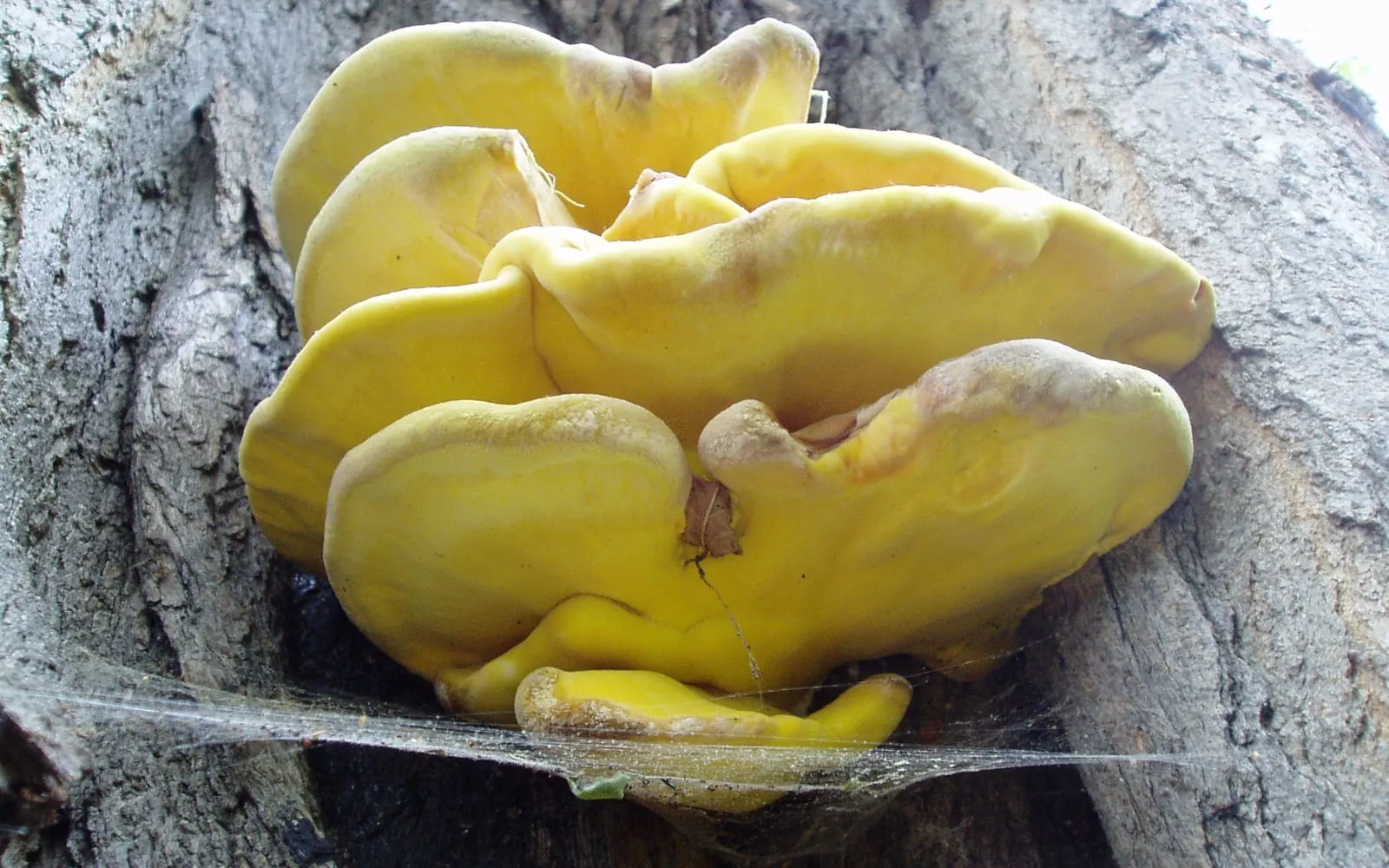
The risk on this page is a falling tree or limb rather than anything biological. Brackets at the base or over the roots deserve a qualified inspection where people or property are within reach, since decay in the butt and root plate can leave a tree that looks sound and is not. Do not eat a bracket on the strength of an internet photograph. Chicken of the woods is edible and causes reactions in some people, and it is inedible when it has grown on yew.
What you are looking at
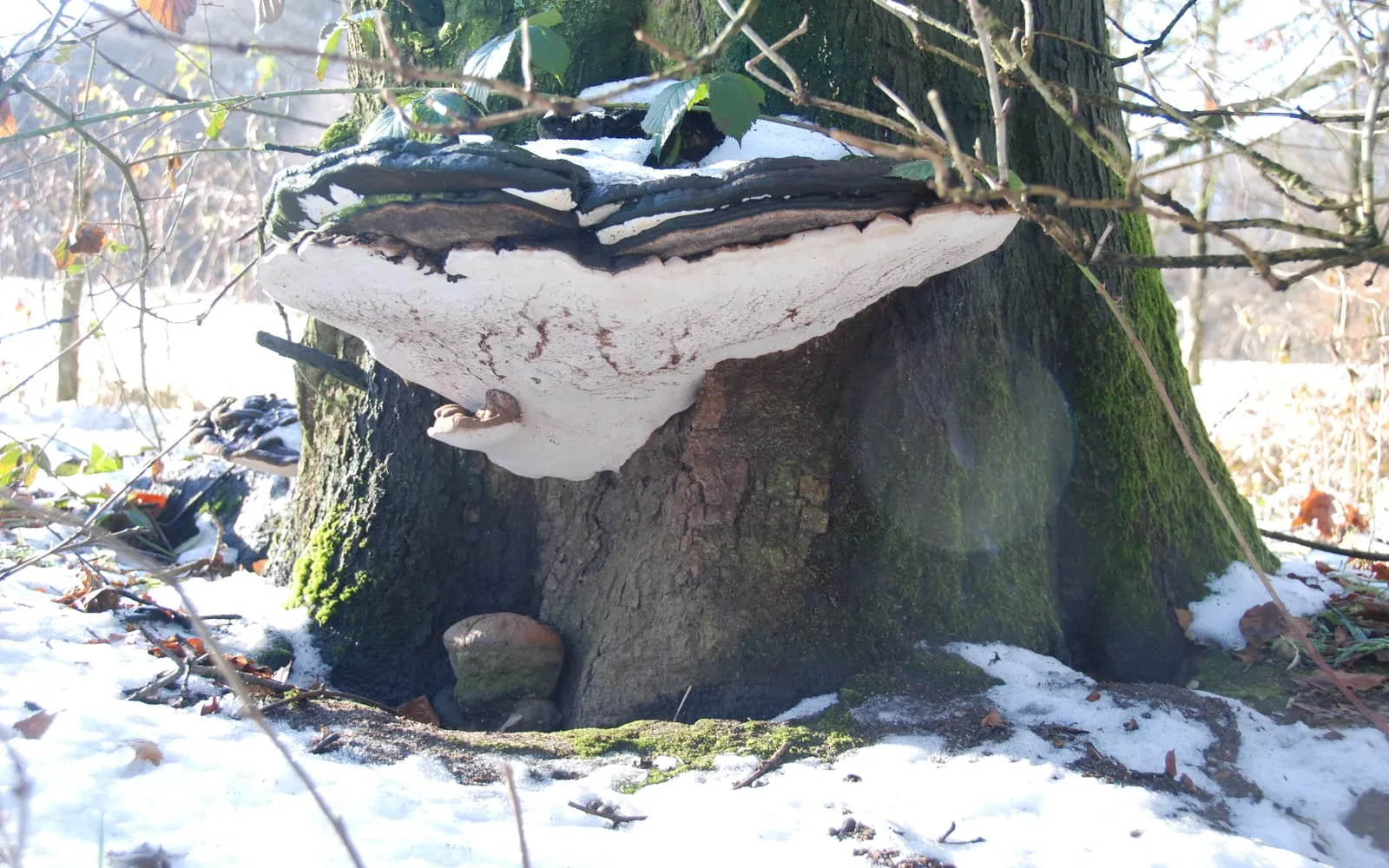
A shelf growing straight out of a tree. It may be hard and woody, banded in grey and brown and clearly several years old, or soft and bright and gone within a month. It may sit at the base of the trunk, halfway up, on a major limb or over a buried root.
Under it there is often a dusting of fine powder on the bark or the ground, reddish-brown in some species and white in others, which is the spore deposit.
Tap the trunk and the note may sound hollow. Where there is a cavity, the wood inside is either crumbling into small cubes or gone soft, pale and stringy.
Very often the bracket sits at an old wound. A pruning cut, a torn branch stub and a scrape from a mower or a vehicle are all doors it comes in by.
The bracket is the last thing to appear
A bracket is a fruiting body. The fungus itself has been growing through the wood as a network of threads for years, sometimes for decades, before it puts anything out where you can see it.
So a bracket appearing is not the start of a problem. It is a report on something already well advanced.
That is why knocking it off achieves nothing at all. The organism is inside the tree and the shelf is the equivalent of an apple on an apple tree. Removing it does not touch the decay, it does not slow it, and it throws away the one thing the bracket was good for, which is telling you which fungus you have.
Identify the fungus before deciding
Wood decay fungi vary enormously in what they mean for a tree. Some are compatible with a long-lived tree. Others create an urgent safety problem.
Some species decay only the dead heartwood at the centre of the trunk. A tree does not need its heartwood for strength in the way people assume, since a hollow tube is structurally efficient, and veteran oaks and yews have stood hollow for hundreds of years. Brackets on such a tree may mean it is old rather than that it is failing.
Other species attack living sapwood, or work in the roots and the butt, and those are the ones that lead to trees coming over in a gale while looking perfectly healthy above.
The type of rot matters too. A brown rot leaves the wood crumbling into cubes and it loses strength fast. A white rot leaves it pale, soft and fibrous and it generally loses strength more slowly.
Do not judge this from a photograph of the trunk alone. Photograph the bracket from above and below, note the tree species and exactly where on the tree it is growing, and have it identified. An arboriculturist or a local fungus group can usually name it. That name gives you a much better starting point for deciding whether the tree needs work.
When to call someone
Where a tree stands clear of anything it could damage, a slow decline into a hollow veteran is often the best outcome available and needs no intervention.
Where a tree is within falling distance of a house, a road, a footpath, a play area or a neighbour’s garden, and it carries brackets at the base or over the root plate, get a qualified arboriculturist with a tree risk qualification to look at it. The combination of basal brackets and a target is the one that justifies a professional visit.
Between those, monitoring is a reasonable answer. Photograph the tree and the brackets each autumn from the same spot, and watch the crown as much as the trunk.
Decay is not only a problem
Standing decaying wood supports a large share of the invertebrates in a garden, and the beetles that depend on it are among the most threatened groups in Europe. Hollows and cavities house bats, owls, woodpeckers and a long list of hole-nesting birds.
Felling a tree because it has brackets removes all of that for a risk that may not exist. Where the tree can be kept, reduction to lower the sail area, retention as a standing monolith, and leaving it under observation are all options an arboriculturist will raise.
What to do about it
Leave the bracket where it is.
Photograph it from above and below, note the host and the position on the tree, and get it identified.
Tap the trunk and listen for a hollow note as a prompt rather than a verdict.
Call a qualified arboriculturist where there are basal brackets and something within falling distance.
Stop the wounding, and keep mowers, strimmers and vehicles away from the butt.
Mulch the root area and keep compaction, trenching and raised soil off it.
Prune small and early rather than large and late, and leave the cut unpainted.
Photograph the tree from the same spot each autumn and watch the crown.
Keep the tree if you safely can, since the decay is habitat.
What it gets mistaken for
Honey fungus fruits as tufts of honey-coloured toadstools with soft gills, and leaves white sheets under the bark and black bootlaces in the soil.
Fairy ring toadstools stand in open turf in a circle rather than growing out of wood.
Coral spot dots dead twigs with pink-orange pinhead pustules.
Phytophthora kills the bark at the collar and leaves a sharp margin between brown and white tissue.
Wind rock loosens a tree in its socket with the wood sound throughout.
What to do, in order
Nothing available to a gardener will cure this once a plant has it. The steps below are about limiting the spread and deciding what to plant in its place.
Start here
Prevention, and the changes that stop the problem returning. Most of these pages should end at this tier.
- Identify the fungus before deciding what to do
- Some bracket fungi rot only dead heartwood and a tree can live with them for decades. Some attack living sapwood, roots or the base of the trunk and can make the tree unsafe. Photograph the bracket from above and below, note the host and where on the tree it is growing, and get it named by an arboriculturist or a local fungus group.
- Get a professional assessment where the tree could hit something
- Brackets at the base or over the root plate of a tree standing near a house, a road, a path or a play area are a question for a qualified arboriculturist with a tree risk qualification. It is a cheap visit and the only way to get a defensible answer.
- Stop wounding the tree
- Almost every infection begins at a wound. Mower and strimmer damage to the butt, torn branch stubs, bark scraped by vehicles, and large pruning cuts are the usual doors. Mulch a circle round the base so nothing mechanical goes near it, and prune small and early rather than large and late.
- Look after the roots
- Compaction, trenching, raised soil levels and paving over the root plate all weaken a tree's ability to wall decay off. A tree with good soil conditions contains decay for far longer than a stressed one.
- Consider retaining the tree rather than removing it
- Decaying wood in a standing tree supports a large share of the invertebrates, bats and hole-nesting birds in a garden or a wood, and many veteran trees have been hollow for centuries. Where nothing valuable is within falling distance, reduction, monitoring or leaving a standing monolith are all better outcomes than felling.
- Do not paint or seal the wound
- Wound paints were standard practice for decades and are now known to seal moisture and fungi in rather than out. A clean cut left open compartmentalises better than a sealed one.
Then reach for a barrier
Netting, hand removal and water. Nothing here harms anything except the target.
- Do not knock the bracket off
- By the time a bracket appears, the fungus has been decaying wood inside the tree for years. The bracket is the fruiting body and removing it does nothing to the organism, which is what makes this the most common wasted effort on the subject. It also destroys the evidence needed to identify the species.
- Tap the trunk and listen
- A hollow or drumming note where a solid one is expected suggests a cavity. This is a rough test rather than a survey, and it is a useful prompt to get someone qualified to look.
- Leave a decaying limb where it can be left safely
- A limb over open ground can be reduced rather than removed, and cut material can be stacked as a log pile. Where the same limb overhangs a path, take it off.
In pictures
Plants affected
Guides that name it among the problems to watch for. The list is the plants it is characteristic of rather than everything it will feed on.