
Disease
Blight
Phytophthora infestans
Also called Late blight, Potato blight, Tomato blight
Blight causes brown leaf blotches, stem streaks and rapid crop collapse in tomatoes and potatoes. Watch for Hutton Periods, keep foliage dry and cut potato haulms quickly once infection appears.
At a glance
- Type
- Disease
- Cause
- Oomycete (water mould)
- Severity
- Destroys the crop or display
- Affects
- Herbs and edibles
- Active
- June to September
- Established in
- Worldwide
What you are seeing
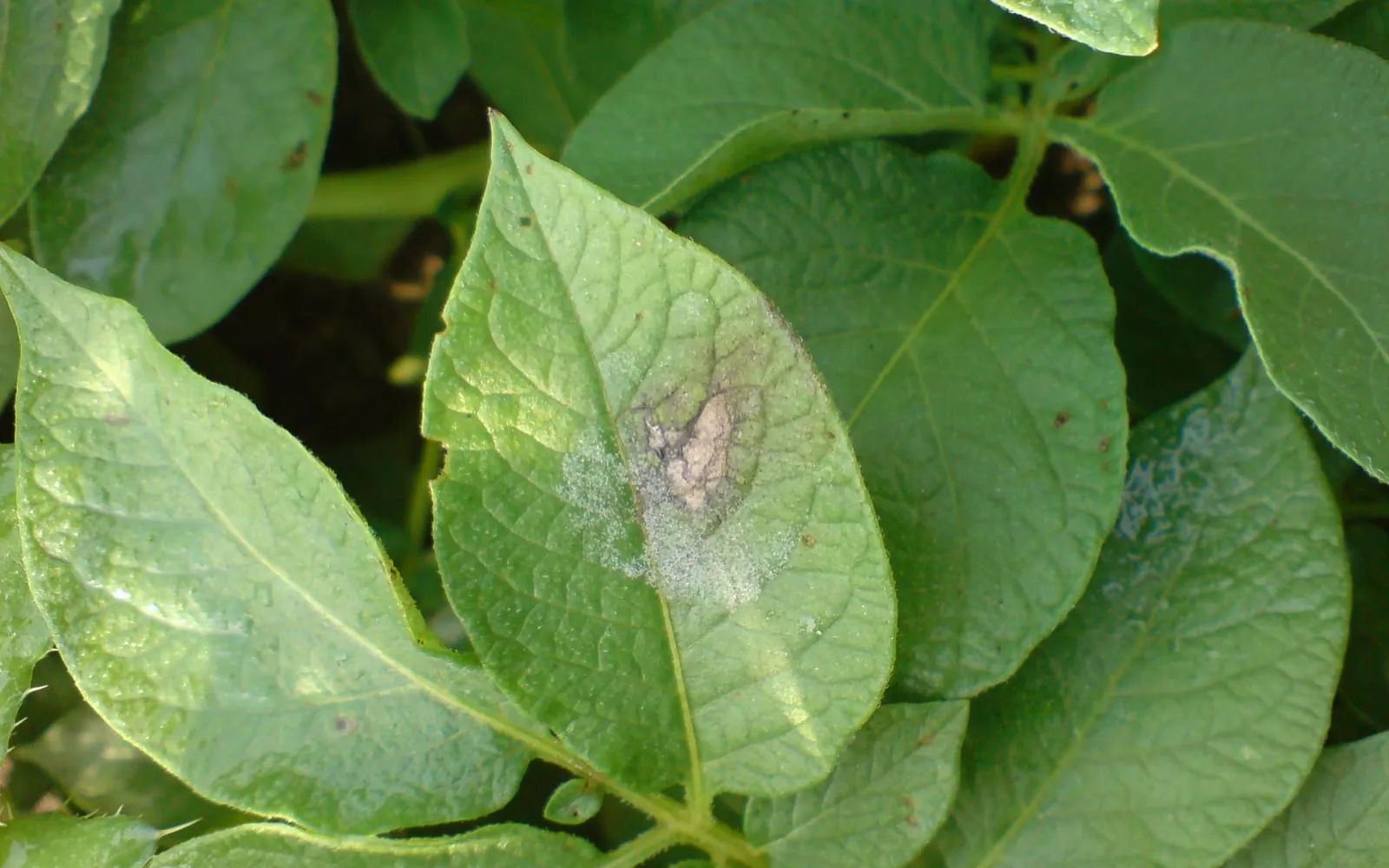
- Dark brown or blackish patches at the tips and edges of the leaves, often with a pale yellow-green border
- A fine white mould ring around the lesion on the underside of the leaf on a humid morning
- Brown or black streaks running along the stems
- The whole plant collapsing within a week or two once it starts
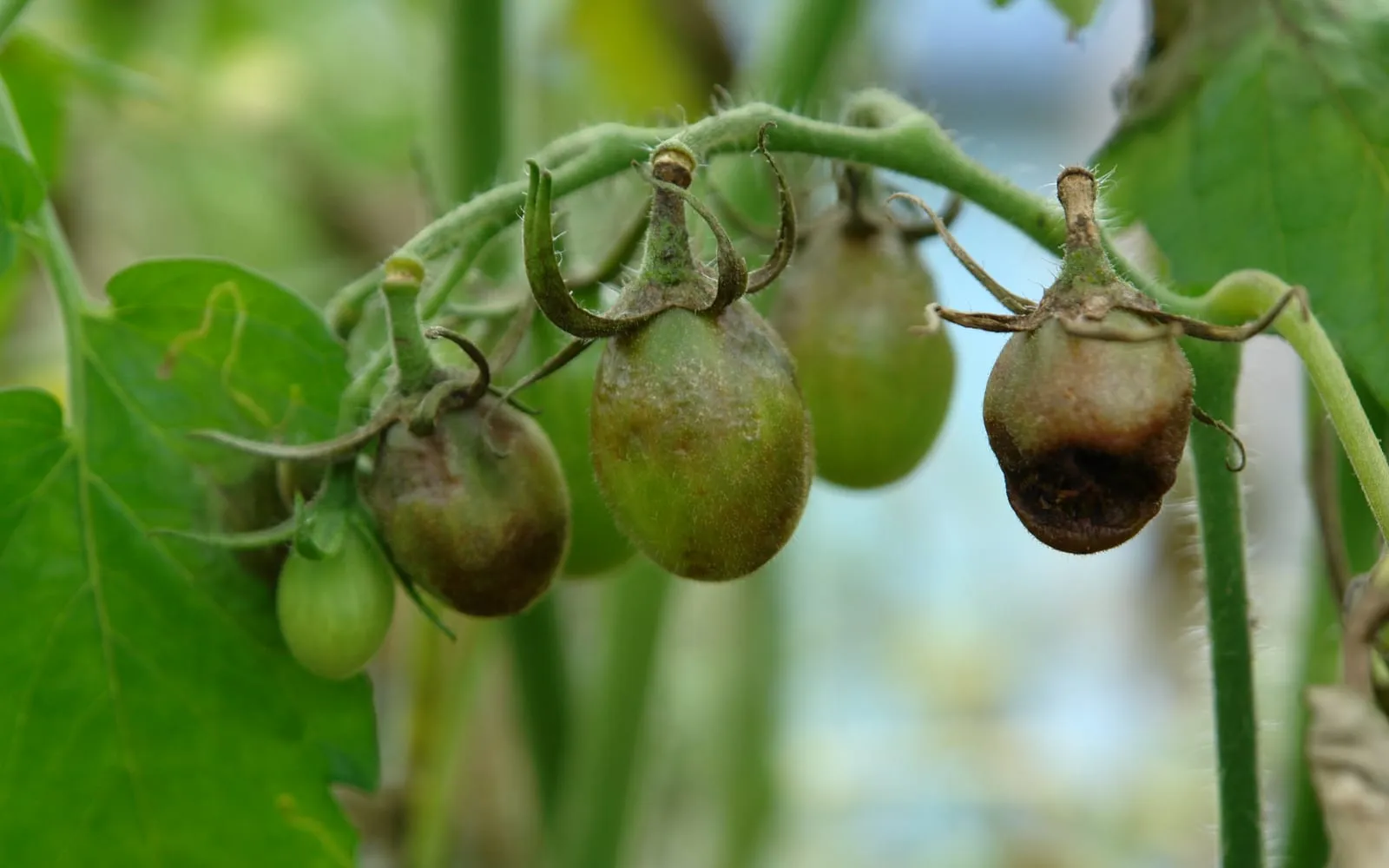
- Firm, dark brown, blotchy patches on tomato fruit, frequently beginning at the shoulder, going leathery rather than soft
- Potato tubers with a reddish-brown firm rot under the skin, spreading into the flesh in patches
- Stored tubers turning to a foul-smelling soft rot weeks after lifting
Before you treat anything
Blighted potato tubers should not be eaten. Beyond the rot itself, damaged tubers are readily invaded by bacterial soft rots, and a bag of stored potatoes with one blighted tuber in it will spoil around it. Sort carefully before storing and check the store every few weeks.
What you are looking at
Dark brown or blackish patches appear at the tips and edges of the leaves, usually with a pale yellow-green border where the killed tissue meets the living. They are not neat spots. They spread outwards, run down the leaf stalk, and turn up as brown streaks on the stems.
Go out early on a humid morning and turn a leaf over. Around the edge of each patch there is a fine white bloom, and that is the organism producing spores. By midday it has dried and gone, which is why so many people never see it.
Then it moves. A potato bed that showed a few marks on Saturday can be a collapsed brown mass by the following weekend, with a distinct smell of decay over it. Nothing else in a vegetable garden works at that speed.
On tomatoes the fruit is where it hurts. Firm, dark brown, blotchy areas develop, often starting at the shoulder near the stalk, and the flesh underneath goes leathery. A fruit picked before the mark shows will develop one in the fruit bowl.
It is not a fungus
Phytophthora infestans is an oomycete, a water mould. Its ancestors are closer to brown algae than to anything in the fungal kingdom, and the resemblance to a fungus is convergence rather than kinship.
That has two practical consequences. Products developed against true fungi are frequently poor against oomycetes, so a general garden fungicide is doubly useless here. And oomycetes produce swimming spores that need a film of liquid water to move in, which is why blight is a disease of wet warm weather rather than merely humid weather, and why keeping the leaves dry is the whole prevention strategy.
The genus is the same one behind Phytophthora root rot on rhododendrons and sudden oak death. This species is the one that emptied Ireland in the 1840s.
The two days that decide it
Blight infection is predictable enough to be forecast. In Great Britain the current standard is the Hutton Criteria, which replaced the older Smith Period in 2017 and better matches the strains now in circulation.
A Hutton Period is two consecutive days with a minimum temperature of at least 10 degrees C and at least six hours each day at 90 per cent relative humidity or above. Free forecast services publish them by postcode.
Knowing this changes what you do with your July. A warning means going out to look at the crop rather than assuming the weather has been fine. Two warm muggy nights after a wet day is the pattern, and it is why blight arrives in the same week across a whole county.
Airborne spores travel miles. An allotment site where one plot has blight will have it everywhere within a fortnight, so a neighbour’s crop matters as much as your own care.
Why the page says there is no cure
Once the organism is inside the plant, nothing available to a gardener will get it out. Amateur fungicide approvals in Great Britain no longer include an effective blight product, and the protectant most people remember was mancozeb, which had its approval withdrawn in 2021 and cannot be used.
Much of the advice that still ranks for this search recommends a spray programme that is no longer legal to follow.
What remains is prevention and salvage, and both work well.
What to do about it
Choose the plant. A Sarpo potato or a Crimson Crush tomato in an ordinary cool summer will still be standing when everything around it has gone, and that decision is made once, in a catalogue, in January.
Grow tomatoes under cover and water them at the base. A greenhouse tomato is close to safe from this.
Lift early potatoes before blight season. First and second earlies are usually ready by the end of July, and a crop that is out of the ground cannot get blight.
Then, when it does arrive, act on the day rather than the week. Cut every potato stem off at soil level and take the foliage away. The tubers stop growing, and you lose the last few weeks of bulking, but the spores never wash down to them. Leave the bed undisturbed for two or three weeks so the spores on the soil surface die, then lift on a dry day and sort carefully. Anything with a firm brown patch under the skin goes in the bin rather than the store.
For tomatoes, pick everything that has begun to colour and ripen it indoors, discarding any fruit already marked.
Bag the infected material. A home compost heap will not kill this.
What it gets mistaken for
Early blight, Alternaria solani, produces smaller brown spots with concentric rings in them, like a target, on older lower leaves. It moves slowly and does not flatten a crop in a week.
Grey mould enters through wounds and dead flowers and grows a fuzzy grey coat that puffs spores. Blight lesions are firm and dry with no fuzzy growth except the fine white ring at the margin.
Blossom end rot marks a tomato only at the base, opposite the stalk, in a flat leathery sharply bounded patch, and it leaves the foliage untouched. Blight marks the shoulder and the leaves at the same time.
Magnesium deficiency yellows potato foliage between the veins from the bottom of the plant upwards, with no brown dead patches and no smell. It looks alarming in August and matters very little.
What to do, in order
Nothing available to a gardener will cure this once a plant has it. The steps below are about limiting the spread and deciding what to plant in its place.
Start here
Prevention, and the changes that stop the problem returning. Most of these pages should end at this tier.
- Grow a blight-resistant cultivar
- The single most effective thing available. Among potatoes the Sarpo varieties, including Sarpo Mira and Sarpo Axona, stand up to blight that flattens everything around them. Among tomatoes, Crimson Crush, Mountain Magic and their relatives crop outdoors in a cool wet summer where a traditional variety will not.
- Grow tomatoes under cover
- Infection needs liquid water on the leaf, so a tomato in a greenhouse or under a rain shelter, watered at the base, is very hard for blight to reach. Outdoor tomatoes in a wet August are the ones that go.
- Choose earlies and lift them before blight arrives
- First and second early potatoes are usually ready to lift by the end of July, which is often before the first serious blight period. That is a way of sidestepping the disease entirely rather than fighting it, and it works better in most British gardens than maincrops do.
- Earth up generously
- Spores wash off the foliage and down through the soil to the tubers. A good ridge of soil over the developing crop is a physical distance the spores have to travel through, and it saves a proportion of a crop whose haulm has been lost.
- Keep tomatoes and potatoes apart
- Both are hosts and both are infected by the same organism. A row of outdoor tomatoes next to a potato bed doubles the chance of both going, and a greenhouse door opening onto a potato patch is a route in.
- Never leave a heap of discarded tubers
- Overwintered tubers in a discard pile, and volunteers coming up in last year's bed, are how the organism survives from one season to the next in a garden. Clear both. Buy certified seed potatoes rather than saving your own.
- Watch the blight warnings
- Infection follows a specific weather pattern, and it is forecast. A Hutton Period is two consecutive days with a minimum temperature of at least 10 degrees C and at least six hours each day at 90 per cent humidity or above. Free services publish these by postcode, and a warning is the moment to inspect the crop rather than the moment to panic.
Then reach for a barrier
Netting, hand removal and water. Nothing here harms anything except the target.
- Cut the potato haulm off at the first sign
- Take every stem off at ground level and remove it from the plot. The tubers stop growing, and that is the price, but the spores on the foliage never reach them. This is the difference between losing the foliage and losing the crop.
- Wait two or three weeks before lifting
- Spores washed onto the soil surface stay viable for a while, and lifting immediately drags the tubers up through them. Leave the ground alone for a fortnight or more after cutting the haulm, then lift on a dry day.
- Pick and ripen tomatoes indoors
- Once blight appears on an outdoor tomato, take everything that has begun to colour and ripen it in the house. Discard any fruit with a mark on it, since the rot carries on developing off the plant.
- Bag the infected material, do not compost it
- A garden compost heap does not reach a temperature that reliably destroys this. Infected haulm and fruit go into the household waste or to a municipal green waste facility that composts hot.
In pictures
Plants affected
Guides that name it among the problems to watch for. The list is the plants it is characteristic of rather than everything it will feed on.
Common on UK allotments
This is one of the pests and diseases allotment growers meet most often. See it alongside the other common problems on the allotment guide.
Common allotment pests and diseasesA common tomato problem
This is one of the problems tomato growers meet most often. See it alongside the other pests, diseases and disorders on the tomato guide.
Common tomato problems