
Outdoor plant
Chinese peony
Paeonia lactiflora
Also known as Common garden peony, White peony
How to grow peony, Paeonia lactiflora. Why planting it too deep stops it flowering, how to support the heavy heads, and the ants that are not a problem.
At a glance
- Difficulty
- Moderate
- Water
- In dry spells during the growing season
- Light
- Full sun, and it tolerates light shade at the cost of flowering
- Temperature
- Extremely hardy, and it needs winter cold to flower well
- Hardiness
- USDA 3-8, RHS H7, hardy to -35 C
- Type
- Herbaceous perennial, very long lived and dying back each winter
- Height
- 60-100 cm
- Native to
- Northern China, eastern Siberia, Mongolia and Tibet
- Best month
- June in the Northern Hemisphere, December in the Southern Hemisphere
Winter cold is a requirement. A peony needs several hundred hours below about 7 C to break dormancy and flower, so it performs badly in zone 9 and fails in warm-winter climates. Planting depth is the other half. The buds must sit no more than 3 to 5 cm below the surface, and a peony planted too deep makes leaves for decades and never flowers.
Hardiness zones describe winter cold alone. Summer heat, humidity, rainfall and the length of the growing season decide as much, so treat the range as the outer limit rather than as a recommendation.
Every month named in this guide is for the temperate Northern Hemisphere. If you garden in the Southern Hemisphere, shift each one by six months, so June becomes December. Closer to the equator the wet and dry seasons matter more than the calendar, and the shift stops being a useful guide.
Harmful if eaten
- Do not eat
- All parts, and the roots most of all
- Harm from
- Eating it
- Affects
- People, cats, dogs and horses
Peony contains paeonol and related compounds, concentrated in the roots, and the ASPCA lists Paeonia as toxic to cats, dogs and horses. Eating any part causes vomiting and diarrhoea, and a dog digging up and chewing a root is the likeliest route to a real problem. The RHS lists peony as harmful if eaten. Human poisoning is rare and the usual outcome of eating flowers or foliage is stomach upset, so a child who has chewed a petal needs watching rather than an ambulance. Peony root has a long history in Chinese medicine, where the prepared root of this species is bai shao, and that is a processed extract rather than a garden plant, with its own interactions that do not transfer to a border. Two other points come up. The ants that swarm over peony buds in May are feeding on nectar and do the plant no harm at all, so do not spray them. The sap causes mild skin irritation in some people, so wear gloves when dividing.
Sources: RHS potentially harmful garden plants, ASPCA toxic and non-toxic plants
About
A peony that never flowers has almost always been planted too deep.
The growth buds sit on the crown at the top of a fleshy root, and they need to be within 2 to 5 cm of the surface. Bury the crown at 10 cm, which looks like sensible planting depth for anything else, and the plant makes healthy foliage every year and never sets a bud. Gardeners then feed it, move it, and feed it again, and the answer was three centimetres of soil.
Get that right and a peony is one of the longest-lived plants in a temperate garden. Clumps of a century are common, they need no division, and they get better rather than worse with age.
The flowering season is short. Two weeks, three in a cool year, somewhere in late May and June. The flowers are enormous, often scented, and they flatten in the first heavy rain unless they are supported, which is the second thing to get right.
Herbaceous peonies die to the ground each winter. Tree peonies are woody and keep their framework, and intersectional or Itoh peonies cross the two. This guide covers the herbaceous kind, which is what most garden peonies are.
Appearance and character
A herbaceous perennial reaching 60 to 100 cm, forming an upright clump that dies back to a fleshy root each winter.
Shoots emerge in March in a strong crimson-red, which is one of the better things about the plant, and green up as they extend.
Leaves are large, deeply divided into oval leaflets, glossy mid to dark green, and they stay presentable all summer, so the clump earns its space after flowering.
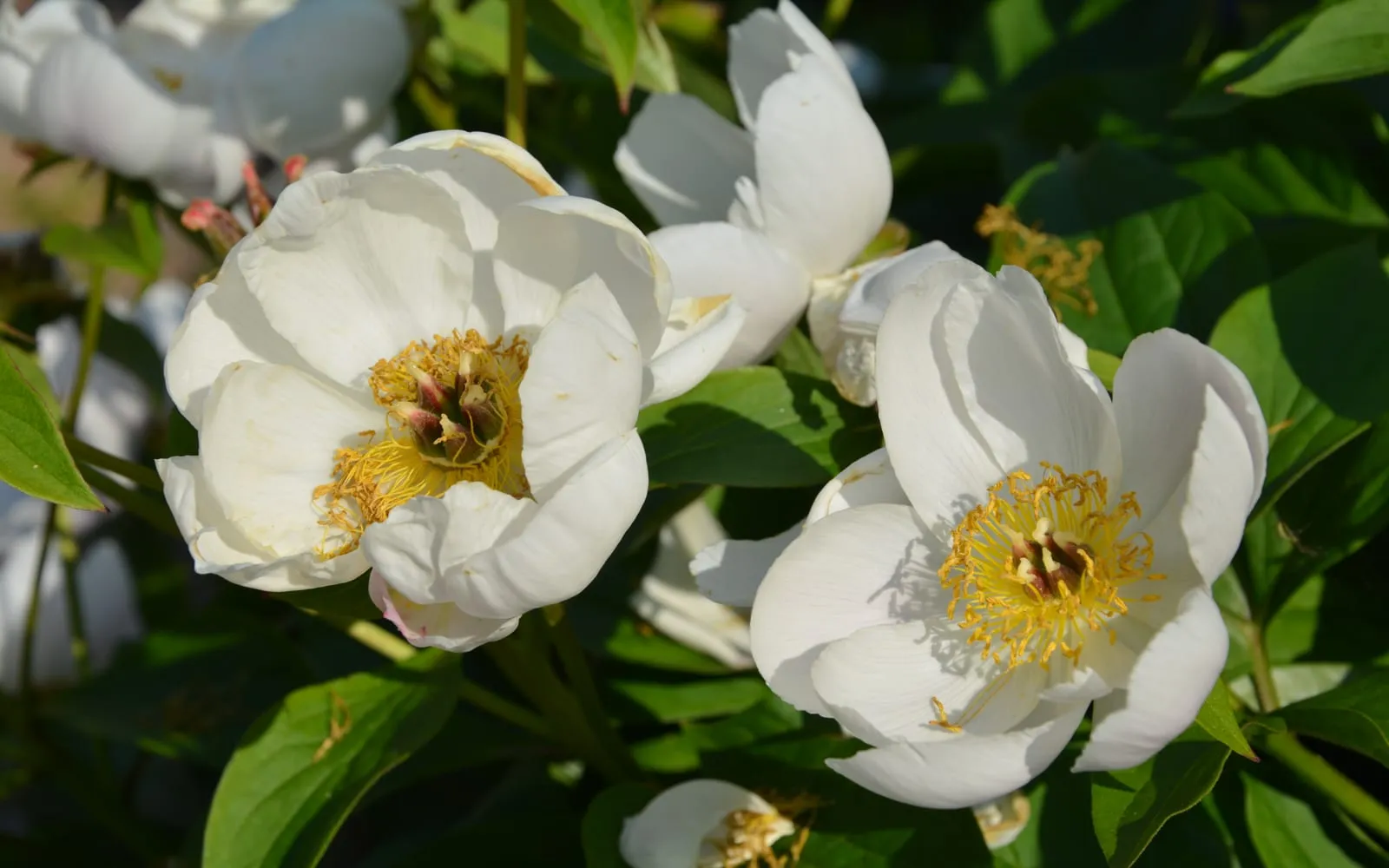
Flowers open in late May and June, 10 to 20 cm across, in white, cream, pink, coral and deep red. Forms run from single with a boss of gold stamens, through semi-double and anemone-form, to the heavy fully double types.
Scent varies by cultivar and is strongest in the white and pale pink doubles. ‘Sarah Bernhardt’ and ‘Duchesse de Nemours’ are both strongly scented.
Buds are round and hard for weeks before opening, and ants patrol them for nectar.
Seed pods split in autumn to show black fertile seeds among sterile red ones, which is a good display in its own right on single-flowered cultivars.
Autumn foliage colour is often a decent bronze-red before it collapses.
Where it is from
Northern China, eastern Siberia, Mongolia and Tibet, growing in open grassland and scrub on well-drained slopes.
That origin explains the requirements. Full sun, free drainage, deep fertile soil and a proper cold winter, since peony needs a period of chilling to break dormancy and flower.
It has been cultivated in China for around two thousand years, first as a medicinal plant and then as an ornamental, and the Chinese peony tradition produced hundreds of named cultivars long before it reached Europe.
The plant arrived in Britain in the eighteenth century and the great flowering of European breeding came in nineteenth-century France, which is where the cultivars still sold today largely come from. ‘Duchesse de Nemours’ dates from 1856 and ‘Sarah Bernhardt’ from 1906.
The name comes from Paeon, physician to the gods in Greek mythology, reflecting the plant’s medicinal reputation.
The native British species Paeonia mascula grows wild only on Steep Holm in the Bristol Channel and is a naturalised medieval survival rather than a true native.
How it grows
Plant bare-root in autumn, which is the best time, or container-grown in spring.
Set the crown 2 to 5 cm below the surface and no deeper. The pink or white growth buds on the crown should be just under the soil. This single detail decides whether it flowers.
Plant in full sun in deep, fertile, free-draining soil, working in compost or well-rotted manure below the root rather than around the crown.
Avoid shade, avoid waterlogged ground and avoid planting under trees where the root competition and shade both work against it.
Support the stems before they need it. Put a peony ring or a circle of canes and string in place in April while the shoots are short, and let the foliage grow through it. Trying to prop a collapsed clump after a June downpour never works.
Water in dry spells through spring and early summer while the buds are forming.
Deadhead after flowering, cutting the stem back to a strong leaf, which keeps the clump tidy and stops it putting energy into seed.
Cut the foliage to the ground in late autumn once it has died back, and clear it away rather than composting it, because peony wilt overwinters on the debris.
Leave it alone. Peonies resent disturbance and a clump moved or divided sulks for two or three years before flowering again.
Divide only to propagate, in September or October, cutting the root into pieces with three to five buds each and replanting at the same shallow depth.
Expect a newly planted peony to take two or three years to flower properly.
Through the seasons
Winter is dormant and the crown needs no protection. This is when the chilling happens that the plant depends on.
Spring pushes crimson shoots in March, and supports go in during April before the foliage extends.
Summer flowers in late May and June for two or three weeks, then the foliage carries the clump through to autumn.
Autumn is planting and dividing season, and the foliage is cut down and cleared once it dies back.
Care difficulty
Moderate, and the difficulty is concentrated at planting.
Once a peony is in the right place at the right depth it is close to permanent, needing support in spring, a feed, a deadhead and an autumn cut-down.
The failures are planting too deep, planting in shade, moving an established clump, and peony wilt in a wet spring.
None of those is a matter of daily care. Getting the position and the depth right buys decades.
Watering
Water in dry spells from March through to the end of flowering, which is when the plant is building and opening its buds.
Established clumps in deep soil manage on rainfall in a temperate climate.
Water thoroughly and infrequently rather than sprinkling, so the water reaches the deep fleshy roots.
Never let it stand in water. Waterlogging rots the crown.
Mulch in spring with compost, keeping it clear of the crown so the buds are not buried.
Warning signs, diseases and pests
No flowers on a healthy plant is the classic peony problem. Check the depth first by scraping the soil away from the crown, and if the buds are more than 5 cm down, lift the plant in autumn and replant it shallower. The other causes are too much shade, a clump moved or divided in the last two or three years, too much nitrogen, and a plant that is too young.
Buds that form to pea size and then dry up and go brown without opening is bud blast. It follows a dry spring, a late frost, or drought at the roots.
Whole stems wilting and collapsing at ground level in a wet spring, with a brown rot at the base and grey fuzz on it, is peony wilt caused by Botrytis paeoniae. Cut affected stems out below soil level, clear all debris in autumn, improve air movement and avoid overhead watering.
Flowers flattened after rain is the weight of the heads rather than a fault. Support them in April.
Ants swarming over the buds are feeding on nectar and doing no harm. Leave them.
Purple-brown blotches on the leaves in late summer is leaf blotch, which is cosmetic. Clear the foliage in autumn.
Honey fungus attacks peony and is fatal.
Growing environment
Full sun for the best flowering. It tolerates a few hours of shade and flowers less.
Deep, fertile, moist but free-draining soil. It grows on clay if the drainage is adequate and on chalk without complaint.
Extremely hardy, and it needs winter cold, so it does poorly in a very mild sheltered microclimate.
Allow 60 to 90 cm of space per clump.
It suits a herbaceous border, a cottage garden, a cutting garden or a mixed border with shrubs, and it makes an excellent cut flower picked in bud.
Do not plant it under trees or against a hedge, where root competition and shade both reduce flowering.
Grow it with plants that carry the border after its short season. Hardy geranium, nepeta, alchemilla and later-flowering perennials fill the gap while the peony foliage stays presentable.
Its wildlife value is best in the single-flowered cultivars, where bees can reach the stamens. Fully double flowers offer almost nothing.
Feeding
Feed in early spring as the shoots emerge, with a balanced general fertiliser or one higher in potash than nitrogen.
Feed again after flowering to build the crown for next year.
Mulch in spring with compost or well-rotted manure, keeping it away from the crown so the buds are not buried, which is a common way of accidentally planting a peony too deep.
Avoid high-nitrogen feeds and fresh manure over the crown. Both produce leaf at the expense of flower.
Troubleshooting
My peony never flowers. Planted too deep, nine times out of ten. The buds on the crown should sit 2 to 5 cm below the surface. Scrape the soil back to check, and lift and replant shallower in autumn if it is buried.
What else stops it flowering? Too much shade, being moved or divided in the last two or three years, too much nitrogen, or a plant that is still too young. A new peony takes two or three years.
The buds went brown and never opened. Bud blast, usually caused by drought, a late frost or a dry spring. Water in dry spells while the buds are forming.
Whole stems collapsed and rotted at the base. Peony wilt, a botrytis disease that follows a wet spring. Cut affected stems below soil level, clear all foliage in autumn and do not compost it.
Should I kill the ants on the buds? No. They are feeding on nectar and do the plant no harm. The old idea that peonies need ants to open is a myth in the other direction.
The flowers fall over in the rain. The heads are heavy. Put a peony ring in place in April before the foliage grows, rather than trying to prop them afterwards.
Can I move it? You can, in autumn, and it will sulk for two or three years before flowering again. Peonies resent disturbance and are best left alone.
When do I cut it back? Late autumn, once the foliage has died down. Clear the debris away rather than composting it, because peony wilt overwinters on it.
Are peonies poisonous to dogs? The ASPCA lists Paeonia as toxic to cats, dogs and horses. The roots are the most concentrated part, so a dog digging one up is the real risk.