
Edible
Blackberry
Rubus fruticosus
Also known as Bramble, Brambleberry
How to grow blackberries, Rubus fruticosus. Choosing a thornless variety, training the canes so you never cut the wrong ones, and why the fruit turns sour after Michaelmas.
At a glance
- Difficulty
- Easy
- Water
- Weekly in dry weather while the fruit swells
- Light
- Full sun for the sweetest fruit, tolerating partial shade
- Temperature
- Very hardy, and among the toughest fruit you can grow
- Hardiness
- USDA 5-9, RHS H6, hardy to -25 C
- Type
- Perennial root system with biennial canes
- Height
- 2-4 m of cane, trained flat on wires
- Native to
- Europe, and native throughout Britain
- Best month
- September in the Northern Hemisphere, March in the Southern Hemisphere
Wild types are close to indestructible, while the thornless cultivars grown in gardens are a good deal softer and take damage below about -15 deg C. Chill is low at 200 to 500 hours, so blackberries crop in mild winters where currants and cherries will not. It is a declared weed across Australia and New Zealand, where the European species has taken over hillsides and clearing it is a legal obligation on some land.
Hardiness zones describe winter cold alone. Summer heat, humidity, rainfall and the length of the growing season decide as much, so treat the range as the outer limit rather than as a recommendation.
Every month named in this guide is for the temperate Northern Hemisphere. If you garden in the Southern Hemisphere, shift each one by six months, so September becomes March. Closer to the equator the wet and dry seasons matter more than the calendar, and the shift stops being a useful guide.
Not known to be toxic
- Safe to eat
- The fruit, and the young leaves as a herbal tea
Non-toxic. The ASPCA does not list Rubus among plants harmful to cats, dogs or horses, and the fruit is one of the safest wild foods there is. Dogs eat windfall blackberries without harm beyond an upset stomach from quantity. The leaves have a long history as a herbal tea and are not poisonous. One ordinary caution applies, as it does to raspberry and to the rose family generally. Wilted Rubus leaves can develop small amounts of cyanogenic compounds as they break down, so cut prunings should not be left where livestock graze, although the quantities are far below those in cherry laurel. The real hazards of blackberrying are mechanical and bacterial rather than toxic. The thorns are hooked and vicious, they break off under the skin and they cause infected scratches readily, so wear thick gloves and long sleeves. Where fruit is picked from a roadside, wash it, and pick above the height a dog can reach. The old country advice not to pick after Michaelmas Day at the end of September is sound for a practical reason, since by October the fruit is watery and often colonised by moulds.
Sources: ASPCA toxic and non-toxic plants, RHS potentially harmful garden plants
About
Everyone has picked blackberries and almost nobody grows them, which is a shame, because a cultivated thornless variety gives fruit two or three times the size of anything in the hedge, over a season that runs from July to October, from a plant that needs less than any other soft fruit.
The old objection was the thorns, and modern varieties have solved it. ‘Loch Ness’, ‘Oregon Thornless’ and ‘Loch Tay’ are all completely spine-free, which turns picking and pruning from a bloody business into a pleasant one.
The one thing to get right is training. Blackberry fruits on canes made the previous year, and the plant produces this year’s canes and next year’s canes at the same time. Keep them physically separate on the wires and you will never cut the wrong ones.
Appearance and character
A vigorous perennial with a permanent root system throwing up biennial canes, which grow one year, fruit the next and then die.
Canes are long, arching and angular in section, 2 to 4 m or more, green or purple when young and brown and woody in their second year.
Wild brambles are armed with hooked thorns that face backwards, which is what makes them so effective at catching clothing and skin. Cultivated thornless varieties have none.
Tip-rooting is the family habit. Where the end of an arching cane touches soil it roots and forms a new plant, which is how a bramble patch advances across ground.
Leaves are divided into three or five toothed leaflets, mid to dark green above and paler beneath, and many wild forms keep them through winter.
Flowers open from May to August, 2 to 3 cm across, white to pale pink with five petals and a boss of stamens, and they are among the best nectar sources of the summer.
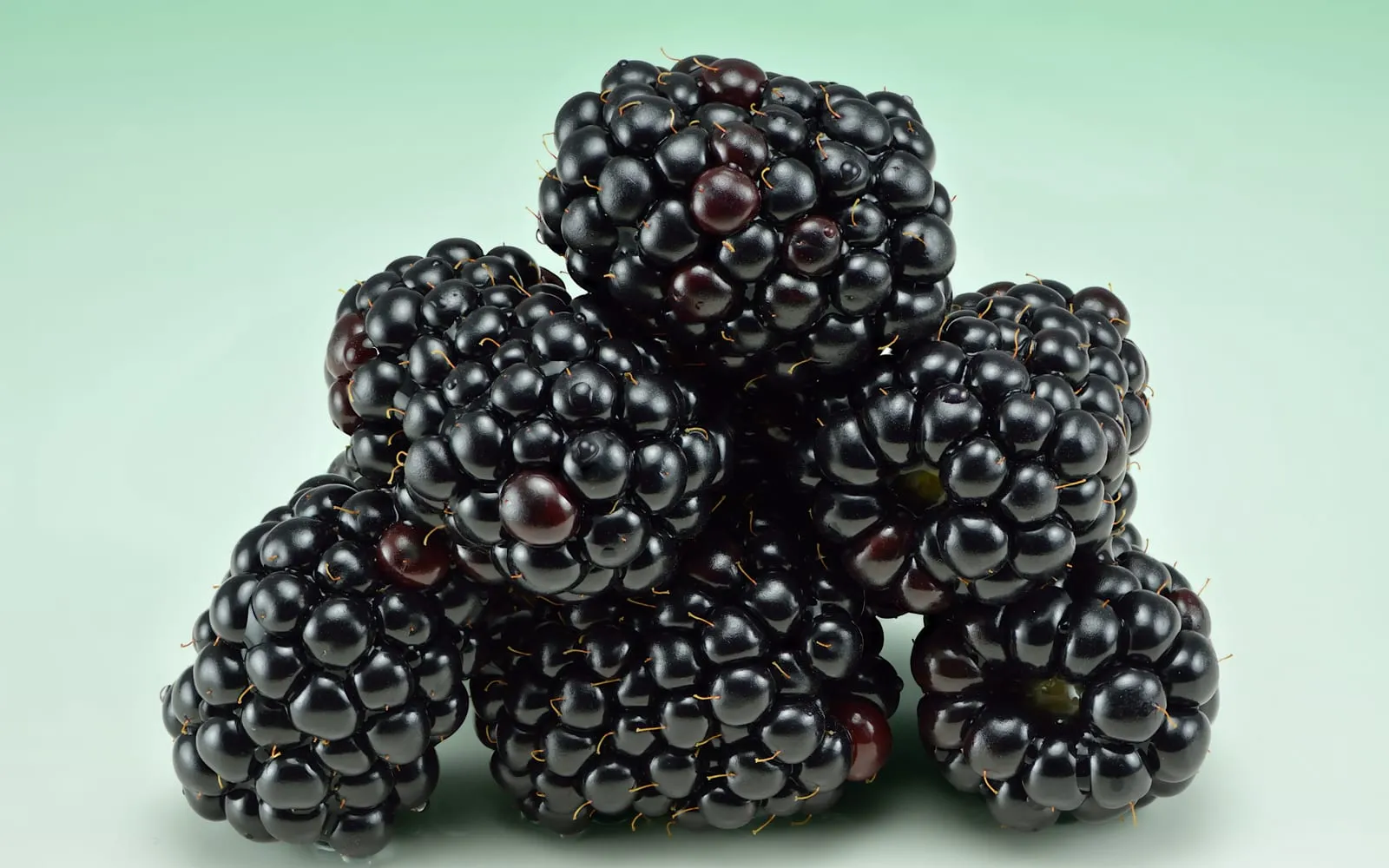
Fruit ripens from July to October, an aggregate of glossy black drupelets that comes away with the white core still inside. That retained core is the botanical difference from a raspberry, which pulls free and leaves a hollow.
The wild blackberry is not one species. Rubus fruticosus is an aggregate of over three hundred microspecies in Britain, most reproducing without fertilisation, and they differ in flavour, season and leaf.
Where it is from
Europe, and native throughout Britain, where brambles grow in hedgerows, woodland edges, scrub and on any patch of neglected ground.
Blackberry is a coloniser. It moves into cleared or disturbed ground quickly, holds it with thorny cover, and is often the first stage in the return of woodland.
Its ecological value is considerable. The flowers feed bees and hoverflies through midsummer, the fruit feeds birds and mammals in autumn, and a bramble thicket is prime nesting and hibernation cover.
Cultivated varieties came mostly from North America in the nineteenth and twentieth centuries, where the native blackberries are larger-fruited, and the thornless forms are twentieth-century breeding.
Britain’s regional names run to dozens, and the folklore is consistent on one point. The Devil is said to spit or worse on the brambles at Michaelmas, and nobody should pick after 29 September. The fruit does deteriorate then.
How it grows
Plant bare-root canes between November and March, or container-grown at any time, 2.5 to 4 m apart depending on the vigour of the variety.
Cut every newly planted cane back to about 25 cm after planting.
Build a support before planting. Posts with four horizontal wires at 90, 120, 150 and 180 cm is the standard.
Train the canes so that fruiting and new growth are separated. The simplest system is to tie the fruiting canes along the wires to one side and train the new canes up the middle and along the other side, swapping over each year. A fan or a rope system does the same job.
Prune immediately after fruiting. Cut every cane that has just carried fruit right down to the ground, and tie in the new ones in its place.
That is the whole pruning regime. Because the fruited canes are on one side and the new canes on the other, there is no risk of cutting the wrong wood.
Remove the tips of arching canes before they reach the ground, unless you want new plants.
Pick from July to October as the fruit ripens. A ripe blackberry is dull rather than shiny and comes away with almost no pull.
Propagate by tip layering. Bend a cane over, bury the tip 10 cm deep in summer, and sever it from the parent the following spring.
Through the seasons
Winter is planting and mulching. Plant bare-root canes, apply sulphate of potash in late winter, and mulch the row with manure.
Spring brings the new canes from the base. Tie them in as they grow, keeping them separate from the fruiting canes.
Summer is flowering and the start of the crop. Water while the fruit swells, and pick from July on early varieties.
Autumn is the main harvest and the pruning. Cut out the fruited canes as soon as picking finishes and tie in the new ones.
Care difficulty
Easy, and blackberries are more forgiving than any other soft fruit. They tolerate shade, poor soil, cold, wind and neglect.
The training system is the only technique worth learning, and it exists to make the pruning foolproof.
Vigour is the real management issue. A cultivated blackberry is a large plant and needs its allotted space and its annual cut.
Tip-rooting turns a plant into a thicket if the arching canes are left to reach the ground.
Pests and diseases are minor compared with raspberries.
Watering
Water weekly in dry weather from flowering until picking finishes, since that is when fruit size is decided.
Mulch generously with well-rotted manure or compost each spring, which conserves moisture and feeds the row.
Established plants tolerate drought better than raspberries and produce smaller fruit for it.
Avoid overhead watering in humid weather, which encourages grey mould on ripening fruit.
Do not hoe deeply around the base, since the roots run near the surface.
Warning signs, diseases and pests
Spreading into ground you wanted for something else is the commonest complaint. Arching canes root wherever the tip touches soil, and a suckering root system sends up canes at a distance. Cut back the cane tips before they reach the ground, and dig out strays while they are small.
Raspberry beetle affects blackberries as well, leaving a small white grub at the stalk end and a dried brown patch on the fruit. Later-fruiting varieties largely escape it because the beetle has finished flying. Pick thoroughly and remove infested fruit.
Purple blotch produces dark purple patches around the buds and nodes on the canes, which then die back. Cut out affected canes and improve airflow.
Cane spot causes small purple spots that become greyish pits on the canes.
Grey mould rots the fruit in a wet season. Pick regularly, remove affected berries, and avoid overhead watering.
Fruit that ripens unevenly, with some drupelets staying red and hard, usually means poor pollination in cold weather or, occasionally, dry roots.
Very few new canes each spring means an old exhausted plant or a starved row.
Japanese beetle skeletonises leaves and eats into the ripening fruit, feeding in visible groups. It is well established across most of the United States, reached northern Italy in 2014 and southern Switzerland since, and the rest of Europe treats a sighting as notifiable.
Spotted wing drosophila lays eggs in fruit while it is still ripening, and berries that looked sound can collapse into a soft, maggot-filled mess within a day. It has been established across North America and Europe since 2008 and remains a quarantine priority in Australia and New Zealand. Pick promptly and cover the crop with fine mesh where it occurs.
Growing environment
Full sun gives the sweetest and heaviest crop. Blackberries fruit acceptably in partial shade, which makes them useful on a north-facing fence where little else will crop.
Almost any soil, and they do best on moisture-retentive loam with organic matter. They tolerate clay and mild alkalinity better than raspberries do.
A post and wire support, put in before planting.
Give each plant 2.5 to 4 m of wire. Vigorous varieties such as ‘Himalayan Giant’ need considerably more than compact ones like ‘Loch Ness’.
A boundary fence, a wall or a wire run along the edge of a plot suits them, and they make an effective intruder-proof barrier if a thorny variety is chosen deliberately.
Choose a thornless variety unless you want the barrier. Picking and pruning are transformed by it.
Shelter helps but is not needed, since blackberries stand wind well.
Feeding
Mulch generously with well-rotted manure or garden compost each spring.
Apply sulphate of potash in late winter to support fruiting.
A general-purpose fertiliser in March suits a plant on poor soil.
Avoid heavy nitrogen, which produces long soft canes and less fruit.
Blackberries are less fussy about soil pH than raspberries and rarely show the iron deficiency that yellows raspberry leaves on chalk.
Troubleshooting
Which canes do I cut? The ones that have just fruited, right down to the ground, as soon as picking finishes. Train the new canes on the opposite side of the wires and the question answers itself.
It is taking over the garden. Arching canes root where the tips touch soil. Cut the tips back before they reach the ground and dig out strays while small.
Small white grubs at the stalk end of the fruit. Raspberry beetle. Later varieties largely escape it. Pick thoroughly and destroy infested fruit.
Some drupelets stay red and hard. Usually poor pollination during cold weather while the flowers were open, and sometimes dry roots.
Should I grow a thornless variety? For a garden, yes. ‘Loch Ness’, ‘Loch Tay’ and ‘Oregon Thornless’ crop well and make picking and pruning far easier.
Why should I not pick after the end of September? The folklore blames the Devil, and the real reason is that autumn fruit becomes watery and picks up moulds and fly damage.
Do I need a support? Yes. The canes are long and arching and will sprawl across the ground otherwise, rooting as they go.
How do I get more plants? Tip layering. Bury the end of an arching cane 10 cm deep in summer and cut it from the parent next spring.
Blackberry problem guides
Not sure what is wrong? See the common vegetable pests guide.