
Edible
Stinging nettle
Urtica dioica
Also known as Common nettle, Nettle
How to grow nettles on purpose, Urtica dioica. Picking the tops for the kitchen, siting a patch butterflies will use, making liquid feed, and why the sting works.
At a glance
- Difficulty
- Easy
- Water
- Rarely, and never in an established patch
- Light
- Full sun for a butterfly patch, and it tolerates partial shade
- Temperature
- Very hardy, and it dies back to the ground each winter
- Hardiness
- USDA 3-10, RHS H7, hardy to -30 C
- Type
- Herbaceous perennial spreading by yellow rhizomes
- Height
- 1-2 m
- Native to
- Europe, Asia and North Africa, including native Britain
- Best month
- March in the Northern Hemisphere, September in the Southern Hemisphere
It marks ground rich in phosphate and nitrogen, so a stand tells you about the soil rather than the climate, and it grows across most of the temperate world without complaint. Plants are male or female. It spreads by yellow rhizome as much as by seed and is treated as an invasive weed in parts of North America and Australasia.
Hardiness zones describe winter cold alone. Summer heat, humidity, rainfall and the length of the growing season decide as much, so treat the range as the outer limit rather than as a recommendation.
Every month named in this guide is for the temperate Northern Hemisphere. If you garden in the Southern Hemisphere, shift each one by six months, so March becomes September. Closer to the equator the wet and dry seasons matter more than the calendar, and the shift stops being a useful guide.
Skin irritant
- Safe to eat
- The young tops, cooked or dried, picked before the plant flowers
- Do not eat
- The stinging hairs on the leaves and stems
- Harm from
- Handling it
- Affects
- People, cats, dogs and horses
Nettles sting rather than poison. Each leaf and stem carries hollow hairs tipped with silica, and the tip snaps off on contact to leave a needle that injects a mixture including histamine, acetylcholine, serotonin, formic acid and a peptide called moroidin. The result is immediate burning, raised white weals and an itch that lasts a few hours. It is unpleasant and it is not dangerous, and severe allergic reactions are rare. Rubbing a dock leaf on the spot is folklore with no evidence behind it, and any relief comes from the cool sap and the rubbing rather than from the dock. Washing the area and leaving it alone works as well. Avoid rubbing at first, since that drives more of the broken hair tips into the skin. Sticky tape lifted off the skin removes the fragments. Both cooking and drying destroy the sting completely, which is why nettle soup and nettle tea are perfectly safe. One dietary rule matters. Pick only the young tops, and only before the plant flowers. After flowering the leaves develop gritty deposits of calcium carbonate called cystoliths, which irritate the kidneys and urinary tract. Cutting a patch down in June produces fresh young growth that is safe to pick again. Horses and dogs get stung on the muzzle and legs and take no lasting harm.
Sources: RHS potentially harmful garden plants, ASPCA toxic and non-toxic plants
About
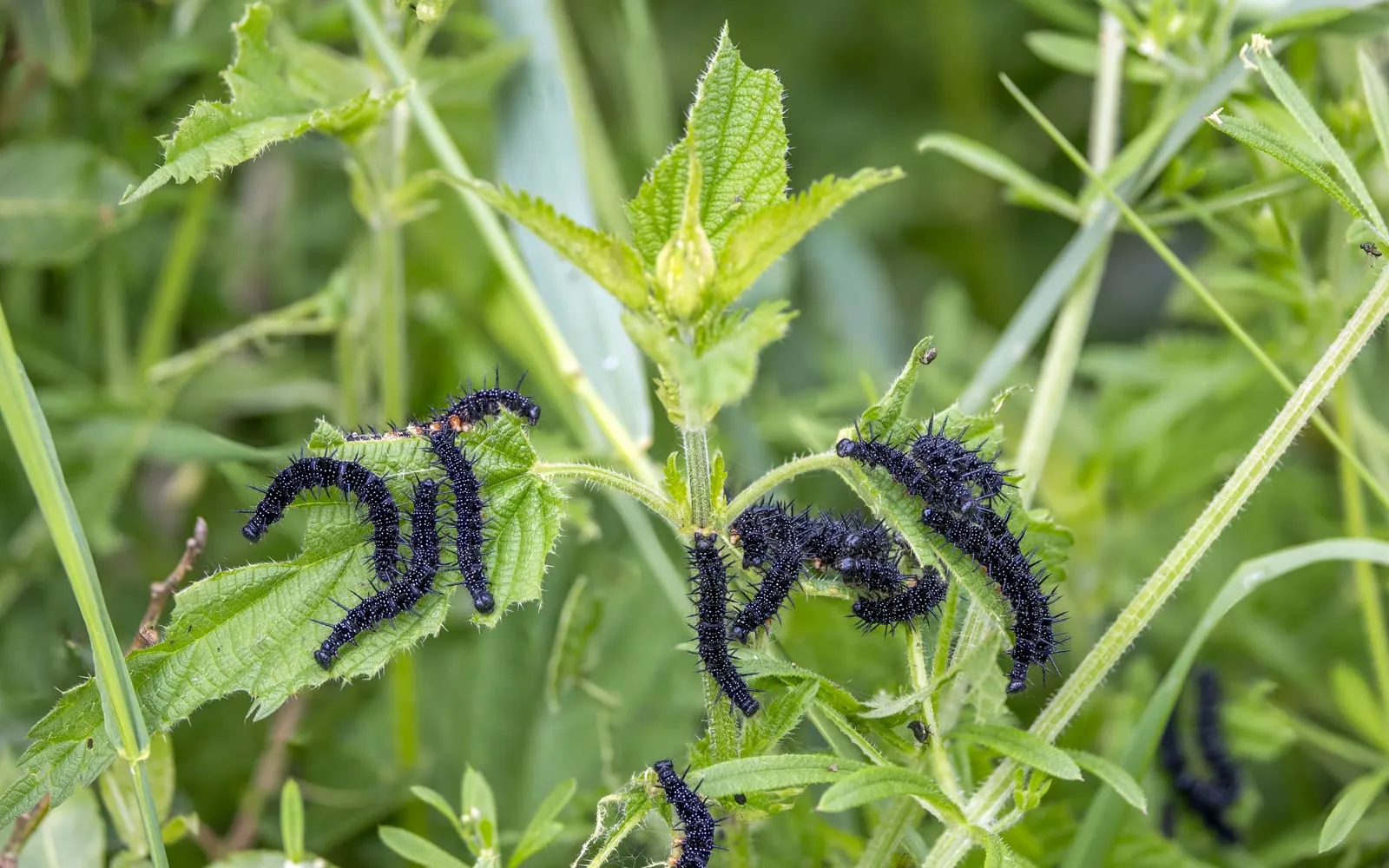
Growing nettles on purpose sounds perverse until you look at what depends on them. The caterpillars of small tortoiseshell, peacock, red admiral and comma butterflies all feed on nettle, and for the first two it is the only foodplant they use in Britain.
They are also a spring vegetable. The young tops picked in March and April make a soup that tastes somewhere between spinach and spring greens, they are free, and they arrive weeks before anything sown that year.
The third use is a liquid feed. A bucket of nettles left to rot in water produces a high-nitrogen fertiliser that costs nothing and smells appalling. Nettle tops are a good compost activator for the same reason, thrown on the heap to heat a sluggish one.
None of which changes the fact that a nettle patch spreads and needs containing. Choose the spot deliberately.
Appearance and character
An upright herbaceous perennial, 1 to 2 m tall, growing in dense colonies from a network of bright yellow rhizomes just below the surface.
Stems are square in section, ridged, and covered in stinging hairs.
Leaves are carried in opposite pairs, oval to heart-shaped with a pointed tip, coarsely toothed, deeply veined and matt mid-green, and covered in stinging hairs on both surfaces.
The stinging hairs are visible with a hand lens as fine bristles standing off the surface, each ending in a tiny silica bulb.
Flowers open from June to September as drooping catkin-like clusters of tiny greenish blooms in the leaf axils. They are wind-pollinated and unremarkable to look at.
The species is dioecious, which is what dioica means. Male and female flowers grow on separate plants, and female catkins hang more heavily as the seed forms.
Rhizomes are the giveaway when digging. Bright yellow, brittle and running horizontally, and every fragment regrows.
Where it is from
Europe, Asia and North Africa, and native throughout Britain, where it grows on waste ground, in hedgerows, on woodland edges, and wherever soil has been enriched and disturbed.
Nettles indicate high nitrogen and phosphate, which is why they mark old farmyards, middens, badger setts, rabbit warrens and abandoned settlements. A patch of nettles in an empty field often means a building once stood there.
Their uses run deep in European history. Nettle fibre was spun into cloth for centuries and German uniforms in the First World War were partly made of it when cotton ran short. The leaves gave a green dye, the roots a yellow one, and the plant was used to curdle milk before rennet.
Roman soldiers were said to have brought nettles to Britain to flog themselves with in the cold, which is almost certainly untrue and has been repeated for two thousand years.
The plant supports over forty insect species, and the aphids that colonise it early in the year are among the first food available to ladybirds and hoverflies.
How it grows
Choose the position before doing anything else. A nettle patch spreads by rhizome and needs a boundary it cannot cross, such as a mown path, a wall or a buried barrier.
Plant rhizome sections or young plants in spring or autumn, or leave an existing patch and manage it.
Site a butterfly patch in full sun, in a sheltered spot, and make it reasonably large. Small shaded clumps are almost never used, since the butterflies want warm young growth in an open position.
Cut half the patch back to the ground in June. This produces a flush of fresh young growth for the second generation of caterpillars in late summer, and it also gives you a second picking for the kitchen.
Leave the other half standing, since some species overwinter in the dead stems.
Pick the top four to six leaves of young shoots from March until the plants flower, wearing gloves. Use scissors and drop the tops straight into a bag.
Stop picking once flowering starts, and cut a section down to get fresh growth if you want more.
Contain the spread by cutting the rhizomes at the boundary each spring with a spade, or by sinking a barrier 30 cm deep.
Through the seasons
Winter is dormancy. The stems die back to brown skeletons that shelter overwintering insects, so leave some standing.
Spring is the picking season and the start of growth. Take the young tops from March, and watch for the first butterfly eggs in April and May.
Summer is caterpillars and cutting. Peacock and small tortoiseshell larvae feed in communal webs from May, and cutting half the patch in June gives a second flush.
Autumn is seed and die-back. Cut back what you want to control, and leave the rest.
Care difficulty
Easy in the sense that it grows itself, and the work is entirely in restraint and in handling.
Spreading is the ongoing task. Rhizomes run, and a patch left alone will keep expanding into whatever is next to it.
Gloves are needed for every operation, and long sleeves for anything involving cutting a whole patch back.
The timing rules for picking are the part worth learning. Young tops only, and nothing after the plant flowers.
Nothing here needs feeding, watering or protecting.
Watering
Established nettles need no watering at all.
Water new plantings through their first summer if you are deliberately establishing a patch.
A dry summer slows growth and produces smaller leaves, and the plant recovers as soon as it rains.
Damp fertile ground gives the lushest growth and the best picking.
Warning signs, diseases and pests
Spreading into ground you wanted for something else is the only real problem. Rhizomes run horizontally just below the surface and every fragment regrows. Cut around the patch with a spade each spring, sink a barrier 30 cm deep, or use a mown path as the boundary. Digging a patch out means removing every yellow rhizome fragment and returning for the regrowth.
Nettle rust produces orange pustules on the stems and leaves in damp summers. It is unsightly and harmless to the colony, and rusted growth should not be picked for the kitchen.
Aphids build up in enormous numbers on nettles in spring, which is a benefit rather than a pest. They feed ladybirds, lacewings and hoverflies that then move on to the rest of the garden.
Caterpillars stripping the leaves are the entire point of a butterfly patch. Peacock and small tortoiseshell larvae feed communally in silk webs and can defoliate a stand, which it regrows.
A patch that butterflies ignore is usually too small, too shaded, or too sheltered by surrounding growth. Butterflies want large sunny stands of young growth.
Getting stung repeatedly usually means gloves that are too thin. Nettle hairs go through fabric gloves readily.
Growing environment
Full sun for a butterfly patch. Partial shade suits a patch grown for picking and for liquid feed.
Damp, fertile soil, high in nitrogen and phosphate. Nettles thrive on ground that is too rich for most wildflowers.
A boundary is the most important part of the position. A path, a wall, mown grass or a sunken barrier all work.
The far corner of a garden, the back of a compost area or a strip along a boundary fence all suit it and keep it out of the way.
Make a butterfly patch at least a couple of square metres and in the open. Small shaded clumps go unused.
Avoid siting it beside a path where people brush past, or anywhere children play.
Keep it away from a vegetable bed, where the rhizomes will invade.
Feeding
Nettles need no feeding. They colonise the richest ground available on their own.
The relationship runs the other way, since nettles make an excellent feed for everything else. Pack a bucket or a water butt with leaves and stems, cover with water, weight them down and leave for three to four weeks. Dilute the resulting liquid at roughly one part to ten and use it as a high-nitrogen feed.
Nettle feed is high in nitrogen and low in potassium, so use it on leafy crops rather than on fruiting ones. Comfrey feed suits tomatoes better.
Fresh nettles added to a compost heap act as an activator and speed up decomposition.
Troubleshooting
Does a dock leaf help? No, beyond the cooling of the sap and the distraction of rubbing. Wash the area, avoid rubbing it at first, and lift out the broken hair tips with sticky tape.
When can I pick them for the kitchen? The young tops from March until the plants flower. After flowering the leaves develop gritty cystoliths that irritate the kidneys. Cut a patch down in June for a second picking.
Does cooking remove the sting? Completely. So does drying. Both destroy the hairs and the compounds they carry.
The butterflies never use my patch. It is probably too small, too shaded or too sheltered. Butterflies want a large sunny stand of young growth, and cutting half of it in June provides that.
It is spreading into the vegetable bed. The yellow rhizomes run just below the surface. Cut around the patch with a spade each spring or sink a barrier 30 cm deep.
Orange spots on the stems. Nettle rust. Harmless to the plant and a reason not to pick that growth for eating.
How do I make nettle feed? Pack a bucket with leaves and stems, cover with water, weight them down, and leave for three to four weeks. Dilute one to ten. It smells dreadful and works well on leafy crops.
How do I get rid of a patch entirely? Dig out every yellow rhizome fragment and return for the regrowth over two or three seasons, or cut it to the ground repeatedly through a full growing season to exhaust it.