
Outdoor plant
Black-eyed Susan
Rudbeckia fulgida
Also known as Orange coneflower, Perennial black-eyed Susan
How to grow rudbeckia, Rudbeckia fulgida. Black-eyed Susan for late summer, the difference between the perennial and the annual sorts, and leaving the seed heads for birds.
At a glance
- Difficulty
- Easy
- Water
- In dry spells during the growing season
- Light
- Full sun to light shade
- Temperature
- Fully hardy, to about -35 deg C
- Hardiness
- USDA 3-9, RHS H7, hardy to -35 C
- Type
- Herbaceous perennial, long lived and spreading gently by runners
- Height
- 60-90 cm
- Native to
- Eastern and central North America, from Ontario south to Florida
- Best month
- September in the Northern Hemisphere, March in the Southern Hemisphere
Buy by species, because the two commonly sold behave completely differently. Rudbeckia fulgida is a true perennial that spreads and returns for years, while Rudbeckia hirta is short-lived and often dies after a single season, which is the source of most disappointment. Both take heat, drought and cold, and both want full sun and ordinary soil rather than a rich one.
Hardiness zones describe winter cold alone. Summer heat, humidity, rainfall and the length of the growing season decide as much, so treat the range as the outer limit rather than as a recommendation.
Every month named in this guide is for the temperate Northern Hemisphere. If you garden in the Southern Hemisphere, shift each one by six months, so September becomes March. Closer to the equator the wet and dry seasons matter more than the calendar, and the shift stops being a useful guide.
Not known to be toxic
Rudbeckia is not listed by the RHS as a potentially harmful garden plant and is not recorded by the ASPCA as toxic to cats, dogs or horses. No part of it is a recognised poisoning hazard and it is a sound choice for a garden used by children and pets. Several North American peoples used root preparations of Rudbeckia species medicinally, and the plant is grazed by livestock without recorded problems. Where a plant is unlisted by both sources rather than positively assessed, the correct reading is that no hazard has been recorded rather than that one has been ruled out, so there is no reason to encourage anybody to eat it. Handling it causes mild skin irritation in a small number of people who are sensitive to the daisy family, which also covers chrysanthemum, echinacea and feverfew, so anyone who reacts to those should wear gloves when cutting it back.
Sources: RHS potentially harmful garden plants, ASPCA toxic and non-toxic plants
About
Rudbeckia is the yellow that carries a border from August into October, and it does it without being asked.
The flowers are simple daisies, deep golden-yellow with a raised chocolate-brown centre, and a good clump produces them by the hundred over two months. They stand up in wind, they last in a vase, and the plant needs no staking, no deadheading and no dividing for years at a time.
Two different plants are sold under the name and the difference matters. Rudbeckia fulgida, and particularly the cultivar ‘Goldsturm’, is a hardy perennial that comes back every year and spreads gently. Rudbeckia hirta is the annual or short-lived perennial sold as bedding, in a wider range of bronze, mahogany and bicolour shades, and it usually dies after a single season.
Buy the perennial for a border and the annual for pots and gaps.
The seed heads are worth keeping. They stand black and cone-shaped through the winter, they look right under frost, and goldfinches work them for the seed.
It sits naturally in the prairie-style planting that has dominated garden design for the last twenty years, alongside echinacea, helenium and grasses.
Appearance and character
A herbaceous perennial reaching 60 to 90 cm, forming an upright clump that spreads gently by short runners and dies back each winter.
Leaves are oval to lance-shaped, 8 to 12 cm long, rough and hairy to the touch, dark green, and largest at the base of the plant.
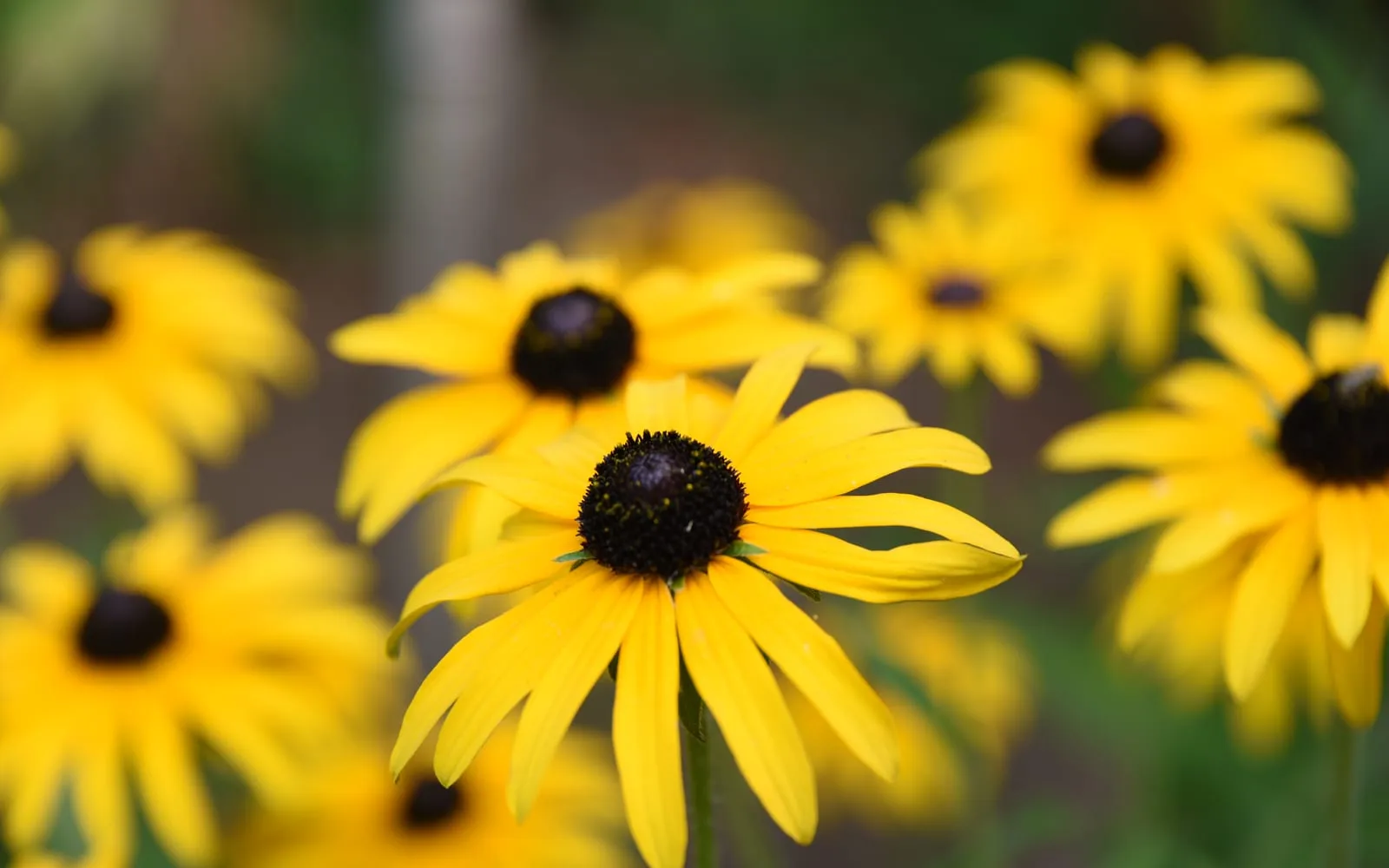
Flowers open from late July through to October, 6 to 10 cm across, with a single row of deep golden-yellow ray florets around a raised dark brown to near-black central cone.
The cone is a mass of tiny disc florets and it darkens and hardens as the flower ages.
Flowering is prolific and long. A single clump gives eight to ten weeks of colour without deadheading.
Seed heads stand black and rounded through winter on stiff stems and hold up under frost and snow.
‘Goldsturm’ is the standard cultivar, selected in Germany in the 1930s, and it is more uniform and freer-flowering than the wild species.
Rudbeckia laciniata ‘Herbstsonne’ is the tall relative at 2 m with drooping yellow rays and a green cone.
Where it is from
Eastern and central North America, from Ontario and New York south to Florida and west to Texas, growing in prairie, open woodland, meadows and along roadsides.
That prairie origin explains its behaviour. Full sun, fertile soil, moisture in the growing season, cold winters and a late flowering season that follows the summer rains.
The genus is named after Olof Rudbeck and his son, both professors at Uppsala, and Linnaeus named it in their honour.
Rudbeckia fulgida var. sullivantii ‘Goldsturm’ was selected by Karl Foerster’s nursery near Berlin in 1937 and released after the war, and it became one of the most widely planted perennials in the world.
Rudbeckia is central to the New Perennial and prairie planting movement associated with Piet Oudolf and others, where it is valued as much for the winter seed heads as for the flowers.
Rudbeckia hirta, the annual sort, is the state flower of Maryland and the plant most Americans mean by black-eyed Susan.
The rough hairy leaves are what hirta describes, and fulgida means shining.
How it grows
Plant in spring or autumn into fertile, moisture-retentive but free-draining soil.
Choose full sun for the best flowering. It tolerates light shade and flowers less.
Improve the soil with compost at planting, since rudbeckia is a moderately hungry plant and drought is what causes mildew.
Space plants 45 cm apart. It spreads gently outwards by short runners and fills a gap within three years.
Protect the emerging shoots from slugs and snails in spring, which is when the damage happens.
Water in dry spells through the growing season.
Feed once in spring and mulch with compost.
Leave the seed heads standing over winter. They are one of the better winter silhouettes in a border, they feed goldfinches, and the standing stems shelter overwintering insects.
Cut the old stems down in late February or March before the new growth starts.
Divide every four or five years in spring if the clump goes bare in the centre or begins to spread further than you want.
Deadhead during the season only if you want to stop it seeding, which is rarely necessary since ‘Goldsturm’ seeds sparingly.
Propagate by division in spring, which is simple and reliable, or from seed for the species.
Do not confuse it with the annual Rudbeckia hirta when buying, which will not come back the following year.
Through the seasons
Winter shows the black seed heads standing above bare ground, which is a reason to leave them.
Spring brings the shoots up in April, and the old stems are cut down then. This is slug season.
Summer builds through June and July and starts flowering in late July.
Autumn is the peak, flowering through September and often into October, followed by the seed heads.
Care difficulty
Easy. Rudbeckia is one of the least demanding perennials for late colour.
It is hardy, long-lived, self-supporting, free-flowering, unattractive to deer and rabbits, and needs no deadheading.
The jobs are slug protection in spring, watering in a dry summer, and dividing every four or five years.
Powdery mildew and leaf spot both occur and neither threatens the plant.
Watering
Water in dry spells through the growing season, since drought reduces flowering and brings on mildew.
Established clumps in reasonable soil manage on rainfall through most cool summers.
Water at the base rather than over the foliage, which reduces leaf spot and mildew.
Mulch in spring with compost, which holds moisture and does more than watering.
It dislikes waterlogged winter ground, so improve drainage on heavy clay.
Warning signs, diseases and pests
Shoots eaten in spring is slugs and snails. Protect the clump as the growth emerges, which is the only real pest problem it has.
White powdery coating on the leaves from midsummer is powdery mildew, which follows dry roots. Water and mulch, and cut affected growth away.
Dark brown or purple spots on the leaves spreading upwards in a wet summer is rudbeckia leaf spot, caused by Septoria. Remove affected leaves, clear all debris in autumn, and water at the base rather than overhead.
The clump spreading further than intended is normal in good soil. Lift the outer runners in spring.
A bare centre with growth only around the edges is congestion. Divide it in spring.
Flopping stems is unusual and indicates too much shade or too much nitrogen.
Aphids on the buds feed a great many predators and rarely need action.
Failure to reappear after winter usually means you bought Rudbeckia hirta, the annual, rather than Rudbeckia fulgida.
Growing environment
Full sun for the heaviest flowering, and it tolerates light shade.
Moist, fertile, free-draining soil. It dislikes prolonged drought and winter waterlogging equally.
Fully hardy to about -35 deg C.
Allow 45 cm per plant, and plant in groups of three or five for the mass effect that suits it.
It suits a herbaceous border, a prairie-style planting, a cottage garden, a cutting bed or a wildlife garden.
Grow it with the plants it belongs with. Echinacea, helenium, aster, sedum, veronicastrum and ornamental grasses such as Molinia and Calamagrostis all flower or stand at the same time, and the combination is the basis of prairie planting.
Its wildlife value is high and it runs into winter. Bees, hoverflies and butterflies work the flowers from August to October when much else has finished, and goldfinches feed on the seed heads through the winter, which is the argument for leaving them standing.
Choose ‘Goldsturm’ for reliability, Rudbeckia laciniata ‘Herbstsonne’ for the back of a large border at 2 m, and Rudbeckia hirta only for pots and annual gaps.
Feeding
Feed once in spring with a balanced general fertiliser as the shoots emerge.
Mulch every spring with compost, keeping it clear of the crown.
Avoid high-nitrogen feeds, which give soft growth that flops and mildews.
A clump with fewer flowers each year is more likely congested than hungry. Divide it before reaching for fertiliser.
Troubleshooting
It did not come back this year. You probably bought Rudbeckia hirta, which is an annual or short-lived perennial sold as bedding. Rudbeckia fulgida ‘Goldsturm’ is the hardy perennial that returns every year.
Should I cut the seed heads off? No. Leave them standing through winter. They look well under frost, they feed goldfinches, and the stems shelter insects. Cut everything down in late February.
The leaves went white and powdery. Powdery mildew following dry roots. Water in dry spells, mulch thickly, and cut affected growth away.
Brown spots are spreading up the leaves. Rudbeckia leaf spot, which follows a wet summer. Remove affected leaves, water at the base rather than overhead, and clear all debris in autumn.
The shoots were eaten in spring. Slugs and snails. Protect the clump as the growth emerges in April.
It is spreading beyond where I planted it. Normal in good soil, since it runs gently. Lift the outer sections in spring and give them away.
When do I divide it? Every four or five years in spring, when the centre goes bare or it outgrows its space.
Does it need staking? No. The stems are stiff and self-supporting in sun. Floppy growth means too much shade or too much nitrogen.
What should I plant with it? Echinacea, helenium, aster, sedum and ornamental grasses, which flower at the same time and stand through winter together.