
Edible
Buckwheat
Fagopyrum esculentum
Also known as Common buckwheat, Beech wheat, Sarrasin, Soba
How to grow buckwheat, Fagopyrum esculentum. Sowing, fast growth, bee forage, harvesting seed and using it as a green manure.
At a glance
- Difficulty
- Easy
- Water
- Water through establishment, then leave it
- Light
- Full sun to light shade
- Temperature
- Grows from 10 deg C upward and dies at 0
- Hardiness
- USDA 3-10, RHS H2, hardy to 2 C
- Type
- Fast tender annual, killed by the first frost
- Height
- 60-120 cm
- Native to
- Yunnan, south-western China
- Best month
- May, June and September in the Northern Hemisphere, November, December and March in the Southern Hemisphere
Not a cereal but a knotweed relative, and its constraint is heat rather than cold. Flowers abort above about 30 C, so it is sown to flower in cool weather and does badly through a hot midsummer, and the first frost kills it outright. Ten to twelve weeks from sowing to harvest lets it fill a gap between two crops. It crops on poor acid ground where cereals starve, and it is one of the best nectar plants in agriculture.
Hardiness zones describe winter cold alone. Summer heat, humidity, rainfall and the length of the growing season decide as much, so treat the range as the outer limit rather than as a recommendation.
Every month named in this guide is for the temperate Northern Hemisphere. If you garden in the Southern Hemisphere, shift each one by six months, so May becomes November. Closer to the equator the wet and dry seasons matter more than the calendar, and the shift stops being a useful guide.
Toxic if eaten
- Safe to eat
- The seed, hulled, milled or as groats, and the young leaves cooked
- Do not eat
- Large quantities of the plant, for grazing animals
- Harm from
- Eating it and handling it
- Affects
- People and horses
Buckwheat contains no gluten and is a staple of gluten-free baking. Two separate hazards deserve naming. Buckwheat allergy is severe where the crop is eaten heavily, and in Japan and Korea it is among the leading causes of food-induced anaphylaxis in children. It is not one of the 14 named allergens in Britain, so it is often undeclared here, which matters for anyone diagnosed elsewhere. Second, the plant contains fagopyrin, a photosensitising pigment concentrated in the leaves and flowers. Livestock fed large amounts of green buckwheat and then exposed to sunlight develop fagopyrism: inflamed, blistered skin on unpigmented areas, and horses, sheep and cattle are all susceptible. The seed carries far less, and normal human consumption of the grain does not cause it. Do not turn animals onto a flowering buckwheat green manure.
Sources: Food Standards Agency on food allergy, British Horse Society on poisonous plants
About
Buckwheat is not a wheat and not a grass. It belongs to the Polygonaceae, alongside rhubarb, sorrel, dock and knotweed, and its seed is a small triangular nut rather than a grain. Crops of this kind are called pseudocereals, and quinoa and amaranth are the other two you are likely to meet.
The name records a resemblance rather than a relationship. The seed looks like a tiny beech mast, and the Dutch boekweit and German Buchweizen both mean beech wheat, which English borrowed and shortened.
What buckwheat does better than almost anything is grow fast on poor ground. It goes from sowing to flowering in about a month and to harvest in ten to twelve weeks, which lets it fill a gap between two other crops. Gardeners in cool climates mostly sow it as a summer green manure and a bee plant, and it earns its place on both counts.
Appearance and character
The plant is unmistakable once you have seen it. Reddish hollow stems carry heart-shaped or arrow-shaped leaves on long stalks, and the whole thing branches freely into a loose bush. At each leaf joint there is a papery sheath around the stem, called an ochrea, which is the family signature and is the same structure you find on a dock.
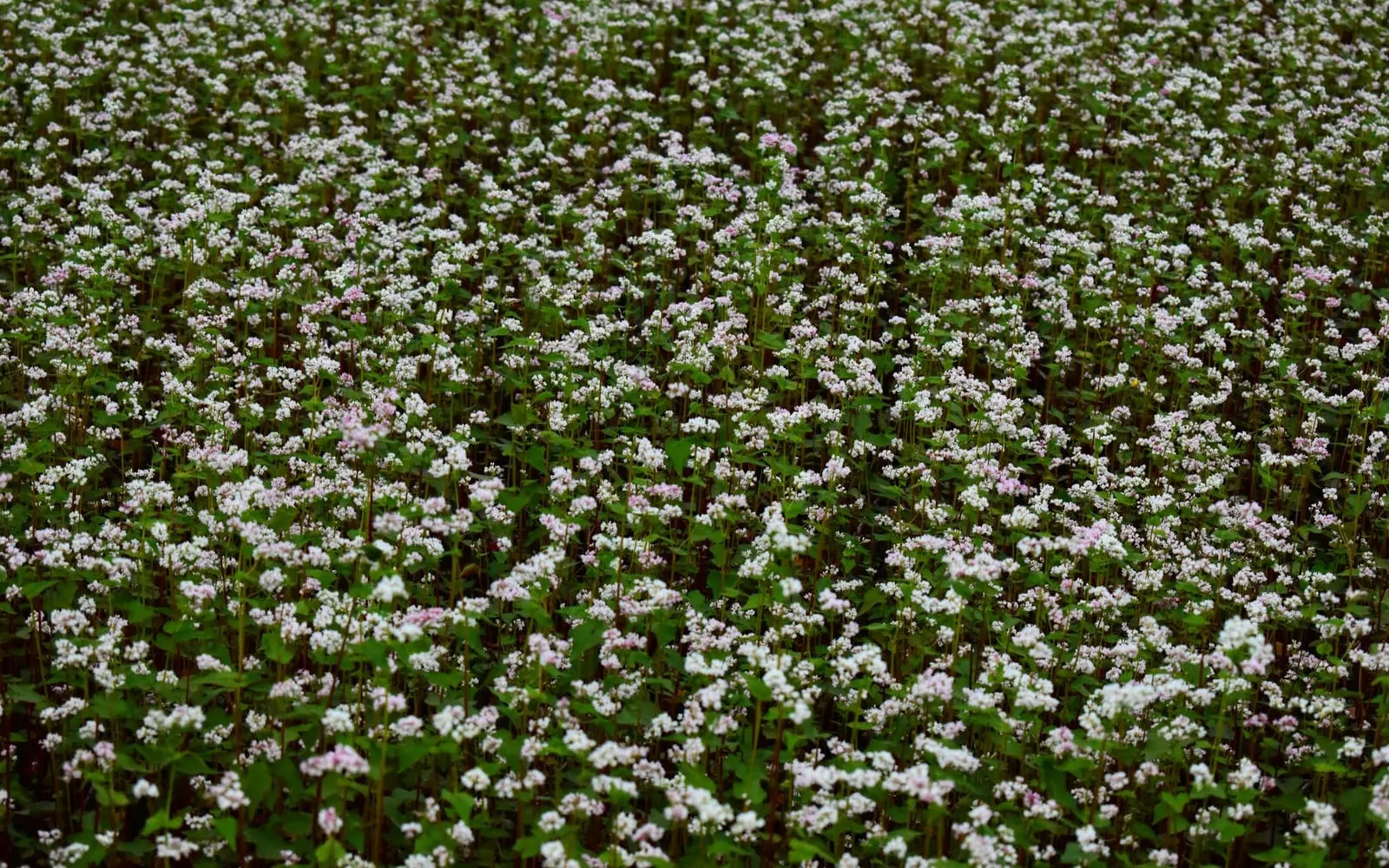
The flowers come in dense clusters at the tips and in the leaf axils, white or pink, small and heavily scented, and they run for weeks. Bees work them hard, particularly in the morning, and buckwheat honey is dark and strongly flavoured.
The seed is a three-sided nutlet about 5 mm long, dark brown to black, with sharp edges and a tough hull. Hulled it gives a pale green-brown groat. Roasted, the same groat becomes kasha and turns a deep reddish brown.
Where it is from
Buckwheat was domesticated in south-western China, most likely in Yunnan, from a wild ancestor that still grows there. The archaeological record puts cultivation in China from around 4000 BC, and pollen evidence suggests earlier use.
It travelled north and west across central Asia, reaching eastern Europe by the medieval period and western Europe soon after. Russia, Ukraine and Poland took to it wholeheartedly, and kasha remains a staple across that region.
Brittany adopted it as sarrasin and built the galette on it. Japan built soba on it. In both places buckwheat filled the same role, a crop for thin acid soil in a short season, and in both places the food it produced outlasted the agricultural necessity that created it.
How it grows
Buckwheat germinates within four days in warm soil and grows very quickly, so a crop covers the ground in about three weeks. The seedling pushes up two large kidney-shaped seed leaves that look nothing like the true leaves that follow.
Flowering starts around five weeks after sowing and continues for a month or more, with the plant setting seed and flowering at the same time. Ripening is therefore uneven, and a harvested crop always contains a mix of black ripe seed, green immature seed and open flowers.
Pollination is the interesting part. Common buckwheat is heterostylous: half the plants carry flowers with long styles and short stamens and half the reverse, and a flower only sets seed with pollen from the other type. Insects have to do the work, so a crop with no bees around it sets almost nothing.
Through the seasons
Sow from May to July, once the soil has warmed to 10 deg C and all frost has passed. Broadcast it thickly for green manure or in rows at 15 cm for a seed crop, and rake it in. It emerges within a week.
Flowering starts in about five weeks and runs through the summer. A July sowing will be flowering in August, when very little else on the plot is, and the bees will find it within a day.
Harvest ten to twelve weeks after sowing, when about three-quarters of the seed has turned brown or black. Cut the plants, dry them under cover, and thresh by beating them in a bag. As a green manure, cut it down at flowering and leave it on the surface or dig it in, and be sure to do so before it sets seed or you will be weeding buckwheat next year.
Care difficulty
Buckwheat is one of the easiest things a gardener can sow. It germinates readily, smothers weeds, needs no feeding, has almost no pests, and produces a crop in three months from a standing start.
The one thing that kills it is frost, at either end. A late spring frost takes out a May sowing and the first autumn frost takes out the plants standing in September, so the sowing window is narrow at both edges.
The second thing to plan around is that it self-seeds enthusiastically. Buckwheat left to shed becomes a persistent volunteer in the following year’s crop, which is easy to pull but tiresome. Cut a green manure at flowering.
Watering
Water it through germination and the first fortnight, particularly on light soil in a dry June, and then leave it alone. The root system is shallow and fibrous, which is why the plant dislikes prolonged drought and recovers poorly from it.
A soak once a week in a dry spell keeps a seed crop flowering. Drought during flowering stops nectar production, which the bees will tell you about by going elsewhere.
The plant dislikes waterlogging and will yellow and collapse in a wet heavy soil. Free-draining ground, even poor and stony ground, gives a far better crop than rich wet clay.
Warning signs, diseases and pests
Buckwheat has almost no disease problems in a cool climate, which is one of the reasons it works as a break crop. What goes wrong is mechanical or climatic rather than pathological.
Slugs are the real threat and they take the seedlings. A May or June sowing into warm soil grows away fast enough to escape, and a cool damp start gives them time to clear a patch.
Lodging follows rich ground or heavy rain. The stems are hollow and the plant is top heavy when flowering, so a fed crop lies down. It usually keeps flowering from the horizontal, which is untidy rather than fatal.
Frost ends the crop, and there is no warning beyond the forecast. A plant hit at 0 deg C blackens within a day. Aphids appear on the growing tips in a hot dry summer and rarely amount to anything, and birds take ripening seed from a small patch.
Growing environment
Full sun gives the best seed crop, though buckwheat tolerates light shade better than any cereal and will still flower under a fruit tree.
Soil should be poor and free draining. The plant evolved on thin acid mountain ground and performs well from pH 5 to 7. It has an unusual ability to take up phosphate from forms other plants cannot reach, which is why it is valued as a green manure on soils where phosphate is locked up.
Warmth is required and heat is not. Buckwheat grows well in a cool summer and drops its seed set above about 30 deg C, when high temperatures interfere with pollination. It is a mountain crop, and it shows.
Feeding
Do not feed buckwheat. On decent ground it produces plenty of leaf, flops over and sets less seed, and on poor ground it produces a tidy crop with no help at all.
As a green manure, the plant’s job is to scavenge phosphate and potassium from the soil and to hold them in its tissue until you cut it down. Adding fertiliser to a green manure crop defeats the purpose.
If you have ground so exhausted that nothing will grow, buckwheat is the crop to try first rather than the crop to feed.
Troubleshooting
Is buckwheat gluten-free? Yes. It is not a wheat and not a grass, and it contains no gluten, which makes it a staple of gluten-free baking. Check packaging on soba noodles, since most Japanese soba is a blend of buckwheat and wheat flour.
Why did my crop set almost no seed? Pollination. Common buckwheat comes in two flower forms and each will only set seed with pollen from the other, so insects have to move between them. A crop with few bees around it, or one flowering in a cold wet week, sets very little.
Can I use it as a green manure? It is one of the best summer options. Sow after an early crop comes out, let it flower for the bees, then cut it down before it seeds. It smothers weeds, and it takes up phosphate in forms other plants cannot use.
When should I cut a green manure crop? At flowering, and before the first seeds turn black. Left to shed, buckwheat volunteers freely in the following year’s beds.
Is it safe for animals? The grain is. The green plant is not, in quantity. Buckwheat contains fagopyrin, a photosensitising compound, and livestock grazing a lot of green buckwheat and then standing in the sun develop blistered inflamed skin on their unpigmented areas.
What is kasha? Roasted buckwheat groats, which is how the grain is usually eaten across eastern Europe. Roasting turns the pale groat reddish brown and gives it a strong nutty flavour that unroasted buckwheat lacks.
How do I hull the seed? With difficulty. The hull is hard and three-sided and clings, and hand methods give a low yield. A grain mill set very wide will crack them, and winnowing separates the result. Most home growers use the crop whole in soups or grow it as green manure.
My buckwheat is flat on the ground. Lodging, from rich soil or heavy rain on a top-heavy plant. It usually keeps flowering horizontally, so leave it unless you need to walk through it.
Buckwheat problem guides
Not sure what is wrong? See the common vegetable pests guide.