
Outdoor plant
Purple Coneflower
Echinacea purpurea
Also known as Eastern purple coneflower, Echinacea, Coneflower
How to grow Echinacea purpurea. Why it hates being moved, leaving the seed heads for goldfinches, keeping stems upright without staking, and why year one disappoints.
At a glance
- Difficulty
- Moderate
- Water
- Regularly in the first year, rarely after that
- Light
- Full sun, six hours minimum. Shade makes it flop
- Temperature
- Fully hardy, to about -20 deg C
- Hardiness
- USDA 3-9, RHS H7, hardy to -35 C
- Type
- Herbaceous perennial
- Height
- 60-120 cm
- Native to
- The prairies and open woodland of eastern and central North America
- Best month
- August in the Northern Hemisphere, February in the Southern Hemisphere
Prairie winters are cold and dry, and the plant is far tougher than any winter it meets. Wet is what kills it, so a wet winter on heavy ground rots the crown of a plant that would shrug off -35 C on sand. Aster yellows, a phytoplasma spread by leafhoppers, produces green deformed flowers and has no cure, so affected plants have to be dug out and destroyed.
Hardiness zones describe winter cold alone. Summer heat, humidity, rainfall and the length of the growing season decide as much, so treat the range as the outer limit rather than as a recommendation.
Every month named in this guide is for the temperate Northern Hemisphere. If you garden in the Southern Hemisphere, shift each one by six months, so August becomes February. Closer to the equator the wet and dry seasons matter more than the calendar, and the shift stops being a useful guide.
Not known to be toxic
Non-toxic. NC State Extension carries no toxicity section for Echinacea purpurea and notes that the herbaceous parts can be steeped as a tea, and Echinacea does not appear on the RHS list of potentially harmful garden plants. The plant has a long history of medicinal use, first by indigenous peoples of the Great Plains and later as one of the most widely sold herbal remedies in the world, and root preparations are taken by people deliberately. The ASPCA does not list it among plants toxic to dogs, cats or horses. Two sensible cautions rather than warnings. Echinacea is in the daisy family, so anyone with a known allergy to ragweed, chrysanthemums or marigolds may react to it. And the dried seed heads are spiky enough to prick a hand, which is a reason to wear gloves when cutting them down rather than a reason to avoid the plant.
Sources: NC State Extension, Echinacea purpurea, RHS potentially harmful garden plants
About
Echinacea takes three years to show you what it can do. Plant one in spring and the first summer gives a few flowers on a modest plant. The second is better. The third is when the clump reaches full size and flowers from July to October.
Its prairie taproot explains the care. The root is deep, and it spends its early seasons building that root rather than putting on display. It also explains why echinacea resents being moved or divided, unlike most herbaceous perennials, and why a plant lifted and split often sulks for two years or dies.
The name comes from the Greek for hedgehog, describing the spiky central cone rather than the petals.
Appearance and character
A stiff upright clump of rough, oval, toothed leaves with strong wiry stems rising to 60 to 120 cm.
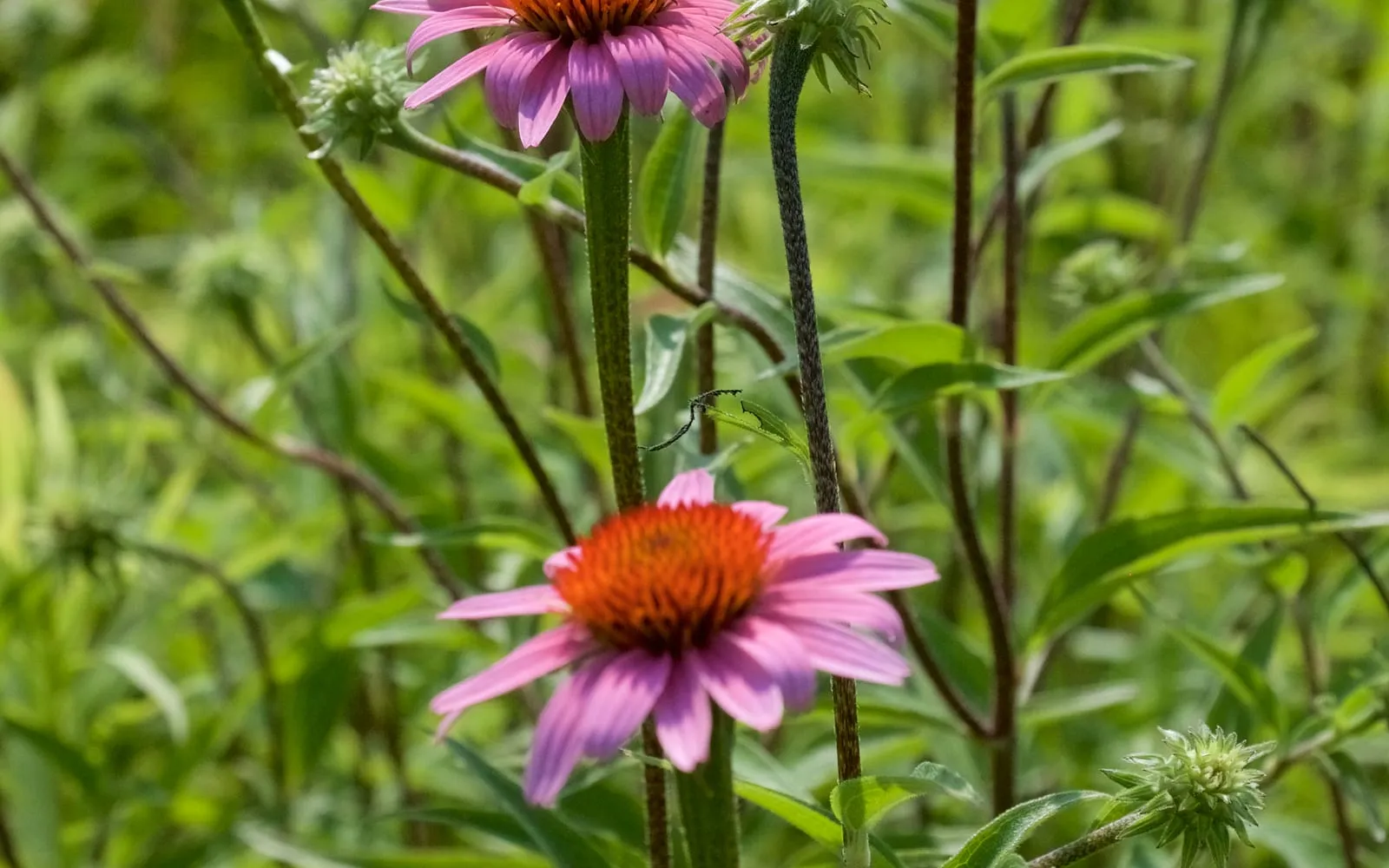
Flowers are large daisies with drooping purple-pink ray petals swept back from a domed centre of orange-brown, and that centre is stiff and prickly to touch. Each flower lasts for weeks, and a clump flowers from July into October.
The drooping petals are characteristic and often mistaken for wilting. The species holds them back and down; many modern cultivars have been bred to hold them flat, which looks tidier and rather less like the wild plant.
Seed heads persist through winter as dark spiky cones on stiff stems, holding their shape under frost, and goldfinches work them from autumn onward.
Named cultivars now cover white, orange, red, yellow and double forms, though many are shorter-lived and less robust than the straight species.
Where it is from
Eastern and central North America, on tallgrass prairie, in open woodland and along roadsides, from Ohio south to Georgia and west to Iowa.
Prairie conditions are the guide. Full sun, no shelter, soil that drains freely, and low fertility. Prairie plants grow tall and stand up in wind because the poor soil produces tough stems.
Rich garden soil and generous feeding undo that. A well-fed echinacea grows soft and tall and falls over in the first summer downpour.
Winters on the prairie are cold and comparatively dry. Temperate winters are milder and much wetter, and it is the wet rather than the cold that kills echinacea here.
How it grows
A herbaceous perennial dying back to the ground each winter and returning from the crown in spring.
The taproot is the defining feature. It goes deep, makes the established plant drought-tolerant to a degree few border perennials match, and makes transplanting risky. Plant echinacea where you want it and leave it alone.
Division is possible in spring on a large clump, though it sets the plant back badly and many gardeners lose divisions altogether. Raising new plants from seed is more reliable, and the species comes reasonably true, though named cultivars do not.
Seed needs a period of cold to germinate well, so sow in autumn and leave the tray outside over winter, or give it a month in the fridge before sowing in spring.
Flowering runs from July to October and deadheading the earliest flowers extends it, though leaving the later ones to form seed heads is the better trade.
Emerging spring growth is slow. Echinacea appears later than most perennials and is often assumed dead in April.
Through the seasons
Spring brings late, slow growth from the crown. Slugs are the main threat now. Mulch lightly with compost, keeping it off the crown itself. Cut back last year’s stems if you left them standing.
Early summer is when to consider the Chelsea chop, cutting the clump back by a third in late May. This produces a shorter, sturdier, later-flowering plant and removes any need for staking.
Summer and autumn are the flowering season, July through October. Water only in prolonged drought.
Winter is when the plant earns its keep a second time. Leave the seed heads standing. They feed goldfinches, they look striking in frost, and the old stems protect the crown.
Care difficulty
Moderate, and the difficulties are all about expectations and drainage.
Winter wet is the real killer. Cold alone is no problem for a plant hardy to -20 deg C, but cold combined with waterlogged clay rots the crown. Dig grit into heavy soil before planting, or plant on a slight mound.
Feeding is the second trap, and the instinct to help makes it worse. Rich soil and fertiliser give tall soft stems that flop. Grow it lean.
The third is patience. Year one is modest, and pulling the plant out to try something else is a common mistake.
Watering
Water regularly through the first growing season while the taproot goes down. This is the only period when watering changes the outcome.
After that, water only in a prolonged drought, and then deeply at the base rather than lightly and often. An established echinacea is markedly drought-tolerant.
Avoid overhead watering, which encourages leaf spot and mildew.
Do not water in autumn or winter, and make sure the soil around the crown drains freely through the wet months.
Container plants need more attention than plants in the ground, and they are generally a poor choice for a species with a deep taproot.
Warning signs, diseases and pests
Crown rot from winter wet is the most common cause of loss. The plant fails to appear in spring, and the crown is soft and brown. Prevention is drainage, and avoiding a thick mulch sitting directly over the crown through winter.
Aster yellows is a distinctive disease worth recognising. Flowers become deformed and green, with strange leafy growths sprouting out of the cone, and the plant is stunted. It is caused by a phytoplasma spread by leafhoppers, there is no cure, and infected plants must be dug up and destroyed rather than composted, since they act as a reservoir.
Slugs and snails graze the emerging crown in spring, and because echinacea comes up late and slowly, repeated grazing can finish a young plant.
Powdery mildew coats the leaves in a dry summer, particularly on crowded plants.
Floppy stems that fall outward from the centre indicate over-feeding, too much shade, or both.
Failure to appear in spring is often patience rather than death. Echinacea emerges weeks later than most perennials.
Growing environment
Full sun, six hours minimum. Shade produces leggy plants that lean and flower poorly.
Fully hardy to about -20 deg C. The plant is far tougher than a temperate winter in terms of cold, and vulnerable to it in terms of wet.
Soil should be free-draining and only moderately fertile. Heavy clay must be improved with grit before planting. Do not enrich it with manure.
Spacing at 45 cm apart allows airflow, which reduces mildew.
An open exposed border suits it better than a sheltered one, since the stems toughen in wind and the plant needs no staking when grown hard.
Avoid moving it once planted. Choose the position carefully.
Feeding
A light mulch of garden compost in spring is the whole feeding programme, and many growers give nothing at all.
Avoid rich feeding entirely. Nitrogen produces tall soft stems that fall over and reduces the number of flowers.
If the soil is very poor, a single application of a balanced granular fertiliser in spring is enough.
Leave the seed heads standing over winter rather than cutting them down and mulching heavily over the crown, which traps moisture where it does harm.
Troubleshooting
Very little flowering in the first year. Normal. Echinacea builds its taproot first and reaches full performance in year three.
Stems flopping outward. Over-feeding, too much shade, or a rich soil. Stop feeding, and try the Chelsea chop in late May next year.
Did not come back in spring. Either crown rot from winter wet, or simple lateness. Wait until at least late May before giving up. If the crown is soft and brown, improve the drainage before replanting.
Deformed green flowers with leafy growths from the cone. Aster yellows. Dig up and destroy the plant, and do not compost it.
Divided a clump and the divisions died. Echinacea has a taproot and resents division. Grow new plants from seed instead.
Petals drooping downward. Normal for the species. Cultivars bred to hold their petals flat are available if you prefer the look.
Should I cut it back in autumn? Leave the seed heads standing. They feed goldfinches, protect the crown, and look better in frost than bare soil does.