
Edible
Coriander
Coriandrum sativum
Also known as Cilantro, Chinese parsley, Dhania
How to grow coriander, Coriandrum sativum. Why it bolts, why you must sow it direct rather than transplant, succession sowing for a steady supply, and harvesting the seed.
At a glance
- Difficulty
- Moderate
- Water
- Steadily, and never let it dry out and then flood it
- Light
- Full sun in spring and autumn, light shade in midsummer
- Temperature
- Hardy enough to overwinter under cover. Heat makes it bolt
- Hardiness
- USDA 2-11, RHS H4, hardy to -8 C
- Type
- Annual, going from seed to seed in a single season
- Height
- 50-60 cm once it flowers
- Native to
- Southern Europe, North Africa and western Asia
- Best month
- September in the Northern Hemisphere, March in the Southern Hemisphere
It bolts on lengthening days as well as on heat, which is why a spring sowing runs to seed at 15 cm even in a cool year and why the leaf crop is sown in early spring and again in autumn. For seed the opposite applies, and a hot dry ripening period is what fills it. Sowing thickly and cutting young beats trying to stop a plant flowering.
Hardiness zones describe winter cold alone. Summer heat, humidity, rainfall and the length of the growing season decide as much, so treat the range as the outer limit rather than as a recommendation.
Every month named in this guide is for the temperate Northern Hemisphere. If you garden in the Southern Hemisphere, shift each one by six months, so September becomes March. Closer to the equator the wet and dry seasons matter more than the calendar, and the shift stops being a useful guide.
Not known to be toxic
- Safe to eat
- Leaves, stems, seed, flowers and roots
Non-toxic in every part. The ASPCA does not list Coriandrum sativum among plants harmful to cats, dogs or horses, and the whole plant is used in cooking. Leaves and stems are the fresh herb, the ripe seed is the spice, the flowers are edible, and the root is used in Thai cooking. The strong dislike some people have for the leaf is a genetic difference rather than a reaction to anything harmful. Variants of the olfactory receptor gene OR6A2 make certain aldehydes in the leaf register as soap, which is why the same plate of food divides a table. That perception has no bearing on safety. One handling note is worth adding. Coriander belongs to the carrot family, which contains several dangerously poisonous wild plants including hemlock and hemlock water dropwort, and a bolted coriander plant in flower carries the white umbels typical of the whole family. Never gather anything from that family in the wild on the strength of a resemblance to a garden herb.
Sources: ASPCA toxic and non-toxic plants, RHS potentially harmful garden plants
About
Coriander wants to flower, and the craft of growing it lies in delaying that moment for as long as you can.
A coriander plant germinates, makes a rosette of broad leaves, and then throws up a flowering stem and dies, all within a few months. Anything that stresses it brings that forward. Root disturbance does it, drought does it, and a hot dry week in June does it fastest of all.
The two practical answers are to sow direct where the plant is to grow, and to sow again every three or four weeks. A single sowing gives you three weeks of leaf. Six sowings give you a season.
Appearance and character
A slender annual with a low rosette of leaves at first, rising to 50 or 60 cm once it flowers.
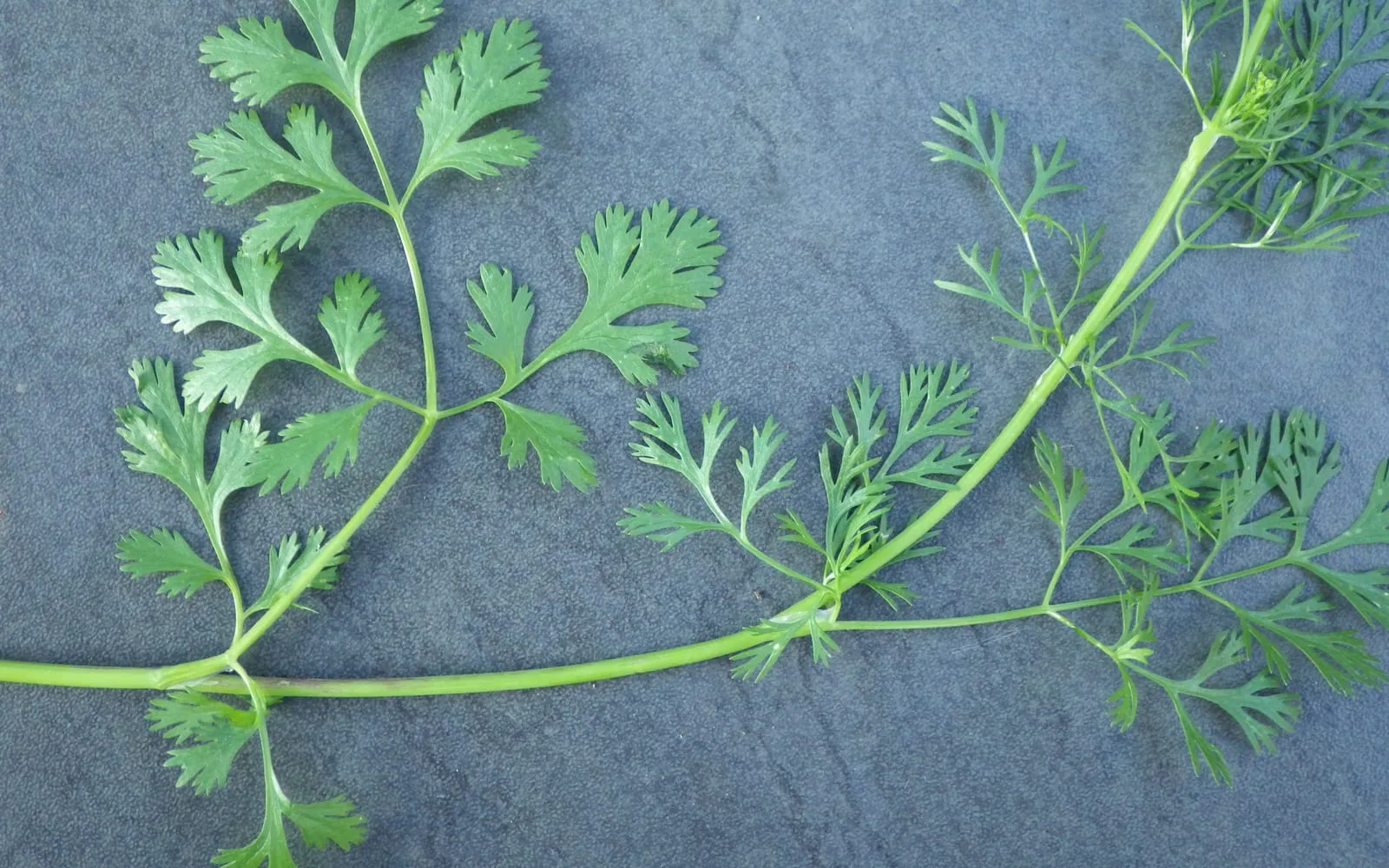
The leaves come in two distinct shapes on the same plant, which surprises people who have only bought it in a bag. Early ones are broad, rounded and shallowly lobed, resembling flat-leaved parsley. Later ones, produced as the plant runs up to flower, are fine and thread-like, cut into narrow segments.
Flowers are small and white to pale pink, carried in flat-topped umbels typical of the carrot family, and hoverflies work them heavily.
Seed follows as pale brown spheres about 4 mm across, ribbed and hard when ripe.
The whole plant is aromatic when brushed, and the smell of the leaf is nothing like the smell of the ripe seed. Fresh leaf is sharp and citrus-soapy, while the dried seed is warm, sweet and faintly orange-peel.
Where it is from
Southern Europe, North Africa and western Asia, where it grows in dry open ground with a short spring growing season.
It is one of the oldest herbs in cultivation. Seeds have been recovered from the tomb of Tutankhamun, from Bronze Age sites in Greece, and from Roman deposits in Britain, and the Romans are thought to have introduced it here.
Its native climate explains the bolting. A plant adapted to a short wet spring followed by a hot dry summer survives by setting seed before the drought arrives, so warmth and dryness both act as signals to flower.
The two names describe two crops. British and Indian usage calls the whole plant coriander, while American usage calls the leaf cilantro and reserves coriander for the seed. Seed merchants sell separate varieties for each.
Leaf varieties such as ‘Calypso’ and ‘Confetti’ are bred to hold in rosette far longer before bolting. Seed varieties such as ‘Moroccan’ bolt early on purpose.
How it grows
Sow direct into the ground or into the final pot. Coriander has a taproot and resents transplanting, and moving a seedling is one of the surest ways to make it bolt within a fortnight.
Sow thinly from March to September, 1 cm deep in rows 20 cm apart, and thin the seedlings to about 15 cm.
Sow again every three or four weeks. Succession is the difference between coriander that runs out in July and coriander on the table from May to October.
Rub the seed gently between your palms before sowing to split the two halves, which improves germination.
Pick leaves from the outside of the rosette once the plant has five or six of them, taking no more than a third at a time.
Cut the whole plant at the base for a large harvest, and it will often resprout once.
Let a few plants run to seed deliberately in late summer. Cut the heads when they turn pale brown, dry them in a paper bag, and the seed shakes free.
A September sowing under a cloche or in a cold greenhouse overwinters as a rosette and gives an early crop in March.
Through the seasons
Winter suits a plant on a bright windowsill or under cover. Autumn-sown plants sit as low rosettes and need very little water.
Spring is the main sowing season. Start outdoors from late March, keep sowing every three weeks, and protect seedlings from slugs.
Summer brings the bolting. Sow in light shade, water steadily, choose bolt-resistant leaf varieties, and accept that a June sowing will flower sooner than a May one.
Autumn is the seed harvest and the last sowings. Collect ripe seed in September, and sow under cover for spring.
Care difficulty
Moderate, and the difficulty is concentrated in one problem.
Bolting frustrates more gardeners than any other aspect of coriander, and the plant is doing what an annual is supposed to do rather than failing.
Germination is easy and quick, usually seven to fourteen days in warm soil.
The plant needs no feeding and very little attention once established.
Anyone who accepts succession sowing as part of the routine finds coriander straightforward. Anyone expecting one plant to last the summer will be disappointed every year.
Watering
Water steadily and evenly. Drought is a direct trigger for flowering, and a plant that dries out will bolt within days of recovering.
Avoid the pattern of letting a pot go bone dry and then soaking it. Fluctuation causes more bolting than a consistently modest supply.
Water the soil rather than the leaves, particularly in humid weather, since wet foliage encourages mildew.
Do not waterlog the roots. Coriander rots in cold wet compost, and seedlings damp off readily.
Containers dry out fastest and need checking daily in summer. Use a deep pot of at least 20 cm to give the taproot room.
Warning signs, diseases and pests
Bolting shows first as the leaves changing shape, from broad and lobed to fine and feathery, followed by a stem rising from the centre. Nothing reverses it. Pinching out the flower stem buys a week at most. Treat it as the signal to sow the next batch, and let the plant flower for the hoverflies and the seed.
Slugs and snails destroy seedlings overnight, and coriander is among their favourite targets at that stage.
Aphids gather on the flower heads and stems in summer. A plant close to flowering is rarely worth treating.
Damping off kills seedlings at soil level in cold wet compost. Sow into free-draining compost, avoid overwatering, and give good ventilation under cover.
Powdery mildew appears as a white dusting on the leaves late in the season, usually on crowded or dry plants.
Yellow lower leaves on a young plant usually mean waterlogging rather than hunger.
Poor germination often follows sowing into cold wet soil in early spring, or sowing old seed. Coriander seed stays viable for about three years.
Growing environment
Full sun for spring and autumn sowings. For midsummer sowings, light afternoon shade slows the bolting noticeably.
Light, free-draining soil of moderate fertility. Heavy wet ground and rich manured beds both produce disappointing plants.
Sow where the plant is to grow. A module-raised coriander plant that has had its roots disturbed will bolt early no matter what else you do.
Shelter from strong wind, which flattens the flowering stems.
A deep container suits it well. Depth matters more than width because of the taproot.
Indoors it needs the brightest windowsill available, and even then it stretches and flops in winter.
Feeding
Coriander grown for leaf needs almost nothing. Fertile soil produces soft growth with less flavour.
A single balanced liquid feed mid-season is enough for a container plant.
Avoid high-nitrogen feeds, which make the growth sappy and prone to mildew.
Fresh manure is unnecessary and unhelpful.
Plants grown for seed benefit from a low-nitrogen feed as the flower stem rises, though most soils supply enough already.
Troubleshooting
It flowered after three weeks. Coriander bolts under stress, and the usual causes are transplanting, heat and drought. Sow direct, water steadily, use a bolt-resistant leaf variety, and sow again every three weeks.
The leaves have gone thin and feathery. That is the plant switching to its flowering foliage. The broad leaves will not return.
Can I stop it bolting by pinching out the flowers? It buys a few days. Succession sowing is the real answer.
Why does it taste of soap to me? A variant of the OR6A2 olfactory receptor gene changes how certain aldehydes in the leaf are perceived. Roughly one person in ten tastes soap, and cooking the leaf reduces the effect.
The seedlings collapsed at soil level. Damping off from cold wet compost. Sow into free-draining compost, water less, and improve ventilation.
Can I grow it on a windowsill all winter? A September sowing kept somewhere bright works reasonably well. Expect slower, softer growth than outdoors.
When do I harvest the seed? When the heads turn from green to pale brown. Cut the stems, hang them upside down in a paper bag, and the seed drops out as it dries.
Can I use supermarket pots in the garden? Those are dozens of seedlings crammed into one pot and they bolt almost immediately when planted out. Split the clump and expect a short crop, or sow your own direct.