
Edible
Fennel
Foeniculum vulgare
Also known as Sweet fennel, Herb fennel, Bronze fennel
How to grow fennel, Foeniculum vulgare. The difference between herb fennel and Florence fennel, stopping the bulb bolting, and the yellow flowers that separate it from every poisonous lookalike.
At a glance
- Difficulty
- Moderate
- Water
- Weekly for Florence fennel, and rarely for established herb fennel
- Light
- Full sun, which is what develops the aniseed oils
- Temperature
- Hardy to about -10 deg C, and the top dies back in winter
- Hardiness
- USDA 4-9, RHS H5, hardy to -10 C
- Type
- Hardy perennial as herb fennel, grown as an annual for bulbs
- Height
- 1.5-2.5 m for herb fennel, and about 60 cm for Florence fennel
- Native to
- The Mediterranean, on dry stony ground and coastal cliffs
- Best month
- April in the Northern Hemisphere, October in the Southern Hemisphere
Florence fennel bolts from a cold check and again from long days, so the bulb crop is sown after midsummer almost everywhere and spring sowings run to seed. Herb fennel has no such problem and is perennial. It is a serious invasive across California, Australia and New Zealand, so cut the seedheads off before they ripen.
Hardiness zones describe winter cold alone. Summer heat, humidity, rainfall and the length of the growing season decide as much, so treat the range as the outer limit rather than as a recommendation.
Every month named in this guide is for the temperate Northern Hemisphere. If you garden in the Southern Hemisphere, shift each one by six months, so April becomes October. Closer to the equator the wet and dry seasons matter more than the calendar, and the shift stops being a useful guide.
Skin irritant
- Safe to eat
- The leaves, stems, seeds, pollen and the swollen bulb of Florence fennel
- Do not eat
- None in normal culinary use, though the essential oil is concentrated
- Harm from
- Handling it and eating it
- Affects
- People
Fennel is a food plant and is safe in normal culinary quantities. It is not listed by the RHS as harmful, and the leaves, seeds and bulb are eaten widely. Two cautions matter. The concentrated essential oil is a different matter from the herb, since it contains estragole and anethole and is not something to take in quantity, and medicinal doses of fennel oil are generally advised against in pregnancy. The sap, like that of most plants in this family, contains furanocoumarins and can cause a mild phototoxic skin reaction in susceptible people who handle a lot of it in bright sun. The ASPCA lists fennel as toxic to cats, dogs and horses, which sits oddly beside its use as a vegetable, and reflects gastrointestinal upset and photosensitisation reported with large quantities rather than any serious hazard from a nibbled frond. The identification point matters more than any of this. Fennel is the one common umbellifer in Britain with yellow flowers, and the plants it might otherwise be confused with, hemlock and hemlock water-dropwort, both have white ones. Crush a leaf as well, because fennel smells strongly of aniseed and neither of those does.
Sources: ASPCA toxic and non-toxic plants, RHS potentially harmful garden plants
About
Two quite different plants are sold as fennel and the confusion causes most of the disappointment.
Herb fennel is a tall hardy perennial grown for its feathery aniseed foliage and its seeds. It reaches head height, comes back every year, seeds itself everywhere and is almost impossible to kill.
Florence fennel is the same species grown as an annual vegetable for the swollen white bulb at the base. It is fussy, prone to bolting, and needs a specific sowing window in a cool climate.
Buying the herb and expecting the bulb is a common mistake. A packet labelled only “fennel” is usually the herb.
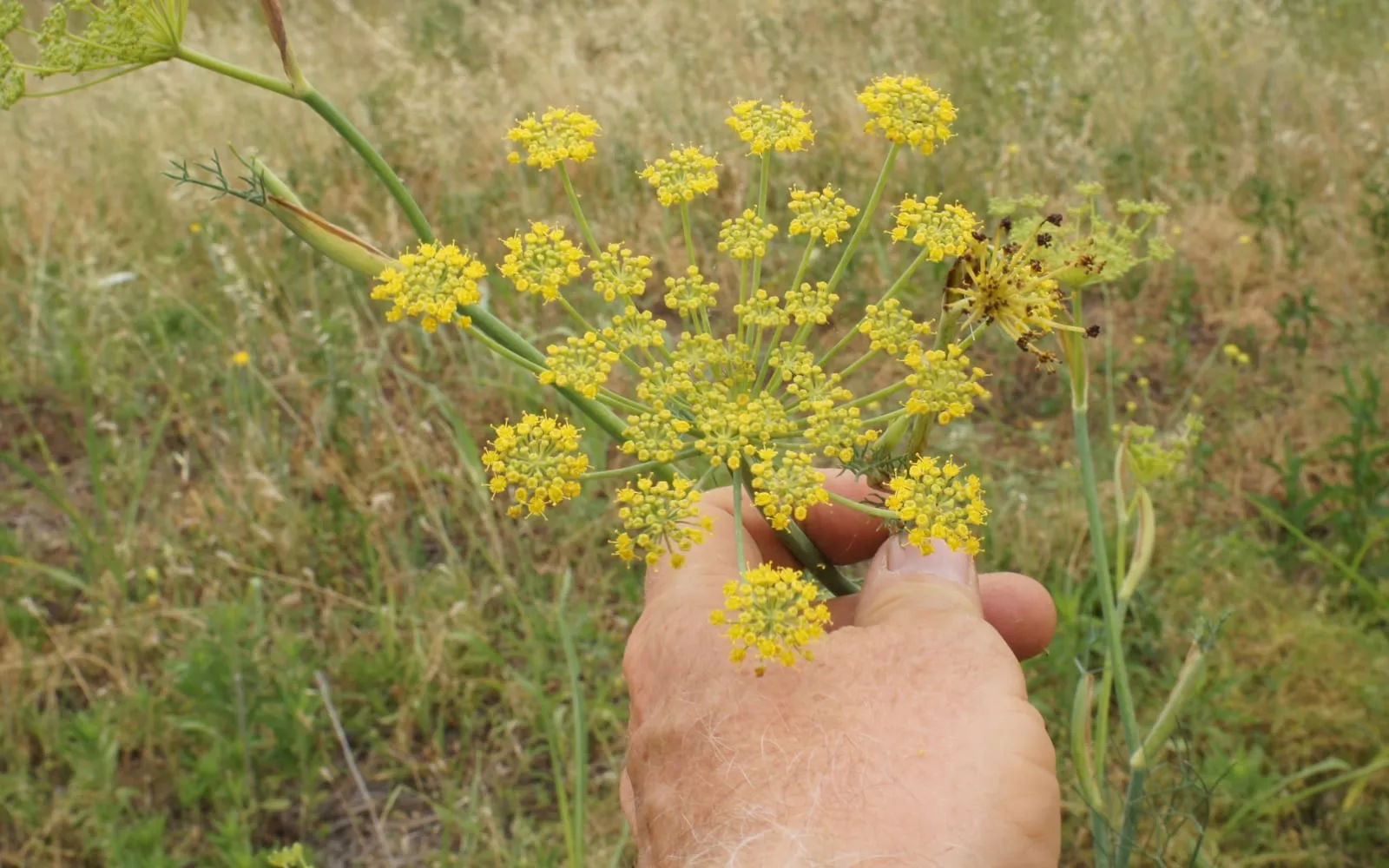
Its yellow flowers help with identification for a reason that has nothing to do with cooking. Fennel is the only common umbellifer in Britain with yellow umbels, which makes it the easiest member of the family to tell apart from hemlock and hemlock water-dropwort at a glance.
Appearance and character
Herb fennel is an upright perennial reaching 1.5 to 2.5 m, dying back to a crown each winter and regrowing in spring.
Foliage is the character. Leaves are divided into very fine thread-like segments, soft and feathery, blue-green in the species and coppery purple in the widely grown bronze form.
Stems are stout, hollow, ridged and glaucous, sometimes with a bluish bloom.
Flowers open from July to September in domed umbels 5 to 10 cm across, made up of many tiny bright yellow florets with no petals to speak of.
Seeds are ridged, oval, greenish turning brown, about 5 mm long, with a strong sweet aniseed flavour.
The whole plant smells powerfully of aniseed when crushed, which is the single most useful field check.
Florence fennel is much shorter, around 60 cm, and forms an overlapping bulb of swollen leaf bases at ground level.
Where it is from
The Mediterranean, growing on dry stony ground, roadsides and coastal cliffs.
It has been cultivated since classical antiquity and is naturalised in Britain, mostly near the coast and on waste ground in the south.
Its dry stony origins explain what it wants. Sun, sharp drainage and no winter waterlogging. It is hardy to about -10 deg C and it dislikes sitting wet more than it dislikes cold.
Fennel is the food plant of the swallowtail butterfly in southern Europe, and elsewhere it draws large numbers of hoverflies and small parasitic wasps to its open umbels.
How it grows
For herb fennel, sow direct in April or May where it is to grow, or plant a container-grown plant in spring. It resents root disturbance, so avoid transplanting established clumps.
Choose full sun and free-draining soil. Give it space at the back of a border, since it reaches head height and is transparent enough to see through.
Cut the stems down in late autumn or leave them standing over winter for insects and cut in early spring.
For Florence fennel, timing is the whole thing. Sow from mid-June to early July, and not before. Sown earlier, the lengthening days trigger flowering and the plant bolts instead of bulbing.
Sow direct rather than transplanting, or use modules and plant out very young, since root disturbance is a second bolting trigger.
Thin to about 30 cm apart, keep the soil consistently moist, and earth up loosely around the swelling bulbs to blanch them.
Harvest bulbs when they are the size of a tennis ball, about twelve to fourteen weeks after sowing, cutting just above ground level. The stump often resprouts useful leafy shoots.
Collect seed from herb fennel in September when the umbels turn brown, and cut the heads off before they scatter if you do not want seedlings.
Through the seasons
Winter is dormancy for herb fennel, which dies back to a crown. Florence fennel is over.
Spring brings new feathery growth from March. Sow herb fennel in April.
Summer is the harvest of leaves and the sowing window for Florence fennel in mid to late June. Flowering starts in July.
Autumn ripens seed in September, and Florence fennel bulbs come in from late September to October.
Care difficulty
Herb fennel is easy to the point of being weedy. Florence fennel is moderate and catches people out.
The bulb crop fails for two reasons, and both are avoidable. Sowing too early puts the plant into flower instead of bulb, and any check to growth, whether from transplanting, drought or cold, does the same.
Herb fennel’s difficulty is the opposite. It seeds prolifically and the taproot makes established plants hard to dig out.
Fennel is also mildly allelopathic and suppresses the germination and growth of some neighbours, so it is not a good companion for beans, tomatoes or seedlings generally. Give it a corner of its own.
Watering
Herb fennel needs watering only in its first season and in prolonged drought.
Florence fennel is the opposite and needs consistent moisture from sowing to harvest. Any dry spell checks growth and triggers bolting, and a bulb that has stalled rarely recovers.
Water Florence fennel deeply two or three times a week in dry weather rather than lightly every day, and mulch to hold moisture.
Avoid waterlogging in winter, which rots the crown of the perennial form.
Warning signs, diseases and pests
Bolting is the main event with Florence fennel. The plant runs up a flower stem and the bulb stays flat and stringy. The causes are sowing before mid-June, transplant shock, drought and cold snaps. Sow late, sow direct and water consistently.
Slugs strip young seedlings, particularly Florence fennel in early growth.
Aphids gather on soft shoot tips and on developing umbels. Predators usually deal with them and a jet of water handles the rest.
Seedlings everywhere is the herb fennel complaint. Cut the umbels off in late August before the seed ripens.
Poor growth in nearby plants may be the allelopathy rather than a disease. Move the fennel or move the neighbours.
Rot at the crown over winter indicates waterlogged soil rather than cold damage.
The plant has few diseases of consequence anywhere.
Growing environment
Full sun. Fennel in shade is drawn, floppy and much less aromatic.
Free-draining soil, moderately fertile. Add grit to clay. Raised beds suit Florence fennel well.
Shelter from strong wind, since herb fennel at 2 m is top-heavy and the hollow stems snap.
Give herb fennel a permanent position away from the vegetable beds, both because it resents disturbance and because of its effect on neighbouring seedlings.
Bronze fennel is worth growing for looks alone and is as useful in the kitchen as the green form. It combines well with grasses and late perennials.
The flowers are excellent for hoverflies and parasitic wasps, so a plant left to bloom earns its place in a kitchen garden as pest control.
Feeding
Dig compost or well-rotted manure into the bed before sowing Florence fennel, which is the only feeding it needs.
Herb fennel needs no feeding at all and grows coarser and floppier if it is fed.
Avoid high-nitrogen fertiliser on Florence fennel, which produces leaf at the expense of a firm bulb.
A liquid feed every fortnight suits Florence fennel grown in a container, where the compost runs out quickly.
Troubleshooting
My Florence fennel bolted instead of making a bulb. Sown too early, or checked by drought, cold or transplanting. Sow from mid-June to early July, sow direct, and keep it evenly watered.
Which fennel did I buy? If it is a tall perennial coming back each year with feathery leaves and no bulb, it is herb fennel. Florence fennel is a short annual grown for the swollen white base.
Is this fennel or something poisonous? Fennel has yellow flowers and smells strongly of aniseed when crushed. Hemlock and hemlock water-dropwort both have white flowers, and hemlock smells rank and mousy. If the flowers are white, it is not fennel.
It has seeded all over the garden. Cut the umbels off in late August before the seed ripens. Dig out unwanted seedlings while the taproot is small.
Nothing grows well near it. Fennel is mildly allelopathic and suppresses some neighbours, particularly seedlings, beans and tomatoes. Give it its own corner.
The bulb is stringy and tough. Usually a check to growth, or harvested too late. Cut bulbs at about tennis ball size.
Can I eat it if I am pregnant? Fennel as a vegetable and a culinary herb is ordinary food. Concentrated fennel essential oil in medicinal doses is generally advised against, which is a different thing.
Is it safe for my cat or dog? The ASPCA lists fennel as toxic to cats, dogs and horses on the basis of stomach upset and photosensitisation from large quantities. A nibbled frond is not a concern.