
Houseplant
Chinese hibiscus
Hibiscus rosa-sinensis
Also known as Rose of China, Tropical hibiscus, Shoeblack plant
How to grow Chinese hibiscus, Hibiscus rosa-sinensis. Flowers that last a day, why bud drop happens, and keeping it through a cool winter indoors.
At a glance
- Difficulty
- Moderate
- Water
- Regular in the growing season, and reduced in winter
- Light
- Bright light with several hours of direct sun
- Temperature
- 18 to 27 deg C, and never below 10 deg C
- Hardiness
- USDA 9-11, RHS H1c, hardy to 7 C
- Type
- Evergreen shrub, long lived and fast growing in warmth
- Height
- 1-2 m indoors
- Native to
- Uncertain, and probably a very old cultivated hybrid of Asian species
- Best month
- January in the Northern Hemisphere, July in the Southern Hemisphere
Of uncertain wild origin and probably an ancient hybrid from tropical Asia. It flowers on new growth, so pruning drives the display, and each bloom lasts a day. Outdoors year round in USDA 9 and warmer, where it is the standard flowering hedge across the tropics.
Hardiness zones describe winter cold alone. Summer heat, humidity, rainfall and the length of the growing season decide as much, so treat the range as the outer limit rather than as a recommendation.
Every month named in this guide is for the temperate Northern Hemisphere. If you garden in the Southern Hemisphere, shift each one by six months, so January becomes July. Closer to the equator the wet and dry seasons matter more than the calendar, and the shift stops being a useful guide.
Not known to be toxic
Chinese hibiscus is one of the safer flowering houseplants. It is not listed by the RHS as a potentially harmful garden plant, and the ASPCA lists Hibiscus rosa-sinensis as non-toxic to cats and dogs, which is a positive assessment rather than merely an absence from the list. The flowers are edible and are used across Asia and the Pacific in salads and as a garnish, and the related Hibiscus sabdariffa provides the calyces used for hibiscus tea and karkade. Horses are the exception, since the ASPCA has recorded gastrointestinal upset in horses eating hibiscus, which does not arise with a houseplant. The plant has a long record of medicinal use in Ayurveda and Chinese medicine, including as a hair treatment and, in some traditions, as a contraceptive, and concentrated extracts are a different matter from the plant on a windowsill. The dark flower pigment was used to polish shoes across parts of Asia, which is where shoeblack plant comes from.
Sources: RHS potentially harmful garden plants, ASPCA toxic and non-toxic plants
About
Each hibiscus flower lasts one day, and a plant that is happy produces them continuously for months.
That is the deal, and knowing it in advance saves a good deal of disappointment. A bloom opens in the morning, is at its best by midday, closes and falls by the following morning. People who expect a flower to last a week assume something is wrong.
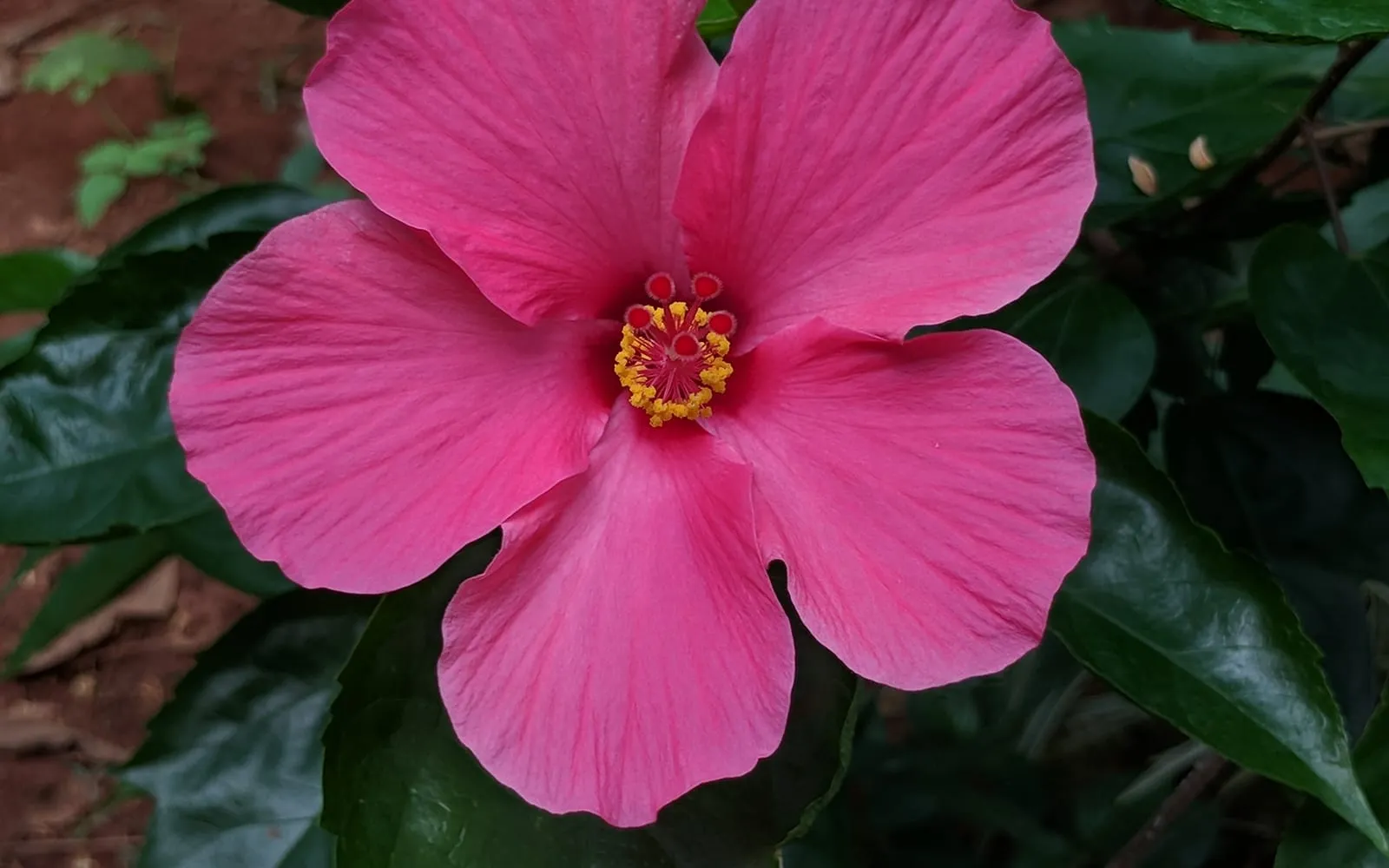
The flowers are worth it. Ten to fifteen centimetres across in scarlet, crimson, pink, apricot, yellow, orange and white, single or double, with a long protruding column of stamens and stigma that gives the genus its unmistakable outline.
Bud drop is the real complaint. A hibiscus covered in fat buds that yellow and fall without opening has usually been moved, chilled, dried out or put in a draught, and the plant is notably sensitive to change.
Keep it warm, bright, evenly watered and in one place, and it flowers from spring into autumn and sometimes right through a mild winter indoors.
It is a tropical plant. The hardy garden hibiscus grown outdoors in cool temperate gardens is Hibiscus syriacus, a different species, deciduous and fully hardy, and the two need entirely different treatment.
Appearance and character
An evergreen shrub reaching 1 to 2 m indoors, bushy and upright, and much larger in the tropics.
Leaves are broadly oval with a pointed tip, 6 to 15 cm long, glossy dark green, with coarsely toothed margins.
Flowers are large and trumpet-shaped, 10 to 15 cm across, with five broad overlapping petals and a long staminal column projecting well beyond them, tipped with five stigmas.
Colours run through scarlet, crimson, deep red, pink, coral, apricot, orange, yellow, cream and white, often with a contrasting dark eye, and doubles and bicolours are widely grown.
Each flower lasts a single day.
Flowering runs from spring to autumn indoors, and continues through winter in a warm conservatory.
Growth is fast in warmth, adding 30 cm or more in a season.
Stems are woody at the base and green at the tips.
Hibiscus syriacus, the hardy garden hibiscus, is deciduous, fully hardy, with smaller lobed leaves and smaller flowers, and it is a completely different plant despite the shared common name.
Where it is from
The wild origin is uncertain and it is probably a very old cultivated hybrid of species from tropical Asia, since no confirmed wild population is known.
It has been cultivated in China, India and across the Pacific for centuries and was carried by Polynesian voyagers throughout the Pacific islands.
It is the national flower of Malaysia, where it is bunga raya, and the state flower of Hawaii is a related native species.
Hibiscus flowers are worn behind the ear across Polynesia and are used in garlands, offerings and cooking.
The name shoeblack plant records the use of the crushed dark flowers as a shoe polish across parts of Asia and the Caribbean.
The plant is in Malvaceae alongside mallow, hollyhock, cotton, okra and lime tree, and the long staminal column is a family characteristic.
Hibiscus sabdariffa, roselle, provides the red calyces used for hibiscus tea, karkade and agua de Jamaica, and it is a different species from the ornamental.
Extensive breeding, particularly in Hawaii, Florida and Australia from the twentieth century, has produced thousands of named cultivars.
How it grows
Grow it in bright light with several hours of direct sun. Flowering is directly proportional to the light it gets, and a plant in shade produces leaves and few flowers. A south or west-facing windowsill or a conservatory is ideal.
Use a rich free-draining loam-based compost in a pot with drainage holes.
Pot into a container only slightly larger than the root ball. Hibiscus flowers better slightly pot-bound.
Water regularly through the growing season, keeping the compost damp without waterlogging, and reduce it in winter when growth slows.
Never let it stand in a saucer of water, and never let it dry out completely, since both cause bud drop.
Keep it above 10 deg C and out of draughts, and away from a radiator and cold glass.
Do not move it once it is in bud. A change of position, temperature or light is the commonest cause of bud drop.
Raise the humidity by standing the pot on a tray of damp pebbles or misting the foliage, avoiding the flowers.
Feed fortnightly from April to September with a high-potash feed such as tomato food. Hibiscus is a hungry plant and general balanced feeds give leaves rather than flowers.
Deadhead spent flowers, which is largely cosmetic since they fall on their own.
Prune in early spring, before growth starts, cutting back by up to a third to keep the plant bushy and in bounds. Hibiscus flowers on new wood, so spring pruning costs no flowers and improves them.
Pinch out the growing tips of young plants to build a bushy shape.
Repot every two years in spring, or top-dress annually.
Stand it outside in a sheltered sunny spot through July and August in a warm summer, hardening it off gradually and bringing it in before the nights turn cold.
Overwinter it indoors above 10 deg C in the brightest position available, watering sparingly, and expect it to drop some leaves.
Propagate from semi-ripe cuttings in summer with bottom heat.
Through the seasons
Winter is a rest period, or continued flowering in a warm conservatory. Water sparingly, stop feeding, and keep it above 10 deg C in good light.
Spring is pruning and repotting season, and growth and flowering start as the light increases.
Summer is the main flowering period, needing bright light, regular water, humidity and fortnightly high-potash feeding.
Autumn continues flowering into October, and this is the point to reduce watering and stop feeding.
Care difficulty
Moderate. Hibiscus grows readily and it is fussy about consistency.
Warmth, bright light, steady moisture and regular feeding are what it wants, and the plant responds to any interruption by dropping its buds.
Bud drop is the recurring frustration and it is almost always a change rather than a disease. Moving the plant, a cold draught, letting it dry out or a sudden temperature swing all cause it.
The winter is the other difficulty, since a cool dim winter provides neither the light nor the warmth the plant wants, and a hibiscus indoors from November to March usually looks tired by spring and recovers once pruned.
Pests under cover are more of a problem than with most houseplants.
Watering
Water regularly through the growing season, keeping the compost damp without waterlogging.
Check with a finger and water when the top 2 to 3 cm has dried.
Reduce watering from October to March, when growth slows, and keep the compost just damp.
Never let it dry out completely, since that causes bud drop and leaf loss.
Never let it stand in a saucer of water, since waterlogging causes yellow leaves and root rot.
Raise the humidity with a pebble tray or by misting the foliage, avoiding the flowers.
Use tepid water rather than cold, and rainwater in a very hard-water area.
Warning signs, diseases and pests
Fat buds yellowing and dropping without opening is bud drop, which is the standard hibiscus complaint. The causes are a change of position, a draught, a sudden temperature change, letting the compost dry out, waterlogging, or a shortage of feed. Keep it in one place, warm, evenly watered and fed.
Flowers lasting a single day is normal rather than a fault.
Yellowing leaves is usually cold, a draught or waterlogging, and occasionally a nutrient shortage.
Few flowers with plenty of leaf growth is insufficient light or a feed too high in nitrogen. Move it into full sun and switch to a high-potash feed.
A cloud of tiny white insects rising when disturbed is whitefly, which is common under cover. Use sticky traps and a biological control.
Sticky leaves with black sooty mould is aphids or whitefly honeydew.
Fine mottling with faint webbing is red spider mite, which thrives in dry air. Raise the humidity and use a biological control.
White cottony masses in the leaf axils is mealybug.
Leaf drop in winter is common and usually a response to low light and cool conditions, and the plant recovers in spring.
Distorted mottled leaves is occasionally hibiscus chlorotic ringspot virus, for which there is no cure. Destroy an affected plant.
Growing environment
Bright light with several hours of direct sun. A south or west-facing windowsill or a conservatory, since flowering is proportional to the light.
A rich free-draining loam-based compost in a pot only slightly larger than the root ball.
18 to 27 deg C, and never below 10 deg C. Keep it away from draughts, cold glass and radiators.
Moderate humidity. A pebble tray or occasional misting helps and reduces spider mite.
Allow 60 cm to 1 m of spread on a mature plant.
It suits a sunny windowsill, a conservatory, a heated greenhouse, a bright porch or a summer patio.
The ASPCA lists it as non-toxic to cats and dogs, which makes it one of the better flowering houseplants for a household with animals.
Grow it with other warmth-loving flowering plants that want the same conditions. Bougainvillea, citrus, gardenia and abutilon all share the light, warmth and high-potash feeding.
Do not confuse it with Hibiscus syriacus, the hardy garden hibiscus, which is fully hardy, deciduous and grown outdoors.
Feeding
Feed fortnightly from April to September with a high-potash feed such as tomato food. This is the single most useful adjustment for flowering.
Avoid general balanced feeds and anything high in nitrogen, which give leaves rather than flowers.
Avoid high-phosphate feeds, which hibiscus growers find can cause problems over time.
Do not feed from October to March.
Repot every two years in spring into fresh compost, or top-dress annually.
Yellowing leaves late in the season with green veins can be a magnesium or iron shortage, and a dose of Epsom salts or sequestered iron addresses it.
Troubleshooting
All the buds fell off before they opened. Bud drop, which is the standard hibiscus problem. It follows any change, including moving the plant, a draught, a temperature swing, drying out, waterlogging or a shortage of feed. Keep it in one place, warm, evenly watered and fed fortnightly.
The flowers only lasted a day. Normal. Each hibiscus flower lasts one day, and a happy plant produces them continuously for months.
Lots of leaves and hardly any flowers. Insufficient light, or a feed too high in nitrogen. Move it into direct sun and switch to a high-potash tomato feed.
The leaves have gone yellow. Usually cold, a draught or waterlogging. Check the position and the drainage. A magnesium shortage is also possible late in the season, and Epsom salts address it.
When should I prune it? Early spring, before growth starts, cutting back by up to a third. Hibiscus flowers on new wood so spring pruning costs nothing and improves the plant.
Is this the same as the hardy garden hibiscus? No. That is Hibiscus syriacus, deciduous and fully hardy, grown outdoors through USDA 5. This is a tropical evergreen that needs to be above 10 deg C.
Can it go outside? Through July and August in a sheltered sunny spot in a warm summer, hardened off gradually. Bring it in before the nights turn cold.
Is it safe for cats and dogs? Yes. The ASPCA lists it as non-toxic to both, which is a positive assessment rather than just an absence from the list.
It looks terrible after the winter. Common. A cool dim winter gives it neither the light nor the warmth it wants. Prune it back by a third in early spring, repot or top-dress, and it recovers quickly.
Chinese hibiscus problem guides
Not sure what is wrong? See the common houseplant pests guide.