
Houseplant
Poinsettia
Euphorbia pulcherrima
Also known as Christmas star, Christmas flower, Mexican flame leaf
How to buy a poinsettia that lasts, keep it alive past January, and get the bracts to colour up again. Plus the truth about whether poinsettias are poisonous.
At a glance
- Difficulty
- Easy
- Water
- Every 5-7 days, when the top 2-3 cm is dry
- Light
- Bright indirect light, 4-6 hours
- Temperature
- 15-22 deg C, never below 12 deg C
- Humidity
- Ordinary room humidity is fine
- Hardiness
- USDA 10-12, RHS H1b, hardy to 13 C
- Type
- Evergreen perennial shrub, sold as a temporary houseplant
- Height
- 30-60 cm as sold, up to 4 m in the wild
- Native to
- Southern Mexico, Guatemala
- Best month
- December in the Northern Hemisphere, June in the Southern Hemisphere
Dry deciduous forest on the Pacific slope of Mexico, where it is a leggy shrub of 4 m rather than a compact pot plant. The red bracts colour in response to long nights, so a plant kept in an evening-lit room will stay green. Fourteen hours of true darkness for eight weeks brings it back.
Hardiness zones describe winter cold alone. Summer heat, humidity, rainfall and the length of the growing season decide as much, so treat the range as the outer limit rather than as a recommendation.
Every month named in this guide is for the temperate Northern Hemisphere. If you garden in the Southern Hemisphere, shift each one by six months, so December becomes June. Closer to the equator the wet and dry seasons matter more than the calendar, and the shift stops being a useful guide.
Harmful if eaten
- Do not eat
- The milky sap
- Harm from
- Eating it, handling it and sap in the eyes
- Affects
- People, cats, dogs and horses
The poinsettia's reputation as a deadly Christmas plant does not survive contact with the evidence. A review of 22,793 reported poinsettia exposures in the United States found no deaths, and 92 per cent of people involved developed no symptoms at all. The story it all rests on, a child said to have died in Hawaii in 1919, was never substantiated. What the plant does have is the milky latex common to every euphorbia. It irritates skin, it stings badly if you rub it into an eye, and eating leaves or bracts can cause a sore mouth and vomiting. The ASPCA lists it for cats, dogs and horses whilst describing its toxicity as generally over-rated. Wash your hands after breaking a stem, keep the sap away from your eyes, and there is no need to banish it from a house with a cat or a toddler, though a cat that chews it will probably be sick.
Sources: ASPCA, RHS potentially harmful garden plants, Krenzelok et al, poinsettia exposure outcomes (1996)
About
Poinsettias outsell every other indoor plant over Christmas, and most of them are in the bin by February. They have a reputation for being temperamental, which they have not earned. Most poinsettias that die in January were damaged before their owner got them home.
The plant is a Mexican shrub that grows three or four metres tall on dry hillsides, cut back hard by growers and drenched in growth regulators to make the compact thing you buy. Left alone it becomes leggy and shrubby, which is what it is supposed to be.
Two facts explain almost everything that goes wrong with it. Cold kills it, and the red parts are leaves.
Appearance and character
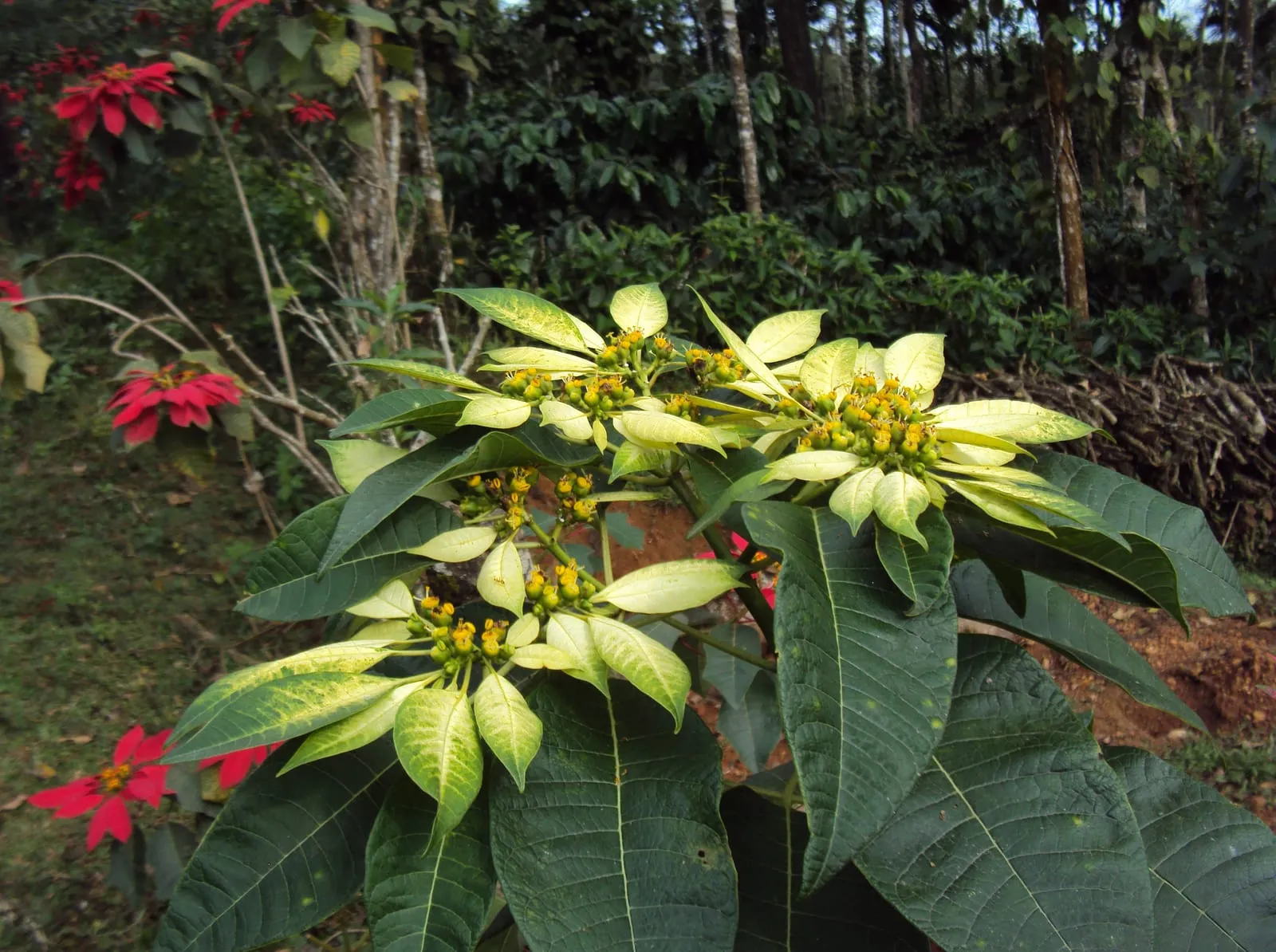
The scarlet, cream, pink or marbled parts are bracts, which are leaves that have given up photosynthesis to do the job of petals. The actual flowers are the knobbly yellow-green cluster at the centre of each rosette, called cyathia, and each one is a tiny cup holding reduced male and female flowers with a yellow nectar gland on the rim.
Those cyathia are how you tell a fresh plant from a spent one in the shop. On a fresh plant they are tight, green-yellow and still closed, with no pollen showing. Once they have shed their pollen and started dropping, the plant is at the end of its display and the bracts will follow within a fortnight. Two plants side by side on a shelf can be a month apart in age, and the bracts alone will not tell you which is which.
Breeding has taken the bracts well past red into cream, apricot, pink, and the speckled and marbled sorts. Some of what you see in shops is glitter and spray paint on a white cultivar. That does the plant no favours, though it survives it.
Where it is from
Southern Mexico and Guatemala, on seasonally dry Pacific slopes rather than in rainforest. It grew up warm, bright and periodically parched.
That origin explains the two mistakes people make. It does not want to be wet, because its ancestors spent months of the year dry. And it has no experience of cold at all, so a night below 12 deg C does damage that shows up as leaf drop a week later, long after you have forgotten the cause.
The common name honours Joel Poinsett, the first United States minister to Mexico, who sent cuttings home in the 1820s.
How it grows
An evergreen perennial shrub, grown commercially as a disposable. Nothing stops you keeping it, and a second-year plant is a taller, looser, more interesting thing than the supermarket dome.
It is a short-day plant, which is the single most important fact about growing it on. The bracts only colour when the plant has had a long enough run of long nights, so its display is triggered by the calendar rather than by feeding or by light levels.
Through the seasons
Winter is the display. Keep it warm, bright and away from draughts, water it sparingly, and do not feed it at all.
Spring is when the bracts fade and drop, usually in February or March. Cut the stems back to about 10 cm, keep the compost barely moist, and let it rest for a few weeks. A pot of bare stubs looks like a dead plant, and it is worth labelling so nobody throws it out.
Summer is growth. Repot into a slightly larger pot, start feeding fortnightly, and pinch out the shoot tips once or twice up to the end of July to build a bushy plant. It can spend warm weeks outdoors in a sheltered, bright spot.
Autumn is the dark treatment, and it starts around the last week of September. From then, the plant needs 14 hours of complete, unbroken darkness every night for eight weeks, with bright light during the day. A cupboard, a cardboard box or a black bin liner from six in the evening until eight in the morning does it. Light leaking in from a hallway or a street lamp for even a few minutes resets the clock, and this is where nearly every attempt at re-flowering fails.
Care difficulty
Easy for the six weeks most people keep it, and a proper project after that.
Getting it to Christmas alive takes almost nothing beyond warmth and restrained watering. Getting it to colour up a second time takes eight weeks of nightly discipline. If yours dropped its bracts in February and you assumed you had killed it, you had not. That is the plant finishing its year on schedule.
Watering
Water when the top 2-3 cm of compost feels dry, which usually falls every five to seven days in a heated room. Use tepid water. Cold water straight from the tap chills the roots of a plant that has no tolerance for it, and leaf drop follows.
Water thoroughly until it runs from the drainage holes, then empty the saucer after ten minutes. The decorative foil sleeve most plants are sold in has no holes in it, so it turns the pot into a bucket. Take the plant out of the sleeve to water it, or cut the bottom off the sleeve.
Ease off once the bracts fade and through the spring rest, then increase again when new growth starts.
Warning signs, diseases and pests
Glasshouse whitefly is the pest that comes home with the plant. Tiny white insects lift off the leaves in a cloud when you brush past, and sticky honeydew with black sooty mould follows on the leaves below. Check the undersides of the leaves in the shop before you buy, because a heavy infestation is easier to avoid than to clear. Yellow sticky traps and a firm rinse deal with mild cases.
Spider mites arrive later, in dry centrally-heated rooms, and show as fine pale speckling and webbing where leaf meets stem.
Fungus gnats mean the compost is being kept too wet. Let the surface dry out properly between waterings and they go.
Root rot from overwatering causes sudden wilting on soil that is plainly damp. By the time you see it the roots are usually brown and soft, and the plant rarely comes back.
Growing environment
Bright indirect light for four to six hours a day. A spot near an east or west window suits it. Direct midday sun through glass scorches the bracts.
Keep it between 15 and 22 deg C. Below 12 deg C it drops its leaves, and the damage is done by brief exposure rather than by sustained cold. Never buy one from a display outside a shop door, off a forecourt, or from a chilled porch. Ask for it sleeved for the walk to the car, and do not leave it in a cold boot.
Then keep it away from the two things that kill it indoors. Draughts from opening front doors, and radiators, which cook one side of the plant and dry the air around it.
Ordinary room humidity is fine. Poinsettias are often listed as wanting 60 to 80 per cent, which describes Mexican hillside air in the wet season and not what the plant needs from your living room.
Feeding
Do not feed it while it is in flower. The plant is finished growing for the year and the fertiliser goes nowhere except into the compost as salt.
Start feeding in spring once you have cut it back and new shoots appear. A balanced liquid feed at half strength every fortnight through spring and summer builds the plant that gives you next winter’s display. Stop when the dark treatment begins in late September.
Water first, then feed. Fertiliser onto dry roots burns them.
Troubleshooting
Leaves dropping within days of getting it home. Cold damage on the journey, or a draught where it now sits. There is no fix once it starts. Buy sleeved and keep it away from the front door.
Lower leaves yellowing and falling. Overwatering, most likely with the pot sitting in its foil sleeve. Check the pot drains.
Wilting on damp compost. Root rot. Tip it out and look at the roots. Brown and mushy means it has gone.
Bracts fading and dropping in February. Normal. Cut back to 10 cm and start the year again.
Bracts stayed green this year. The dark treatment was interrupted. Even a brief light during those 14 hours prevents colouring, and a hall light or a torch is enough.
Tall and leggy by autumn. Not pinched out. Take out the growing tips once or twice during summer and stop by the end of July.
Sticky leaves with black mould. Whitefly honeydew. Deal with the whitefly and the mould washes off.
Poinsettia problem guides
Not sure what is wrong? See the common houseplant pests guide.