
Pest
Oak processionary moth
Thaumetopoea processionea
Also called OPM, Oak processionary caterpillar, Processionary moth
Caterpillars in a nose-to-tail procession up an oak trunk, and white silk nests on the trunk or a branch fork. Their hairs cause rashes and breathing trouble, so this is a page about reporting it and keeping away rather than dealing with it.
At a glance
- Type
- Pest
- Cause
- Insect
- Severity
- Weakens the plant
- Affects
- Garden plants
- Active
- April to July
- Established in
- Europe and Asia
What you are seeing
- Caterpillars moving nose to tail in a long single-file procession up a trunk or along a branch
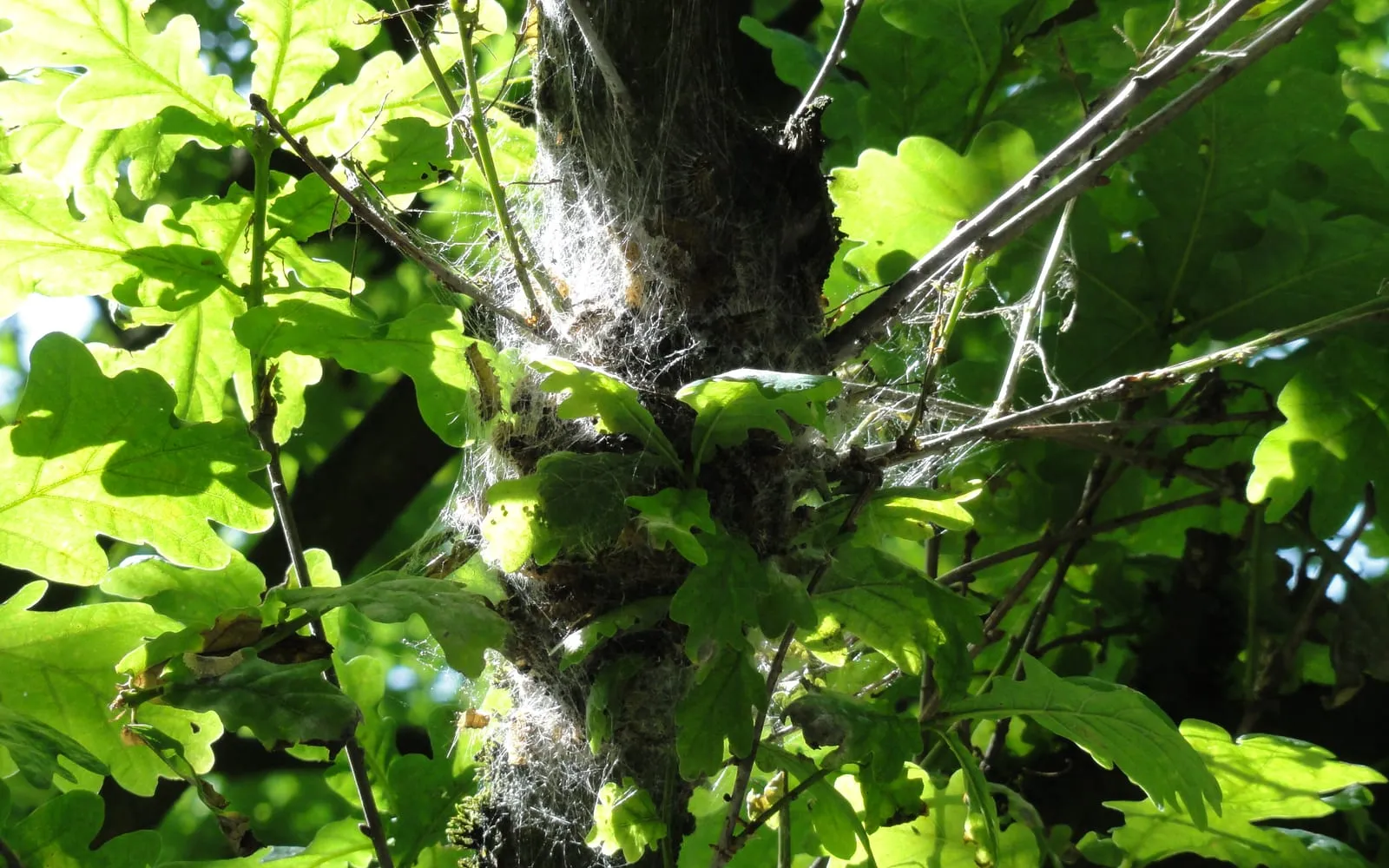
- Dense white silk nests the size of a fist or larger on the trunk or in a branch fork
- Nests that look like a pocket of dirty white felt rather than a loose web
- Caterpillars grey with a dark stripe down the back, covered in long white hairs
- Oak leaves stripped to the veins, worst in the upper crown
- Old nests staying attached to the bark for months after the caterpillars have gone
- Rashes, itching or eye irritation in people who have been under an affected tree
Before you treat anything
This is the most hazardous organism covered on this site. Each caterpillar carries several hundred thousand tiny barbed hairs containing thaumetopoein, which cause itchy rashes, conjunctivitis, sore throats and, in some people, breathing difficulty. Reactions do not need contact with the caterpillar, because the hairs are shed and carried on the wind, and they stay active in old nests and in the ground beneath for months or years. Dogs are affected through the nose and mouth and can be seriously hurt. Keep away, keep animals away, do not disturb the nests, and seek medical or veterinary advice for anything beyond a mild rash.
Keep away from it and report it
This page is shorter on treatment than most, because there is nothing a gardener should do beyond reporting the sighting and keeping people and animals away.
In England, report through TreeAlert to the Forestry Commission, and check whether the tree is inside or outside the current demarcated area, because the legal duty differs and the boundary moves each year. In North America, Australia and New Zealand, where the moth is absent, contact the national plant health authority or the exotic plant pest hotline. Elsewhere in Europe, contact the local plant health or municipal authority.
Removal is done by licensed operators wearing respiratory protection, who vacuum or fix the nest and dispose of it as hazardous waste. It is not a ladder and a bin bag.
What you are looking at
Caterpillars moving in a long single-file line, head to tail, up a trunk or along a branch. The procession is the sign the moth is named for and nothing else in a temperate garden does it.
The nests are the other sign. Dense white silk pads, often the size of a fist and sometimes much larger, sitting flat against the trunk or tucked into a branch fork. They look like matted felt rather than the loose airy webbing a spider or an ermine moth makes, and they discolour to grey-brown with age.
The caterpillars are grey with a dark stripe down the back and are covered in long white hairs. They feed on oak leaves and can strip a crown, working from the top down.
Old nests stay stuck to the bark for months after the caterpillars have gone, and they are still dangerous.
The hairs are the hazard
Each caterpillar carries several hundred thousand tiny barbed hairs from its third stage onwards, containing a protein called thaumetopoein.
The hairs cause itchy rashes, conjunctivitis, sore throats and, in some people, breathing difficulty. They are shed continuously, blow on the wind, and settle in the ground layer under an affected tree, so people are affected who have never touched a caterpillar or seen a nest.
That is why the advice includes not mowing, strimming or leaf-blowing beneath the tree. Disturbing the ground layer puts a season of shed hairs back into the air.
Dogs come off worst because they investigate with the nose and mouth. A dog that has been under an affected tree and is drooling, pawing at its face or swelling around the muzzle needs a vet rather than a wait-and-see.
If you have been exposed, wash your skin and hair, and wash the clothing separately at a high temperature. Hairs cling to fabric and go on causing reactions from a jumper that has been put back on.
What it does to the tree, which is less than you would think
A heavy infestation strips an oak’s leaves, and a stripped oak in June looks finished. Most healthy oaks refoliate later in the summer and survive.
Repeated defoliation over several years weakens a tree and leaves it open to other problems, so this is not harmless to the tree. Set against the health risk to people and animals, though, the tree is the smaller concern, and the control effort is aimed at the hairs rather than at saving the oak.
The moth reached Britain around 2005, most probably on imported semi-mature oaks for landscaping, which is also how it has made its longer jumps across Europe. Anyone planting oak of any size should buy from an inspected source, and that decision matters more than anything done afterwards.
What to do about it
Report it, through TreeAlert in England or the plant health authority where you are.
Keep children and dogs away from the tree and the ground under it, and mark the area off.
Leave the nests alone, old ones included.
Do not mow, strim or blow leaves beneath an affected tree.
Do not prune, fell or move oak material from the site.
Wash skin, hair and clothing separately after any exposure.
See a doctor for anything beyond a mild rash, and a vet for an affected dog.
Buy semi-mature oaks only from an inspected source.
What it gets mistaken for
Ordinary defoliating caterpillars scatter over the foliage, build no felted trunk nest and never form a procession.
Ermine moth webbing is loose, airy and drapes over whole branches of blackthorn, hawthorn or spindle rather than sitting as a dense pad on an oak trunk.
Galls are the tree’s own tissue, firm and attached.
Box tree caterpillar is bright green with a black head, webs box, and is harmless to handle.
Leaf miners work inside the leaf and leave the surface intact.
Not established in North America, Australia and New Zealand
Do not prune, spray or otherwise treat a suspected case. Doing so risks spreading an organism the country has kept out, and it disturbs the evidence needed to identify it. Photograph what you can see, leave the plant alone, and contact your national or state plant health authority. The control advice further down this page is written for regions where this problem is already established.
Native to central and southern Europe and moving north, with populations established in the Netherlands, Belgium, Germany and around London. Reporting duties apply inside Europe as well as outside it. In England it is notifiable outside the established zone and sightings go to the Forestry Commission through TreeAlert, so a reader in Yorkshire has a duty a reader in Richmond does not. Check the current demarcated area rather than assuming, since it changes each year.
What to do, in order
The steps below apply where this problem is already established.
Start here
Prevention, and the changes that stop the problem returning. Most of these pages should end at this tier.
- Report it, and do not attempt to deal with it
- In England report through TreeAlert to the Forestry Commission, and check whether you are inside or outside the current demarcated area, since the duty differs. In North America, Australia and New Zealand, where the moth is absent, contact the national plant health authority or the exotic plant pest hotline. Elsewhere in Europe contact the local plant health or municipal authority. Removal is a job for trained operators in respiratory protection and it is not a garden task.
- Keep people and animals away from the tree
- Rope off or otherwise mark the area under an affected tree and keep children and dogs out of it. Hairs fall from the nests and the caterpillars and collect in the ground layer, so the ground beneath matters as much as the tree.
- Do not mow, strim or blow underneath it
- Anything that stirs the ground layer puts shed hairs back into the air in quantity, which is how bystanders who never touched a caterpillar end up affected. Leave the ground alone until the site has been dealt with.
- Do not prune, fell or move oak from an affected site
- Moving infested material spreads the moth, and the long-distance jumps it has made in Europe have been on semi-mature oaks moved for landscaping. Where a statutory notice applies it will set out what may be moved.
- Buy semi-mature oaks only from an inspected source
- The London outbreak is thought to have arrived on imported oak trees. For anyone planting oak at any size, provenance is the single decision that matters here.
Then reach for a barrier
Netting, hand removal and water. Nothing here harms anything except the target.
- Leave the nests alone, including the old ones
- A nest keeps its hairs long after the caterpillars have left, and an abandoned nest knocked down in autumn still causes reactions. Removal is done by licensed operators who vacuum or spray-fix the nest and dispose of it as hazardous waste. Knocking one down with a stick is how people are hurt.
- Wash and change if you have been exposed
- Where someone has been under an affected tree, wash the skin and hair and wash the clothing separately at a high temperature. Hairs cling to fabric and go on causing reactions from clothing that has been put back on.
Then bring in the predators
Encourage what already lives in the garden, and buy predators in where the problem is under glass and nothing will arrive on its own.
- Leave the birds and the parasitoids alone
- Cuckoos and a few other birds eat the caterpillars despite the hairs, and several parasitic wasps and flies attack them. None of this controls an outbreak and all of it helps, so broad-spectrum treatment of an oak is counterproductive as well as unnecessary.
Biological controls are live organisms and their sale and release are regulated country by country. An agent sold freely in one place may be unapproved in another, so buy from a licensed supplier where you live and never import or move one yourself.
Plants affected
Guides that name it among the problems to watch for. The list is the plants it is characteristic of rather than everything it will feed on.