
Edible
Radish
Raphanus sativus
Also known as Summer radish, Mooli, Daikon, Winter radish
How to grow radish, Raphanus sativus. The fastest crop in the garden, why they go woody or all leaf, and sowing winter radishes for storage.
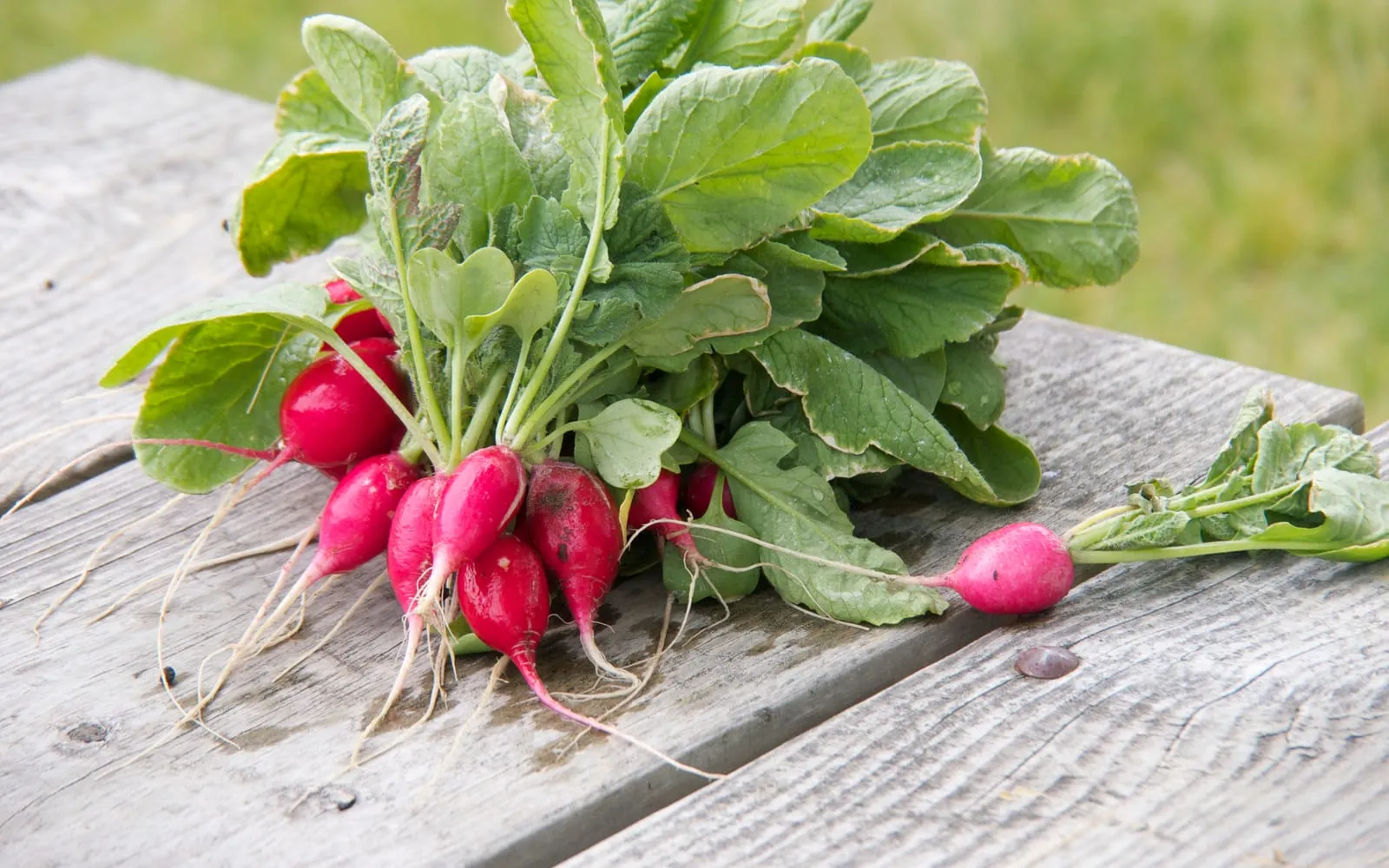
At a glance
- Difficulty
- Easy
- Water
- Regular and steady, since fluctuation splits the roots
- Light
- Full sun in spring and autumn, and light shade in midsummer
- Temperature
- Hardy, and summer radishes germinate readily in cool soil
- Hardiness
- USDA 2-11, RHS H5, hardy to -8 C
- Type
- Annual, ready in three to six weeks from sowing
- Height
- 15-25 cm for summer types, and 40 cm for winter types
- Native to
- South-east Asia, and cultivated across Asia and Europe since antiquity
- Best month
- May in the Northern Hemisphere, November in the Southern Hemisphere
Summer radish germinates in soil barely above 5 deg C, which makes it the first crop of the year in a cold garden. Heat and long days turn the root pithy and split it, and above about 25 deg C it flowers instead of swelling. Winter radish is sown late and stores in the ground.
Hardiness zones describe winter cold alone. Summer heat, humidity, rainfall and the length of the growing season decide as much, so treat the range as the outer limit rather than as a recommendation.
Every month named in this guide is for the temperate Northern Hemisphere. If you garden in the Southern Hemisphere, shift each one by six months, so May becomes November. Closer to the equator the wet and dry seasons matter more than the calendar, and the shift stops being a useful guide.
Not known to be toxic
Radish is a food crop and carries no toxicity concern for people. It is not listed by the RHS as a potentially harmful garden plant, and the ASPCA does not list Raphanus sativus as toxic to cats and dogs, though a dog eating a quantity of raw radish may get an upset stomach from the mustard oils. Those mustard oils, which are glucosinolates and their breakdown products, are what give radish its heat, and they are the same class of compound found in mustard and horseradish. They are harmless in the amounts anybody eats and they are irritant in concentrated form. The leaves are edible and are used in soup and pesto, and their roughness comes from stiff hairs rather than anything harmful. Fodder radish grown as a green manure and grazed by livestock carries the same brassica considerations as other forage brassicas, which do not arise with a garden crop. Where a plant is unlisted rather than positively assessed, read that as no hazard recorded, and in the case of a vegetable eaten across Eurasia for millennia the position is straightforward.
Sources: RHS potentially harmful garden plants, ASPCA toxic and non-toxic plants
About
Radish goes from seed to plate in three to four weeks, which makes it the fastest thing you can grow and the obvious first crop for a child.
That speed is also the whole of its difficulty. A radish left in the ground a week past ready goes woody, hollow and fiercely hot, and the window between perfect and ruined is short. Sowing a short row every two weeks matters more than sowing a long one once.
The two other failures are both about growing conditions. All leaf and no root means too much nitrogen, too much shade or too much crowding. Splitting means the soil went dry and then got wet.
None of that is hard to avoid. Steady water, no fresh manure, thin the row, and pull them young.
Winter radishes are a different crop. Mooli and daikon are the long white Asian types, and black Spanish and China rose are the round storage types, all sown in midsummer for autumn and winter use. They reach the size of a parsnip, they store for months, and they are far more useful than the speed of the summer sort suggests.
Radish also works as a catch crop, sown between slower vegetables and pulled before they need the room.
Appearance and character
An annual forming a rosette of rough hairy leaves above a swollen root that sits partly above the soil.
Summer radishes are small and quick, ready three to six weeks from sowing, in round, oval and long shapes. Colour runs through scarlet, red and white, pink, purple, yellow and white-tipped red.
‘French Breakfast’ is the long red type with a white tip, ‘Scarlet Globe’ and ‘Cherry Belle’ are the round red ones, and ‘Sparkler’ is red with a white base.
Winter radishes are much larger, sown in midsummer and lifted in autumn. Mooli and daikon are long white roots up to 40 cm, black Spanish is a round black-skinned white-fleshed root, and China rose is pink.
Leaves are rough, hairy, lobed and edible, and they are used in soup and pesto.
The flesh is white in most cultivars, crisp when young, and it goes pithy and hollow when the root is over-mature.
Flowers are pale lilac or white with four petals, on branching stems, and the young seed pods are edible and pleasantly hot, particularly in the cultivar ‘Rat’s Tail’ grown for pods rather than roots.
Where it is from
South-east Asia, with the wild ancestor uncertain, and cultivated across Asia and the Mediterranean since antiquity.
Egyptian records mention radish being fed to the workers building the pyramids, and the Greeks and Romans grew it widely.
The Asian winter radishes, mooli and daikon, are the older and larger form, and the small fast European summer radish is a comparatively recent selection dating from around the sixteenth century.
Daikon is central to Japanese cooking, eaten raw, cooked, dried and pickled, and Japan grows more radish by weight than any other vegetable.
Radish is in Brassicaceae alongside cabbage, mustard and turnip, which is why flea beetle finds it and why it should be rotated with the brassicas rather than with the roots.
The heat comes from glucosinolates converted to isothiocyanates when the tissue is damaged, which is the same chemistry as mustard and horseradish.
Fodder radish is grown as a green manure and a soil-breaking crop, since the root penetrates compacted subsoil.
How it grows
Do not manure the ground for radish. Freshly manured or heavily nitrogen-fed soil produces leaves at the expense of roots. Grow them on ground manured for a previous crop.
Rake to a fine tilth and remove stones, which fork the roots.
Sow a short row every two weeks from March to September. Succession sowing is the best thing you can do with the crop. A metre of row at a time is plenty for most households.
Sow thinly, 1 cm deep, in rows 15 cm apart, or broadcast thinly in a patch.
Thin to 2.5 cm apart as soon as the seedlings can be handled. Crowded radishes make leaves and no root, and this is the commonest reason a row disappoints.
Water regularly and steadily, keeping the soil damp. Fluctuation between dry and wet splits the roots.
Provide light shade for midsummer sowings, from a taller crop or a shade net, since heat and drought cause bolting and heat in the root.
Sow winter radishes in July and August, thinning to 15 cm for mooli and 20 cm for the round storage types, and lift them from October.
Pull summer radishes as soon as they are ready, at about 2 cm across for the round types. A few days late and they go woody and hot.
Check the row every two or three days once they start to swell.
Lift winter radishes in late autumn and store them in boxes of damp sand in a cool shed, or leave them in the ground under a straw mulch in a mild area.
Use radish as a catch crop, sown between rows of slower vegetables such as parsnips or brassicas and pulled before the main crop needs the space.
Sow radish along a row of parsnips as a row marker, since it germinates in days and parsnip takes weeks.
Rotate with the brassicas rather than with the root crops, since radish shares their pests and diseases.
Through the seasons
Winter is storage and eating for winter radishes, and the ground is empty of summer types.
Spring starts the sowing from March, and early sowings under cloches crop in April.
Summer is the main sowing and cropping season, with light shade needed for midsummer sowings, and July and August are when winter radishes go in.
Autumn takes the last summer sowings in September and lifts the winter radishes from October.
Care difficulty
Easy, and the easiest crop in the vegetable garden.
It germinates in days, crops in weeks, needs no feeding and no support, and a child can grow it successfully.
The three things that go wrong are all straightforward. Thin the row, keep the water steady, and pull them young.
Flea beetle is the only pest of consequence and it is cosmetic on a fast crop.
Winter radishes are equally easy and take longer.
Watering
Water regularly and steadily, keeping the soil damp at all times.
Fluctuation is what causes splitting. A dry spell followed by heavy watering or rain splits the roots open.
Water in the morning and give a thorough soak rather than a light daily sprinkle.
Midsummer sowings need the most attention, since drought makes the roots woody and hot as well as triggering bolting.
Winter radishes need steady water through their longer growing period.
Warning signs, diseases and pests
Leaves peppered with small round holes, worst on seedlings in dry spring weather, is flea beetle. It is cosmetic on a fast crop and can kill seedlings in a bad year. Keep the soil damp, which discourages it, and cover the row with fine insect mesh.
Plenty of leaf and no root is too much nitrogen, too much shade or crowding. Do not manure the ground, thin to 2.5 cm, and grow them in sun.
Roots split lengthwise is fluctuating moisture. Water steadily.
Woody, hollow, pithy roots with a fierce heat is over-maturity. Pull them younger and sow shorter rows more often.
A flower stem rising from the centre is bolting, caused by heat, drought or crowding. Pull the plant and sow again in cooler conditions.
Forked or distorted roots is stony soil or fresh manure. Remove stones and grow on ground manured for a previous crop.
Tunnels through the root is cabbage root fly larvae, which affects radish as a brassica. Net the crop with fine insect mesh.
Swollen distorted roots on a stunted plant is club root, which affects radish as a brassica. Rotate with the brassica bed and lime to pH 6.5 to 7.
Harlequin bug drains the leaves into pale cloverleaf-shaped blotches across the southern and central United States, where it can overwinter, and turns up further north as a seasonal visitor. It has not established outside the Americas.
Growing environment
Full sun in spring and autumn, and light shade in midsummer.
Light, moisture-retentive, free-draining, stone-free soil that was manured for a previous crop rather than freshly enriched.
Hardy, and summer radish germinates readily in cool soil, which is why it is one of the first things sown in March.
Thin to 2.5 cm apart for summer types, 15 cm for mooli and 20 cm for round winter types, in rows 15 to 30 cm apart.
It suits a vegetable bed, a raised bed, a container, a windowbox or a gap between slower crops.
Rotate with the brassicas rather than the roots, since radish shares club root and cabbage root fly with the cabbage family.
Use it as a catch crop and as a row marker. Radish germinates in days, so a few seeds sown along a parsnip row shows where the row is weeks before the parsnips appear.
Grow winter radishes for a crop that keeps into the new year and does something quite different from the summer type.
Feeding
None needed for summer radishes, and feeding them is counterproductive.
Nitrogen produces leaves at the expense of roots, which is the commonest reason a row makes tops and nothing else.
Grow them on ground manured for a previous crop rather than freshly enriched.
Winter radishes benefit from reasonably fertile soil, since they occupy the ground for several months, and they should still not be given fresh manure.
Feed container-grown radishes lightly with a balanced liquid feed if the compost is old.
Troubleshooting
All I got was leaves. Too much nitrogen, too much shade or crowding. Do not manure the ground for radish, thin the row to 2.5 cm apart as soon as you can handle the seedlings, and grow them in full sun.
They went woody and hot. Left in the ground too long. Radishes go from perfect to woody in a few days. Check the row every two or three days once they start swelling, and sow a short row every fortnight rather than a long one once.
The roots split. Fluctuating moisture, usually a dry spell followed by rain or heavy watering. Keep the soil evenly damp.
The leaves are full of tiny holes. Flea beetle, which is worst on seedlings in dry spring weather. Keep the soil damp and cover the row with fine insect mesh. It is cosmetic on a fast crop.
How often should I sow? A short row every two weeks from March to September. Radishes do not wait and a single long row goes over before you eat it.
What is a winter radish? Mooli, daikon, black Spanish and China rose are large radishes sown in July and August, lifted in autumn and stored for months. They are a different crop from the fast summer sort and worth growing.
Can I eat the leaves? Yes. They are rough and hairy raw, and they are good in soup or made into pesto.
Where do they fit in a rotation? With the brassicas rather than the roots, since radish is in the cabbage family and shares club root and cabbage root fly with it.
Can I grow them in a pot? Easily, in any container 15 cm deep, in compost that is not heavily fed. They are a good windowbox crop.
Radish problem guides
Not sure what is wrong? See the common vegetable pests guide.