
Pest
Leaf miners
Also called Holly leaf miner, Allium leaf miner, Leaf mining moth
Leaf miners leave pale tunnels and brown blotches while both leaf surfaces stay intact. Sprays rarely reach larvae inside leaves, so control depends on removing affected leaves and clearing leaf fall where it helps.
At a glance
- Type
- Pest
- Cause
- Insect
- Severity
- Weakens the plant
- Affects
- Garden plants, Herbs and edibles, Houseplants
- Active
- March to October
- Established in
- Worldwide
What you are seeing
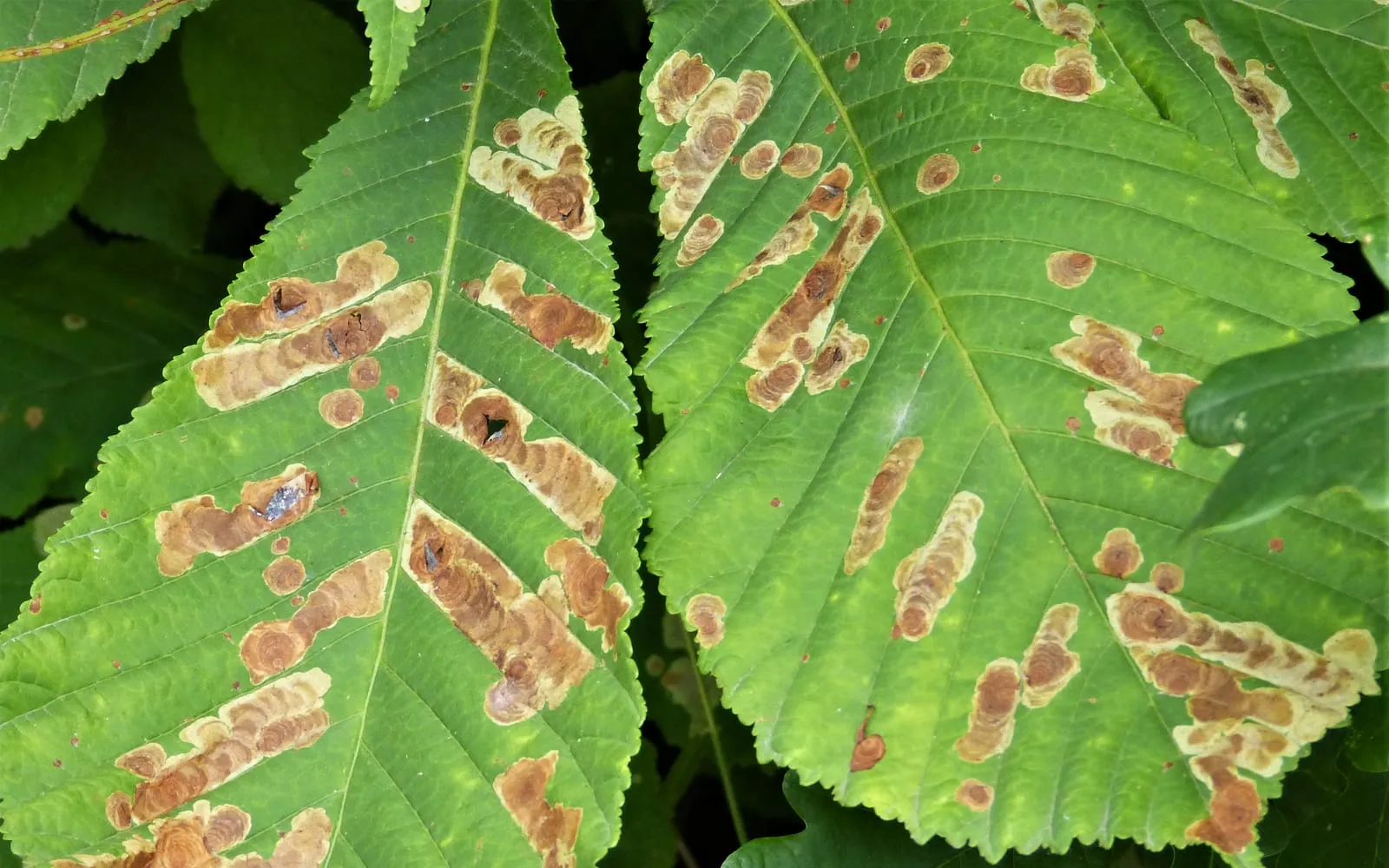
- Pale winding lines or brown blotches with both leaf surfaces still whole over them
- A dark thread of droppings visible inside the tunnel when the leaf is held to the light
- A grub or a flat pupa showing through the leaf surface at the end of a mine
- Horse chestnut foliage going brown from midsummer and falling by early September
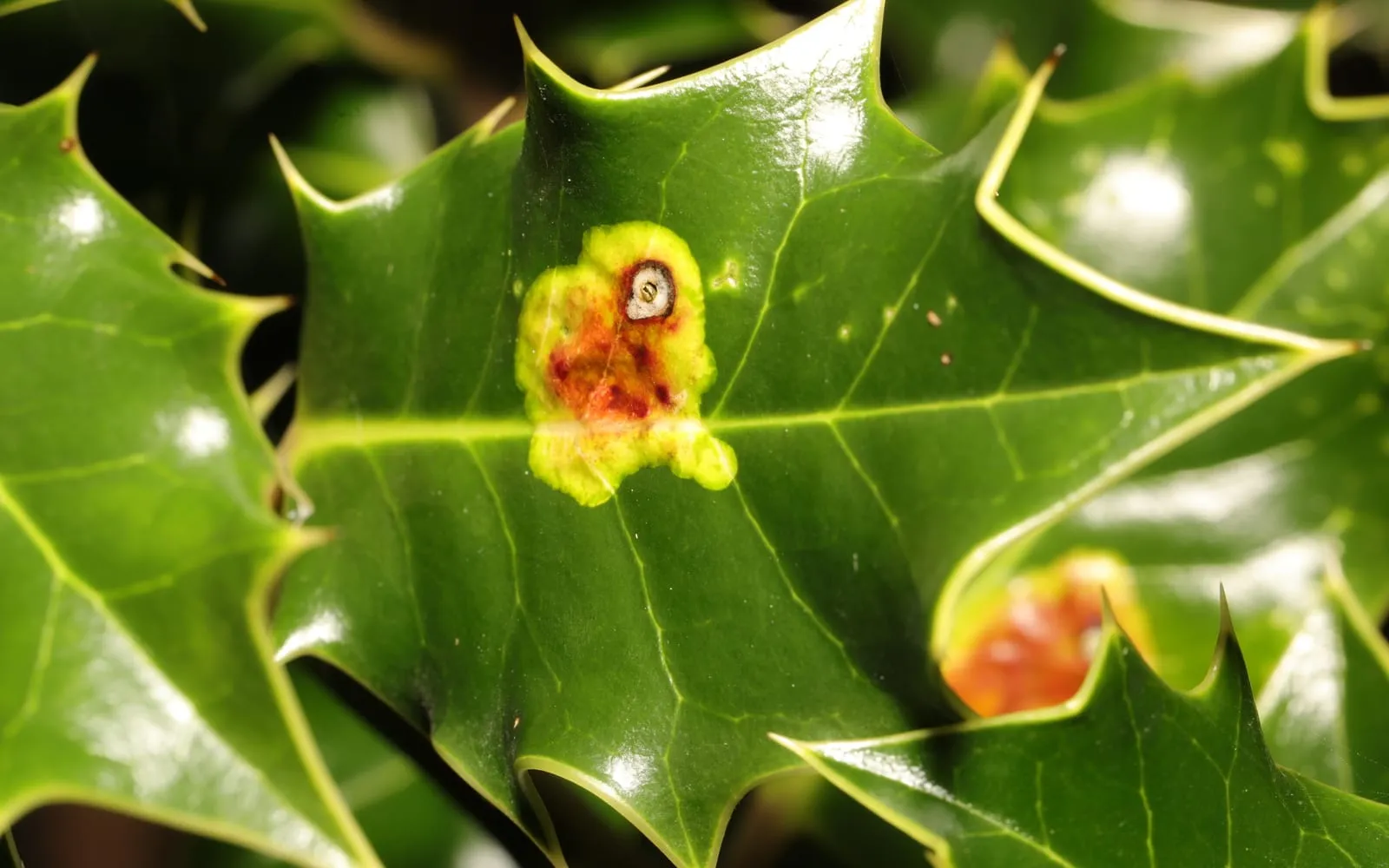
- Yellow blotches on holly leaves, one to a leaf, each with a dark centre
- Leeks and onions with white streaks down the leaves and small brown pupae inside the stem
- Beetroot, chard and spinach with dried papery patches spreading between the veins
Before you treat anything
Nothing here is harmful. Leaves from a mined horse chestnut are safe to compost so long as the heap is hot enough or the bag stays sealed until the following summer.
What you are looking at
A leaf is two skins with a layer of green tissue between them. A leaf miner is a grub small enough to live inside that layer, eating it away while leaving both skins in place. What shows on the surface is the empty chamber underneath, pale or brown, with the leaf still whole over the top of it.
Hold the leaf up to the light. A dark thread running down the middle of the tunnel is the trail of droppings, and a small pale grub or a flat brown pupa usually sits at the end where the feeding is still going on.
Mines come in two shapes. A serpentine mine winds across the leaf getting wider as the grub grows, and turns up on chrysanthemums, lilac and citrus. A blotch mine spreads as a patch, and that is what horse chestnut, holly and beetroot carry.
Which ones are worth your attention
Horse chestnut leaf miner is the one everybody sees. It reached Britain in 2002 and is now across most of England and into Wales and Scotland. From July the leaves fill with brown blotches until whole avenues look autumnal in August, and by early September the trees are bare. Two decades of watching this has shown the trees survive it. Growth slows a little and the conkers come smaller, and the tree leafs out normally the next spring.
Allium leaf miner is the one that costs you a crop. It arrived in the same decade and has spread quickly through England. Larvae tunnel down into a leek or onion, pupate inside the stem as small brown capsules, and the wounds let in the rots that turn the plant to slime. A row of leeks can be written off.
Beet leaf miner runs through beetroot, chard and spinach in late spring, drying patches of leaf to brown paper. Roots still bulk up under moderate damage.
Holly leaf miner has been here always, causes one yellow blotch per leaf, and harms nothing.
Why spraying does not work
The grub sits between two waterproof layers of leaf. A contact insecticide lands on the outside of those layers and stays there, so the insect it is aimed at never meets it. This is the reason leaf miners have a reputation for shrugging off treatment.
Products that move inside the plant would reach them, and none is sold to amateurs for use on a tree of any size. Spraying a chestnut of thirty metres is outside what any garden sprayer can do in any case.
What does happen when a garden is sprayed is that the parasitic wasps hunting the miners are killed. Those wasps sit on the leaf surface and lay through it into the grub, so they are exposed to everything the miner is protected from. Britain’s native parasitoids have been building up on the horse chestnut moth since it arrived, and every spray sets that back.
What to do about it
Rake the leaves up under a horse chestnut in autumn and stop the pupae inside them from flying next spring. Seal them in a bag, bury them, or get the heap hot. This is the only measure that reduces next year’s numbers.
Cover leeks and onions with insect-proof mesh from planting, and keep it sealed at the edges. Two flights, one in spring and one in autumn, both need excluding.
Pull affected leeks and bin them rather than composting them.
Pick mined leaves off beetroot, chard, spinach and chrysanthemums while there are few, or squash the grub through the leaf where you want to keep the foliage.
Leave the holly alone.
Leave a mature horse chestnut alone too. It looks dreadful in August and it will be green again in May.
What it gets mistaken for
Bleeding canker on horse chestnut is the serious disease of the same tree, and it shows as rusty or black sticky patches weeping down the trunk and main branches. Anyone worried about a chestnut should look at the bark rather than the leaves.
Leaf scorch browns the margins and tips of leaves first, and the dead tissue is dry all the way through when you feel it between finger and thumb. A mine is hollow and the surface over it stays flexible.
Rust and leaf spots break through the leaf surface and shed spores onto a finger rubbed across them.
Sawfly and caterpillar damage takes tissue away from the outside and leaves holes and chewed edges.
Leaf blotch of horse chestnut, a fungus, produces irregular brown patches with yellow edges as well. Those patches cross the veins freely, whereas the miner is penned in between them and its blotches run in neat lengthways strips.
What to do, in order
Start here
Prevention, and the changes that stop the problem returning. Most of these pages should end at this tier.
- Rake up and destroy fallen horse chestnut leaves
- The moth spends the winter as pupae inside the dead leaves under the tree, and it is the one intervention with real evidence behind it. Collect the leaves in autumn and compost them in a sealed bag, in the hot centre of a heap, or under a covering that stops the adults flying out in spring. A tree in a garden with no other chestnut nearby can be kept noticeably cleaner this way.
- Decide whether a horse chestnut needs anything at all
- The mining looks appalling and does very little. Trees have carried heavy infestations for two decades in Britain without dying, and the measurable cost is a smaller conker. A mature tree with brown leaves in August is having a bad summer rather than a fatal one, and spending money on it is rarely worthwhile.
- Rotate leeks and onions away from last year's ground
- Allium leaf miner pupates in the crop and in the soil where the crop stood. Moving the row is worth doing, though the adults fly far enough that rotation alone will not hold it.
- Pull and destroy affected leeks rather than composting them
- The brown pupae sit inside the stem, so a leek dropped on the heap seeds next spring's generation. Bin them, burn them, or bury them deep.
- Sow beetroot, chard and spinach early or late
- Beet leaf miner is at its worst on soft growth from late spring to midsummer. Crops sown early enough to be established, or late enough to come after the main flights, take much less damage.
Then reach for a barrier
Netting, hand removal and water. Nothing here harms anything except the target.
- Cover leeks and onions with insect-proof mesh
- Allium leaf miner flies in two periods, roughly March to May and again from October to November, and mesh fine enough to exclude it, laid over hoops from planting, is the only reliable defence. Seal the edges into the soil and lift it only on ground that grew no alliums the year before.
- Pick off mined leaves as they appear
- On beetroot, chard, spinach and chrysanthemums the larva is still inside the leaf, so removing the leaf removes the insect. This works while the numbers are small and is worth ten minutes a week on a row.
- Squash the larva through the leaf
- Hold a mined leaf up to the light, find the grub at the growing end of the tunnel, and press it between finger and thumb. Faster than picking on a plant you would rather keep the foliage of.
Then bring in the predators
Encourage what already lives in the garden, and buy predators in where the problem is under glass and nothing will arrive on its own.
- Leave the parasitic wasps to it
- Native parasitoid wasps lay into leaf-mining larvae through the leaf surface and account for a large share of them in an unsprayed garden. They have been slow to build up on the horse chestnut moth because it is a recent arrival, and they are steadily catching up. Insecticide sprayed on the foliage kills the wasps and cannot reach the miner.
Biological controls are live organisms and their sale and release are regulated country by country. An agent sold freely in one place may be unapproved in another, so buy from a licensed supplier where you live and never import or move one yourself.
In pictures
Plants affected
Guides that name it among the problems to watch for. The list is the plants it is characteristic of rather than everything it will feed on.
A common tomato problem
This is one of the problems tomato growers meet most often. See it alongside the other pests, diseases and disorders on the tomato guide.
Common tomato problems