
Disease
Fusarium wilt
Fusarium oxysporum
Also called Fusarium, Fusarium yellows, Basal rot, Vascular wilt
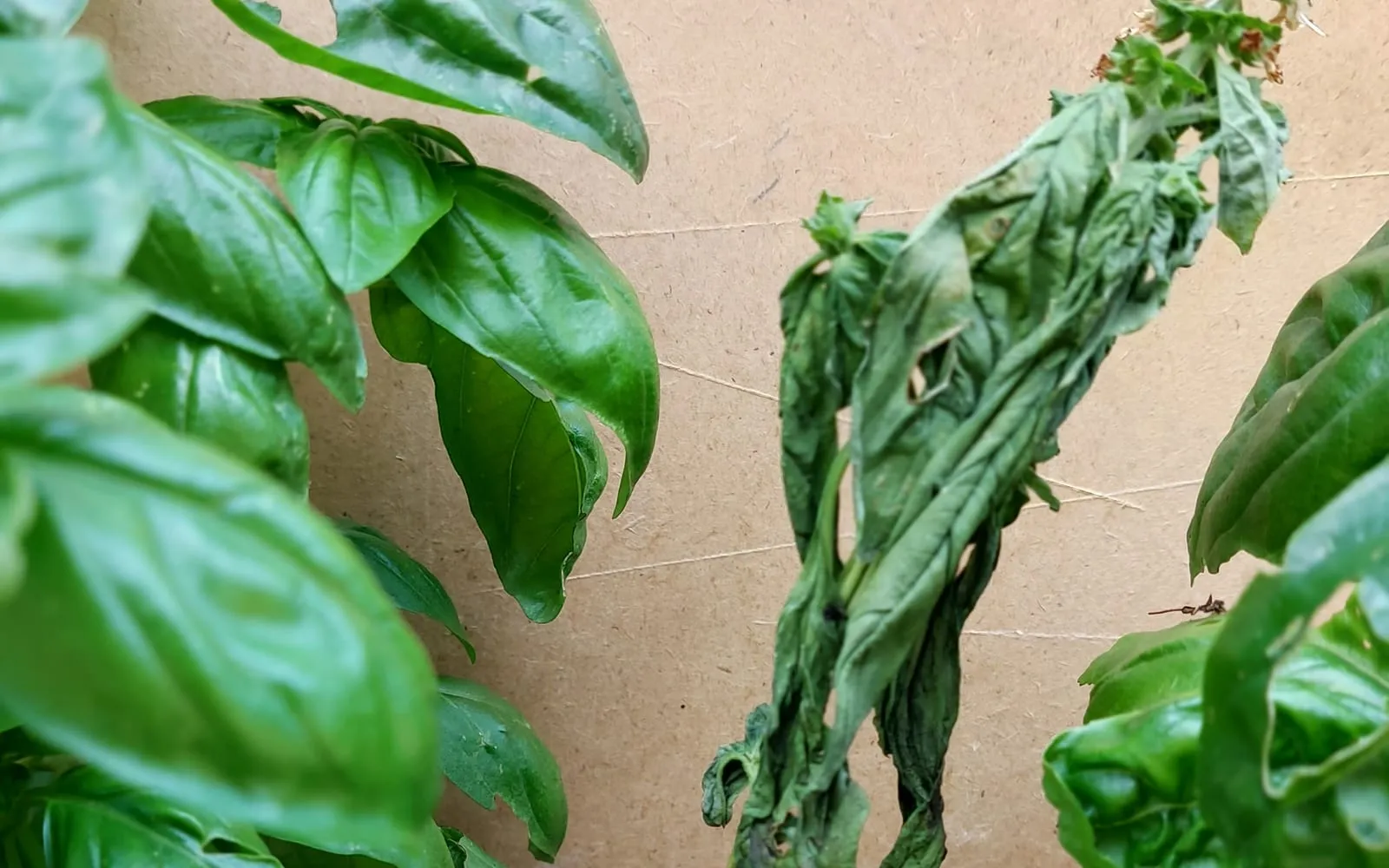
Lower leaves yellow and die while the plant wilts in the heat and recovers overnight. Cut the stem and the water-carrying tissue is stained brown. The fungus is host-specific, so what killed the tomatoes will not touch the beans.
At a glance
- Type
- Disease
- Cause
- Fungus
- Severity
- Can kill the plant
- Affects
- Garden plants, Herbs and edibles, Houseplants
- Active
- June to September
What you are seeing
- Oldest lowest leaves yellowing first and the yellowing working upwards
- Wilting in the heat of the day with recovery overnight, until one day there is no recovery
- Yellowing and wilting on one side of the plant, or one side of a single leaf
- A brown or reddish-brown stain in a ring inside the stem when you cut it across
- The stain visible well up the stem rather than only at the base
- Growth stunted and the plant carrying small unripe fruit that never fills
- Worst in hot weather and on light soils, and slow or absent in a cool summer
- Roots and stem base sound and firm, with no rot at ground level
Before you treat anything
Fruit from an infected plant is safe to eat. Some Fusarium species produce mycotoxins in stored grain, which is a different problem from this one and a reason to keep stored cereals dry, rather than a reason to avoid a tomato.
What you are looking at
The lowest leaves yellow first. The yellowing works up the plant while the top still looks well, and the dead leaves hang on the stem rather than dropping cleanly.
The plant wilts in the heat of the afternoon and stands back up overnight. That goes on for days or weeks, each day a little worse, until one morning it has not recovered.
Often one side goes before the other. A single branch, one half of the plant, or even one half of a leaf either side of the midrib.
Cut the main stem across, 10 to 20 cm above the soil. A ring of tissue just inside the bark is stained brown or reddish-brown, and in a Fusarium plant that stain usually runs a long way up the stem.
The roots and the stem base are firm and sound. Nothing is rotting at ground level.
Blocked plumbing
The fungus lives in soil and enters through the fine roots, often through a wound made by a nematode or by cultivation. From there it grows into the xylem, the tissue that carries water from the roots to the leaves.
Inside the xylem it multiplies and spreads upward, and the plant responds by plugging its own vessels with gums and gels to wall the infection off. Between the fungus and the plant’s own blockade, the water supply is throttled.
That is why the plant wilts in the afternoon and recovers at night. In the heat the leaves lose water faster than the damaged plumbing can replace it. At night demand falls and the plant catches up. As more vessels block, the recovery gets shorter, and then it stops.
The brown stain in the cut stem is the blocked and discoloured vascular tissue itself.
Fusarium or verticillium
These two produce almost the same picture in the plant and the same brown ring in the stem, and they are the classic pair to separate.
Temperature is the most useful difference. Fusarium is a warm-weather disease, running hardest in soil above about 24 deg C, so it worsens through high summer. Verticillium prefers cooler conditions, often shows in early summer, and can stall when the real heat arrives. A wilt that appeared in June and eased in August was probably verticillium; one that got steadily worse through August was probably Fusarium.
The staining differs in degree. Fusarium tends to stain darker and reach higher up the stem, while verticillium staining is often faint and confined to the lower stem.
Host range is the other difference and it runs the other way. Verticillium has a very wide host range, so it moves between unrelated crops. Fusarium is narrow, which is the subject of the next section.
The strain that killed your tomatoes is harmless to everything else
Fusarium oxysporum is a single species divided into more than a hundred formae speciales, each of which attacks one host or a narrow group of related plants and nothing else.
Fusarium oxysporum f. sp. lycopersici kills tomatoes and cannot touch a cucumber. The one that kills basil does nothing to lettuce. The one that ended the Gros Michel banana trade is a banana pathogen and is covered on its own page.
For a gardener this is unusually good news, and it is the practical difference between this and the diseases it gets confused with. A bed that has lost a tomato crop to Fusarium is available for beans, brassicas, roots and onions straight away. Honey fungus and Phytophthora cinnamomi offer nothing comparable, since both have host lists in the thousands.
What the specificity does not do is let you clear the ground. The fungus persists for many years as thick-walled resting spores, so the tomatoes will meet it again whenever they come back round. That is what resistant cultivars and grafted rootstocks are for.
What to do about it
Cut a stem across and look for the brown ring before deciding anything.
Buy cultivars labelled F, FF or FFF, which is the whole answer for tomatoes.
Graft onto a resistant rootstock where infested ground has to be used, and keep the union above the soil.
Grow in containers of fresh compost for a small crop.
Pull out infected plants with their roots, bag them and take them away.
Plant anything unrelated in the same bed without hesitation.
Rotate to reduce the load, while expecting rotation alone to fall short.
Sow early enough to crop before the real heat where the climate allows it.
Feed with nitrate rather than ammonium nitrogen on ground with a history.
Test before liming, and lime for the soil rather than for the disease.
Wash tools, boots and canes between beds.
What it gets mistaken for
Verticillium wilt looks nearly identical and runs in cooler weather, with fainter staining lower down the stem.
Bacterial soft rot dissolves the tissue into foul-smelling slime.
Root rot from overwatering browns and softens the roots and the collar.
Drought wilts a plant in dry soil and it recovers on watering.
Clubroot swells brassica roots into knobbly clubs.
Root-knot nematodes bead the roots and open the wounds this fungus enters through, so the two often occur together.
What to do, in order
Nothing available to a gardener will cure this once a plant has it. The steps below are about limiting the spread and deciding what to plant in its place.
Start here
Prevention, and the changes that stop the problem returning. Most of these pages should end at this tier.
- Grow resistant cultivars, which is the whole answer for tomatoes
- Tomato cultivars carrying resistance are labelled with an F, or FF and FFF where they resist more than one race, usually alongside V for verticillium and N for nematodes. On ground with a history this ends the problem outright, and it costs nothing beyond reading the seed packet. Resistant cultivars exist for peas, melons, spinach, basil and several others.
- Rotate long, and accept that rotation alone will not clear it
- The fungus survives in soil for many years as thick-walled chlamydospores, so a three-year rotation moves the crop rather than starving the fungus. It reduces the load and it will not clear infested ground. Where the ground is known to be infested, resistance and grafting do the work and rotation supports them.
- Take comfort in how specific it is
- Fusarium oxysporum is divided into formae speciales, each of which attacks one host or a narrow group. The strain that killed the tomatoes cannot touch the beans, the brassicas or the onions. A bed that lost a tomato crop is available for anything else, and that is a real difference from honey fungus or from a root-rotting Phytophthora.
- Do not lime a soil in the hope of stopping it
- Raising the pH is often recommended and does very little on its own, while it can lock up iron and manganese and make the plant worse. Test before liming and lime for the soil rather than for the disease.
- Grow through the cool of the season where you can
- The fungus needs warm soil, and infection runs hardest above about 24 deg C. An early crop that fruits before the heat arrives often escapes. In a cool summer the same infested bed may produce a normal crop, which is why the disease appears to come and go.
- Avoid heavy nitrogen in ammonium form
- Ammonium feeding acidifies the root zone and worsens Fusarium wilt, while nitrate forms do not. Where a bed has a history, feed with a nitrate-based fertiliser rather than pushing sulphate of ammonia into it.
Then reach for a barrier
Netting, hand removal and water. Nothing here harms anything except the target.
- Cut a stem across and look at the ring
- Slice through the main stem 10 to 20 cm above the soil. Healthy tissue is pale and even. In a Fusarium plant a ring of the water-carrying tissue just inside the bark is stained brown to reddish-brown, and it often runs a long way up the stem. That stain is the diagnosis, and it rules out root rot, drought and every leaf disease at once.
- Pull out and destroy the affected plants
- Nothing cures an infected plant and every day it stands adds spores to the soil. Take out the roots with it, bag it and take it away rather than composting it.
- Graft onto a resistant rootstock
- Grafted tomatoes, melons and cucumbers on resistant rootstocks are sold widely and are the standard answer where infested ground has to be used. Keep the graft union above the soil line, since a scion rooting into the ground bypasses the rootstock and the protection.
- Grow in containers of fresh compost where the ground is infested
- For a small crop this sidesteps the problem entirely, and it is more reliable than any amendment applied to the bed. Use new compost, since reused compost from an infected crop carries the fungus.
- Clean tools, boots and canes between beds
- The fungus moves in soil, on tools and on old canes and string kept from an infected crop. Washing the canes or replacing them is worth more than it sounds.
Plants affected
Guides that name it among the problems to watch for. The list is the plants it is characteristic of rather than everything it will feed on.
A common tomato problem
This is one of the problems tomato growers meet most often. See it alongside the other pests, diseases and disorders on the tomato guide.
Common tomato problems