
Disease
Tomato spotted wilt virus
Orthotospovirus tomatomaculae
Also called TSWV, Spotted wilt, Tomato spotted wilt, Bronze leaf
Tomato spotted wilt virus causes pale rings on fruit and bronze young leaves. Thrips spread it only if they acquired the virus as larvae, so removing infected plants matters more than spraying adults late.
At a glance
- Type
- Disease
- Cause
- Virus
- Severity
- Can kill the plant
- Affects
- Garden plants, Herbs and edibles, Houseplants
- Active
- April to September
- Established in
- Worldwide
What you are seeing
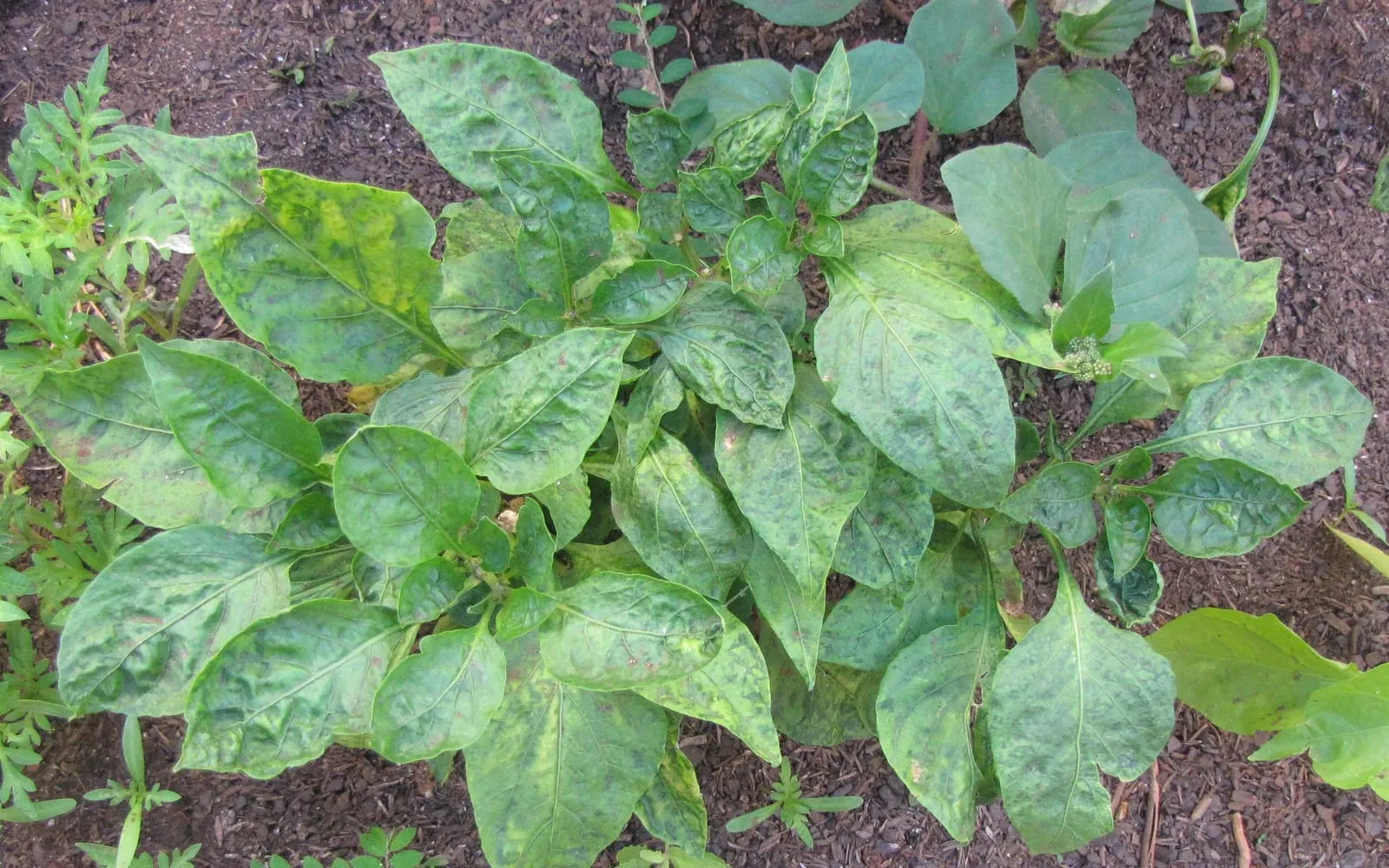
- Pale or brown concentric rings on the fruit, like a target, on green and ripe fruit alike
- A bronze or purple-brown cast over the young leaves before any spotting appears
- Small dark ringspots and blotches on the leaves, often with the veins staining brown
- Dark streaks running up one side of the stem and the growing tip dying back
- One side of the plant affected and the other side growing normally
- Plants stunted and never recovering, with the whole plant lost from one infected shoot
- Bought bedding or pot plants showing it within weeks of coming home
Before you treat anything
Fruit from an infected plant is safe to eat where it is worth picking at all, and the rings are unappetising rather than harmful. Nothing on this page is hazardous.
What you are looking at
Pale rings on the fruit, in concentric circles like a target, sometimes brown and sometimes yellow-orange. They show on green fruit and stay through ripening, and they sit flat in the skin rather than sinking into it.
Before that, the young leaves take on a bronze or purple-brown cast, as though someone had breathed on them. Small dark ringspots follow, the veins stain brown, and dark streaks run up one side of the stem. The growing tip often dies back.
A common pattern is one side of the plant collapsing while the other side keeps growing, because the infection entered through one shoot and spread from there.
The symptoms vary more than almost any other plant disease, and they vary by host, by cultivar and by the age of the plant when it was infected. On a lettuce it is brown flecking and one-sided stunting, on a peanut it is ring patterns and dwarfing, on a chrysanthemum it is dark line patterns. The concentric rings on tomato fruit are the one sign that holds.
The larvae carry it, the adults cannot pick it up
Thrips spread this virus, and they are the only thing that does. The detail that decides the advice is which thrips, and when.
A thrips can only acquire the virus as a first or second-stage larva feeding on an infected plant. Once it has done so, it carries the virus for the rest of its life and infects every plant it feeds on as an adult. An adult that has never fed on an infected plant as a larva can feed on one all day and will never transmit anything.
Killing adult thrips on a diseased plant therefore does far less than it appears to. The insects doing the damage grew up somewhere else, arrived already infectious, and will have fed before any spray reaches them. Denying the larvae an infected plant to grow up on is the control that works, which means pulling out diseased plants and clearing the weeds that carry the virus silently.
Western flower thrips is the main vector and the one that carried the disease around the world on the ornamental plant trade in the 1980s. It is resistant to most insecticides available to amateur growers, which closes off the obvious route a second time.
Where it comes into a garden
Seed does not carry the virus, and it survives poorly on hands and tools, which rules out the routes tobacco mosaic uses.
It arrives on a plant. Bought bedding, pot chrysanthemums, cyclamen, dahlias, gloxinias and busy lizzies come out of glasshouses where western flower thrips lives, and a plant can carry the virus for weeks without showing it. Put that plant in the greenhouse with the tomatoes over winter and the tomatoes are next.
It also sits in weeds. Chickweed, sowthistle, dandelion, fat hen and the wild nightshades all host the virus, often without symptoms, and thrips breed in them. A weedy strip beside the bed is a reservoir that reinfects the crop every year regardless of how clean the plants were when they went in.
What to do about it
Pull an infected plant as soon as you are confident, bag it and take it off the plot.
Clear the weeds in the bed and along its edges, since that is where the virus overwinters.
Keep bought ornamentals out of the greenhouse the tomatoes will grow in.
Raise your own plants from seed, which cannot carry it.
Grow tomatoes with the Sw-5 gene, and treat a resistant pepper as partial cover in a hot climate because Tsw resistance fails above about 30 deg C.
Fit thrips-proof mesh at around 0.15 mm on greenhouse vents.
Hang blue sticky traps to know when adults arrive.
Lay reflective mulch under young plants.
Introduce Amblyseius mites early, before the thrips build up, and add Orius where numbers are already high.
Do not spray adult thrips and expect the spread to stop.
What it gets mistaken for
Mosaic viruses mottle the leaf light and dark green and leave the fruit unringed.
Thrips damage on its own silvers and stipples the leaf with black frass specks, and the plant carries on growing.
Hormone weedkiller drift twists and cups the leaves and never marks the fruit.
Blossom end rot sinks one leathery patch into the base of the fruit.
Verticillium wilt takes one side of the plant and stains the inside of the cut stem brown.
Fungal leaf spots spread outward from a centre and eventually hole the leaf.
What to do, in order
Nothing available to a gardener will cure this once a plant has it. The steps below are about limiting the spread and deciding what to plant in its place.
Start here
Prevention, and the changes that stop the problem returning. Most of these pages should end at this tier.
- Pull infected plants out as soon as you are sure
- An infected plant is a reservoir that every thrips larva hatching on it can pick the virus up from, so leaving it standing while you decide is how one plant becomes a row. Bag it, take it off the plot and do not compost it near the crop. The plant will not recover, and nothing you apply changes that.
- Keep the weeds down, in the crop and around it
- Chickweed, sowthistle, dandelion, fat hen and nightshades all carry the virus without looking ill, and thrips breed in them. A weedy border beside a tomato bed is where the infection sits between one crop and the next, and clearing it does more than anything sprayed on the crop.
- Keep ornamentals away from the tomatoes
- Bought bedding, pot chrysanthemums, cyclamen, dahlias and gloxinias are the commonest way the virus arrives in a garden or a greenhouse, because they are grown in the same nurseries where western flower thrips lives. Do not overwinter ornamentals in the greenhouse the tomatoes go into, and inspect anything new before it joins them.
- Grow resistant cultivars, and know where the resistance stops
- Tomatoes carrying the Sw-5 gene resist most strains and are widely available. Peppers carrying Tsw are resistant too, but that resistance breaks down in sustained heat above about 30 deg C, so it holds in a cool summer and fails in a hot one. A reader in a hot climate should treat a resistant pepper as a partial measure rather than a guarantee.
- Start with clean plants
- The virus is not carried in seed, so plants raised from your own seed start clean. Most garden outbreaks arrive on a bought plant, which makes raising your own the strongest single measure available.
- Take out the first infected plant in a greenhouse without waiting
- Under glass the thrips population is continuous and the spread is faster than outdoors. One plant removed in the first week costs a plant, and the same plant left for a month costs the house.
Then reach for a barrier
Netting, hand removal and water. Nothing here harms anything except the target.
- Hang blue sticky traps to know what you have
- Thrips are drawn to blue more than yellow. Traps will not control a population and they tell you when adults arrive, which is when the weeding and the inspecting need to start.
- Use insect mesh on greenhouse vents
- Thrips are small enough to walk through ordinary netting, so this needs mesh sold as thrips-proof at around 0.15 mm. It is the one barrier that keeps a clean house clean.
- Lay reflective mulch under the crop
- Silver or aluminium-faced mulch confuses thrips approaching from above and reduces how many land on young plants. It works best early in the season while the plants are small and the ground is still showing.
- Do not try to spray your way out of it
- Killing adult thrips on an infected plant does not stop transmission, for the reason set out below, and western flower thrips is resistant to most of what an amateur can buy. Removal and hygiene do the work here.
Then bring in the predators
Encourage what already lives in the garden, and buy predators in where the problem is under glass and nothing will arrive on its own.
- Introduce predatory mites early in the season
- These mites eat first-stage thrips larvae, which is the stage that acquires the virus, so they cut transmission as well as feeding damage. Introduce them before the population builds rather than in response to it, because they work slowly and will not rescue a heavy infestation.Amblyseius cucumeris and Amblyseius swirskii are sold across Europe and North America for greenhouse thrips. Australia and New Zealand approve far fewer species and prohibit releasing an unapproved one, so check the local register rather than importing.
- Add Orius predatory bugs where thrips numbers are already high
- Orius takes adult thrips as well as larvae and works faster than the mites, and it needs warmth and flowering plants to establish. Use it alongside the mites rather than instead of them.Sold in Europe and North America for glasshouse crops. Restricted or unavailable in Australia and New Zealand.
Biological controls are live organisms and their sale and release are regulated country by country. An agent sold freely in one place may be unapproved in another, so buy from a licensed supplier where you live and never import or move one yourself.
Plants affected
Guides that name it among the problems to watch for. The list is the plants it is characteristic of rather than everything it will feed on.
A common tomato problem
This is one of the problems tomato growers meet most often. See it alongside the other pests, diseases and disorders on the tomato guide.
Common tomato problems