
Edible
Runner Bean
Phaseolus coccineus
Also known as Scarlet runner, Painted lady
How to grow runner beans, Phaseolus coccineus. Building the support, why the flowers drop without setting, picking to keep them coming, and why you must never eat them raw.
At a glance
- Difficulty
- Easy
- Water
- Copiously once flowering starts, every two or three days
- Light
- Full sun, with shelter from strong wind
- Temperature
- 15-25 deg C. Killed by frost
- Hardiness
- USDA 7-11, RHS H2, hardy to 0 C
- Type
- Tender perennial, grown as an annual where frost comes
- Height
- 2.5-3 m
- Native to
- Highlands of Central America, from Mexico to Panama
- Best month
- May in the Northern Hemisphere, November in the Southern Hemisphere
It sets pods in cooler weather than french bean and stops setting above about 27 deg C, which reverses the usual order and makes it the better bean in a cool maritime summer and the worse one in a hot continental climate. The tuberous root survives a mild winter and shoots again. Dry air at flowering costs the set, so spraying the flowers is worth the trouble.
Hardiness zones describe winter cold alone. Summer heat, humidity, rainfall and the length of the growing season decide as much, so treat the range as the outer limit rather than as a recommendation.
Every month named in this guide is for the temperate Northern Hemisphere. If you garden in the Southern Hemisphere, shift each one by six months, so May becomes November. Closer to the equator the wet and dry seasons matter more than the calendar, and the shift stops being a useful guide.
Toxic if eaten
- Safe to eat
- The cooked pods, and the cooked mature seeds
- Do not eat
- Raw pods and raw seeds
- Harm from
- Eating it
- Affects
- People, cats and dogs
Runner beans are food once cooked and genuinely dangerous raw. Like other Phaseolus beans they contain phytohaemagglutinin, a lectin that clumps red blood cells and irritates the gut lining. Eating raw or lightly cooked beans causes violent vomiting and diarrhoea within a few hours, and as few as four or five raw seeds have been enough to hospitalise an adult in recorded cases. Boiling destroys the lectin, and boiling is the operative word. Slow-cooking at a low temperature can raise the toxicity rather than reduce it, because the lectin is activated at temperatures below boiling and never reaches the heat that would destroy it. Bring dried seeds to a rolling boil for at least ten minutes. Fresh sliced pods cooked normally are entirely safe, and the risk in a garden is a child grazing raw pods off the plant. The same warning covers pets. Teach children to pick beans into a bowl rather than eat them at the row.
Sources: RHS potentially harmful garden plants, ASPCA toxic and non-toxic plants
About
Britain grows runner beans as a vegetable and much of the world grows them as a flower. The plant arrived from Central America in the seventeenth century and spent its first hundred years here as an ornamental climber, admired for the scarlet flowers and ignored as food.
They are the most productive thing you can grow in a small space, because the crop goes upward. A double row two metres long and three metres high will feed a household from July to October.
The rule that governs the whole season is picking. Keep cutting young pods and the plant keeps flowering, and leave pods to swell their seeds and it stops.
Appearance and character
A vigorous twining climber reaching 2.5 to 3 metres, winding anticlockwise up anything it can reach. It does not have tendrils, so the stem itself does the climbing and needs something narrow enough to grip.
Leaves are large and made of three broad heart-shaped leaflets, mid-green and slightly rough.
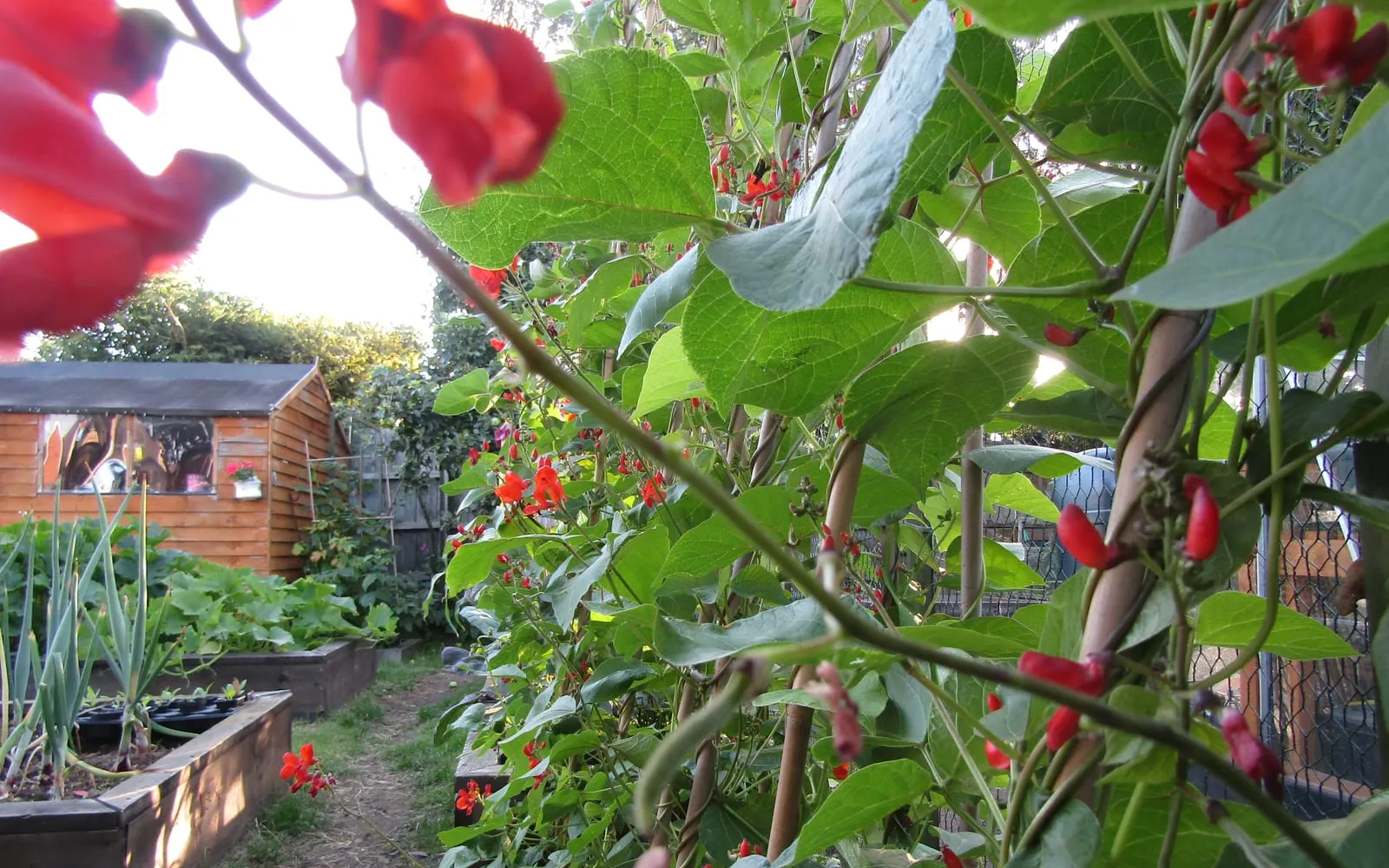
Flowers come in clusters on long stalks, scarlet in most varieties, and also white in ‘White Lady’ or bicoloured red and white in ‘Painted Lady’. White flowered varieties are said to set better in hot weather.
Pods are long, flat and rough-textured, 20 to 30 cm when ready, mid-green and sometimes streaked with purple.
Underground the plant makes a fleshy tuberous root. In its native highlands it is a perennial that dies back and regrows, and a lifted root will survive a cold winter in a frost-free shed if you want to try it.
Where it is from
The mountains of Central America, from Mexico south to Panama, where it grows at 1,000 to 2,000 metres and has been cultivated for at least two thousand years.
That highland origin is why it dislikes heat. Runner beans set pods best between about 15 and 25 deg C, and a heatwave with dry air makes the flowers drop without setting, which is the commonest complaint about them anywhere.
It is a true perennial there, dying back to the tuberous root in the dry season and resprouting with the rains.
Wet, cool, humid summers suit it, which is why Britain grows better runner beans than most of southern Europe.
Frost kills the top growth outright, so the season is bounded by the last frost in May and the first in October.
How it grows
Sow from mid-April indoors in deep pots or root trainers, two seeds per pot, about 5 cm deep. Sow direct outdoors from late May once the soil has warmed.
Germination takes a week to ten days in warmth. The seedlings grow fast and resent being pot-bound, so time the sowing to plant out three or four weeks later.
Build the support before you plant. A double row of canes 2.4 m long, set 30 cm apart within the row and 45 cm between the rows, crossed near the top and tied to a horizontal cane, is the standard and it holds. A wigwam of six or eight canes works in a border.
Plant one bean at the foot of each cane after the last frost, and twist the shoot anticlockwise around the cane to start it off.
Flowering starts about eight weeks after sowing. Pinch out the growing tips when the plants reach the top of the canes, which pushes growth into side shoots and pods.
Picking begins in July and continues until frost, provided you keep cutting.
Through the seasons
Spring is preparation and sowing. Dig a trench in late winter and fill it with compost and manure, sow indoors from mid-April, and build the support in May.
Late spring is planting out, after the last frost. Protect young plants from slugs, and water them in well.
Summer is the crop. Water heavily, mulch, pick every two or three days from July, and pinch out the tips at the top of the canes.
Autumn ends with the first frost, which blackens the plants overnight. Cut the tops off and leave the roots in the ground, since the nodules fix nitrogen and the bed benefits.
Care difficulty
Easy, and the failures come from three predictable places.
The support is the first. A row of beans in leaf presents an enormous sail, and an underbuilt frame goes over in an August gale with the whole crop on it. Use long canes, push them in deep, and tie the top bar properly.
Water is the second. Runner beans are among the thirstiest things in a vegetable garden and a dry plant sheds its flowers.
Picking is the third. Miss a week in August and the pods go stringy and the plant stops producing.
Frost bounds the season at both ends and there is nothing to be done about it.
Watering
Water copiously from the moment flowering starts. A mature row in dry weather wants a thorough soak every two or three days, and more in a heatwave.
The trench of manure dug in over winter is the traditional preparation and it works because it holds water at depth where the roots are.
Mulch thickly in June, once the soil is warm and damp, to slow the drying.
Water at the base rather than over the flowers.
Dry roots cause flower drop, which is the single commonest problem with this crop. Spraying the flowers with water is an old remedy that does little; the answer is water at the roots.
Warning signs, diseases and pests
Flowers dropping without setting pods is the classic runner bean failure. The usual causes are dry soil at the roots, temperatures above about 30 deg C, or cold nights early in the season. Water hard and mulch. A white-flowered variety sets better in heat. Poor pollination plays a part in a bee-scarce garden, so plant something else nearby that flowers at the same time.
Blackfly cluster on the soft growing tips from June. Pinching out the tips when the plants reach the top of the canes removes most of the infestation, and ladybirds handle the rest.
Slugs and snails destroy young plants in the week after planting out.
Halo blight shows as small dark spots on the leaves each ringed with a pale yellow halo, spreading in wet weather. Remove affected plants, and do not save seed from them, since it is seed-borne.
Stringy tough pods mean they were left too long. Pick at 20 cm.
Plants blown over in August mean the support was not strong enough.
Leaves yellowing from the base upward late in the season is normal ageing.
Mexican bean beetle, a coppery ladybird-like beetle that eats leaves rather than aphids, skeletonises the foliage from the underside and is worst in the Mid-Atlantic and Appalachian United States. It has not established outside the Americas.
Growing environment
Full sun, with shelter from strong wind. Wind both damages the plants and keeps pollinators away.
Deep, rich, moisture-retentive soil. Dig a trench 30 cm deep over winter and fill it with compost, manure and even kitchen scraps, then cover it back over. This is the best preparation for the crop.
A support at least 2.4 m tall, built to take weight and wind.
Space plants 30 cm apart within a row and 45 cm between double rows.
Containers work if they are large. A half barrel with a wigwam of five canes supports five plants, and it needs watering daily.
Runner beans fix nitrogen through root nodules, so follow them with a leafy crop and leave the roots in the ground when you clear the tops. The tall stems and that nitrogen make the climbing bean one of the three sisters, grown up sweetcorn with squash spreading below.
Feeding
Prepare the trench with well-rotted manure the winter before. That is the main feed and it does most of the work.
Avoid high-nitrogen fertiliser. Beans fix their own nitrogen and extra produces leaf at the expense of pods.
Once pods start setting, a fortnightly high-potassium liquid feed keeps the plant cropping into autumn.
Mulch with compost in midsummer.
Container plants need feeding weekly from the moment they flower, since the compost is exhausted quickly by a plant of this size.
Troubleshooting
Flowers falling off without making beans. Dry roots, heat above 30 deg C, or cold nights. Water heavily at the base and mulch. Try a white-flowered variety in a hot garden.
The pods are tough and stringy. Picked too late. Cut them at 20 cm and pick every two or three days.
The plants have stopped producing. Pods were left to swell their seeds. Strip every mature pod off and the plant usually restarts.
Blackfly all over the tips. Pinch the tips out once the plants reach the top of the canes. That removes the colony and directs growth into pods.
The whole row blew over. The support was too light. Use 2.4 m canes pushed 30 cm into the ground, crossed and tied to a horizontal bar.
Can I eat them raw? No. Raw pods and raw seeds contain phytohaemagglutinin and cause violent sickness. Cook them.
Can I save the seed? Yes, from open-pollinated varieties. Leave a few pods to dry on the plant, shell them, and store somewhere cool and dry.
Do they come back next year? The tuberous root can survive a mild winter under a deep mulch, or be lifted and stored frost-free. Most gardeners find a fresh sowing crops better.
Runner Bean problem guides
Not sure what is wrong? See the common vegetable pests guide.