
Edible
Wild garlic
Allium ursinum
Also known as Ramsons, Bear's garlic, Wood garlic
How to grow wild garlic, Allium ursinum. Planting it in the green, keeping it in bounds, when to pick, and the deadly lookalikes that catch foragers every spring.
At a glance
- Difficulty
- Easy
- Water
- Rarely, once it is in the right position
- Light
- Dappled or full shade, and it dislikes open sun
- Temperature
- Fully hardy. It needs winter cold to come through
- Hardiness
- USDA 4-8, RHS H6, hardy to -20 C
- Type
- Bulbous perennial, dormant from midsummer to late winter
- Height
- 30-45 cm in flower
- Native to
- Europe and western Asia, including native British woodland
- Best month
- April in the Northern Hemisphere, October in the Southern Hemisphere
Winter cold breaks the bulb's dormancy, so a mild climate gives patchy uneven emergence and a colony that fades. The rest of its needs follow the woodland floor it grows on, meaning damp soil, deep shade from May onwards and undisturbed leaf litter. It dies down by midsummer and dry gardens never hold it.
Hardiness zones describe winter cold alone. Summer heat, humidity, rainfall and the length of the growing season decide as much, so treat the range as the outer limit rather than as a recommendation.
Every month named in this guide is for the temperate Northern Hemisphere. If you garden in the Southern Hemisphere, shift each one by six months, so April becomes October. Closer to the equator the wet and dry seasons matter more than the calendar, and the shift stops being a useful guide.
Toxic to pets if eaten
- Safe to eat
- The leaves, flower buds, flowers and bulbs, for people
- Do not eat
- Every part, for cats, dogs and horses
- Harm from
- Eating it
- Affects
- Cats, dogs and horses
Wild garlic is a food plant for people and a poison for pets. It belongs to the same genus as onion and garlic, and the ASPCA lists Allium species as toxic to cats, dogs and horses. The organosulfur compounds damage red blood cells and cause Heinz body haemolytic anaemia, with vomiting, weakness, pale gums and dark urine following a day or more after eating. Cats are the most susceptible and dogs are the most likely to eat it. A carpet of it in a garden where a dog grazes is worth thinking about. The far more serious risk concerns people, and it comes from misidentification rather than from the plant. Wild garlic grows alongside three species that have killed foragers in Europe. Lily-of-the-valley contains cardiac glycosides, autumn crocus contains colchicine for which there is no antidote, and lords-and-ladies is packed with calcium oxalate needles. All three produce broad green leaves in the same woodland at the same time. The crush test is the standard check, since only wild garlic smells of garlic, and it fails the moment your hands carry the smell from an earlier leaf. Test each leaf with clean hands, look at how it grows, and pick nothing you cannot name. Wild garlic leaves rise singly, each on its own stalk straight from the ground. Lily-of-the-valley wraps two or three leaves around one shared stem, and autumn crocus leaves are stiffer, glossier and stalkless in a rosette. Note also that uprooting any wild plant in Britain without the landowner's permission is an offence under the Wildlife and Countryside Act 1981, so bulbs come from your own garden or from a nursery.
Sources: ASPCA (Garlic, Allium sativum), RHS potentially harmful garden plants
About
Wild garlic solves a problem most gardens have, which is what to grow in dry shade under deciduous trees where nothing else wants to live. It fills that ground with broad green leaves from February, flowers white in April, and has vanished completely by the end of June.
That disappearing act is the point. Wild garlic is a spring ephemeral, doing all its growing in the weeks between the soil warming and the tree canopy closing overhead, then retreating to the bulb for the rest of the year.
It also spreads. In the conditions it likes, a small patch becomes a large one within a few years, so plant it where a carpet is what you want.
Appearance and character
A bulbous perennial forming dense carpets, reaching 30 to 45 cm when in flower.
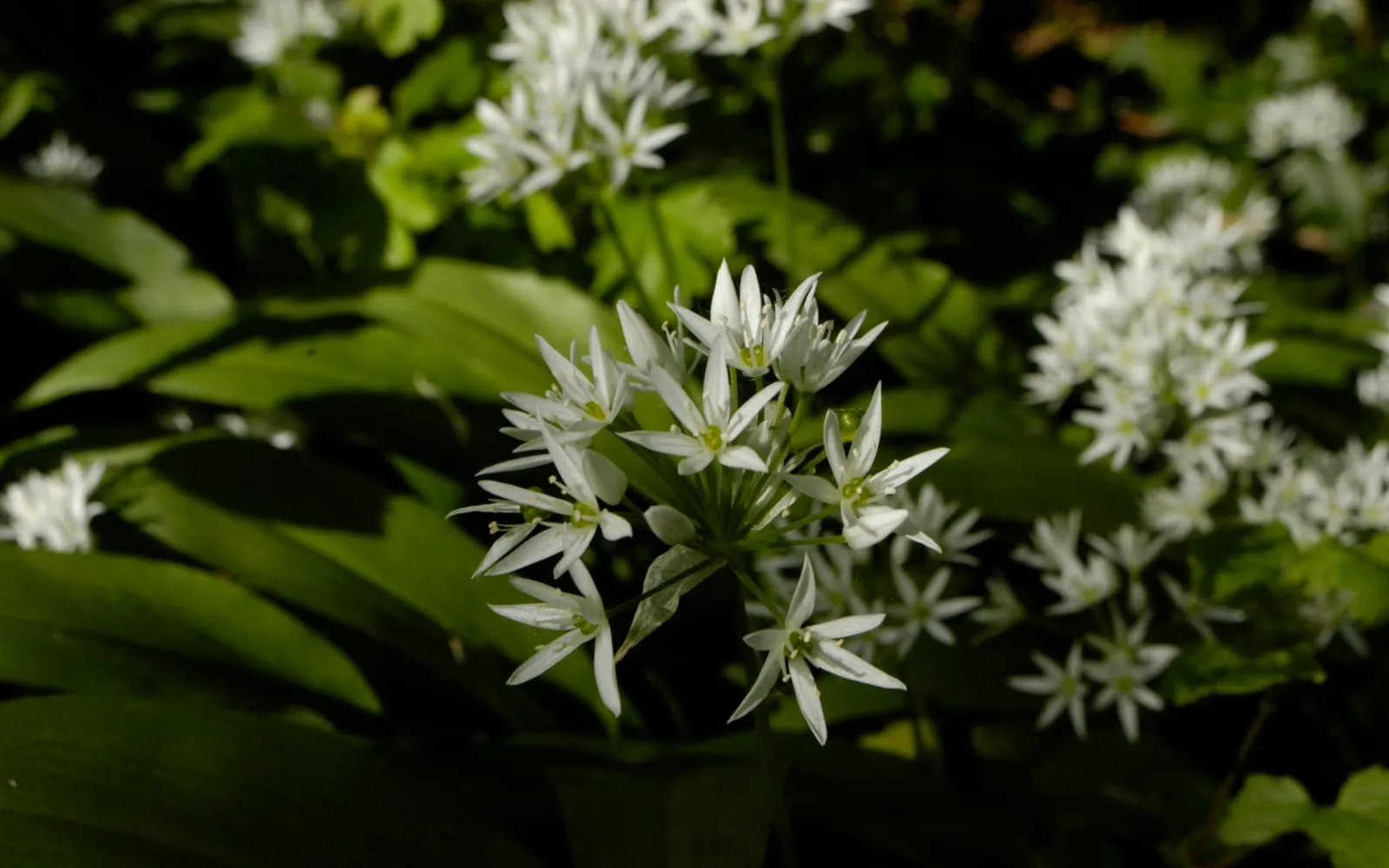
Leaves are broad, elliptical and pointed, 10 to 25 cm long, bright fresh green and slightly glossy. Each leaf rises singly on its own stalk directly from the ground, which is the most reliable way to tell it from lily-of-the-valley.
Flowers open in April and May as rounded umbels of six to twenty small white star-shaped blooms, each with six narrow pointed petals, carried on a triangular stem.
The smell reaches you before the plant does. A wood full of wild garlic on a warm April afternoon announces itself from a considerable distance.
Bulbs are small, narrow and white, sitting close to the surface, and each parent bulb makes offsets alongside seed.
By late June the leaves have yellowed and collapsed and the ground is bare, which is worth planning for.
Where it is from
Europe and western Asia, including Britain, where it is native and grows in damp deciduous woodland, on shaded stream banks and in old hedgerows.
Ancient woodland is its stronghold, and in some regions a heavy carpet of it is treated as an indicator that the wood has been there a very long time.
Its habitat sets the growing conditions. Deep shade under a summer canopy, damp leaf-littered soil, and a burst of light in early spring before the trees come into leaf are exactly what the garden position needs to reproduce.
The common name ramsons comes from Old English hramsa, which survives in place names like Ramsbottom and Ramsey.
The Latin ursinum means “of bears”, from an old belief that bears ate the bulbs on waking from hibernation, and the German name Barlauch carries the same idea.
How it grows
Plant in the green, meaning growing plants lifted with their leaves on, in early spring. This is far more reliable than dry bulbs, which frequently fail to establish.
If planting bulbs, do it in autumn as soon as you get them, 5 to 8 cm deep and 10 cm apart, and do not let them dry out beforehand.
Sow fresh seed in autumn where it is to grow. Seed needs a cold winter to germinate and seedlings take three to four years to reach flowering size.
Choose the position carefully and expect it to spread. Under shrubs, beneath deciduous trees, or in a shaded corner where it can colonise freely all suit it. A mixed border does not.
Pick leaves from March to May, taking a few from each clump rather than stripping one. Young leaves before flowering have the best texture.
Pick the flower buds too. They are the best part of the plant, hot and crunchy, and picking them also limits self-seeding.
Cut back nothing after flowering. The leaves feed the bulb as they yellow, and removing them early weakens the patch.
Divide congested clumps in spring after flowering if you want to move some elsewhere.
Through the seasons
Winter brings the first shoots, often in late January or February. Nothing is needed beyond keeping the ground clear of thick leaf litter.
Spring is the whole season. Leaves are at their best in March and early April, flowers open through April and May, and picking runs the full span.
Early summer is the retreat. Leaves yellow and collapse through June, seed ripens and falls, and the ground goes bare. Plant something later to follow it if the gap will bother you.
Autumn is planting and mulching time. Put down leaf mould or compost over the dormant bulbs and plant new stock.
Care difficulty
Easy, and closer to establishing a colony than to caring for a plant.
Getting it started is the only real hurdle, and dry bulbs are the reason most attempts fail. Plant in the green instead.
Controlling it becomes the concern once it settles in. Picking the flower buds before they set seed is the simplest brake.
Shade and moisture matter far more than soil quality.
It has no requirement for feeding, staking, deadheading or watering once established.
Watering
Established plants need no watering in a shaded position with reasonable soil.
Water new plantings through their first spring, particularly if planted in the green during a dry March.
A dry spring shortens the season and yellows the leaves early. A mulch of leaf mould does more to prevent this than watering does.
Do not water the dormant bulbs in summer. They want to be left alone.
Containers rarely suit wild garlic, since the compost dries out during the dormant period and the bulbs shrivel.
Warning signs, diseases and pests
Spreading beyond its allotted space is the commonest problem by a wide margin. Wild garlic seeds itself freely and increases by bulb offsets. Pick the flower buds to eat before they open, edge the patch, and dig out strays while they are small. A colony that has taken hold in a border takes several seasons to remove.
Allium rust shows as bright orange pustules on the leaves in damp crowded conditions. Remove affected leaves, thin the patch, and do not compost the clippings.
Onion white rot causes yellowing collapsing leaves with a fluffy white fungal growth and small black dots at the bulb. It persists in soil for many years, so avoid planting wild garlic where onions or garlic have suffered it, and do not move soil from an infected area.
Slugs graze the emerging leaves in February, and the damage is cosmetic.
Bulbs that never appear were usually planted dry and shrivelled before they had a chance. Buy plants in the green instead.
Leaves yellowing in May rather than June point to a position that is too sunny or too dry.
Growing environment
Dappled or full shade. Wild garlic scorches and disappears early in open sun.
Damp, humus-rich soil with plenty of leaf litter. It tolerates heavy clay and does best on neutral to slightly alkaline ground.
Under deciduous trees is the classic position, since the plant gets its light before the canopy closes and its shade for the rest of the year.
Give it room to spread and a boundary it cannot cross easily, such as a path, a wall or mown grass.
Plan for the summer gap. Ferns, hostas and later-emerging perennials cover the bare ground once the leaves have gone.
Avoid growing it in a container or in a small mixed border, where it becomes a nuisance rather than a feature.
Feeding
Mulch with leaf mould or well-rotted garden compost each autumn. That is the entire feeding programme.
Fertiliser is unnecessary and encourages soft growth that rusts.
Fallen tree leaves left in place through winter do the same job for nothing.
A patch that is thinning after many years is usually congested rather than hungry, and dividing it in spring is the fix.
Troubleshooting
How do I tell it from lily-of-the-valley? Wild garlic leaves rise singly, each on its own stalk from the ground, and crush with a strong garlic smell. Lily-of-the-valley wraps two or three leaves around one shared stem and has no smell. Lily-of-the-valley is poisonous, so check every leaf with clean hands.
The bulbs I planted never came up. Dry bulbs establish poorly. Plant in the green in spring instead.
It has taken over the border. Pick the flower buds before they set seed, dig out strays each spring, and expect the removal to take a few seasons.
The leaves went yellow in May. The position is too sunny or the spring was too dry. Move it into deeper shade and mulch with leaf mould.
When is the best time to pick? Leaves in March and early April, before flowering, when they are tender. Flower buds in late April are the best part of the plant.
Is it safe for my dog? No. Wild garlic is an Allium and damages red blood cells in cats, dogs and horses. Site it away from where a dog grazes.
Can I pick it from the woods? Picking leaves for personal use is generally accepted with the landowner’s permission, and digging up bulbs without permission is an offence under the Wildlife and Countryside Act 1981.
Orange spots on the leaves. Allium rust, brought on by damp crowded growth. Remove the affected leaves and thin the patch.