
Edible
Chives
Allium schoenoprasum
Also known as Wild chives, Garden chives
How to grow chives, Allium schoenoprasum. Cutting for tender regrowth, dividing congested clumps, the edible flowers, and why a herb you can eat is dangerous to cats and dogs.
At a glance
- Difficulty
- Easy
- Water
- Keep the soil moist through the growing season
- Light
- Full sun to partial shade. Four hours of direct sun is enough
- Temperature
- Fully hardy, to about -20 deg C. Dies back and returns
- Hardiness
- USDA 3-9, RHS H7, hardy to -30 C
- Type
- Hardy herbaceous perennial
- Height
- 20-40 cm
- Native to
- The temperate Northern Hemisphere, including Britain
- Best month
- March in the Northern Hemisphere, September in the Southern Hemisphere
Dormancy is part of the cycle rather than an interruption, and a clump that never gets a cold winter stays evergreen, tires within two or three years and wants dividing far more often. Heat above about 30 deg C stops growth until the weather breaks. Cutting hard after flowering brings a fresh flush in any climate.
Hardiness zones describe winter cold alone. Summer heat, humidity, rainfall and the length of the growing season decide as much, so treat the range as the outer limit rather than as a recommendation.
Every month named in this guide is for the temperate Northern Hemisphere. If you garden in the Southern Hemisphere, shift each one by six months, so March becomes September. Closer to the equator the wet and dry seasons matter more than the calendar, and the shift stops being a useful guide.
Poisonous to pets if eaten
- Safe to eat
- Leaves and flowers, for people
- Do not eat
- Every part, for cats, dogs and horses
- Harm from
- Eating it and handling it
- Affects
- Cats, dogs and horses
Chives are food for people and a genuine danger to pets, which makes this the sharpest split of any plant in these guides. The ASPCA lists Allium schoenoprasum as toxic to dogs, cats and horses through N-propyl disulfide, which destroys red blood cells and causes haemolytic anaemia. The listed signs are vomiting, blood in the urine, weakness, a racing heart and panting, and they can appear days after the animal ate the plant rather than within hours. Cats are more sensitive than dogs. Every part of the plant carries it, including the leaves you harvest, the flowers and the clippings you drop while cutting, and drying or cooking does not destroy it. The RHS lists Allium species on its potentially harmful plants list as a skin irritant for people. None of this makes chives unsafe in your own cooking, where they have been eaten for centuries. It does mean you should grow them where a cat or dog cannot graze them, sweep up what you drop, and ring a vet rather than waiting if a pet has eaten any.
Sources: ASPCA (Chives, Allium schoenoprasum), RHS potentially harmful garden plants
About
Chives are the herb that asks least and gives longest. One clump planted in March will still be feeding you in fifteen years, dying back each winter and coming up again without being told.
They are also wild plants of cold country. Allium schoenoprasum grows across the temperate Northern Hemisphere, including a few rocky sites in Britain, which is why a plant with a Mediterranean-sounding name shrugs off a Scottish winter.
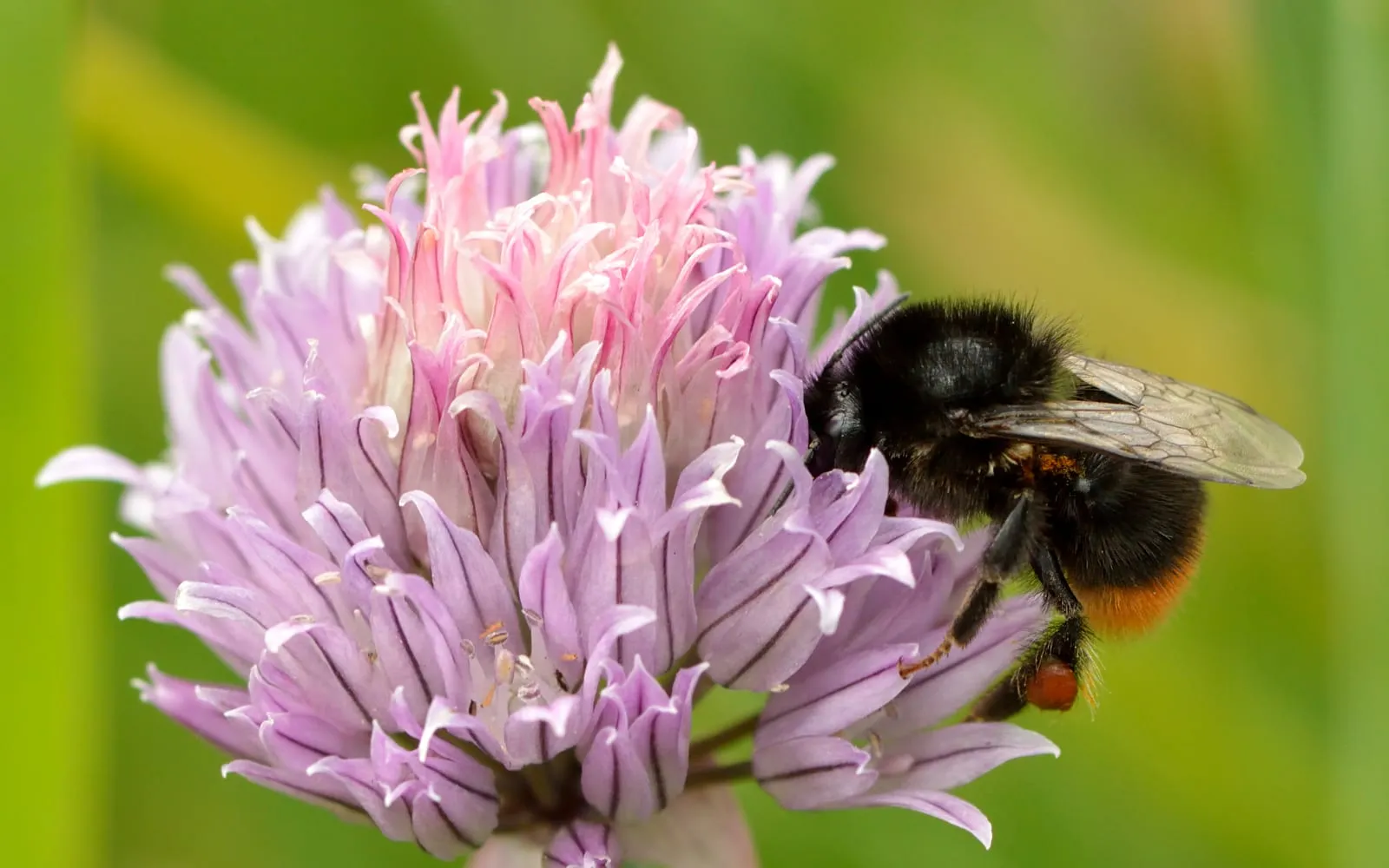
The flowers are the part most people waste. Those purple pompoms are edible, they taste of mild onion, and they pull apart into individual florets that scatter over a salad. Bees work them constantly through June.
Appearance and character
Dense clumps of narrow, hollow, cylindrical leaves, mid green, growing straight up from a cluster of small bulbs just under the soil. The hollowness is easy to confirm by squashing a cut end.
Flowers come in early summer as tight rounded heads of pink to pale purple florets on stems slightly taller and stiffer than the leaves. Each head holds thirty or more individual flowers.
The flavour is onion without the harshness, and it lives in fresh leaves only. Chives lose almost everything on drying, which is why dried chives taste of paper. Freezing keeps far more, and chopped leaves frozen flat in a bag stay usable all winter.
Flower stems are tough and fibrous. Harvest the leaves for the kitchen and leave the flower stalks for the bees, or pick the flower heads themselves.
Where it is from
The temperate Northern Hemisphere, across Europe, Asia and North America. In Britain it is a genuine native, found on damp rock ledges and riverside gravel in a handful of western and northern sites.
River gravel that floods and then drains is the habitat, and it explains a combination that sounds contradictory. Chives want more water than most herbs during growth and sharp drainage underneath, so they rot in a soggy winter bed and go tough in a dry summer one.
They tolerate more shade than most alliums, which follows from growing under riverside vegetation rather than on open hillside.
How it grows
A hardy herbaceous perennial. Each plant is a cluster of small elongated bulbs that divides into more bulbs every year, so a single plant becomes a fist-sized clump in three seasons and a congested one in five.
Growth starts in early March and runs to October. The whole plant dies back to nothing over winter and reappears without fuss.
Flowering happens in June, occasionally with a second flush in September if the first was cut back promptly.
Congestion is what eventually spoils a clump. The centre becomes woody, the leaves thin, and flowering drops off. Lift and split every three years in spring, pulling the clump into fist-sized pieces and replanting the outer, younger sections.
Chives self-seed readily if the flowers are left to set. Seedlings are welcome in a herb bed and a nuisance in a gravel path, so deadhead if you want to control where they go.
Through the seasons
Spring brings the first cutting, usually by late March. Divide congested clumps now, and top-dress the bed with compost.
Summer is flowering and heavy harvesting. Cut hard and often. Water containers most days in hot weather.
Autumn slows growth and the leaves yellow from October. Cut the clump to the ground once it goes over rather than leaving soggy foliage on the crown.
Winter is complete dormancy. Nothing shows above ground, and nothing needs doing. A pot lifted into a cold greenhouse in November gives you cutting through the winter.
Care difficulty
Easy, and the only real skill is in how you cut.
Take whole leaves from the outside of the clump at 2 to 3 cm above the soil, rather than trimming the tips off everything. Tipped leaves stay as blunt stumps and never regrow properly, so a haircut across the top leaves you with a brown-tipped clump that looks worse each time.
When the whole clump goes tough and fibrous, cut every leaf down to 5 cm. It looks brutal and it regrows tender within two weeks.
Watering
Keep the soil moist through the growing season. Chives are thirstier than most herbs and drought makes the leaves yellow, tough and flavourless.
Containers dry out fast and a pot of chives in July may need water every day. Any check to growth from dryness shows up in the kitchen within days.
Cut watering back sharply from October. Wet soil around dormant bulbs over winter rots them, which is the one way an established clump dies.
Mulch in spring with compost to hold summer moisture without waterlogging the crown.
Warning signs, diseases and pests
Allium rust is the main disease, appearing as bright orange pustules on the leaves in warm damp summers. Cut the whole clump to the ground and bin the material rather than composting it. Fresh growth usually comes clean. Crowded clumps get it worst, which is another reason to divide.
Allium leaf miner has spread widely across northern Europe since the 1990s and reached the north-eastern United States in 2015, and it now outranks rust in many gardens. The adult fly leaves a line of white dots down the leaf, and the larvae tunnel into the bulbs, letting rot follow. Cover with fine insect mesh in October and again in March, which are the two flight periods.
Downy mildew shows as pale patches with a greyish felt on the undersides in humid weather. Improve air movement and avoid overhead watering.
Yellow floppy leaves in summer are almost always drought. Water well, cut back to 5 cm and the plant recovers.
A clump that fails to appear in spring has usually rotted in winter wet. Replant on a raised bed or in a pot with grittier compost.
Growing environment
Full sun gives the best flavour, but four hours of direct sun is enough and chives take light shade better than any other allium. Deep shade makes them lank and pale.
Fully hardy to around -20 deg C, with no winter protection needed.
Soil should hold moisture and still drain, which means adding organic matter to sand and grit to heavy clay. Moderate fertility suits them; very rich soil gives soft growth that flops.
Containers work well and pots at least 20 cm across give room for the clump to thicken. Chives on a kitchen windowsill are usually a disappointment, because indoor light is too weak, so grow them outside and cut what you need.
Feeding
An organic liquid feed monthly through the growing season, plus a spring top-dressing of garden compost, covers everything a bed-grown clump wants.
Container plants exhaust their compost within a season and need feeding more seriously, roughly fortnightly from April to August.
Use organic feeds on anything you are going to eat. Seaweed extract works well and encourages leafy growth rather than flowers.
Avoid high-nitrogen fertiliser. It produces soft floppy leaves that are prone to rust and short on flavour.
Troubleshooting
Tough, stringy leaves. The clump is old or has been drought-stressed. Cut everything to 5 cm and water well, and tender growth follows in a fortnight.
Brown blunt tips across the whole clump. The leaves were trimmed rather than cut at the base. Cut whole leaves low down from now on.
Orange spots on the leaves. Allium rust. Cut to the ground, bin the foliage, and divide the clump if it is congested.
White dotted lines down the leaves. Allium leaf miner. Cover with insect mesh next October and March.
Fewer flowers each year. Congestion. Lift and divide in spring, replanting the young outer sections.
Seedlings everywhere. The flowers were left to set. Deadhead after flowering unless you want them.
The cat has eaten some. Ring a vet now rather than waiting for signs. The anaemia chives cause in cats can take several days to appear.