
Edible
Broad Bean
Vicia faba
Also known as Fava bean, Field bean, Horse bean
How to grow broad beans, Vicia faba. Autumn against spring sowing, pinching out for blackfly, and the inherited condition that makes this bean dangerous for some people.
At a glance
- Difficulty
- Easy
- Water
- Little until flowering, then weekly in dry weather
- Light
- Full sun
- Temperature
- Hardy to about -10 deg C. Autumn sowings overwinter outdoors
- Hardiness
- USDA 3-10, RHS H4, hardy to -10 C
- Type
- Hardy annual
- Height
- 45 cm dwarf varieties to 1.5 m tall ones
- Native to
- The Near East, and cultivated across Europe since the Bronze Age
- Best month
- February in the Northern Hemisphere, August in the Southern Hemisphere
Autumn sowing works wherever the winter stays above about -10 deg C, and it gives an earlier crop that beats the worst of blackfly. Heat is the limit at the other end, since flowers drop without setting above about 27 deg C. Damp still air brings chocolate spot, which is the disease that decides most overwintered crops.
Hardiness zones describe winter cold alone. Summer heat, humidity, rainfall and the length of the growing season decide as much, so treat the range as the outer limit rather than as a recommendation.
Every month named in this guide is for the temperate Northern Hemisphere. If you garden in the Southern Hemisphere, shift each one by six months, so February becomes August. Closer to the equator the wet and dry seasons matter more than the calendar, and the shift stops being a useful guide.
Toxic if eaten
- Safe to eat
- The cooked seeds, the young pods, and the shoot tips
- Harm from
- Eating it
- Affects
- People
Broad beans are a staple food and they carry a specific, inherited hazard that no other common vegetable does. People with glucose-6-phosphate dehydrogenase deficiency, an inherited enzyme condition, can develop favism after eating them. The vicine and convicine in the beans trigger rapid destruction of red blood cells, and the result is anaemia, jaundice and dark urine within a day or two, sometimes severe enough to need a transfusion. G6PD deficiency is the commonest enzyme disorder in the world and is most frequent in people of Mediterranean, African, Middle Eastern and South East Asian descent. Inhaling the pollen has triggered episodes in highly sensitive people. Anyone who knows they have the condition should avoid the plant, and anyone who feels unwell after eating broad beans for the first time should seek medical advice rather than assume it was the cooking. For everyone else the beans are safe and nutritious, and they are eaten cooked rather than raw as with all Phaseolus and Vicia beans.
Sources: RHS potentially harmful garden plants, NC State Extension, Vicia faba
About
Broad beans are the first crop of the year and the last thing sown in the old one. An autumn sowing sits through the winter as a small tough plant, starts away in February, and crops in late May, several weeks before anything sown in spring.
They are also the easiest legume to grow in a cool maritime climate, because they want exactly what it provides. Cold does not trouble them, heavy soil suits them, and they need no feeding at all.
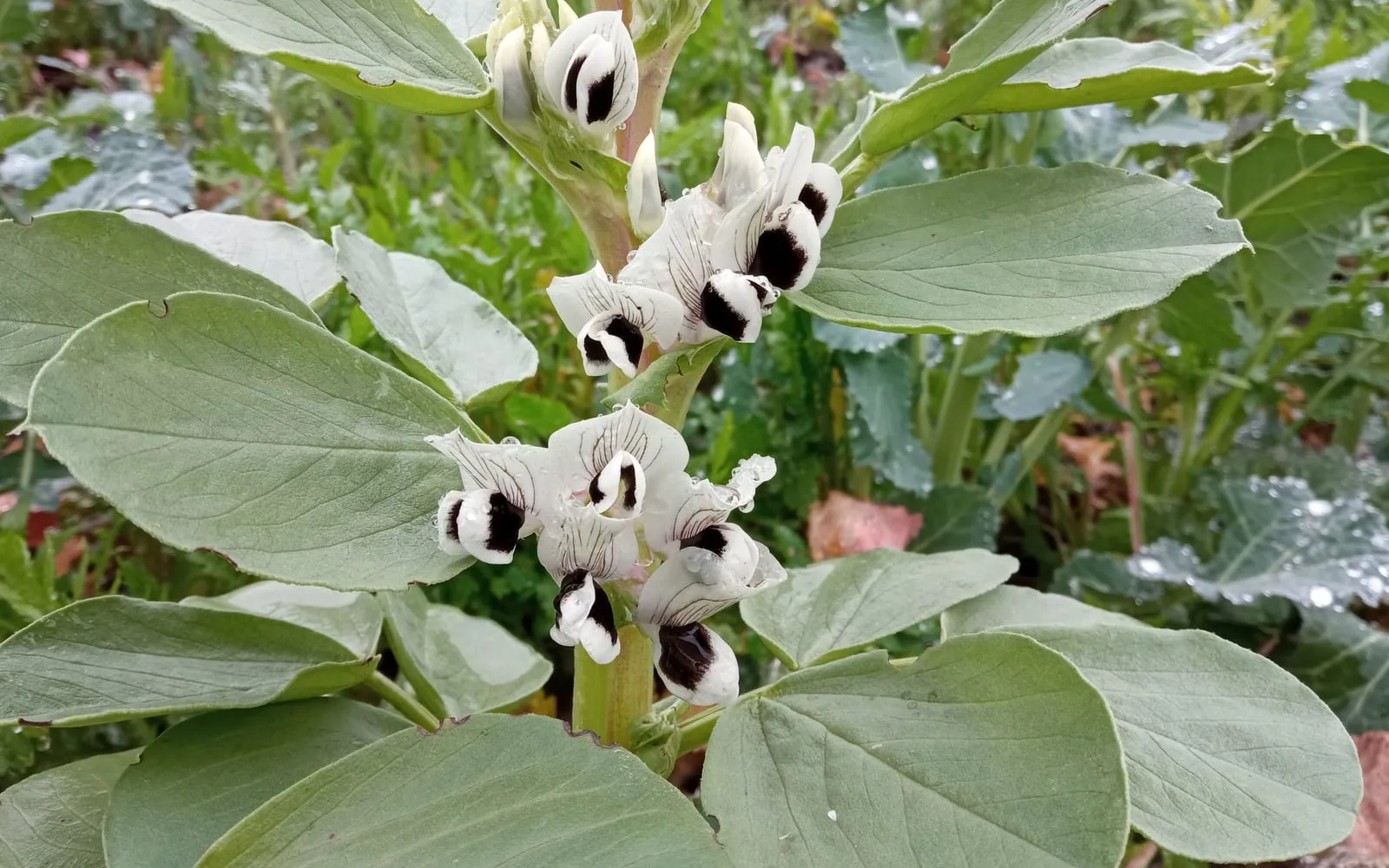
The flowers are worth the space on their own. White with a black velvet blotch, and scented strongly enough on a still evening to find without looking.
Appearance and character
An upright plant with hollow square stems, growing from 45 cm in dwarf varieties such as ‘The Sutton’ to 1.5 m in tall ones like ‘Aquadulce Claudia’.
Leaves are grey-green and waxy, made up of two to six broad oval leaflets, and unlike most vetches they end in a point rather than a tendril.
Flowers appear in clusters at the leaf joints, white or occasionally crimson, each marked with a dark blotch on the wing petals. They are strongly scented and bees work them hard.
Pods stand upward at first and hang down as they fill, growing 15 to 25 cm long with a thick white padded lining around the seeds.
Seeds are large and flat, pale green when young and turning buff and floury if left to mature.
Where it is from
The Near East, with the closest wild relatives in the eastern Mediterranean. Broad beans reached Europe in the Bronze Age and are among the oldest cultivated plants on the continent, found in Neolithic sites and in Egyptian tombs.
Until the Americas supplied Phaseolus, this was the only bean Europe had. Every reference to beans in classical and medieval European writing means this plant.
Its wild origins are cool, seasonally wet and open. Nothing in its history selected for heat or drought tolerance, and a hot dry June ends the crop.
The plant is very hardy. Autumn-sown plants survive to about -10 deg C in the open, and the modern practice of sowing in November for a May crop follows a tradition several centuries old.
How it grows
Sow direct, 5 cm deep and 20 cm apart, in double rows 20 cm apart with 60 cm between the pairs of rows.
There are two windows. November sowing gives an early crop in late May and dodges blackfly almost entirely, and it needs a hardy variety such as ‘Aquadulce Claudia’ and free-draining ground. February to April sowing gives a June and July crop and suits heavy wet soil that would rot an autumn sowing.
Germination takes two to three weeks in cold ground.
Growth is upright and the plant needs support once it passes about 60 cm. Canes at the corners of the double row with string run around the outside is enough.
Flowering starts from the base and works up. Pods form from the bottom of the plant first, which is why the lowest pods are always the first to pick.
Pinch out the top 8 cm of each plant once the lowest flowers have set pods. This removes the soft tip that blackfly colonise and pushes the plant into filling what it has.
Through the seasons
Autumn is the first sowing window, from late October to early November on free-draining soil, using a hardy variety.
Late winter starts the second window. Sow from February under cloches or direct in March. Overwintered plants begin growing again and want their support put in.
Spring brings flowering. Pinch out the tips as the first pods set, and watch for blackfly from May.
Summer is picking, from late May for autumn sowings and June for spring ones. Pick young. Cut the plants down when cropping ends and leave the roots in the ground.
Care difficulty
Easy, and among the most reliable crops in a cool garden. Cold, wet and clay are all fine.
Blackfly is the only real nuisance and pinching out the tips deals with it without spraying.
Wind is the practical problem. A tall variety in flower catches a gale and goes over, so put the support in before it is needed.
Autumn sowings can fail on cold wet clay, where the seed rots rather than germinates. On that soil, sow in spring instead.
Mice dig up autumn-sown seed and are a genuine cause of gappy rows.
Watering
Water sparingly until flowering. Broad beans root deeply and an early soaking does little except encourage soft growth.
From flowering to harvest, water weekly in dry weather. This is the period that determines how well the pods fill.
Overwintered plants need no watering at all through winter.
Mulch in spring to hold moisture and suppress weeds.
Waterlogging in winter is a far greater risk than drought, so autumn sowings belong on ground that drains.
Warning signs, diseases and pests
Blackfly cover the growing tips from May and spread down the plant, distorting the growth and coating it in honeydew. The remedy is mechanical and free. Pinch out the top 8 cm of every plant as soon as the lowest pods have set, and drop the tips in the compost. The tips are edible and good steamed.
Chocolate spot appears as reddish-brown blotches on leaves and stems, worst on overwintered plants in a wet season and on crowded rows. Space the plants well, keep the ground weed-free, and avoid heavy nitrogen. A bad attack can kill an autumn-sown crop.
Pea and bean weevil notches semicircular bites out of the leaf edges. It looks alarming and healthy plants outgrow it.
Bean rust shows as raised rusty brown pustules late in the season and rarely matters, since the crop is nearly over.
Blackened collapsed plants after a hard winter mean the variety was not hardy enough, or the ground was too wet.
Gappy rows after an autumn sowing usually mean mice.
Tough leathery beans mean they were left too long. Pick when the pods are still soft and the seeds are the size of a thumbnail.
Growing environment
Full sun. They tolerate a little shade and crop less.
Fertile, well-worked soil. Broad beans cope with clay better than almost any other vegetable, and the only soil they dislike is one that stays waterlogged through winter.
Shelter matters for tall varieties. Choose a dwarf type such as ‘The Sutton’ for an exposed garden or a container.
Support with canes and string around the outside of the double row, put in place before the plants reach 60 cm.
Rotate on a three or four-year cycle with other legumes.
Containers suit dwarf varieties. Use a deep pot of at least 30 cm and expect a modest crop.
Feeding
They need no feeding. Broad beans fix atmospheric nitrogen through nodules on their roots and supply themselves.
Avoid nitrogen fertiliser altogether. It produces soft sappy growth that blackfly find irresistible and chocolate spot enters easily.
On very poor thin soil, a dressing of general-purpose fertiliser before sowing is enough for the season.
Work compost into the bed the autumn before if the ground is poor in organic matter.
Cut the plants off at ground level when cropping ends and leave the roots in. The nitrogen in the nodules goes to the next crop.
Troubleshooting
Blackfly smothering the tips. Pinch out the top 8 cm of each plant once the lowest pods have set. No spray needed, and the tips are edible.
Brown blotches all over the leaves. Chocolate spot, worst on wet crowded overwintered plants. Improve spacing and drainage, and avoid nitrogen.
The autumn sowing never came up. Either mice took the seed or it rotted in cold wet ground. Sow in spring on heavy soil, or start in pots and plant out.
The plants blew over. Support the double row with canes and string before they reach 60 cm.
The beans are tough and floury. Picked too late. Take them when the pods are soft and the seeds are thumbnail-sized.
Flowers but no pods. Usually cold weather at flowering time keeping pollinators away. It corrects itself as the season warms.
When do I pick? From the bottom of the plant upward, once the pods have filled but still feel soft. The lowest pods are always ready first.
Can I eat the tops? Yes. The pinched-out shoot tips are a traditional vegetable, steamed like spinach.
Broad Bean problem guides
Not sure what is wrong? See the common vegetable pests guide.