
Disease
Ergot and smut
Claviceps purpurea and Ustilago species
Also called Ergot, Ergot of rye, St Anthony's Fire, Loose smut, Bunt, Stinking smut, Corn smut
Two fungi that replace grain in the ear and could not be more different. One is a hard dark horn carrying the alkaloids behind St Anthony's Fire and behind LSD; the other is a bag of black dust, and one kind of it is eaten as a delicacy.
At a glance
- Type
- Disease
- Cause
- Fungus
- Severity
- Destroys the crop or display
- Affects
- Herbs and edibles, Garden plants
- Active
- June to September
- Established in
- Worldwide
What you are seeing
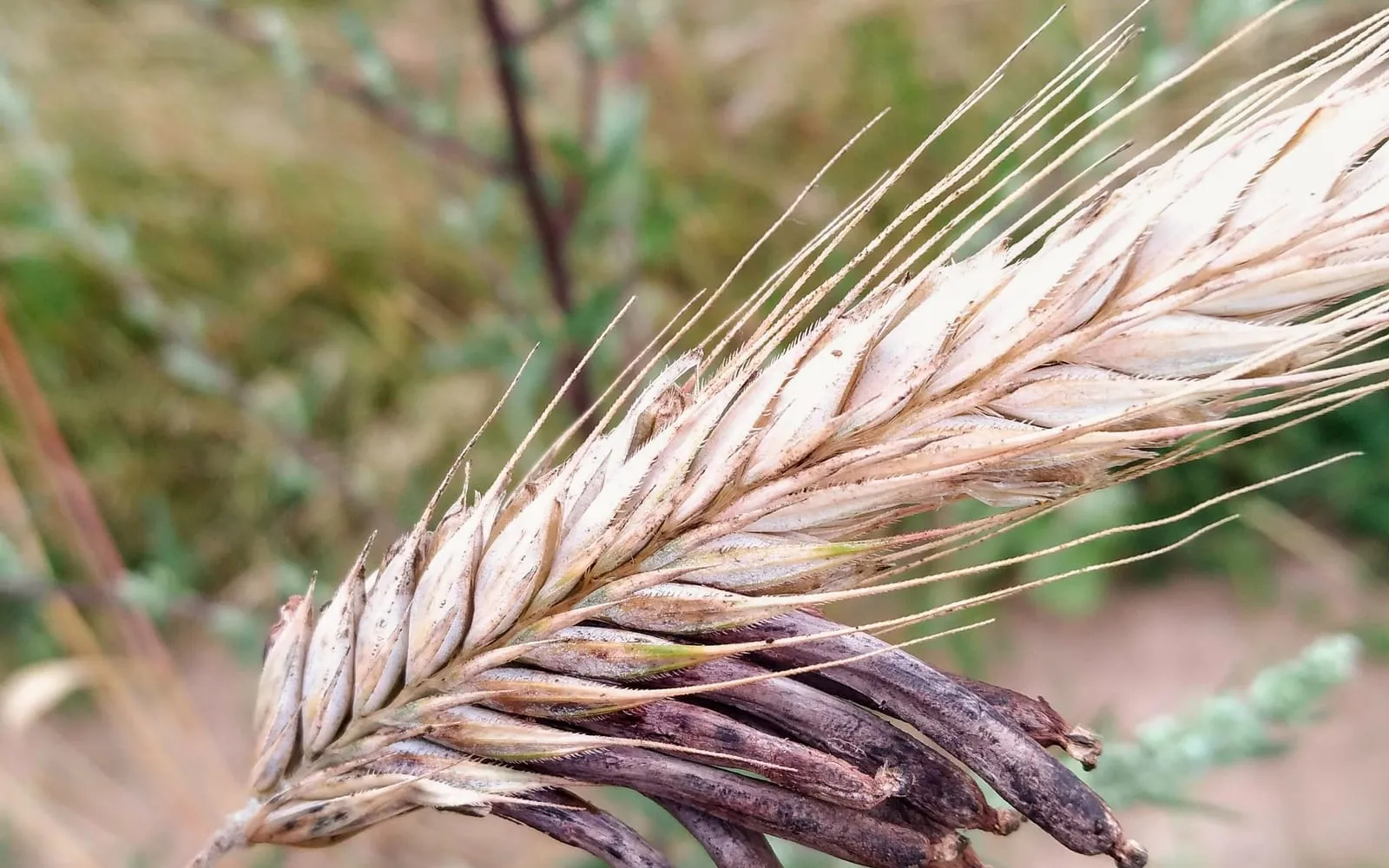
- Hard, dark purple-black, curved bodies standing out beyond the husks where a grain should be
- Those bodies staying firm when squeezed, and breaking to show a solid white or pink interior
- Sticky, sweet honeydew on the ear in early summer, often with flies feeding on it
- Grains replaced instead by a bag of loose sooty black powder that blows away in the wind
- A whole ear of barley or oats turned to black dust by the time it emerges from the sheath
- Wheat grains that look plump but crush to a greasy dark powder smelling of rotten fish
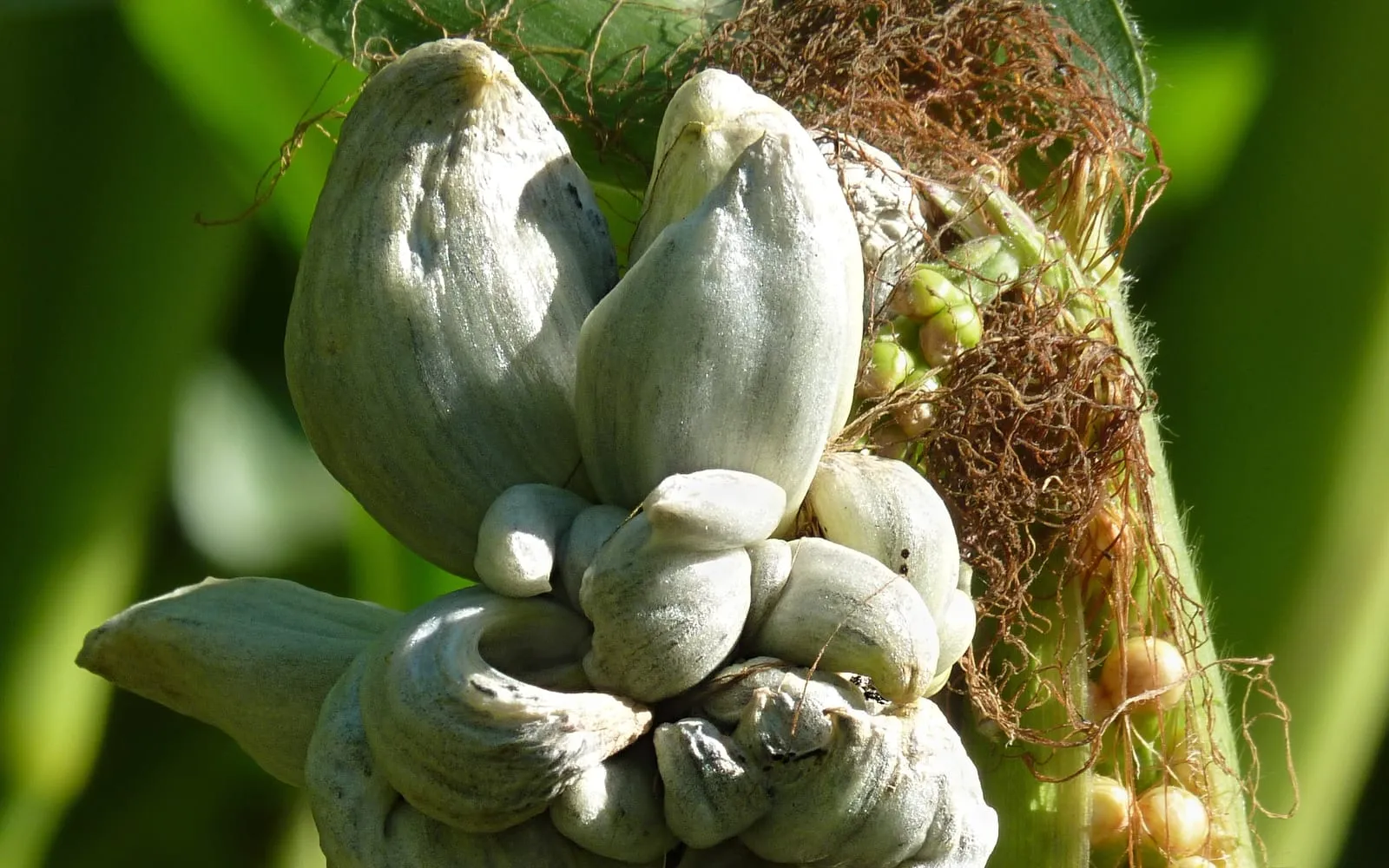
- Sweetcorn kernels swollen into large silver-grey galls that blacken and burst
- The same problem worst on rye, and worst along field edges next to flowering grasses
Before you treat anything
Ergot is poisonous to people, livestock, horses and poultry, and this is the one item in this section where eating the affected part can cause permanent harm. Never eat grain containing the hard dark bodies, never feed it to animals, and do not try to pick them out and use the rest, because the alkaloids spread into grain that looks clean. Discard the batch. The smuts are a separate matter and are not poisonous, but do not eat anything from an ear you cannot identify with certainty.
Two fungi, one page, and one of them is poisonous
Ergot and the smuts both destroy grain by taking the place of it, and both turn parts of an ear black. That is where the resemblance ends.
Ergot replaces a grain with a hard, dark, curved body that sticks out past the husks like a small horn. It is firm all the way through and it is loaded with alkaloids that constrict blood vessels and act on the nervous system. It has killed a great many people.
Smut replaces the grain with spores. The affected part becomes a bag of loose black dust, or on sweetcorn a swollen pale grey gall that blackens and bursts. None of the smuts is poisonous, and one of them is farmed deliberately in Mexico and sold as a delicacy.
They are on one page because a reader who has found something black in an ear needs to know which they have before doing anything else. Squeezing it takes a second and settles it.
Telling them apart
Squeeze it.
An ergot body is hard. It will not crush between finger and thumb, and if you cut one open with a knife it is solid and dense inside, white or pinkish, like a piece of cheese. On the outside it is dark purple to black, often with a fine bloom, curved like a claw, and between about 2 mm and 20 mm long. It stands proud of the husks rather than sitting inside them. On rye it is unmistakable.
A smut is soft. It gives way at once, and what comes out is dry black powder that gets everywhere and blows off on the wind. Under a hand lens the powder is made of spores. On barley and oats a loose smut head emerges from the sheath already ruined, a black skeleton where an ear should be. On wheat, bunt is sneakier: the grains look plump and normal until crushed, when they collapse into a greasy dark powder that smells strongly of rotten fish, which is where the name stinking smut comes from.
Ergot gives itself away earlier in the season too. Infected florets weep a sticky sweet fluid called honeydew in early summer, often with flies and other insects feeding on it. That fluid is full of spores, and the insects carry them to other flowering heads. Sticky ears in June are a warning that hard black bodies will follow in August.
One more thing settles most garden cases. In Britain ergot is found on rye, triticale, wheat, barley, oats and wild grasses. It is not a disease of sweetcorn here. So if the crop is sweetcorn, what you are looking at is smut.
St Anthony’s Fire
Ergotism, the illness caused by eating ergot-contaminated grain, ran through Europe repeatedly for a thousand years, and it took two forms depending on which alkaloids dominated.
The gangrenous form, commoner in western Europe, came from the alkaloids clamping down the small blood vessels. Sufferers described a burning heat in the hands and feet. The blood supply to the extremities failed, the tissue died, and fingers, toes and whole limbs blackened and were eventually lost. The burning gave the disease its popular name.
The convulsive form, commoner in central and northern Europe, brought seizures, violent muscle spasms, a sensation of insects crawling under the skin, hallucinations and psychosis.
The name St Anthony’s Fire comes from the Order of St Anthony, founded in France towards the end of the eleventh century, whose hospitals cared for sufferers. Pilgrimages to their shrines had a reputation for curing the disease, and the likely reason is bleakly practical. Anyone who travelled away from home stopped eating the contaminated rye bread of their own district and began to recover on the road.
Rye is the thread running through the history. It is the most susceptible cereal, it grew where wheat would not, and it was the bread of the poor across northern Europe. Epidemics tracked wet summers, which favour infection, followed by hungry winters, when nobody could afford to discard grain.
The suggestion that ergotism explains the Salem witch trials of 1692 was put forward in 1976 and is still repeated as though settled. It is not. The objections raised at the time have held up, chiefly that contaminated bread would have affected whole households rather than a specific group of accusers. Most historians now put the trials down to social and religious pressures, with ergot as a colourful and unproven footnote.
From poison to pharmacy, and to LSD
The alkaloids that made ergot lethal also made it useful, and midwives knew this long before chemists did. Preparations of ergot were used for centuries to contract the uterus and control bleeding after childbirth. The dose was guesswork and the results were sometimes catastrophic, but the effect was real.
In the twentieth century the individual alkaloids were isolated and turned into controlled medicines. Ergometrine, also called ergonovine, is still used to stop post-partum haemorrhage and sits on the World Health Organization’s list of essential medicines. Ergotamine constricts the dilated blood vessels behind a migraine and treated migraine for decades. Later semi-synthetic relatives such as bromocriptine and cabergoline act on dopamine and are used in Parkinson’s disease and in hormonal disorders.
The shared chemical backbone of the ergot alkaloids is lysergic acid, and that is where the other story starts.
Albert Hofmann was a chemist at Sandoz in Basel, working through derivatives of lysergic acid in search of a circulatory and respiratory stimulant. In November 1938 he made the twenty-fifth compound in the series, lysergic acid diethylamide, which the laboratory shorthand recorded as LSD-25. The pharmacology unit tested it, found it acted strongly on the uterus and made the animals restless, and shelved it as uninteresting.
Five years later Hofmann went back to it, on what he described as an unusual hunch. On 16 April 1943, resynthesising the compound, he absorbed a trace through his skin and spent the afternoon in a state he could not account for. Three days later, on 19 April, he deliberately took 250 micrograms of it, expecting that to be a cautious dose. It was several times a full one. His journey home from the laboratory by bicycle, accompanied by his assistant, is the best-known bicycle ride in the history of chemistry.
The connection gets repeated in a way that invites a dangerous conclusion, so be clear about what it does not mean. The sclerotium growing in an ear of rye contains no LSD. LSD is a laboratory product, made from lysergic acid through a chemical step that does not happen in a field. The ergot body holds the mixture of alkaloids above, and eating it produces vasoconstriction, gangrene and convulsions. The medieval sufferers who hallucinated were losing their fingers at the same time.
Why ergot faded, and why it came back
Ergotism became rare in Europe through a combination of changes, none of them a treatment. Grain cleaning improved, and gravity separators and brine flotation could take the bodies out of a batch. Ploughing buried them, rotations broke the cycle, and bread wheat displaced rye across much of the continent. Ergot did not go away; the grain supply stopped carrying it to the table.
It has become a live agricultural issue again in Britain over the last two decades. Reduced cultivation and direct drilling leave the bodies near the surface where they can germinate, grass weeds in cereal crops give the fungus a place to build up, and rye and triticale have gained ground. Great Britain works to a contractual zero tolerance for ergot in grain outside animal feed, and the European Union set legal maximum levels for the alkaloids in 2022, which apply in Northern Ireland and not in Great Britain.
For a gardener the practical version is short. Growing a few square metres of rye or ornamental barley, expect to see it in a wet summer, and do not eat the crop.
The smuts, and the one people eat
Loose smut of barley, wheat and oats is carried inside the seed. The fungus infects the flower one summer, sits dormant in the embryo of the grain, and grows up inside the plant the next year to emerge as a ruined ear. It is controlled almost entirely by using certified treated seed, which is why it is now rare in commercial crops and turns up mostly where somebody has saved their own.
Bunt, or stinking smut, works differently. Its spores coat the outside of the seed and infect the seedling as it germinates. The grains that result look sound and are full of dark spores that smell of rotting fish, and a very small number of bunted grains will taint a whole batch of flour. Clean treated seed handles it.
Corn smut on sweetcorn is the outlier. Instead of a dusty head it makes swollen galls, sometimes as big as a fist, silver-grey and firm at first and later black and papery as the spores mature. It gets in through wounds and through the silks, and it is worse in hot dry summers followed by rain, and worse on plants that have been damaged by hoeing or by hail.
British growers treat it as a disease and throw it away. In Mexico it has been eaten since before the Spanish arrived, under the name huitlacoche, and it is prized rather than tolerated, with a dense earthy flavour somewhere between a mushroom and a truffle. It is grown deliberately in parts of the United States and sold to restaurants. We have written about that side of it separately in Huitlacoche, the disease that became a delicacy.
If that tempts you, two conditions apply. Take the galls while they are firm and pale, since a black papery one is past eating. And be certain the crop is sweetcorn, which in Britain does not carry ergot, rather than a cereal that does.
What to do about it
Buy certified treated seed every year and never save seed from an affected crop.
Rotate so that cereals do not follow cereals, and give the ground two years off where ergot has appeared.
Choose oats or barley over rye and triticale if ergot is a problem on your ground.
Mow verges, headlands and rough grass before the seed heads open.
Bury the ergot bodies deeper than 5 cm and then leave that ground undug for a year.
Cut out and bag smutted heads before they burst, and pick corn smut galls off while they are pale.
Cut and bin a small stand showing ergot rather than trying to clean it.
Never eat, mill or feed grain containing ergot, and do not pick the bodies out and keep the rest.
What it gets mistaken for
Sclerotinia also leaves hard black bodies, inside hollow rotted stems of beans, lettuce and dahlias, under dense white mould.
Sooty mould is a black film growing on honeydew that wipes off a leaf and leaves it green underneath.
Rust makes raised pustules that shed orange or brown powder from leaves and stems rather than destroying the ear.
Insect galls are made by the plant, stay firm and dry, and never turn to powder.
Blackened, shrivelled ears after a hard frost at flowering are frost damage, and they are empty rather than full of anything.
Black tips and dark speckling on otherwise sound wheat grains are usually sooty moulds growing on ripe ears in a wet harvest, which spoil the appearance and carry none of this risk.
What to do, in order
Start here
Prevention, and the changes that stop the problem returning. Most of these pages should end at this tier.
- Buy fresh certified seed and never save your own from an affected crop
- Loose smut travels inside the seed, having infected the embryo through the flower the previous year, so it is invisible on the grain and grows up with the plant. Bunt travels as spores on the outside of the seed. Both are close to eliminated by starting with clean, treated, certified seed, which is the single most effective thing on this page for the smuts.
- Rotate, and follow cereals with something that is not a cereal
- Ergot bodies drop to the soil at harvest and germinate the following summer. Two years of a break crop puts most of them past their viable life. Rye after rye on the same ground is the worst case, and it is how the historic epidemics were sustained.
- Choose the less susceptible cereal where you have the choice
- Susceptibility to ergot runs in a clear order, with rye worst, then triticale, then wheat, then barley, and oats least affected. Rye is open-pollinated and holds its florets open for a long time, which is exactly the window the fungus infects through. A closed-flowering wheat gets far less on the same soil in the same year.
- Cut the grass round the plot before it flowers
- Ergot infects wild and weed grasses as readily as cereals, and grasses such as black-grass flower earlier than the crop and pass the infection on. Mowing verges, headlands and rough grass before the seed heads open removes the bridge. This is the part most people miss, because they look for the source inside the crop.
- Take out the late tillers where you can
- Side shoots that flower after the main crop has finished are infected at a much higher rate, because by then the spores are abundant and there is nothing else open for them to land on. An evenly established stand that flowers together is far less affected than a patchy one.
- Harvest a bad patch separately and keep it apart
- Ergot concentrates along field margins and in thin patches. Cutting those areas separately keeps the contamination out of the rest of the grain, and it is a great deal easier than cleaning it out afterwards.
- Accept the loss on a small stand rather than trying to salvage it
- On a garden plot or an allotment bed of cereals, a crop showing ergot is not worth the risk or the sorting. Cut it, bag it and bin it, and start again next year with clean seed on different ground.
Then reach for a barrier
Netting, hand removal and water. Nothing here harms anything except the target.
- Bury the ergot bodies deeply, and then leave the ground alone
- The bodies germinate only from the top few centimetres of soil. Ploughing or digging them below about 5 cm puts them out of range, and any cultivation beats leaving them on the surface. Leave that ground undisturbed for at least a year afterwards, since the next digging brings them straight back up.
- Float the ergots off in brine, if you are cleaning your own grain
- Ergot bodies are less dense than sound grain and rise in salt water while the grain sinks. Stir the grain into a strong brine, skim off everything that floats and discard it, then rinse and dry the grain thoroughly. This is the traditional method, and it reduces the contamination rather than clearing it, since the alkaloids can be present in grain that shows nothing visible.
- Cut out smutted ears before they burst
- A loose smut head is a bag of spores waiting to blow onto the open flowers of its neighbours. Snapping the affected heads off into a bag while they are still intact, early in the morning while they are damp, stops that round of spread on a small stand.
- Pick corn smut galls off while they are firm and pale
- On sweetcorn, taking the galls off before they blacken and split keeps the spores out of the soil, where they last for years. Pale firm galls are also the only ones anybody eats.
In pictures
Plants affected
Guides that name it among the problems to watch for. The list is the plants it is characteristic of rather than everything it will feed on.