
Edible
Mustard Greens
Brassica juncea
Also known as Indian mustard, Brown mustard, Mustard spinach, Gai choy
How to grow mustard greens, Brassica juncea. Sowing for heat that mellows with frost, cutting young for salad, and using it as a green manure and biofumigant.
At a glance
- Difficulty
- Easy
- Water
- Every few days in dry weather
- Light
- Full sun, and light shade in midsummer
- Temperature
- 10-22 deg C, and hardy to about -8 deg C
- Hardiness
- USDA 6-11, RHS H4, hardy to -8 C
- Type
- Annual
- Height
- 30-100 cm
- Native to
- Central and eastern Asia
- Best month
- September in the Northern Hemisphere, March in the Southern Hemisphere
More heat-tolerant than most brassicas and hardy enough to stand light frost, which gives it a longer usable season than rocket or mizuna. Heat makes the leaves hotter rather than milder. It seeds itself readily and is naturalised across much of the world.
Hardiness zones describe winter cold alone. Summer heat, humidity, rainfall and the length of the growing season decide as much, so treat the range as the outer limit rather than as a recommendation.
Every month named in this guide is for the temperate Northern Hemisphere. If you garden in the Southern Hemisphere, shift each one by six months, so September becomes March. Closer to the equator the wet and dry seasons matter more than the calendar, and the shift stops being a useful guide.
Skin irritant
- Safe to eat
- The leaves and stems, raw when young or cooked, and the seed as mustard
- Harm from
- Eating it and handling it
- Affects
- People and horses
Mustard greens are a food crop eaten across Asia, Africa and the American south, and the leaves are safe in any normal quantity. The caution here concerns concentration rather than the vegetable. Brassica juncea is one of the highest-glucosinolate crops grown, which is why it is pressed for mustard oil and ground for table mustard, and concentrated preparations of the seed are irritant. Allyl isothiocyanate, the compound released when the seed is crushed and wetted, blisters skin on prolonged contact, which is the mechanism behind the burns caused by traditional mustard plasters left on too long. Handling the growing plant does not do this. The RHS does not list Brassica juncea as a harmful garden plant and the ASPCA does not list it for cats and dogs, though it does list field mustards as a hazard to horses, where large quantities of the seed or foliage cause gastrointestinal irritation. Do not feed quantities of it to a horse, and do not graze stock on a mustard green manure without introducing them gradually. The leaves get much hotter in dry weather and much milder after frost.
Sources: RHS potentially harmful garden plants, ASPCA toxic and non-toxic plants
About
Mustard greens are the hottest leaf most gardeners will grow, and how hot depends on the weather more than on the cultivar. A plant grown fast in cool damp autumn soil is pleasantly peppery. The same variety grown dry in July is close to unpleasant.
Frost mellows it further, which is why the traditional sowing here is late summer for autumn and winter cutting.
The plant has a second use that has nothing to do with the kitchen. Dug in green, the chopped foliage releases isothiocyanates as it breaks down, which suppresses soil-borne pests and diseases. Commercial potato growers use it deliberately, and it is the most useful green manure an allotment can grow between a summer crop and a spring one.
Appearance and character
An upright plant, 30 cm as a cutting crop and up to a metre when allowed to flower.
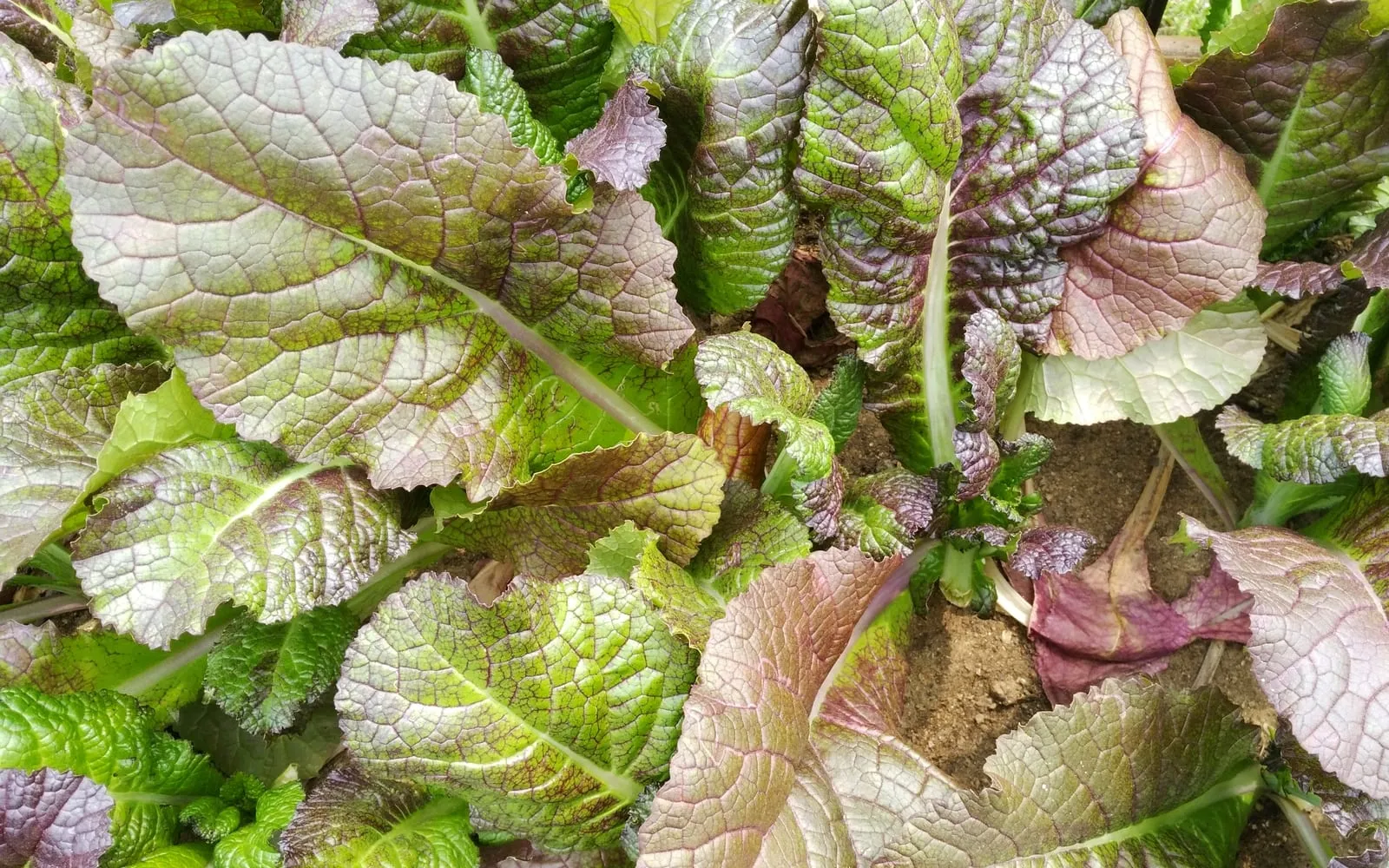
Leaves are broadly oval with toothed and lobed edges, mid to dark green, and usually smooth rather than hairy. Purple-leaved varieties such as ‘Red Giant’ are widely grown and hold their colour into winter.
Frilled and crinkled forms exist too, and ‘Green in Snow’ is the narrow-leaved type usually sold for winter cutting.
Flavour is hot and mustardy, building for a second or two after chewing in the way horseradish does. Cooking removes almost all of it.
Flowering brings a branched stem with small yellow four-petalled flowers, followed by narrow upright pods holding the small dark seeds that are ground for mustard.
Where it is from
Brassica juncea is a natural hybrid between the turnip species, Brassica rapa, and black mustard, Brassica nigra, with the chromosomes of both. It probably arose in the Middle East or central Asia where the two parents overlapped.
India grows it on an enormous scale for mustard oil, which is the dominant cooking oil across the north of the country. China selected the stem and leaf forms for pickling, and gai choy is the sour pickled mustard of Cantonese cooking.
The American south adopted the leaf and made it a staple, cooked long and slow with pork.
British use has been mostly as the mustard half of mustard and cress, as a green manure, and lately as a salad leaf in the bagged-leaf trade.
How it grows
Sow direct. Mustard germinates fast and grows fast, and there is no benefit to raising it in modules.
For cutting leaves, broadcast thinly or sow in drills 15 cm apart and cut at 10 to 15 cm tall, 2 cm above the crown. Three cuts is normal.
For full-sized plants, sow at 1 cm deep in rows 30 cm apart and thin to 25 cm.
Germination takes three to five days, which is faster than any other brassica here.
Baby leaves are ready in three to four weeks and full plants in eight to ten.
For green manure, broadcast at about 5 g per square metre in late summer, let it grow to 30 cm, then chop and dig it in before it flowers. Leave three weeks before sowing anything into that ground.
Sow every three weeks from late July to September for the eating crop.
Through the seasons
Spring takes a sowing in March or April for baby leaves. It bolts by June and the leaves are hotter than an autumn crop.
Summer is the wrong time for eating. Long days and heat bring bolting and a fierce flavour. This is the season to sow it as a green manure instead.
Late summer is the sowing window for the eating crop, from late July to mid-September. Cooling nights and shortening days give tender, milder leaves.
Autumn and winter are the harvest. The plant stands to about -8 deg C and much colder under a cloche, and each frost makes it milder. Growth stops in the darkest weeks and resumes in late January.
Care difficulty
Among the easiest crops in the collection, and the fastest to a first picking.
Flea beetle is the one persistent nuisance and mustards attract it more strongly than other brassicas. Fine mesh from the day of sowing, and a late summer sowing that misses the peak.
Bolting is a seasonal fault rather than a failure of care. Sow after midsummer.
Heat in the leaves catches people out. A grower who found it too hot in July should try the same variety in November before deciding against the plant.
Self-seeding is worth watching. A plant left to flower drops a great deal of seed and turns up as a weed for years, which is only a problem if you did not want it.
Watering
Water every few days in dry weather. Mustard grown dry is tough and much hotter, and the difference is easily enough to spoil a salad.
Aim to keep the top 20 cm damp. The roots go deeper than pak choi or mizuna, so the crop tolerates a short dry spell better than either.
Water immediately after each cut on a cutting patch, which is what drives regrowth.
Water at the base in autumn. Wet leaves overnight bring downy mildew.
Mulch between rows of full-sized plants with 5 cm of compost.
Containers work for a cutting patch. A 20 cm pot on a cool sill gives winter leaves and needs watering every day or two.
Warning signs, diseases and pests
Flea beetle shot-holes the leaves from April to July and prefers mustards to almost anything else in the bed. Cover with fine insect mesh from the day of sowing, keep the surface damp, and sow from late July to sidestep the peak.
Slugs and snails take seedlings and shelter in the crowns of established plants through a wet autumn. Water in the morning and patrol on damp evenings.
Cabbage white caterpillars strip the leaves in late summer. Net with 7 mm mesh.
Small pinholes and papery windowpane patches, with a thin pale green caterpillar that drops off on a silk thread when touched, is diamondback moth. It breeds year-round through much of Asia and is the most economically damaging brassica pest worldwide. The same mesh keeps it off.
Downy mildew brings yellow patches above and grey growth beneath in a still wet autumn. Space the plants, water at the base, and remove affected leaves.
White blister shows as raised chalky pustules on the underside of the leaf and distorted growth above. Remove affected leaves and improve airflow.
Clubroot applies in principle, though the crop occupies the ground too briefly for it to matter in most gardens. Rotate on infected soil, and do not use mustard as a green manure on clubroot ground, since it hosts the disease.
Growing environment
Full sun from September to March, and light shade in high summer.
Fertile, moisture-retentive soil gives tender mild leaves. Work compost in before sowing.
Lime to pH 6.5 or 7.
A cloche or low tunnel from October keeps winter leaves clean and extends picking to February.
Shelter from wind, which tears the larger leaves.
Rotate on four years with the other brassicas where clubroot is present, and remember that a mustard green manure counts as a brassica for that purpose.
Feeding
Work garden compost into the bed before sowing.
Feed with a balanced or nitrogen-rich liquid feed after each cut on a cutting patch, and monthly on full-sized plants through autumn.
Stop feeding in November, when light rather than nutrients limits growth.
Avoid fresh manure and heavy nitrogen. Soft growth is both more mildew-prone and more attractive to slugs, and the flavour suffers.
A green manure crop needs no feeding at all, since the point is to grow bulk cheaply and return it to the soil.
Troubleshooting
The leaves are too hot to eat. Grown in heat, in dry soil, or picked too old. Sow after midsummer, water regularly, and pick young. Frost mellows the flavour considerably.
Small round holes all over the leaves. Flea beetle. Fine mesh from the day of sowing, and sow from late July.
The plants have flowered. Bolting, from a spring or summer sowing. Sow after midsummer, and eat the flowering shoots, which are good.
Yellow patches with grey growth beneath. Downy mildew. Space the plants, water at the base, and ventilate under cover.
Chalky white pustules under the leaves. White blister. Remove affected leaves and improve airflow.
Mustard seedlings coming up everywhere the following year. The crop was allowed to set seed. Cut before the pods form, or accept it as a self-sowing patch.
Can I make mustard from the seed? Yes. Brassica juncea is brown mustard, one of the two species in most table mustards. Let a few plants flower, collect the pods when they turn brown, and dry them before threshing.
Can I use it as a green manure? Yes, and it is one of the best. Sow in late summer, chop and dig it in before flowering, and wait three weeks before sowing. Do not use it on ground with clubroot.
Mustard Greens problem guides
Not sure what is wrong? See the common vegetable pests guide.