
Edible
Black Mustard
Brassica nigra
Also known as True mustard, Rai
How to grow black mustard, Brassica nigra. The hot seed behind traditional table mustard, why the pods shatter, and how it differs from the brown mustard grown commercially.
At a glance
- Difficulty
- Easy
- Water
- Weekly in dry weather
- Light
- Full sun
- Temperature
- Hardy. Sow from March
- Hardiness
- USDA 4-10, RHS H4, hardy to -5 C
- Type
- Hardy annual
- Height
- 60-120 cm, occasionally 2 m
- Native to
- the Mediterranean, western Asia
- Best month
- April and August in the Northern Hemisphere, October and February in the Southern Hemisphere
Grown as a fast annual almost anywhere with three frost-free months, and the sowing date matters more than the zone. It bolts and shatters its pods quickly in heat, which is why the seed crop moved to cooler regions and why it escapes into waste ground so readily. It is a declared weed in parts of Australia and the western United States.
Hardiness zones describe winter cold alone. Summer heat, humidity, rainfall and the length of the growing season decide as much, so treat the range as the outer limit rather than as a recommendation.
Every month named in this guide is for the temperate Northern Hemisphere. If you garden in the Southern Hemisphere, shift each one by six months, so April becomes October. Closer to the equator the wet and dry seasons matter more than the calendar, and the shift stops being a useful guide.
Skin irritant
- Safe to eat
- The seeds and the young leaves
- Do not eat
- Concentrated mustard preparations, which burn skin
- Harm from
- Eating it and handling it
- Affects
- People and horses
Black mustard is a food plant and it appears on neither the RHS list of potentially harmful garden plants nor the ASPCA list. Its seed is considerably hotter than white mustard's, from sinigrin, which releases allyl isothiocyanate when the ground seed meets water. That compound is a strong irritant to eyes and mucous membranes, and a mustard plaster left on skin causes burns, which is a documented historical injury. Grinding a quantity of black mustard seed produces fumes that will make your eyes stream. As with the other brassicas, livestock grazing a heavy stand can be upset by it, and horses in particular should be kept off.
Sources: RHS potentially harmful garden plants, ASPCA toxic and non-toxic plants
About
Black mustard is the hot one, and it is the species that traditional table mustard was made from before commercial growers moved to brown mustard, Brassica juncea, in the twentieth century. The reason for the switch was mechanical rather than culinary. Black mustard pods shatter as they ripen, so the crop cannot be combine harvested, and brown mustard holds its seed.
Its heat comes from sinigrin, which produces allyl isothiocyanate when the ground seed is wetted. That is the compound behind the nose-burning heat of English mustard and wasabi both.
In a garden it is easy, tall and generous with its seed. It grows on ordinary ground from a spring sowing, and the harvest needs timing because the pods will scatter if left.
Appearance and character
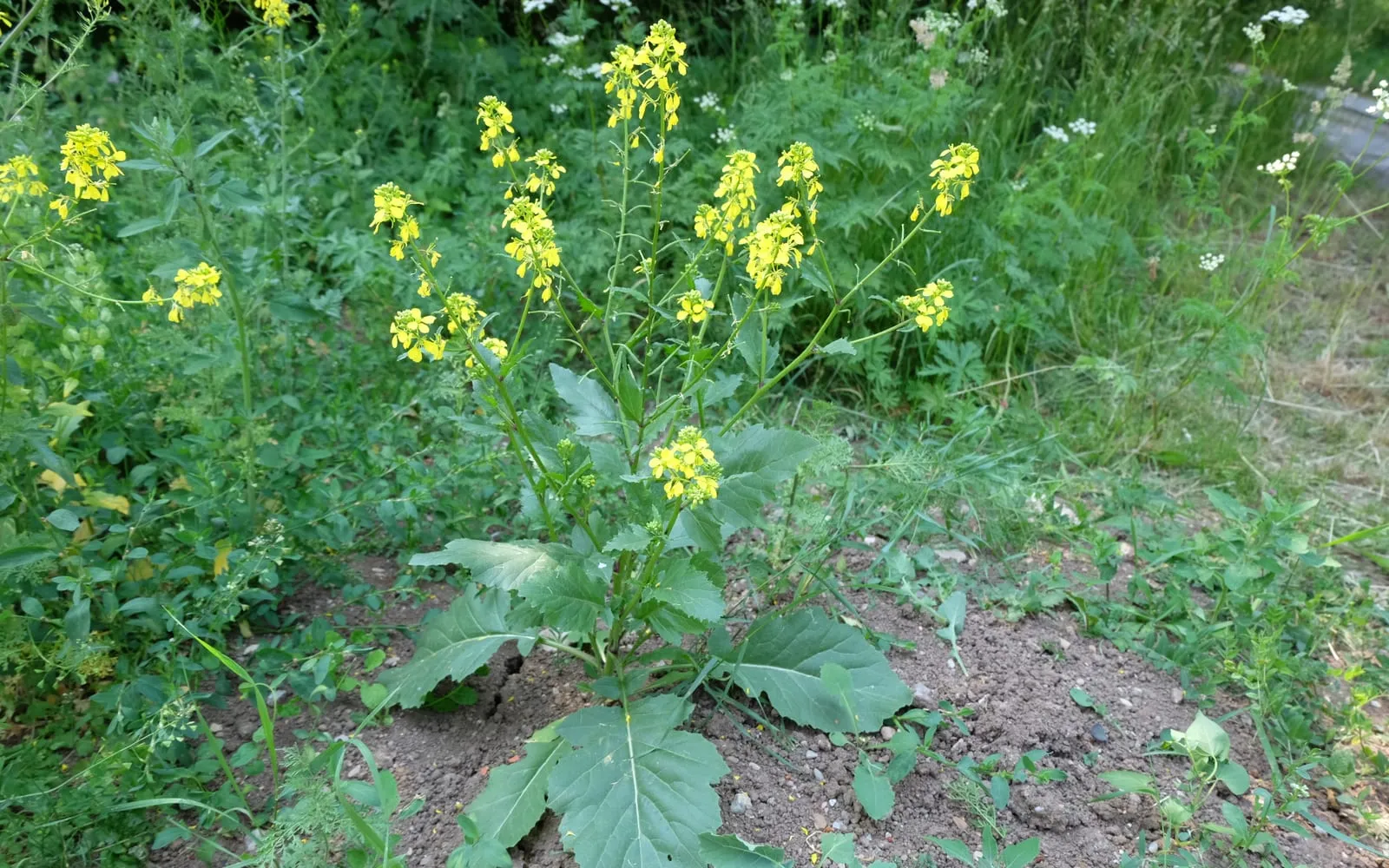
A tall much-branched annual, 60 cm to 1.2 m and occasionally 2 m on good ground.
Lower leaves are large, lobed and bristly, with a big terminal lobe. Upper leaves are narrow and smooth.
Flowers are small and bright yellow, four-petalled, in loose spikes at the tips of the many branches from June.
Pods are the identifying feature. Short, smooth, four-sided and held pressed close against the stem, with a short beak, quite unlike the angled bristly pods of white mustard.
Seeds are small, round and dark reddish-brown to near black, and noticeably smaller than white mustard seed.
The flavour of the crushed seed is sharp and hot, and it goes up the nose rather than sitting on the tongue.
Where it is from
Black mustard is native to the Mediterranean and western Asia and it has spread widely as a weed and a crop.
It is one of the oldest condiment plants. Mustard seed appears in Roman recipes, and the seed ground with must gave the condiment its name.
The mustard of the parable of the mustard seed in the gospels is usually taken to be this species, which grows tall enough on good ground for the description to make sense.
Britain grew it commercially in East Anglia for centuries. Colman’s built its business on blending it with white mustard, and traditional English mustard is that combination.
Commercial cultivation shifted to brown mustard, Brassica juncea, in the twentieth century, because black mustard pods shatter and the crop cannot be harvested by machine. India still grows a large black and brown mustard crop for oil and for the whole seed used in tempering.
How it grows
Sow direct where it is to grow, from March to May, thinly at 1 cm deep, thinning to 20 to 30 cm. It gets large.
Choose an open sunny position on ordinary free-draining ground.
Rotate it as a brassica, since it shares clubroot with cabbages.
Water in dry weather while growing.
Do not feed it. Rich ground gives a huge leafy plant with no more seed.
Watch the pods from late July. They ripen from the bottom of the plant upwards and shatter once fully ripe.
Cut whole plants when the lowest pods have gone brown and before any have split, and stand them upright in a paper sack or a sheet to finish drying.
Thresh by rubbing the dried pods and winnow the seed.
Cut the plants before any seed sheds if you want to avoid a permanent population, because black mustard self-seeds heavily and persistently.
Through the seasons
Winter there is nothing from a spring sowing, and seedlings may overwinter from shed seed.
Spring is sowing, from March, and rapid growth once the soil warms.
Early summer is flowering, from June, in a mass of small yellow flowers.
Midsummer is when the pods fill.
Late summer is harvest and the timing is tight, since the pods shatter once ripe.
Autumn is when self-sown seedlings appear from anything that shed.
Care difficulty
Easy to grow and requiring attention at harvest.
Growing it needs nothing beyond sun, drainage and space. It is vigorous and undemanding.
Harvest timing is the whole skill. Black mustard pods shatter as they ripen, and a crop left for a week too long ends up on the ground. Watch from late July and cut when the lowest pods brown.
Clubroot is the disease to plan around, since it is a brassica.
Flea beetle riddles young plants and does little lasting damage to a seed crop.
Self-seeding is heavy and persistent, and a plant allowed to shed will produce seedlings for years.
Size is worth planning for. It reaches a metre and more and shades its neighbours.
Watering
Water the seedbed before sowing and keep it damp until germination.
Water weekly in dry weather while the plants are growing.
Stop watering once the pods start to turn brown.
Water at the base rather than over the plants.
An established plant copes with a dry summer without much help, since the roots go deep.
A container is a poor choice for a plant this size.
Warning signs, diseases and pests
Pods shattering before harvest is the main loss and the reason the crop was abandoned commercially. Cut when the lowest pods brown and finish the drying under cover.
Flea beetle peppers young leaves with round holes. Mesh over the row from sowing protects them.
Clubroot swells and distorts the roots and stunts the plant. Rotate, and lime acid ground.
Cabbage white caterpillars strip leaves in summer.
Diamondback moth caterpillars are smaller and thinner, pepper leaves with pinholes rather than stripping them, and drop off on a silk thread when touched. It is a minor issue on a plant grown for seed rather than leaf, but it is the most economically damaging brassica pest worldwide and worth knowing on sight.
Aphids gather on flowering stems and rarely need action.
Enormous leafy plants with little seed mean the ground was too rich.
Seedlings for years afterwards mean seed shed. Cut earlier.
Growing environment
Full sun. It grows tall and flowers freely in the open.
Free-draining soil of moderate fertility. It grows on disturbed ground and roadsides in the wild.
pH from 6 to 7.5. Lime acid ground, which also suppresses clubroot.
A vegetable bed in the brassica rotation, with room for a plant of a metre or more.
It is fully hardy and needs no protection.
Give it space from smaller crops, since a mature plant shades a good deal of ground.
Feeding
Nothing is needed. Black mustard grows vigorously in ordinary ground.
Avoid nitrogen, which produces an enormous leafy plant with no more seed.
Compost dug in the previous autumn is ample.
A container plant, if you grow one, takes a weak balanced feed every three weeks.
Lean growing gives better filled seed and a more manageable plant.
Troubleshooting
How is it different from brown mustard? Brown mustard, Brassica juncea, is what commercial growers use because its pods hold their seed and it can be combine harvested. Black mustard shatters. The flavours are similar, with black mustard slightly hotter.
Most of the seed ended up on the ground. The pods shatter once fully ripe. Cut whole plants when the lowest pods brown and before any split, and finish drying them in a paper sack.
Which mustard is hottest? Black and brown carry sinigrin and give the sharp heat that goes up the nose. White mustard carries sinalbin and gives a milder heat on the tongue. English mustard blends the two.
It grew to two metres. Normal on good ground. Grow it harder for a smaller plant, and give it space.
Seedlings keep appearing. It self-seeds heavily and persistently. Cut the plants before any pod sheds.
How do I make mustard? Grind the seed, mix with cold water and leave ten minutes for the heat to develop, then add vinegar to fix it. Hot water destroys the heat and vinegar added too early prevents it forming.
Can I grow it after cabbages? Better not. It is a brassica and shares clubroot.
Black Mustard problem guides
Not sure what is wrong? See the common vegetable pests guide.