
Edible
Swede
Brassica napus var. napobrassica
Also known as Rutabaga, Neep, Swedish turnip
How to grow swedes, Brassica napus var. napobrassica. The long season they need, telling them from turnips, beating powdery mildew and clubroot, and why neeps are not turnips.
At a glance
- Difficulty
- Moderate
- Water
- Weekly through summer, without fail
- Light
- Full sun
- Temperature
- 15-20 deg C to grow, and hardy to about -10 deg C in the ground
- Hardiness
- USDA 3-9, RHS H5, hardy to -12 C
- Type
- Biennial grown as an annual
- Height
- 30-60 cm of foliage
- Native to
- Of cultivated hybrid origin, probably northern Europe
- Best month
- May in the Northern Hemisphere, November in the Southern Hemisphere
A long cool season of 20 to 26 weeks is what makes a swede tender, and heat makes the root woody and strong-flavoured well before it reaches size. Frost improves it. That combination confines the crop to cool temperate regions and explains why it is a northern vegetable everywhere it is grown.
Hardiness zones describe winter cold alone. Summer heat, humidity, rainfall and the length of the growing season decide as much, so treat the range as the outer limit rather than as a recommendation.
Every month named in this guide is for the temperate Northern Hemisphere. If you garden in the Southern Hemisphere, shift each one by six months, so May becomes November. Closer to the equator the wet and dry seasons matter more than the calendar, and the shift stops being a useful guide.
Not known to be toxic
- Safe to eat
- The swollen root, and the young tops as spring greens
Swede is a food crop and carries no toxicity concern for people. The RHS does not list it as a potentially harmful garden plant and the ASPCA does not list Brassica napus as toxic to cats and dogs, though a dog eating a quantity of raw swede is likely to get wind from the mustard oils. The livestock caution that applies to all forage brassicas applies here, and swede is still fed to sheep in Britain on a large scale. Brassica forage contains S-methylcysteine sulphoxide, which causes haemolytic anaemia in animals turned onto a root crop without other feed, and glucosinolates which interfere with iodine uptake. Shepherds introduce stock gradually and balance the crop with hay. None of that arises from a garden row. Brown heart, where the flesh discolours and turns bitter, is a boron deficiency rather than a toxin, and the affected tissue is unpalatable rather than harmful.
Sources: RHS potentially harmful garden plants, ASPCA toxic and non-toxic plants
About
A swede is not a large turnip, though it is grown as though it were and sold next to one. It is a separate plant with a different ancestry, yellow flesh instead of white, and a season roughly three times as long.
Sow in late May and lift in October. Twenty to twenty-six weeks in the ground is what a swede needs to make a root worth eating, and the commonest mistake is sowing in March as though it were a turnip, which gives a woody root and a plant that bolts.
The reward for the wait is the only root vegetable that improves after a hard frost. Cold converts starch to sugar in the root, and a swede lifted in December is markedly sweeter than the same variety lifted in October.
Appearance and character
Smooth, waxy, blue-green leaves with a faint bloom, quite unlike the rough bristly leaves of a turnip. Rubbing a seedling leaf between finger and thumb tells the two apart before either has made a root.
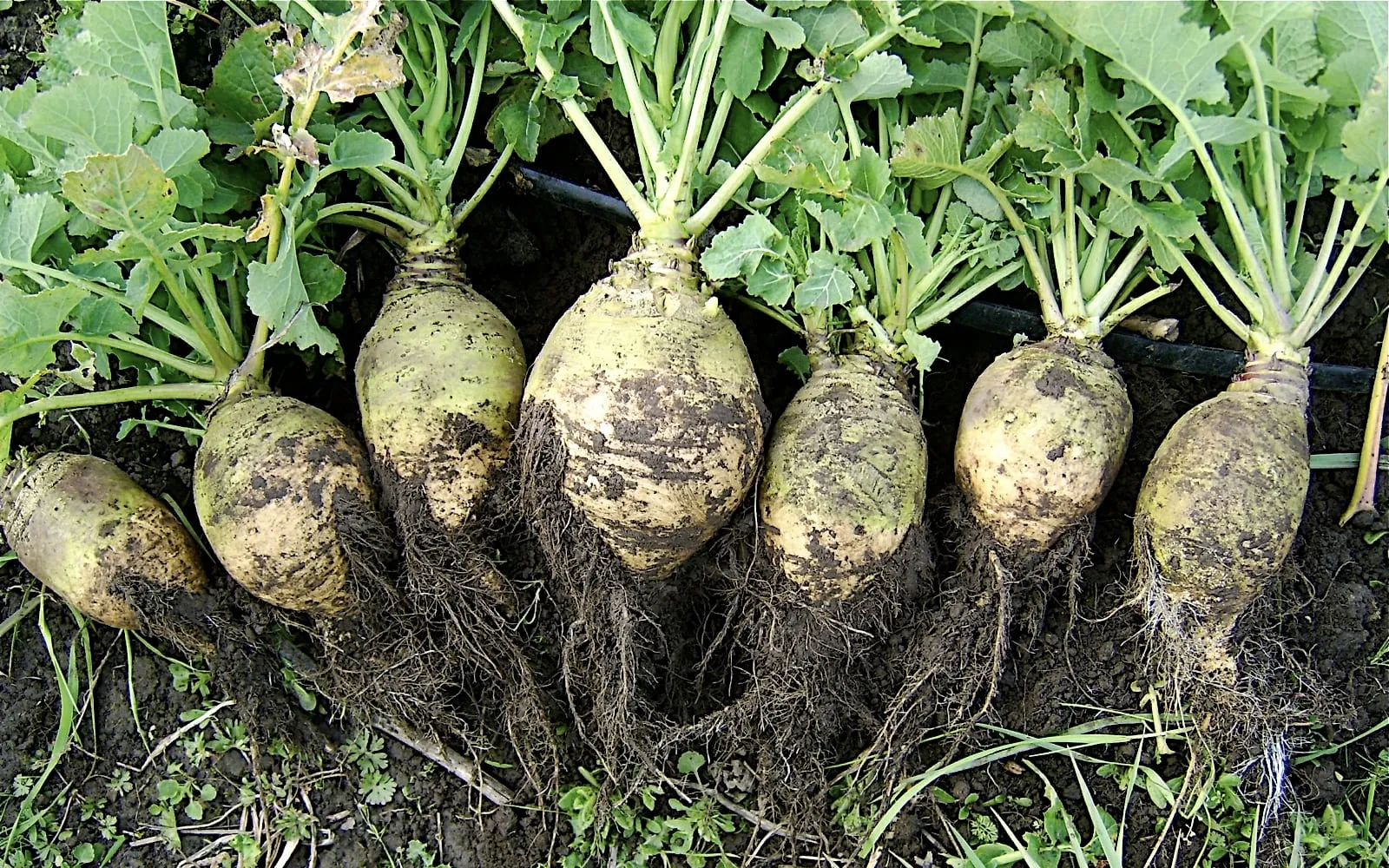
The root is large, round to slightly flattened, and sits mostly below ground with a purple crown where light has reached it and buff-yellow skin below. Flesh is deep yellow to orange, dense and sweet.
A distinct neck of leaf scars sits on top of the root, which is one of the easiest field marks. A turnip has leaves rising straight from the crown with no neck.
Left a second year, the plant sends up a branched stem to about a metre with pale yellow four-petalled flowers, then long narrow pods. The root is spent by then.
Where it is from
The swede is an accident of cultivation rather than a wild plant. It arose from a cross between the turnip, Brassica rapa, and the cabbage, Brassica oleracea, which doubled its chromosomes and produced a fertile new species, Brassica napus. Oilseed rape is the same species selected for its seed.
The cross probably happened in northern Europe in the seventeenth century. Gaspard Bauhin recorded it growing in Sweden in 1620, which is where both the English “swede” and the American “rutabaga”, from the Swedish rotabagge, come from.
Scotland took to it more thoroughly than anywhere else. The “neeps” served with haggis are swede, not turnip, and the naming confusion runs the other way in parts of northern England where a swede is called a turnip and a turnip is called a white turnip.
Halloween lanterns were carved from swedes and turnips in Scotland and Ireland long before pumpkins arrived. Anyone who has tried it understands why the pumpkin won.
How it grows
Sow direct in late May or early June. Sowing earlier gives plants that bolt or run to a woody root, and sowing later leaves too little season.
Sow thinly at 2 cm deep in rows 38 cm apart, then thin in stages to 23 cm apart. Swedes need more room than turnips and crowding them is the second commonest reason for small roots.
Thin early, at the two-leaf stage, and again a fortnight later. A crowded row never makes it up.
Growth is slow to start and then steady. Roots begin to swell from about ten weeks and go on until the frosts.
Lift from October onwards as needed. Roots stand hard frost in the ground and are best left there on free-draining soil, lifted and stored in sand on heavy wet ground where they rot.
Through the seasons
Spring prepares the bed rather than sowing it. Lime in February or March if the pH is below 6.5, and firm the ground by treading. Ground manured for last year’s crop is what you want.
Late spring takes the sowing, from mid-May to mid-June. Cover the row with fine mesh from the day of sowing to keep flea beetle off the seedlings.
Summer is thinning, weeding and watering. Powdery mildew arrives in a dry August and a mulched, watered row shrugs it off.
Autumn and winter are the harvest. Lift from October, and leave the rest in the ground under a straw mulch to sweeten in the frost. Clear the bed by February before the plants start into growth again.
Care difficulty
Not difficult, but unforgiving of a mistimed sowing.
The season is the thing to get right. Late May to mid-June is the window, and a swede sown outside it disappoints in one direction or the other.
Powdery mildew is the problem of a dry late summer, showing as a white coating over the leaves in August and checking the root before it has bulked up. Watering and mulching prevent it more reliably than anything you can spray.
Clubroot ends the crop rather than reducing it. Lime to pH 7, rotate on four years, and raise plants in modules on infected ground so they go out with a root system already working.
Brown heart is the one that catches growers on light and over-limed soil. Boron becomes unavailable at high pH and the flesh browns and turns bitter from the centre outwards. A dressing of borax at 3 g per square metre, dissolved in water and applied evenly, fixes it, and overdoing it damages the crop.
Watering
Water weekly through summer and do not skip. Swedes are in the ground for six months and a dry fortnight in July shows up as a small woody root in October.
Give a proper soak, around 15 litres per square metre, rather than a daily sprinkle. Shallow watering keeps the roots near the surface where they suffer most.
Mulch after thinning. A 5 cm layer of compost between the rows holds moisture, keeps the soil cool and does more to prevent mildew than any other measure.
Splitting follows heavy rain onto dry ground. Even watering is the prevention.
Swedes in containers are not worth the trouble, since the season is long and the root is large. Grow turnips or kohlrabi instead.
Warning signs, diseases and pests
Powdery mildew coats the leaves with a white bloom from midsummer, worst in a dry year on light soil. The plant stops bulking up. Water thoroughly, mulch, and space the rows widely enough for air to move. Some varieties, including ‘Marian’ and ‘Invitation’, carry useful resistance.
Clubroot distorts the root into a swollen mass and wilts the plant on a warm afternoon. There is no cure and the spores last twenty years. Lime to pH 7, rotate on four years, and never carry soil or plants off an infected bed.
Flea beetle shot-holes the seedlings in May and June. Fine mesh from the day of sowing solves it.
Small pinholes and papery windowpane patches on the leaves, with a thin pale green caterpillar that drops off on a silk thread when touched, is diamondback moth. A swede tolerates some leaf loss better than a leaf crop would, but it is worth recognising as the most economically damaging brassica pest worldwide.
Cabbage root fly larvae tunnel the root. Fit a 15 cm collar around each plant at thinning.
Brown heart shows as brown, bitter, sometimes hollow flesh at the centre of a root that looks fine outside. It is boron deficiency, common on light, dry or over-limed soil, and it is corrected with borax rather than with more feeding.
Mealy cabbage aphid forms grey colonies in the growing point. Squash them or wash them off, and leave the ladybirds to it.
Growing environment
Full sun. Swede is one brassica that does not crop acceptably in shade, since it needs the whole season’s light to fill a large root.
Firm, fertile, moisture-retentive soil is the requirement. Medium loam is ideal. Light sandy ground needs compost worked in the autumn before and a mulch after thinning, and heavy clay needs the roots lifted before winter rather than left to rot.
Lime to pH 6.5 to 7. Acid soil limits growth and encourages clubroot. Test rather than guess, because over-liming causes the boron lock-up behind brown heart.
Tread the bed firm before sowing. Brassicas root badly in loose soil.
Never sow into freshly manured ground, which causes forking. Follow a crop that was manured the previous season.
Rotate on four years with every other brassica, counting cabbage, kale, broccoli, cauliflower, sprouts, turnip, kohlrabi, radish, mooli and the oriental greens as the same crop.
Feeding
Swedes need little feeding and a lot of moisture, which is the reverse of what most growers assume from the size of the root.
Skip the nitrogen. It gives a spreading leafy top over a small root and softens the plant against mildew.
A dressing of sulphate of potash at 15 g per square metre before sowing helps on poor or sandy ground.
Add boron only where brown heart has appeared before. Borax at 3 g per square metre, dissolved in a watering can and spread evenly over that square metre, is the dose. It is easy to overdose and the excess is toxic to the crop.
Never apply fresh manure, and where organic matter is needed add well-rotted compost a full season ahead.
Troubleshooting
Small woody roots in October. Sown too early, thinned too late, or too dry in July. Sow between mid-May and mid-June, thin to 23 cm, and water weekly.
White powdery coating over the leaves. Powdery mildew. Water, mulch, and choose a resistant variety next year.
Brown, bitter flesh at the centre of a sound-looking root. Brown heart, a boron deficiency. Apply borax at 3 g per square metre and check the soil is not over-limed.
Swollen distorted roots and a wilting plant. Clubroot. Lime to pH 7, rotate for four years, and raise plants in modules.
Shot holes across the seedling leaves. Flea beetle. Cover with fine mesh from the day of sowing.
The plants have flowered in their first year. Bolting, from sowing too early into cold soil. Wait for late May.
Splitting. Heavy rain after a dry spell. Water evenly through summer.
Is a swede the same as a turnip? No. Swede has smooth waxy leaves, a necked root, yellow flesh and a six-month season. Turnip has rough bristly leaves, no neck, white flesh and is ready in six to twelve weeks. The Scottish neeps served with haggis are swede.
Swede problem guides
Not sure what is wrong? See the common vegetable pests guide.