
Edible
Kohlrabi
Brassica oleracea var. gongylodes
Also known as Turnip cabbage, German turnip
How to grow kohlrabi, Brassica oleracea var. gongylodes. The swollen stem that is not a root, sowing for succession, harvesting before it goes woody, and eating it raw.
At a glance
- Difficulty
- Easy
- Water
- Every few days in dry weather. Steadiness is what counts
- Light
- Full sun, and it accepts light shade in midsummer
- Temperature
- 15-22 deg C. Young plants bolt after a cold spell below 10 deg C
- Hardiness
- USDA 3-10, RHS H5, hardy to -8 C
- Type
- Biennial grown as an annual
- Height
- 30-50 cm
- Native to
- Coastal western Europe and the Mediterranean
- Best month
- June in the Northern Hemisphere, December in the Southern Hemisphere
A young plant that meets a fortnight below 10 deg C bolts rather than swelling, which is the commonest failure and the reason early sowings disappoint. Grown fast and warm it is ready in eight to ten weeks. It stands more heat and more drought than turnip or swede.
Hardiness zones describe winter cold alone. Summer heat, humidity, rainfall and the length of the growing season decide as much, so treat the range as the outer limit rather than as a recommendation.
Every month named in this guide is for the temperate Northern Hemisphere. If you garden in the Southern Hemisphere, shift each one by six months, so June becomes December. Closer to the equator the wet and dry seasons matter more than the calendar, and the shift stops being a useful guide.
Not known to be toxic
- Safe to eat
- The swollen stem, peeled, and the young leaves cooked
Kohlrabi is a food crop and carries no toxicity concern for people. The RHS does not list it as a potentially harmful garden plant and the ASPCA does not list Brassica oleracea as toxic to cats and dogs. A dog that eats a quantity of any raw brassica is likely to get wind and a loose stomach from the glucosinolates, which is discomfort rather than poisoning. Kohlrabi is the same species as cabbage, kale, broccoli, cauliflower and Brussels sprouts, and shares their nutritional profile, including enough vitamin K to be worth a mention for anybody taking warfarin. The advice there is a consistent intake rather than avoidance. The leaves are edible and are cooked like spring greens, and the woody outer skin of an older stem is unpalatable rather than harmful.
Sources: RHS potentially harmful garden plants, ASPCA toxic and non-toxic plants
About
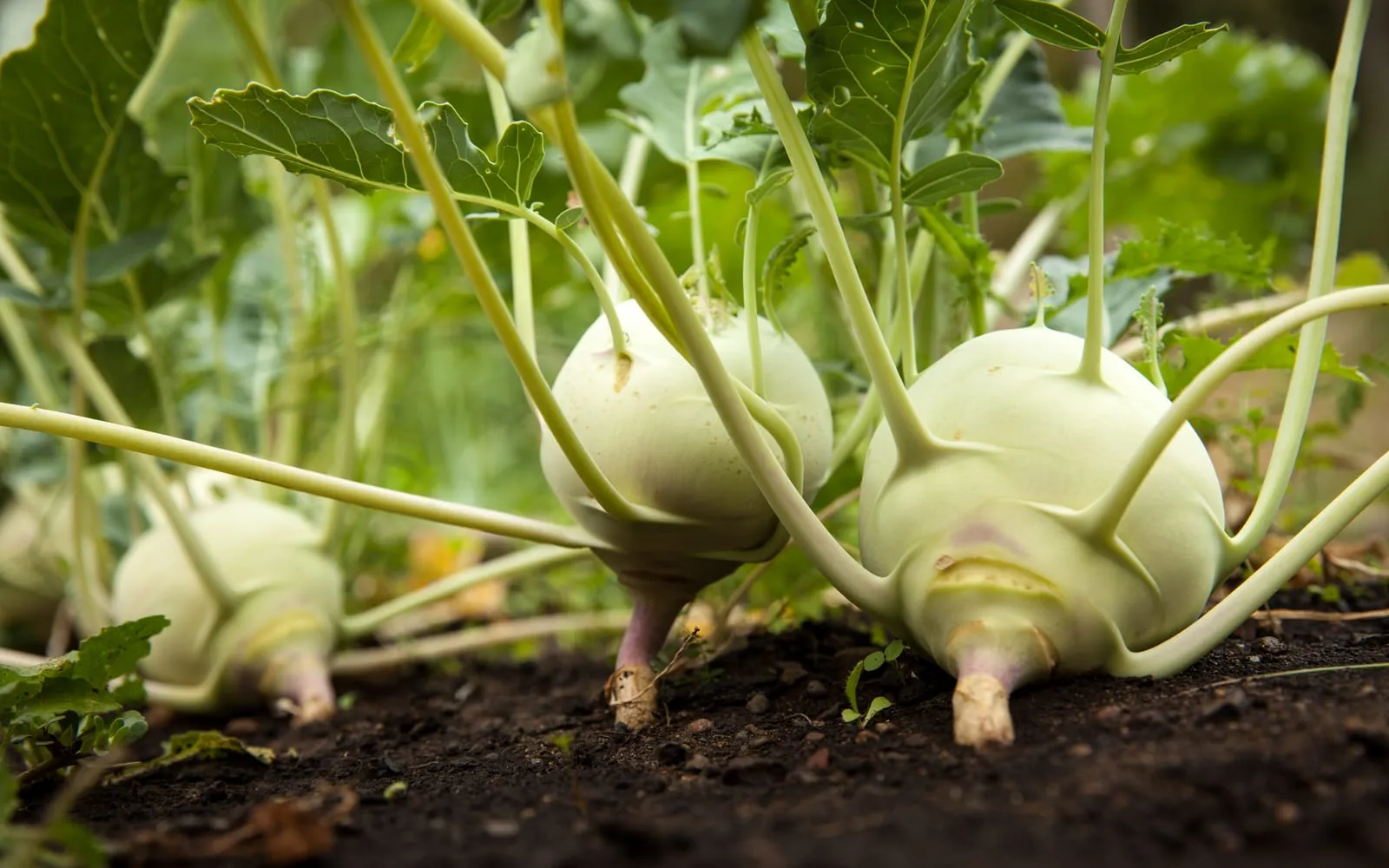
The part you eat is a stem. Kohlrabi swells its stem into a sphere that sits on top of the soil with the leaf stalks radiating from it, which is why it looks like a small green Sputnik and why nothing about growing a root crop applies to it.
Sowing that stem above ground has one useful consequence. Kohlrabi does not need the deep stone-free bed a carrot or a parsnip demands, so it crops on shallow, stony or heavy soil where root vegetables fail.
It is also the fastest brassica. Eight weeks from sowing to a tennis-ball-sized stem, against twenty for a cauliflower and thirty for a Brussels sprout. A row sown every three weeks from April to August keeps a kitchen supplied without occupying ground for long.
Appearance and character
A pale green or deep purple globe, 5 to 10 cm across, resting on the soil surface with a short root beneath it. Long-stalked leaves rise from all over the globe rather than from a crown, leaving a pattern of raised scars as they are picked.
The leaves are oval, slightly lobed, waxy blue-green and held well clear of the ground on stalks 20 to 30 cm long.
Flesh is white, crisp and juicy in both colour forms, tasting of sweet broccoli stem with none of the heat of a turnip. Raw is the best way to meet it, cut into batons.
Purple varieties such as ‘Azur Star’ and ‘Kolibri’ are purple only in the skin, and the colour is lost in cooking.
A plant left to run in its second year sends up a branched stem to a metre with pale yellow flowers, in the manner of every other Brassica oleracea.
Where it is from
Kohlrabi is the wild cabbage of the Atlantic and Mediterranean coasts, Brassica oleracea, selected for a swollen stem. Cabbage was selected from the same plant for a terminal bud, Brussels sprouts for axillary buds, cauliflower and broccoli for an arrested flower head, and kale for leaves. Six vegetables, one species.
The stem-swollen form is the most recent of the group. Nothing certainly describes it before the sixteenth century, when European herbals begin to illustrate it, and the name is the German Kohl for cabbage and Rabi for turnip.
Germany, central Europe and northern India grow it as a staple rather than a curiosity. In Kashmir it is monj haakh and one of the commonest vegetables on the plate.
English-speaking gardeners have long treated it as odd, which is a matter of habit rather than of the plant, since it is easier than most of what it sits beside on an allotment.
How it grows
Sow direct or in modules, and kohlrabi is one of the few brassicas that transplants without complaint provided it goes out young. Module-raised plants give a cleaner start on flea beetle ground.
Sow at 1 cm deep in rows 30 cm apart, and thin or plant out to 20 cm apart. Crowding gives small stems that go woody early.
Growth is fast. Sowings from May onwards reach usable size in eight to ten weeks, and early sowings under fleece take a little longer.
Harvest at 5 to 8 cm across for the best texture. Older varieties turn woody and fibrous beyond that, though modern ones such as ‘Superschmelz’ stay tender at 20 cm and are worth growing where a single large stem suits the kitchen better than a succession of small ones.
Sow every three weeks from April to early August. The plant occupies its ground briefly enough to fit between slower crops.
Through the seasons
Early spring takes the first sowing under cloches or fleece from late March. Kohlrabi bolts if a young plant meets a fortnight below 10 deg C, so protection is worth the trouble at this end of the year.
Late spring and summer carry the successional sowings, one every three weeks. Keep the soil damp, since a check in growth is what turns a stem woody.
Late summer is the last sowing, in early August, for autumn stems. Purple varieties stand cold better than green ones and are the ones to choose here.
Autumn is the harvest of the last sowings. Kohlrabi tolerates light frost and stores for a month in a cool shed with the leaves cut off, though it is better eaten fresh.
Care difficulty
One of the easiest brassicas, with a short season that limits the time anything can go wrong.
Harvest timing is the only real skill. A stem left to grow beyond its variety’s size turns woody from the outside in and cannot be rescued. Pick at 5 to 8 cm for the older varieties and check every few days once they start to swell.
Bolting is the spring problem. A young plant checked by cold decides it has been through a winter and flowers instead of swelling. Sow under cover before May, harden off properly, and plant out after the cold snaps.
Flea beetle hits the seedlings and clubroot is the soil problem that ends the crop, and both are handled as for every other brassica.
Watering is the routine work. Kohlrabi is shallow-rooted and a dry week shows up in the texture.
Watering
Water for steadiness. A stem that grows without interruption is crisp and juicy, and one that stops and starts is woody and fibrous, and the difference is almost entirely water.
Every two or three days in dry weather, enough to wet the top 20 cm. Kohlrabi roots shallowly and does not draw on reserves lower down.
Keep the seedbed damp through germination and for the fortnight after.
Mulch once the plants are established. A 5 cm layer of compost holds moisture and keeps flea beetle down, since the beetles prefer dry surfaces.
Splitting is uncommon in kohlrabi and, where it happens, follows heavy rain onto dry ground.
Container growing works well. Use a pot at least 25 cm deep, water daily in summer, and expect to feed by mid-season.
Warning signs, diseases and pests
Flea beetle shot-holes the seedling leaves in May and June and slows a young plant badly. Cover with fine insect mesh from the day of sowing and keep the soil surface damp.
Cabbage white caterpillars strip the leaves from July. The stem survives a defoliated plant better than a cabbage would, but growth stops. Net with 7 mm mesh, or check the undersides of the leaves twice a week and rub off the egg clusters.
Small pinholes and papery windowpane patches, with a thin pale green caterpillar that drops off on a silk thread when touched, is diamondback moth, the most economically damaging brassica pest worldwide. The same net keeps it out.
Clubroot swells the root below the stem into a distorted mass and wilts the plant on warm afternoons. Lime to pH 7, rotate on four years, and raise plants in modules on infected ground.
Cabbage root fly larvae eat the roots and the plant wilts and topples. Fit a 15 cm collar at planting.
Woody, fibrous flesh is a harvesting fault or a watering one rather than a disease.
Slugs graze young plants to the ground overnight and are worst on a mulched bed in a wet spring.
Growing environment
Full sun for spring and autumn crops, and light shade is an advantage for midsummer sowings, which bolt less readily out of full sun.
Firm, fertile, moisture-retentive soil is ideal, and shallow or stony ground that would ruin a carrot suits kohlrabi perfectly well because the crop sits on top of it.
Lime to pH 6.5 or 7. Acid soil limits growth and encourages clubroot.
Tread the bed firm before sowing or planting.
Work compost in the autumn before rather than fresh manure, which is less critical here than for a root crop but still gives softer growth.
Rotate on four years with the other brassicas, and remember that kohlrabi, cabbage, kale, broccoli, cauliflower and Brussels sprouts are all the same species and share every soil-borne disease.
Feeding
Kohlrabi grows fast and wants its nutrients available from the start rather than fed in later.
Work a balanced general fertiliser into the bed at sowing on poor ground, at around 50 g per square metre.
A liquid feed halfway through the crop helps on light sandy soil and in containers. On a bed in good heart it is unnecessary.
Avoid heavy nitrogen. It gives large leaves over a small stem and softens the plant against pests.
Never use fresh manure. Compost added the previous autumn is the right form of organic matter.
Troubleshooting
The stem is woody and fibrous. Harvested too late or grown too dry. Pick at 5 to 8 cm across for standard varieties, and water every few days.
The plants flowered instead of swelling. Bolting after a cold check on a young plant. Sow under fleece before May and plant out once the cold snaps have passed.
Shot holes across the seedling leaves. Flea beetle. Cover with fine mesh from sowing and keep the surface damp.
Leaves stripped to the ribs in July. Cabbage white caterpillars. Net with 7 mm mesh, and rub off the yellow egg clusters on the leaf undersides.
Swollen distorted roots and a wilting plant. Clubroot. Lime, rotate on four years, and raise plants in modules.
Small stems on a crowded row. Thin or space to 20 cm.
Do I peel it? Yes for anything above 8 cm, where the skin is tough. Small young stems need only a wash.
Can I eat the leaves? Yes. Cook the young ones like spring greens. The older outer leaves are coarse and better composted.
Kohlrabi problem guides
Not sure what is wrong? See the common vegetable pests guide.