
Edible
Turnip
Brassica rapa subsp. rapa
Also known as White turnip, Turnip tops, Neep
How to grow turnips, Brassica rapa subsp. rapa. Sowing for baby roots and for winter, beating flea beetle, why they go woody, and eating the tops.
At a glance
- Difficulty
- Easy
- Water
- Weekly in dry spells, and more often on light soil
- Light
- Full sun, and it takes light shade better than most root crops
- Temperature
- 10-18 deg C. Bolts in sustained heat above 25 deg C
- Hardiness
- USDA 2-9, RHS H5, hardy to -10 C
- Type
- Biennial grown as an annual
- Height
- 30-50 cm of foliage
- Native to
- Europe and central Asia
- Best month
- August in the Northern Hemisphere, February in the Southern Hemisphere
Turnip wants to grow fast and cool, and sustained heat above 25 deg C makes the root woody and sends the plant to flower. Cold suits it, and the leaves are a crop in their own right after frost. Sowings work at both ends of the season and rarely in the middle.
Hardiness zones describe winter cold alone. Summer heat, humidity, rainfall and the length of the growing season decide as much, so treat the range as the outer limit rather than as a recommendation.
Every month named in this guide is for the temperate Northern Hemisphere. If you garden in the Southern Hemisphere, shift each one by six months, so August becomes February. Closer to the equator the wet and dry seasons matter more than the calendar, and the shift stops being a useful guide.
Not known to be toxic
- Safe to eat
- The swollen root and the leafy tops, both cooked or raw
Turnip is a food crop and carries no toxicity concern for people. The RHS does not list it as a potentially harmful garden plant and the ASPCA does not list Brassica rapa as toxic to cats and dogs, though a dog that eats a quantity of raw turnip is likely to get wind and a loose stomach from the mustard oils. Those mustard oils are glucosinolates, the same class of compound that gives radish and mustard their heat, and they are harmless in any amount a person eats. The livestock position is worth recording because turnips are still grown as a fodder crop in Britain. Brassica forage contains S-methylcysteine sulphoxide, which causes haemolytic anaemia in sheep and cattle turned onto a field of roots without other feed, and glucosinolates interfere with iodine uptake and can cause goitre. Shepherds introduce stock to a root crop gradually and balance it with hay for that reason. None of it applies to a garden row or to anybody eating turnip. Green patches on a stored root are chlorophyll rather than the solanine that greens a potato, and they are harmless.
Sources: RHS potentially harmful garden plants, ASPCA toxic and non-toxic plants
About
Turnips are the quickest root crop in the garden. An early variety sown in April is pullable at golf-ball size in six weeks, which is faster than a radish gets to any useful size and far faster than a carrot.
Almost every disappointing turnip has been left in the ground too long. The root goes woody and hot from about tennis-ball size onwards, and a grower waiting for something impressive ends up with something inedible.
The tops are the other half of the crop and are ignored in Britain more than anywhere else. Turnip greens are the leaf a large part of the American south and southern Italy grows the plant for, and a row sown thickly in September gives cutting greens through the winter without ever making a root.
Appearance and character
A low rosette of rough, bristly, lobed leaves in bright mid-green, held on thin stalks. The leaves feel scratchy, which separates a turnip seedling from a swede seedling at a glance, since swede leaves are smooth and waxy blue-green.
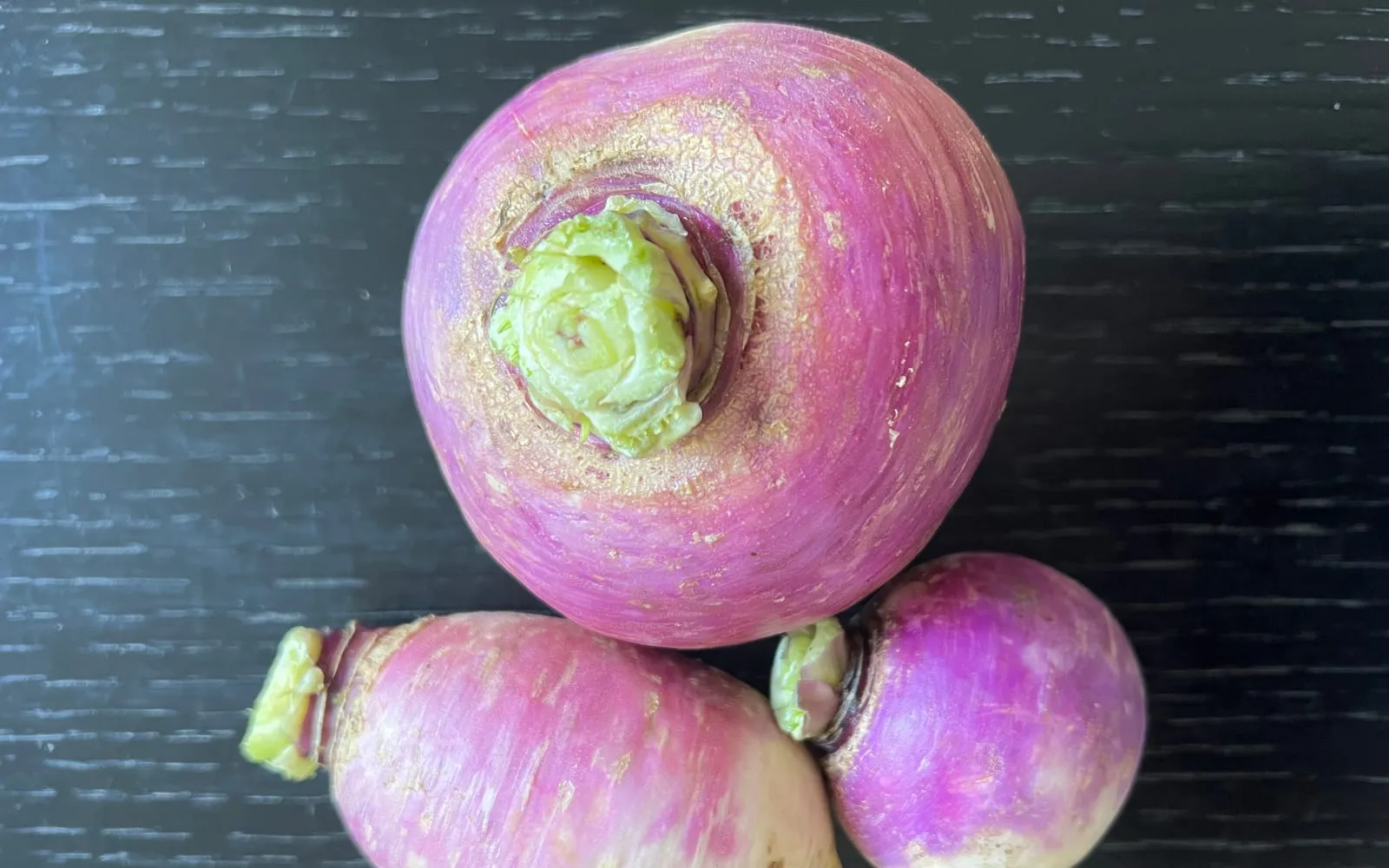
The root sits half out of the ground rather than buried. Most garden varieties are white below and stained purple where the sun has reached them, though ‘Golden Ball’ is yellow throughout and ‘Tokyo Cross’ is white all over.
Flesh is white, crisp and faintly hot when raw, turning sweet and soft when cooked. The heat comes from the same mustard oils that give radish its bite and it fades with size and with cooking.
Left to run a second year, the plant throws up a branched flowering stem to about 60 cm with small four-petalled yellow flowers, followed by narrow seed pods. The root is woody and useless by then.
Where it is from
The turnip is a form of Brassica rapa, a species that also gave the world pak choi, mizuna, tatsoi and Chinese cabbage. Every one of those is the same species selected in a different direction, which is why they cross readily and why saving seed from any of them in a garden growing several is a lottery.
Cultivation goes back to at least the classical world in Europe and to comparable antiquity in central Asia, and the two centres of domestication are still argued over.
Britain owes its turnip fields to Charles Townshend, who in the 1730s popularised the four-course rotation that used turnips as a winter fodder crop and broke the pattern of leaving ground fallow. The nickname that followed him around says more about eighteenth-century agricultural politics than about the vegetable.
The wild form grows on disturbed and coastal ground across Europe with a thin tough root, and the swollen root of the crop is a storage organ the plant intends to spend on flowering in its second summer.
How it grows
Sow direct and thin. Turnips have a taproot, resent transplanting and fork if moved, so a module-raised turnip is usually a poor one. The exception is a first early sowing under cover on clubroot ground, where the head start is worth the risk.
Sow thinly at 1 cm deep in rows 23 cm apart, and thin early to 10 cm for baby roots or 15 cm for maincrops. Thinning late is the commonest reason a row gives leaves and no roots.
Germination is quick, taking a week in warm soil, and growth from there is fast enough that a spring sowing outruns most of its pests.
Sow little and often from March to August. Early varieties take six to eight weeks and maincrops for winter storage take ten to twelve, so a July or August sowing gives roots to lift from October.
For greens rather than roots, broadcast seed thickly in September and cut the leaves at 15 cm, letting them regrow two or three times.
Through the seasons
Early spring takes the first sowings of quick varieties under fleece from March, on ground that was manured for the previous crop rather than this one.
Late spring and summer carry successional sowings every three weeks. Keep the soil damp, because a turnip that dries out turns woody and hot and never recovers when watered again.
Late summer is the main sowing window for winter roots, from mid-July to the end of August. This is also the sowing that misses the worst of the flea beetle, whose adults are most active in warm dry weather in May and June.
Autumn and winter are for lifting and for cutting tops. Maincrop roots stand light frost in the ground and are better lifted before Christmas in wet soil, then stored in boxes of damp sand in a cool shed.
Care difficulty
Straightforward, with three ways to get it wrong.
Sowing too thickly and thinning too late gives a row of leaves over marbles. Thin at the two-leaf stage and again a fortnight later.
Letting the soil dry gives woody, hot roots. Turnips are shallow-rooted and a fortnight of drought in June is enough. Water and mulch rather than hope.
Harvesting late gives the same woody result from a different cause. Pull early varieties at 5 cm across and maincrops at 8 to 10 cm, and pull them all before they get to the size that looks like a good crop.
Clubroot is the one problem that ends the crop rather than reducing it, and it is a soil disease that lasts twenty years. Lime to pH 7, rotate on a four-year cycle, and grow in modules and plant out on infected ground.
Watering
Water for evenness rather than volume. A steady supply gives crisp sweet roots and an interrupted one gives woody hot ones, and the damage from a dry fortnight cannot be undone afterwards.
Roughly 10 litres per square metre a week in dry weather suits them, given as one soak rather than a daily sprinkle.
Keep the seedbed damp through germination and for the fortnight after. Flea beetle does far more damage to a dry, slow-growing seedling than to a fast one.
Mulch between rows once the plants are established. A 5 cm layer of compost holds moisture and keeps the soil cool, which delays bolting in a hot summer.
Splitting follows heavy rain onto dry ground. The root swells faster than its skin, and even watering is the only prevention.
Warning signs, diseases and pests
Flea beetle is the pest that greets every spring sowing. Tiny black beetles shot-hole the seedling leaves and a badly hit row never recovers. Cover with fine insect mesh from the day of sowing, keep the surface damp, and sow after mid-July when the adults have largely finished.
Small pinholes and papery windowpane patches on the leaves, with a thin pale green caterpillar that drops off on a silk thread when touched, is diamondback moth, the most economically damaging brassica pest worldwide. The same mesh keeps it off.
Clubroot swells and distorts the roots into a useless mass and wilts the plant in warm weather. There is no cure. Lime to pH 7 or above, rotate on four years, raise plants in modules to give them a head start, and never move soil or plants from an infected bed.
Cabbage root fly larvae tunnel into the root and leave brown channels. A 15 cm collar of cardboard or roofing felt around each plant stops the female laying at the stem base.
Powdery mildew coats the leaves in late summer on dry soil. Water and mulch.
Slugs take seedlings overnight. Water in the morning so the surface is dry by dusk.
Woody, hot roots mean drought or a late harvest rather than a pest.
Harlequin bug drains the leaves into pale cloverleaf-shaped blotches across the southern and central United States, where it can overwinter, and turns up further north as a seasonal visitor. It has not established outside the Americas.
Growing environment
Full sun gives the fastest growth, though turnips crop acceptably with four or five hours and are a reasonable choice for a partly shaded plot.
Firm, fertile, moisture-retentive soil suits them. Sandy ground dries too fast and gives woody roots, so work in compost the autumn before and mulch.
Lime to pH 6.5 or 7. Acid soil both limits growth and lets clubroot flourish, so liming helps any brassica bed.
Never sow into freshly manured ground. Fresh organic matter causes forking and hairy roots. Follow a crop that was manured the previous season.
Firm the ground before sowing by treading it. Brassicas root badly in fluffy soil and a turnip needs a firm bed to swell against.
Rotate on a four-year cycle with the other brassicas, which for this bed means cabbage, kale, broccoli, cauliflower, Brussels sprouts, swede, kohlrabi, mooli, radish and the oriental greens all counting as the same crop.
Feeding
Turnips need little. On ground in reasonable heart they need nothing.
Avoid nitrogen. It gives a large leafy top over a small root, which is the same mistake that produces disappointing carrots and beetroot.
A light dressing of general fertiliser raked in at sowing helps on poor or sandy ground. Sulphate of potash suits them better than anything nitrogenous.
Never apply fresh manure. Where the bed needs organic matter, add well-rotted compost a full season ahead.
A liquid feed is only worth giving to a row grown for tops rather than roots, where leafy growth is the point.
Troubleshooting
All leaves and no root. Thinned too late, sown too thickly, or fed with nitrogen. Thin at the two-leaf stage and grow on ground manured last year.
Woody, hot roots. Drought, heat, or left in the ground too long. Pull early varieties at 5 cm and maincrops at 8 to 10 cm.
Shot holes all over the seedling leaves. Flea beetle. Cover with fine mesh from sowing and keep the soil damp. A hard-hit row is quicker to resow than to rescue.
Swollen, distorted roots and a wilting plant. Clubroot. Lime the bed, rotate for four years, and raise future plants in modules.
Brown tunnels through the root. Cabbage root fly. Fit collars at the stem base next season.
The plants have flowered. Bolting, usually after a cold spell on a spring sowing or a drought on a summer one. Pull them and sow again.
Splitting. Heavy rain after a dry spell. Water evenly and harvest promptly.
Can I eat the leaves? Yes, and they are the better half of the plant. Cut them at 15 cm and cook them like spring greens. A row sown thickly in September gives greens all winter.
Turnip problem guides
Not sure what is wrong? See the common vegetable pests guide.