
Edible
Chinese Broccoli
Brassica oleracea var. alboglabra
Also known as Kai lan, Gai lan, Chinese kale
How to grow Chinese broccoli, Brassica oleracea var. alboglabra. Cutting kai lan at the right moment, why the flower buds are the crop, and getting a second harvest from side shoots.
At a glance
- Difficulty
- Easy
- Water
- Weekly, and more often on light soil
- Light
- Full sun, with light shade acceptable in midsummer
- Temperature
- 15-25 deg C, and it takes heat better than any other brassica
- Hardiness
- USDA 7-10, RHS H3, hardy to -2 C
- Type
- Annual, or a biennial run as an annual
- Height
- 20-50 cm
- Native to
- Coastal western Europe and the Mediterranean
- Best month
- June in the Northern Hemisphere, December in the Southern Hemisphere
It handles heat better than any other brassica and crops through a tropical wet season where cabbage and calabrese rot, which is why it is a year-round vegetable across southern China and Southeast Asia. Cold does not suit it. Below about -2 deg C the stems are damaged.
Hardiness zones describe winter cold alone. Summer heat, humidity, rainfall and the length of the growing season decide as much, so treat the range as the outer limit rather than as a recommendation.
Every month named in this guide is for the temperate Northern Hemisphere. If you garden in the Southern Hemisphere, shift each one by six months, so June becomes December. Closer to the equator the wet and dry seasons matter more than the calendar, and the shift stops being a useful guide.
Not known to be toxic
- Safe to eat
- The whole plant above ground, stems, leaves and flower buds
Chinese broccoli is a food crop and carries no toxicity concern for people. The RHS does not list it as a potentially harmful garden plant and the ASPCA does not list Brassica oleracea as toxic to cats and dogs, though a dog eating a quantity of any raw brassica is likely to get wind and a loose stomach from the glucosinolates. It is the same species as cabbage, kale, broccoli, cauliflower, Brussels sprouts and kohlrabi, and shares their profile, including the vitamin K content that matters for anybody taking warfarin. A steady intake is the practical advice there rather than avoidance. The slight bitterness in the stems comes from the same glucosinolates and is a flavour rather than a warning. Open flowers are edible and the plant is best cut before they open, for texture rather than for safety.
Sources: RHS potentially harmful garden plants, ASPCA toxic and non-toxic plants
About
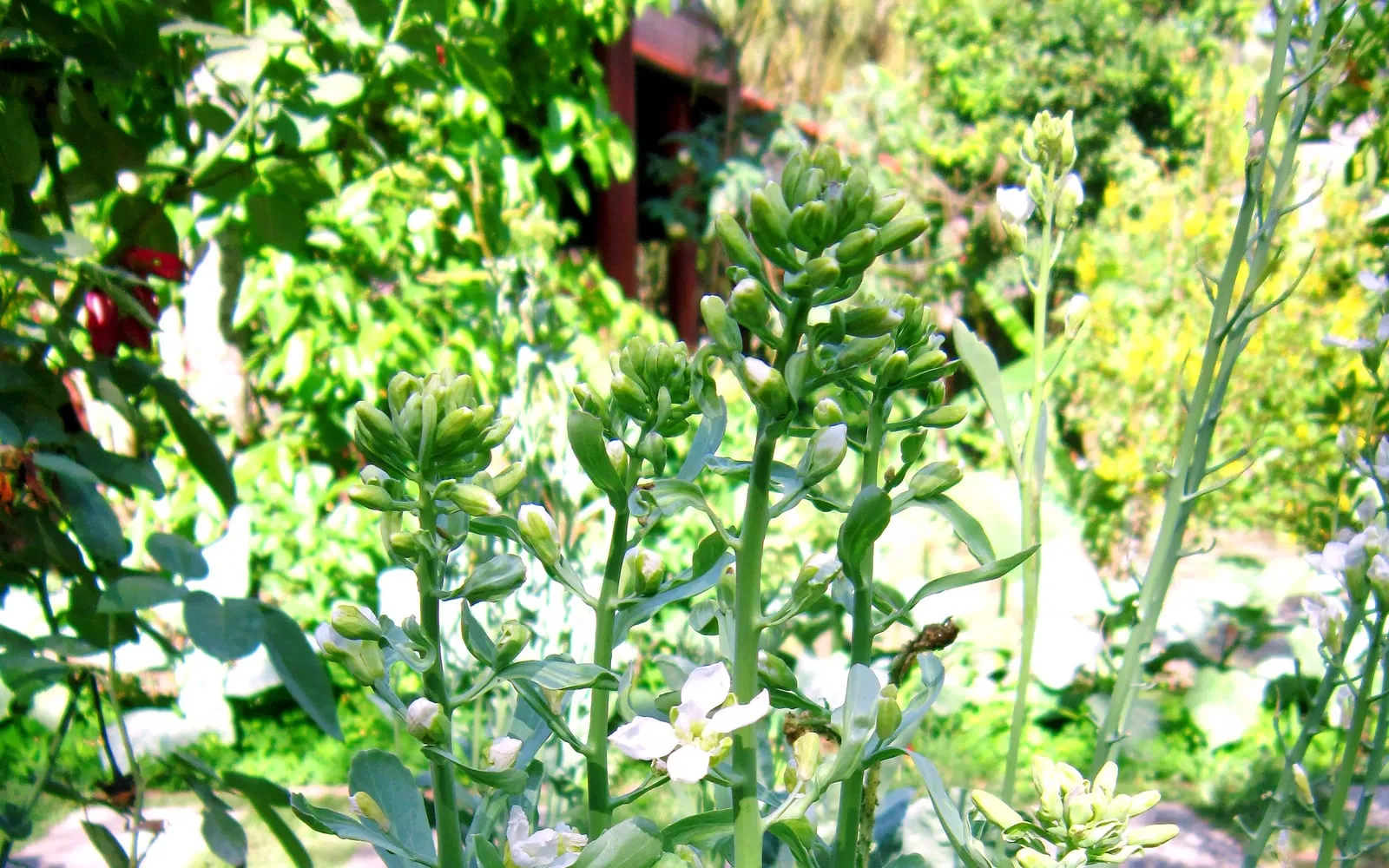
Kai lan is grown for a thick tender stem topped with a cluster of unopened white flower buds, and the whole thing is cut and cooked together. Nothing is discarded and nothing needs peeling.
That makes it the most productive brassica for a small plot. Ten weeks from sowing to the first cut, then side shoots for another month, from a plant that occupies 25 cm of row.
It also solves the summer problem the other oriental greens have. Kai lan is Brassica oleracea, not Brassica rapa, so it does not bolt in long days the way pak choi and mizuna do. A June sowing crops in August, which is when the rest of this group is unusable.
Appearance and character
An upright plant 20 to 50 cm tall with a thick main stem, considerably stouter than a calabrese stem and quite different in texture.
Leaves are broadly oval, smooth, thick and waxy blue-green, with a distinct bloom that water beads on. They are held on long stalks and are as much of the crop as the stem.
The flower head is small, loose and made of white buds rather than the tight green dome of a calabrese. Buds open into four-petalled white flowers, which is where the alboglabra name comes from.
Flavour is closer to a sweet, slightly bitter kale than to broccoli, and the stem is the sweetest part. Blanching or a quick stir-fry suits it.
Left too long, the plant opens its flowers, the stem goes hollow and fibrous, and the leaves coarsen.
Where it is from
Chinese broccoli is the wild cabbage of the Atlantic and Mediterranean coasts, Brassica oleracea, which also gave cabbage, kale, cauliflower, calabrese, Brussels sprouts and kohlrabi. Chinese growers selected this one for stem and flower bud.
How a European coastal plant reached southern China is not settled. The most likely route is Portuguese trade through Macau from the sixteenth century, and the selection into the current form happened in Guangdong.
Cantonese cooking treats it as a staple, blanched and dressed with oyster sauce, and it is one of the vegetables most reliably found in a Chinese greengrocer anywhere in the world.
Broccolini, sold as tenderstem, is a modern hybrid between kai lan and calabrese, made in Japan in the 1990s. Anybody who likes tenderstem is already halfway to liking this plant.
How it grows
Sow direct or in modules. Kai lan transplants well, which sets it apart from most of the crops in this wave, so module-raising to dodge flea beetle and slugs is a reasonable approach.
Sow at 1 cm deep in rows 30 cm apart and thin or plant to 25 cm apart.
Germination takes five to ten days in warm soil.
Cut the main stem when the flower buds are still tight and the stem is 15 to 20 cm long, around ten weeks from sowing. Cut low, leaving three or four leaves on the stump.
Side shoots follow within a fortnight and crop for another month. Keep cutting and keep feeding.
Sow every three weeks from April to July. Late sowings crop into October.
Through the seasons
Spring takes the first sowings from April, under fleece if the soil is still cold. Cover against flea beetle from the day of sowing.
Summer is the main season and the reason to grow this rather than pak choi. Sowings in May, June and July all crop reliably in heat that would bolt any Brassica rapa. Water weekly.
Late summer takes the final sowing in late July for an October cut.
Autumn finishes the crop. Kai lan tolerates a light frost and the flavour sweetens, but it is not a winter vegetable outside the subtropics and a hard frost ends it. Clear the bed and follow with garlic or overwintering onions.
Care difficulty
Easy, and easier than most brassicas because the season is short and the plant tolerates heat.
Judging the cut is the only skill. Buds tight and stem tender is the moment. A week late gives open flowers, a hollow stem and a plant past its best. Check every couple of days once the head shows.
Cabbage white caterpillars are the main pest, and the crop runs straight through their season. Net from the day of sowing rather than after the first butterfly.
Clubroot and cabbage root fly apply as to all brassicas.
Watering and feeding are the routine work, and the plant repays both because it is asked to produce a second and third flush of shoots.
Watering
Water weekly and more often on light soil. A checked plant makes a small head and few side shoots.
Around 12 litres per square metre a week in dry weather, given as one soak rather than a daily sprinkle.
Water immediately after each cut. Side shoots come from stored energy and available water, and a dry plant stops.
Mulch after thinning with 5 cm of compost, which holds moisture and keeps flea beetle down.
Water at the base rather than over the leaves. The waxy bloom sheds water anyway and wet foliage overnight invites mildew.
Warning signs, diseases and pests
Cabbage white caterpillars strip the leaves and foul the flower buds from June onwards, and the crop is in the ground for exactly their season. Net with 7 mm mesh from sowing, and where netting is impractical check the leaf undersides twice a week and rub off the yellow egg clusters.
Flea beetle shot-holes the seedlings in spring and early summer. Fine mesh from the day of sowing, and keep the surface damp.
Small pinholes and papery windowpane patches, with a thin pale green caterpillar that drops off on a silk thread when touched, is diamondback moth. It breeds year-round across the crop’s home range in Asia and is the most economically damaging brassica pest anywhere it is grown, with resistance recorded to nearly every insecticide used against it. The same mesh keeps it off.
Clubroot swells and distorts the roots and wilts the plant on warm afternoons. Lime to pH 7, rotate on four years, and raise plants in modules on infected ground.
Cabbage root fly larvae eat the roots and the plant collapses. Fit a 15 cm collar at planting.
Mealy cabbage aphid forms grey waxy colonies in the growing point and distorts the head. Squash them, wash them off with a jet of water, and leave the ladybirds and hoverfly larvae to the rest.
A hollow, fibrous stem means the plant was cut too late.
Growing environment
Full sun, with light shade acceptable and even helpful for midsummer sowings.
Fertile, moisture-retentive soil grows the tender stems the crop is for. Dig in garden compost before sowing.
Lime to pH 6.5 or 7.
Firm ground suits it, as it does every brassica. Tread the bed before sowing or planting.
Space at 25 cm. Closer spacing gives thin stems and fewer side shoots.
Rotate on four years with the rest of the brassicas, counting cabbage, kale, broccoli, cauliflower, sprouts, kohlrabi, turnip, swede, radish and the oriental greens as one crop.
Feeding
Dig garden compost into the bed before sowing.
Feed with a nitrogen-rich liquid feed every fortnight from four weeks after thinning. The crop is leaf and stem, so nitrogen is the right nutrient here in a way it would not be for a root vegetable.
Feed again immediately after each cut, which is what drives the side shoots.
Avoid fresh manure, which softens growth and encourages aphids.
Container growing works in a pot of 30 cm or more with a fortnightly feed, though yields are lower than in the ground.
Troubleshooting
The flowers opened before I cut it. Cut a week earlier next time, while the buds are still tight. Open flowers are edible and the stem below them is hollow and fibrous.
No side shoots after the first cut. Cut too low, or the plant went short of water and feed. Leave three or four leaves on the stump and feed straight after cutting.
Leaves stripped to the ribs. Cabbage white caterpillars. Net with 7 mm mesh from sowing.
Small round holes across the seedlings. Flea beetle. Fine mesh from the day of sowing.
Grey waxy colonies in the growing tip. Mealy cabbage aphid. Wash them off and squash what remains.
Swollen distorted roots and a wilting plant. Clubroot. Lime to pH 7 and rotate on four years.
Thin, weak stems. Crowding or shade. Thin to 25 cm and give it full sun.
Is this the same as tenderstem broccoli? No, though they are related. Tenderstem is a hybrid between kai lan and calabrese. Kai lan is the parent with the thick stem and the waxy leaves.
Chinese Broccoli problem guides
Not sure what is wrong? See the common vegetable pests guide.