
Edible
Siberian Kale
Brassica napus var. pabularia
Also known as Russian kale, Hungry gap kale, Rape kale
How to grow Siberian kale, Brassica napus var. pabularia. Why it beats curly kale for cold and clubroot, cutting through winter, and telling it from Russian kale.
At a glance
- Difficulty
- Easy
- Water
- Weekly through summer, rarely in winter
- Light
- Full sun, and it crops acceptably in light shade
- Temperature
- Hardy to about -20 deg C, which is hardier than curly kale
- Hardiness
- USDA 3-9, RHS H7, hardy to -20 C
- Type
- Biennial grown as an annual or overwintered
- Height
- 60-100 cm
- Native to
- Of cultivated hybrid origin, probably northern Europe
- Best month
- July in the Northern Hemisphere, January in the Southern Hemisphere
Hardier than curly kale and quicker to regrow after cutting, which is what recommends it in a short season. It is a different species from the other kales, closer to swede and rape, and it resists clubroot better than Brassica oleracea does.
Hardiness zones describe winter cold alone. Summer heat, humidity, rainfall and the length of the growing season decide as much, so treat the range as the outer limit rather than as a recommendation.
Every month named in this guide is for the temperate Northern Hemisphere. If you garden in the Southern Hemisphere, shift each one by six months, so July becomes January. Closer to the equator the wet and dry seasons matter more than the calendar, and the shift stops being a useful guide.
Not known to be toxic
- Safe to eat
- The leaves, the young shoots in spring, and the flower buds
Siberian kale is a food crop and carries no toxicity concern for people. The RHS does not list it as a potentially harmful garden plant and the ASPCA does not list Brassica napus as toxic to cats and dogs, though a dog eating a quantity of raw kale is likely to get wind and a loose stomach from the glucosinolates. The livestock point is worth recording because this is a fodder crop as much as a garden one, and the variety name pabularia means fodder. Brassica forage contains S-methylcysteine sulphoxide, which causes haemolytic anaemia in sheep and cattle grazed heavily on it without other feed, and glucosinolates which interfere with iodine uptake and can cause goitre. Farmers introduce stock gradually and balance the crop with hay. None of that arises from a garden row. Kale is high in vitamin K, which matters to anybody taking warfarin, where a consistent intake rather than avoidance is the practical advice.
Sources: RHS potentially harmful garden plants, ASPCA toxic and non-toxic plants
About
Siberian kale is a different species from the curly kale most gardeners grow, and the difference changes how it grows. Curly kale is Brassica oleracea. This is Brassica napus, the swede and oilseed rape species, and it brings two advantages with it.
It is hardier, standing about -20 deg C against the -15 deg C of a good curly variety. And it shows useful resistance to clubroot, which makes it the kale to grow on ground where the oleracea brassicas have failed.
The leaves are also better raw. Broad, flat and only slightly frilled at the edge, they are tender enough for a salad in a way curly kale never is without massaging.
Appearance and character
An open upright plant, 60 cm to a metre tall, with long-stalked leaves rising from a central stem rather than forming a dense column.
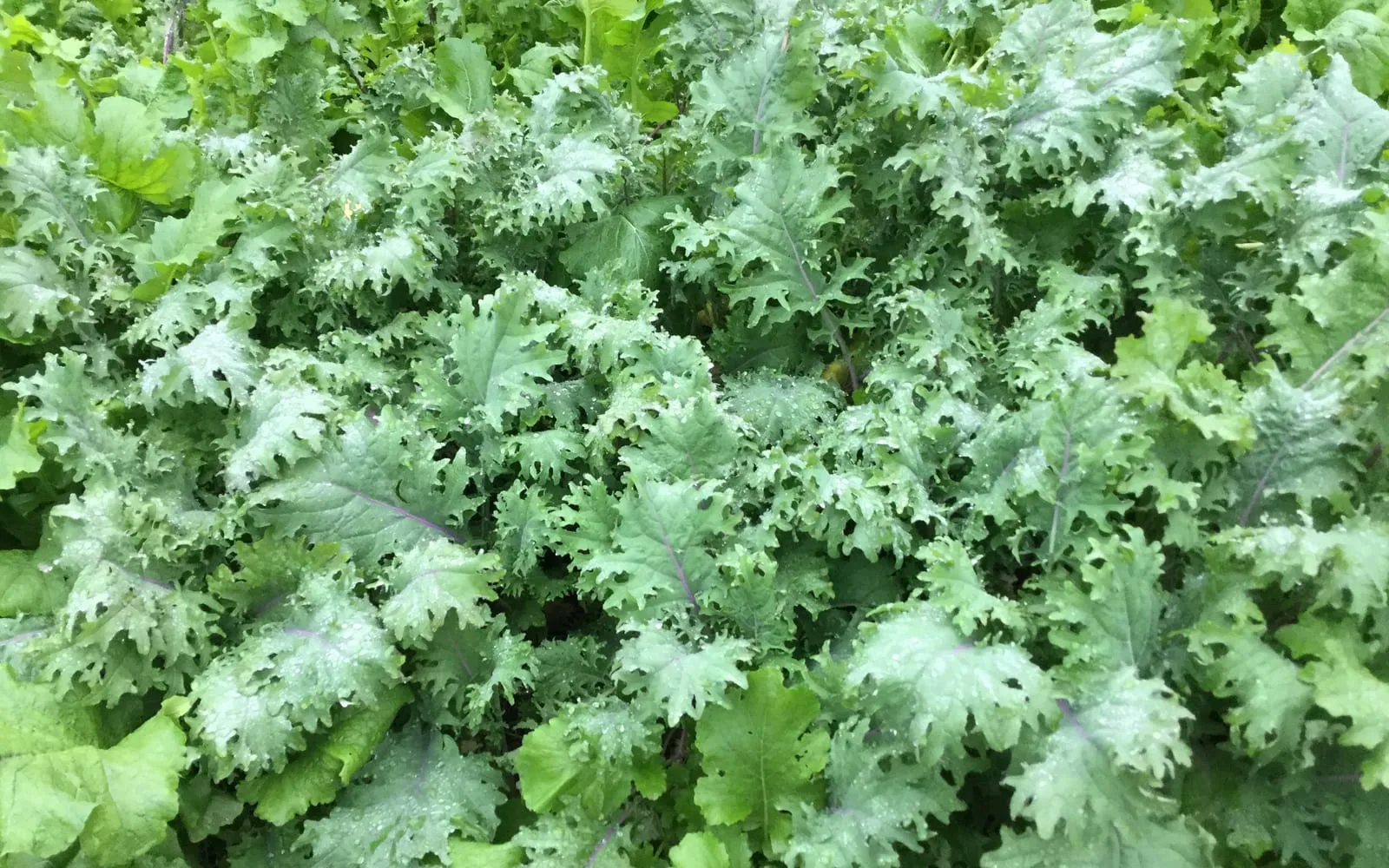
Leaves are broad and oval to oak-leaf shaped, with wavy or shallowly lobed edges rather than the tight curling of a Scotch kale. The surface is smooth and waxy blue-green with a bloom.
Stalks and midribs are often flushed purple, more strongly after frost, and the forms sold as Red Russian have purple veining across the whole leaf.
Texture is soft for a kale, and the flavour is sweet and mild, sweetening further after each frost as starch converts to sugar.
In its second spring the plant bolts, sending up branched stems with pale yellow flowers. The flower shoots are the best part of the whole crop, cut like sprouting broccoli in April when nothing else is ready.
Where it is from
Brassica napus is a hybrid species, the product of a cross between the turnip and the cabbage that doubled its chromosomes and produced something fertile and new. Swede is the root form, oilseed rape is the seed form, and this is the leaf form.
The cross probably happened in northern Europe in or before the seventeenth century. Leaf rape has been grown for fodder across northern Europe and Russia since then, which is where the Siberian and Russian names come from, though the plant is not native to either.
Russian traders are usually credited with bringing it to North America through Alaska in the nineteenth century, and American seed catalogues carried it from the 1860s.
It is known as hungry gap kale, named for the period in March and April when winter stores have run out and spring crops have not started. This is the plant that fills it.
How it grows
Sow direct or in modules. It transplants well, and module-raising gives a cleaner start against flea beetle and slugs.
Sow at 1 cm deep in a seedbed in June or July, then transplant to 45 cm apart in late July or August. Direct sowing works too, thinning to the same spacing.
Plant firmly. Push the transplant in deep, up to the lowest leaves, and firm with a heel. A loosely planted kale rocks in winter gales and never grows well.
Pick from October onwards, taking the lower leaves first and leaving the growing point. A plant picked this way crops all winter.
In April take the flowering shoots as they appear, snapping them off at 15 cm, which encourages more.
Clear the plants in May before they set seed, and follow with a summer crop.
Through the seasons
Early summer is for sowing, in June or early July, in a seedbed or modules.
Late summer is for transplanting, in late July or August, into ground that grew an early crop. Plant deep and firm, water in well, and net against pigeons and caterpillars from the day of planting.
Autumn builds the plant. Water through any dry spell and feed monthly. Start picking lower leaves from October.
Winter is the harvest and the plant needs almost nothing. Frost sweetens the leaves. Check for wind rock after gales and firm the soil around the stem with a heel.
Early spring brings the flowering shoots in March and April, which are the best crop the plant gives. Feed with a nitrogen-rich fertiliser in February to push them.
Care difficulty
Easy, and the easiest kale to grow well in a cold or exposed garden.
Firm planting is the one technique that matters. A kale that rocks in the wind tears its roots, lets water into the hole and stops growing, and this is the commonest reason a winter brassica disappoints.
Pigeons are the pest that decides whether you get a winter crop at all. They strip a plant to the ribs in a hard frost when other food is short, and netting is the only reliable answer.
Mealy cabbage aphid overwinters in the crown and is easy to miss until spring.
Clubroot resistance is a real advantage, though it is partial rather than absolute, so rotate anyway.
Otherwise the plant looks after itself from November to March, which is more than most crops manage.
Watering
Water weekly through summer and early autumn while the plant is building its frame. Around 12 litres per square metre in dry weather.
Water new transplants generously for the first fortnight. Establishment is the critical period.
Winter watering is rarely needed. Winter rainfall covers it in a maritime climate, and wet soil around the stem does more harm than drought.
Mulch after planting with 5 cm of compost, kept clear of the stem.
A dry spell in February and March checks the flowering shoots, so water then if the weather is dry.
Warning signs, diseases and pests
Pigeons are the main winter problem, stripping the leaves to the midribs in cold weather. Net with 2 cm mesh held clear of the foliage on hoops, since pigeons peck through netting laid on the plant.
Cabbage white caterpillars strip the leaves from July to September. Net with 7 mm mesh from planting, or check the leaf undersides twice weekly and rub off the egg clusters.
Small pinholes and papery windowpane patches, with a thin pale green caterpillar that drops off on a silk thread when touched, is diamondback moth, the most economically damaging brassica pest worldwide. The same net keeps it out.
Mealy cabbage aphid forms grey waxy colonies in the growing point and overwinters there, distorting the spring shoots. Squash the colonies, wash them off with a jet of water, and check the crown in February.
Wind rock loosens the stem in winter gales. Firm the soil around the base with a heel after every gale, and earth up 10 cm around the stem in November.
Flea beetle shot-holes seedlings in June and July. Fine mesh over the seedbed.
Clubroot is less likely on this species than on curly kale, and still worth rotating against.
Whitefly rise in clouds from a disturbed plant. They are unsightly, coat the leaves in sticky honeydew that turns sooty, and rarely reduce the crop.
Growing environment
Full sun gives the best plants, and Siberian kale crops acceptably with four or five hours, which makes it useful on a shaded plot.
Fertile, moisture-retentive soil grows the biggest plants. Dig in compost before planting.
Lime to pH 6.5 or 7.
Firm ground is essential. Plant into soil that has settled after an earlier crop rather than into freshly dug ground, and tread it before planting.
Shelter helps but is not required. This is the brassica for an exposed garden.
Rotate on four years with the other brassicas. The clubroot resistance is partial and rotation preserves it.
Feeding
Dig garden compost into the bed before planting.
Feed monthly with a balanced liquid feed through September and October while the plant is growing.
Stop feeding in November. Soft growth going into winter is damaged by frost and attracts aphids.
Feed again in February with a nitrogen-rich fertiliser such as sulphate of ammonia or a spring lawn feed used at vegetable rates, which drives the flowering shoots that are the best of the crop.
Avoid fresh manure, which softens growth.
Troubleshooting
Leaves stripped to the midribs in January. Pigeons. Net with 2 cm mesh on hoops, held clear of the leaves.
The plant rocks in the wind and has stopped growing. Wind rock. Firm the soil with a heel, earth up 10 cm around the stem, and plant more deeply next year.
Grey waxy colonies in the growing tip. Mealy cabbage aphid. Squash and wash them off, and check again in February.
Leaves stripped in August. Cabbage white caterpillars. Net with 7 mm mesh from planting.
Tough, bitter leaves. Picked too old or grown too dry. Take the lower leaves young and leave the growing point.
Swollen distorted roots. Clubroot. The resistance is partial. Lime to pH 7 and rotate on four years.
When do I pull the plants up? May, once the flowering shoots have finished. Leaving them to set seed exhausts the ground and drops seed everywhere.
Is Red Russian the same plant? Yes. Red Russian, Siberian, hungry gap and rape kale are all Brassica napus var. pabularia under different names, and they are grown identically.
Siberian Kale problem guides
Not sure what is wrong? See the common vegetable pests guide.
- Cabbage white caterpillars
- Diamondback moth, the world's most insecticide-resistant brassica pest
- Mealy cabbage aphid, which overwinters in the crown
- Pigeons, which strip a winter plant to the ribs
- Flea beetle on seedlings
- Wind rock on a tall plant in a winter gale
- Clubroot, though this species resists it better than most