
Edible
White Mustard
Sinapis alba
Also known as Yellow mustard, Salad mustard
How to grow white mustard, Sinapis alba. The mild seed behind English and American table mustard, growing it as mustard cress, and its use as a green manure.
At a glance
- Difficulty
- Easy
- Water
- Weekly in dry weather
- Light
- Full sun
- Temperature
- Hardy. It grows through a mild winter
- Hardiness
- USDA 3-10, RHS H5, hardy to -8 C
- Type
- Hardy annual
- Height
- 60-120 cm
- Native to
- the Mediterranean
- Best month
- April and August in the Northern Hemisphere, October and February in the Southern Hemisphere
Germinates in cold soil and grows through a mild winter, which is why it is the standard quick green manure across cool temperate farming. Frost kills the top growth and the residue still works. Do not use it as green manure in a brassica rotation, since it hosts clubroot.
Hardiness zones describe winter cold alone. Summer heat, humidity, rainfall and the length of the growing season decide as much, so treat the range as the outer limit rather than as a recommendation.
Every month named in this guide is for the temperate Northern Hemisphere. If you garden in the Southern Hemisphere, shift each one by six months, so April becomes October. Closer to the equator the wet and dry seasons matter more than the calendar, and the shift stops being a useful guide.
Skin irritant
- Safe to eat
- The seedlings, the young leaves and the seed
- Do not eat
- Concentrated mustard preparations, which burn skin
- Harm from
- Eating it and handling it
- Affects
- People and horses
White mustard is a food plant. Its seedlings are the mustard in mustard and cress, the young leaves are a salad crop, and the seed is the mild base of English and American table mustard. It appears on neither the RHS list of potentially harmful garden plants nor the ASPCA list. Two qualifications matter. The pungency comes from glucosinolates, and a concentrated mustard plaster applied to skin causes burns if left on, which is a real historical injury rather than a theoretical one. Separately, large quantities of mustard foliage can upset grazing livestock, and horses in particular should not be turned onto a heavy stand.
Sources: RHS potentially harmful garden plants, ASPCA toxic and non-toxic plants
About
White mustard is the mild one. Its seed carries sinalbin, which gives a heat that sits on the front of the tongue and fades quickly, where black and brown mustard carry sinigrin and give the sharper nose-burning heat. English mustard blends the two; American yellow mustard is almost entirely this species.
It is also the mustard in mustard and cress, grown as seedlings and cut at a few centimetres, which is how most British children first meet a home-grown crop.
In a garden it does three jobs. Sow it thickly for salad seedlings, thinly for a seed crop, or broadcast it as a green manure to be dug in before flowering. It is a brassica, so it belongs in the brassica rotation and it shares clubroot with cabbages.
Appearance and character
An upright branching annual, 60 cm to 1.2 m, with bristly stems.
Leaves are deeply lobed, with a large terminal lobe and several smaller ones below, mid green and roughly hairy.
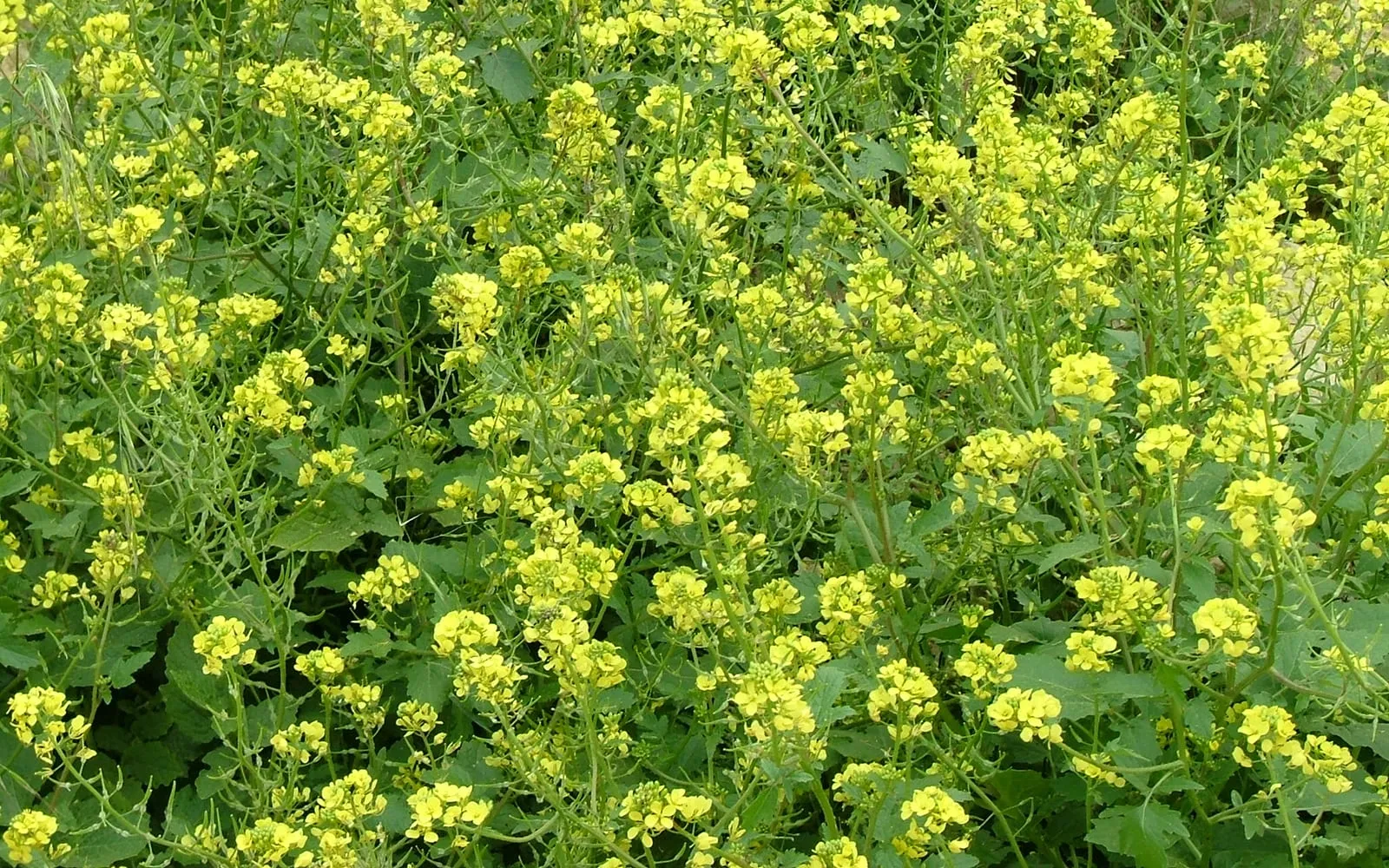
Flowers are bright yellow, four-petalled, in loose spikes at the shoot tips from June, and a stand in flower is conspicuous from a distance.
Pods are the identifying feature. Held out at an angle from the stem, bristly, with a long flattened beak at the tip that is as long as the seed-bearing part.
Seeds are pale yellow to cream, round, and noticeably larger than black mustard’s.
The whole plant is peppery when chewed, and the seedlings carry the same flavour in a milder form.
Where it is from
White mustard is native to the Mediterranean and it has spread across Europe as a crop and as a weed of cultivated ground.
Its use as a condiment is Roman and older. Mustard seed ground with unfermented grape juice, called must, is where the word mustard comes from.
England made it an industry. Mustard has been grown commercially in East Anglia for centuries, and Colman’s of Norwich, founded in 1814, built a business on blending white and brown mustard flours.
Dijon mustard uses brown mustard rather than this species, which is why it is sharper. American yellow mustard is almost entirely white mustard with turmeric for colour, which is why it is mild.
It is grown across Europe and North America now, as a spice crop, as a salad crop and very widely as a green manure and cover crop.
How it grows
For seedlings, sow thickly on damp compost in a tray or on a windowsill, cover for a few days, then bring into the light and cut at 5 cm after a week or two.
For a seed crop, sow direct from March to May, thinly at 1 cm deep, thinning to 15 cm.
For green manure, broadcast at any point from March to September and dig it in before it flowers.
Choose an open sunny position on ordinary ground. It grows on chalk readily.
Rotate it as a brassica. It shares clubroot with cabbages and should not follow them.
Water in dry weather while growing.
Harvest seed in late summer, cutting whole plants when the pods have gone yellow-brown and before they shed, and drying them head-down in paper bags.
Cut a green manure crop before it flowers, since flowering plants are tougher to dig in and will seed.
Watch for self-seeding, which is heavy from a crop left to ripen.
Through the seasons
Winter shows overwintering plants from a late sowing in a mild year, and a green manure crop holding the ground.
Spring is the main sowing time for a seed crop, from March.
Early summer is flowering, from June, in bright yellow.
Midsummer is when the pods fill.
Late summer is harvest, cutting the plants as the pods turn yellow-brown.
Autumn is a good green manure sowing window, covering bare ground through the winter.
Care difficulty
Easy. White mustard is a fast, vigorous, undemanding crop.
Flea beetle is the main pest, riddling the leaves of young plants, and it matters for a salad crop and rather less for seed.
Clubroot is the disease to plan around. Mustard is a brassica and it will carry and be damaged by clubroot, so rotate it and keep it off infected ground.
Self-seeding is heavy if pods are left to ripen and shed, so cut a seed crop promptly.
For green manure, cutting it before flowering is the rule, since a flowering plant is tougher to dig in and will seed.
Nothing else needs doing. It needs no feeding, no staking and little watering.
Watering
Water the seedbed before sowing and keep it damp until germination.
Water weekly in dry weather while the plants are growing.
Keep salad seedlings evenly damp, since drying out ruins a tray.
Stop watering once the pods start to turn.
Water at the base rather than over the plants.
A green manure crop needs watering only in a genuine drought.
Warning signs, diseases and pests
Flea beetle peppers young leaves with small round holes. Cover the row with fine mesh from sowing, particularly for a salad crop.
Clubroot swells and distorts the roots and stunts the plant. It persists in soil for twenty years, so rotate and lime acid ground.
Cabbage white caterpillars strip leaves in summer. Mesh keeps the butterflies off.
Small pinholes and papery windowpane patches, with a thin pale green caterpillar that drops off on a silk thread when touched, is diamondback moth, the most economically damaging brassica pest worldwide. It is a minor concern on a fast-cut green manure or salad crop, but worth recognising where the plant is left to flower and seed.
Slugs take seedlings.
Pods that shed before harvest were left too long. Cut when they go yellow-brown.
Seedlings across the plot the following year mean the pods shed.
A green manure that has flowered will be tougher to dig in and will seed itself. Cut it earlier.
Growing environment
Full sun. It grows in part shade and produces less.
Almost any soil that drains. It is unfussy and grows well on chalk.
pH from 6 to 7.5. Lime acid ground, which also suppresses clubroot.
A vegetable bed, treated as part of the brassica rotation.
For salad seedlings, a windowsill tray or a shallow pot indoors works all year.
As a green manure it is one of the best fast covers available, germinating in days and smothering weeds.
Feeding
Nothing is needed. White mustard grows fast in ordinary ground.
Avoid nitrogen, which produces soft leafy plants with fewer pods.
Compost dug in the previous autumn is ample.
For green manure, feeding defeats the point, since the crop is being grown to add organic matter rather than to consume nutrients.
A container of salad seedlings needs no feeding at all, since it is cut within a fortnight.
Troubleshooting
What is the difference between white, brown and black mustard? White mustard has the mildest heat, from sinalbin, which sits on the tongue and fades. Brown and black mustard carry sinigrin, which gives the sharper heat that goes up the nose. English mustard blends white and brown. American yellow mustard is almost entirely white mustard.
Which is the mustard in mustard and cress? This one. Sow it a few days after the cress so they are ready together, since mustard germinates faster.
The leaves are full of holes. Flea beetle. Cover the row with fine mesh from sowing.
Can I grow it after cabbages? Better not. It is a brassica and shares clubroot, so keep it in the brassica rotation.
I lost the seed at harvest. The pods shed once fully ripe. Cut whole plants when the pods turn yellow-brown and dry them head-down in paper bags.
Is it any good as green manure? One of the best fast covers available. It germinates in days, smothers weeds and adds organic matter. Dig it in before it flowers, and avoid it where clubroot is a problem.
Can I make mustard from my own seed? Yes. Grind the seed, mix with cold water and leave for ten minutes for the heat to develop, then add vinegar to fix it. Hot water and vinegar added too early both kill the heat.
White Mustard problem guides
Not sure what is wrong? See the common vegetable pests guide.