
Edible
Rocket
Eruca vesicaria
Also known as Salad rocket, Garden rocket, Cultivated rocket, Arugula, Roquette, Rucola
How to grow rocket, Eruca vesicaria. Cut-and-come-again sowing, why summer rocket turns fierce, beating flea beetle, and telling salad rocket from wild rocket.
At a glance
- Difficulty
- Easy
- Water
- Every few days in dry weather
- Light
- Full sun in autumn and spring, light shade in summer
- Temperature
- 10-18 deg C. Bolts in heat and in long days
- Hardiness
- USDA 3-11, RHS H5, hardy to -10 C
- Type
- Annual
- Height
- 20-30 cm, and up to 90 cm in flower
- Native to
- The Mediterranean and western Asia
- Best month
- September in the Northern Hemisphere, March in the Southern Hemisphere
Heat and long days push it to flower within weeks, so summer sowings give hot narrow leaves and a flower stem rather than a salad. Autumn and early spring are the honest windows, and a cloche extends both. Flea beetle riddles the leaves in warm dry weather everywhere it grows.
Hardiness zones describe winter cold alone. Summer heat, humidity, rainfall and the length of the growing season decide as much, so treat the range as the outer limit rather than as a recommendation.
Every month named in this guide is for the temperate Northern Hemisphere. If you garden in the Southern Hemisphere, shift each one by six months, so September becomes March. Closer to the equator the wet and dry seasons matter more than the calendar, and the shift stops being a useful guide.
Not known to be toxic
- Safe to eat
- The leaves, the flowers and the young seed pods
Rocket is a food crop and carries no toxicity concern. The RHS does not list Eruca vesicaria as a potentially harmful garden plant and the ASPCA does not list it as toxic to cats and dogs, though a dog that eats a quantity of it is likely to get an upset stomach from the mustard oils. Those mustard oils are glucosinolates and their breakdown products, and rocket carries them at a higher concentration than most salad leaves, which is the whole reason it tastes as it does. They are harmless in any quantity a person eats. Rocket is a moderate nitrate accumulator, and leaves grown fast in low winter light under cover carry more than summer-grown ones, which is a consideration for commercial growers rather than a hazard at garden scale. The flowers are edible and pretty, cream with purple veining, and the young seed pods are eaten raw and taste strongly of the leaf.
Sources: RHS potentially harmful garden plants, ASPCA toxic and non-toxic plants
About
Rocket is the fastest thing in this collection to a first picking. Three weeks from sowing to a cut of baby leaves, and a fortnight between cuts after that.
The reputation problem is heat, both kinds. A spring or summer sowing meets long days and warm soil, bolts within weeks, and produces leaves so peppery they overwhelm a salad. The same seed sown in September gives mild, tender, generous leaves that keep cutting into December.
Two different plants are sold under the name and the difference matters in a garden. Salad rocket, Eruca vesicaria, is the annual with broad lobed leaves that grows fast and bolts fast. Wild rocket, Diplotaxis tenuifolia, is a perennial with narrow, deeply cut leaves, a stronger flavour and much better staying power. Most bagged supermarket rocket is wild rocket. This guide is the annual.
Appearance and character
A low rosette 20 to 30 cm across, with leaves held on thin stalks.
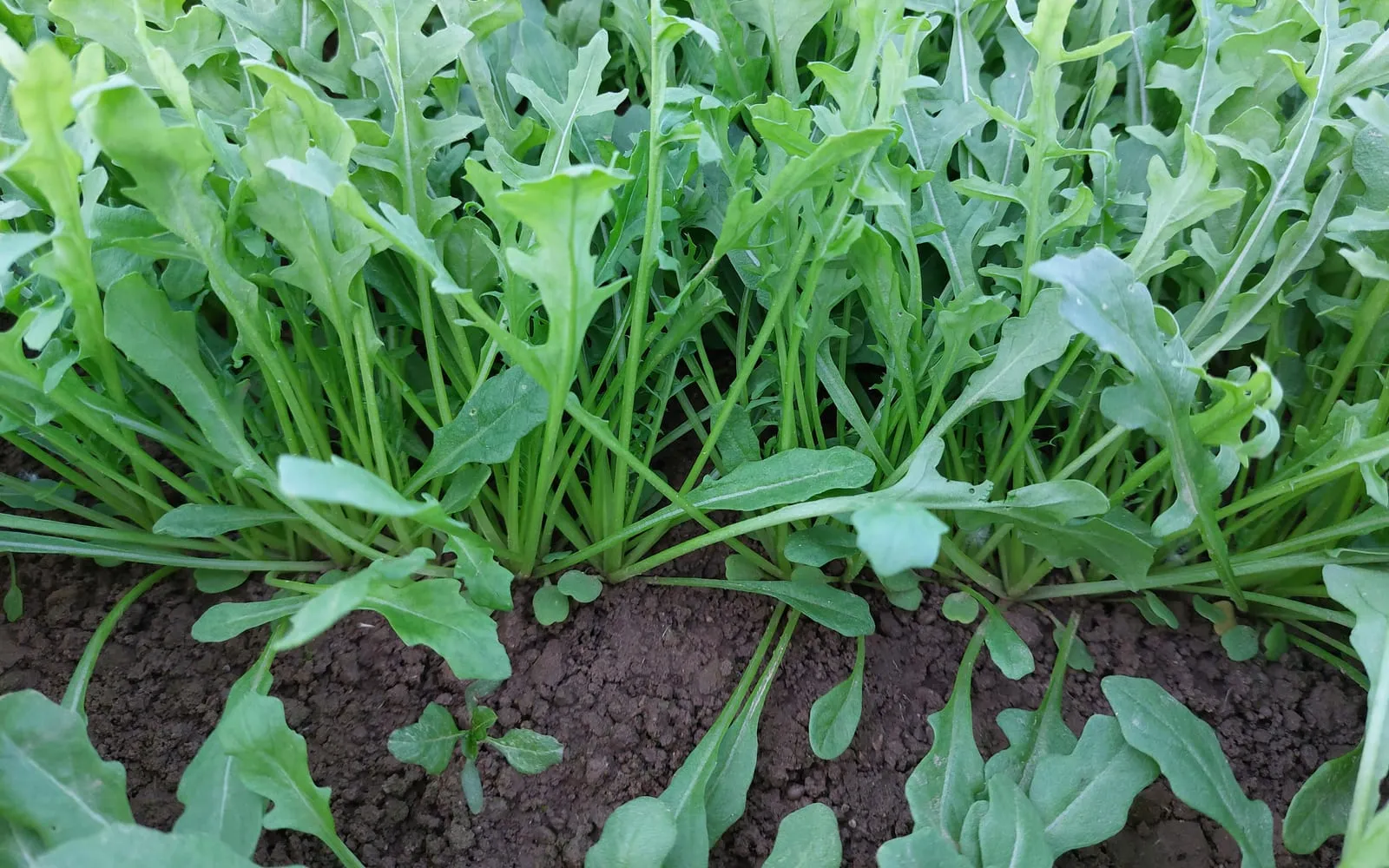
Leaves are oblong and pinnately lobed, with a large rounded terminal lobe and several smaller pairs below it, in a fresh mid-green with a slightly succulent feel.
Flowers open from a branched stem as the plant bolts, four-petalled, cream to pale yellow with distinctive dark purple veining. They are edible and worth leaving on a plant or two.
Seed pods are narrow, upright and beaked, and the young ones are eaten raw.
Flavour is peppery, nutty and warm, and it varies enormously with growing conditions. Cool, damp, fast growth gives mild leaves. Heat and drought give something closer to mustard.
Where it is from
Rocket is native to the Mediterranean and western Asia, growing on dry disturbed ground.
Romans grew it and ate it, and Pliny and Columella both mention it. The Romans also credited it with aphrodisiac properties, which is why mediaeval monastery gardens were discouraged from growing it, and which says more about mediaeval horticulture than about the plant.
Italy kept eating it continuously and Britain did not, which is why it returned as a novelty in the 1980s and 1990s despite having been grown in Tudor gardens.
Wild rocket, Diplotaxis tenuifolia, is a different genus that grows on British waste ground and railway ballast, and it has been naturalised there for centuries.
How it grows
Sow direct. Rocket grows too fast for transplanting to be worthwhile, and a checked plant bolts.
For cutting leaves, broadcast thinly or sow in drills 15 cm apart, and cut at 8 to 10 cm with scissors, 2 cm above the crown. Expect three or four cuts.
For larger leaves, sow at 1 cm deep in rows 30 cm apart and thin to 15 cm.
Germination takes three to seven days.
Baby leaves are ready in three weeks and full leaves in five to six.
Sow every fortnight from August to early October for the main season, and in March and April for a spring crop that will bolt by June.
Let one plant flower and it will seed itself, giving volunteer rocket for several years.
Through the seasons
Spring takes sowings from March under fleece and April outdoors. Cut small and expect bolting by late May.
Summer is the difficult season. Long days and heat bring flowering within a month and a fierce flavour. Sow in light shade, keep it damp, cut very young, or grow something else.
Late summer and early autumn are the season. Sow from August to early October. Shortening days, cooler nights and a fall in flea beetle pressure all work together, and this is when rocket is at its best.
Autumn and winter are the harvest. Rocket stands to about -5 deg C outdoors and much more under a cloche. Growth stops in the darkest weeks and picks up in late January.
Care difficulty
Among the easiest crops to grow, provided you choose the right season.
Flea beetle is the defining nuisance and rocket attracts it more than almost any other salad. Fine mesh from the day of sowing prevents it, and an August or September sowing sidesteps most of the pressure.
Bolting is a spring and summer fault, avoided by sowing after midsummer.
Flavour is the third thing to manage and it is entirely about growing conditions. Fast, cool, damp growth gives mild leaves.
Slugs take seedlings in a damp autumn.
Nothing else needs attention. The crop occupies its ground for six weeks and is gone.
Watering
Water every few days in dry weather. Rocket grown dry is tough and fierce, and the difference from a well-watered crop is dramatic.
Keep the top 15 cm damp. The roots are shallow and there is no reserve below.
Water immediately after each cut, which is what drives regrowth.
Water at the base in autumn, since wet leaves overnight bring downy mildew and comfort slugs.
Mulch lightly with compost between rows.
Container growing suits it. A 20 cm pot or a windowbox gives cutting leaves and needs watering every day or two.
Warning signs, diseases and pests
Flea beetle shot-holes the leaves with small round punctures from April to July, and it prefers rocket to most things in the bed. Cover with fine insect mesh from the day of sowing, keep the soil surface damp, and sow from August when the adults have largely finished.
Bolting sends up a branched flower stem and coarsens the leaves. Sow after midsummer. The flowers and young pods are both worth eating from a bolted plant.
Slugs and snails graze seedlings off at ground level. Water in the morning and patrol on damp evenings.
Cabbage white caterpillars strip leaves in late summer. Net with 7 mm mesh.
Small pinholes and papery windowpane patches, with a thin pale green caterpillar that drops off on a silk thread when touched, is diamondback moth, the most economically damaging brassica pest worldwide. The same mesh keeps it off.
Downy mildew brings yellow patches with grey growth beneath in a wet autumn. Space the plants and water at the base.
Fierce hot leaves are a growing-conditions fault rather than a pest. Water more and pick younger.
Harlequin bug drains the leaves into pale cloverleaf-shaped blotches across the southern and central United States, where it can overwinter, and turns up further north as a seasonal visitor. It has not established outside the Americas.
Growing environment
Full sun from September to April, and light shade in high summer, which delays bolting and keeps the flavour milder.
Fertile, moisture-retentive soil grows tender leaves. Work compost in before sowing.
Neutral to slightly acid soil, pH 6 to 7.
A cloche or low tunnel from October keeps winter leaves clean and extends cutting into February.
Shelter from strong wind, which tears the thin leaves.
Rotate on four years with the brassicas where clubroot is present, though a six-week crop rarely picks it up.
Feeding
Work garden compost into the bed before sowing. A crop this fast needs its nutrients available from the start.
Feed with a balanced or nitrogen-rich liquid feed after each cut. Regrowth depends on it.
Stop feeding in November, when light rather than nutrients limits growth.
Avoid fresh manure and heavy nitrogen, both of which give soft growth that slugs find first.
Winter plants under cover need less feeding than their appearance suggests.
Troubleshooting
Small round holes all over the leaves. Flea beetle. Cover with fine mesh from the day of sowing and keep the surface damp. Sow from August to avoid the worst.
It flowered within a month. Bolting, from a spring or summer sowing meeting long days. Sow from August to early October.
The leaves are unbearably hot. Grown in heat and drought, or picked too old. Sow in autumn, water every few days, and cut at 8 to 10 cm.
Seedlings vanished overnight. Slugs. Water in the morning and patrol on damp evenings.
Yellow patches with grey growth underneath. Downy mildew. Space wider, water at the base, and ventilate under a cloche.
It stopped regrowing after three cuts. Normal. Feed after each cut and expect to resow after three or four.
Rocket is coming up everywhere. A plant was allowed to seed. It is a generous self-seeder, and the volunteers are perfectly good.
Is this the same as the rocket in supermarket bags? Usually not. Bagged rocket is mostly wild rocket, Diplotaxis tenuifolia, which is a perennial with narrow deeply cut leaves and a stronger flavour. This is salad rocket, the faster annual.
Rocket problem guides
Not sure what is wrong? See the common vegetable pests guide.