
Chillies and peppers: the five Capsicum species and how they differ
Sweet peppers, habaneros, bird's eye chillies, aji and rocoto all belong to Capsicum. The five domesticated species differ in their flowers, seeds, origin and cold tolerance. Heat alone will not tell them apart.
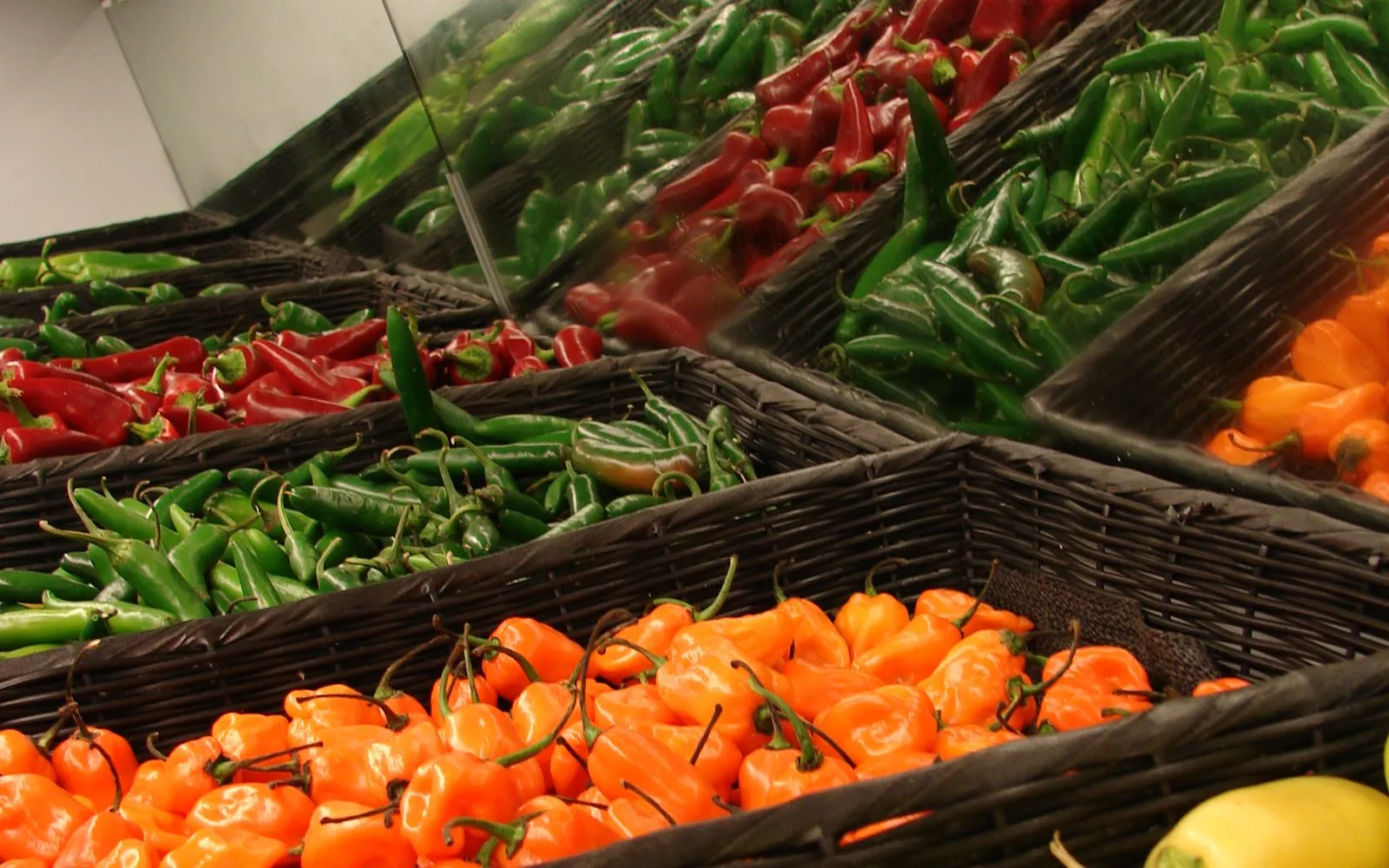
Sweet peppers, jalapenos, habaneros, Scotch bonnets, Peruvian aji and Andean rocoto all belong to Capsicum. They are not related to the black pepper that gave them their English name. Five Capsicum species were domesticated separately in different parts of Latin America. Their flowers, seeds and climate needs tell them apart more reliably than heat.
A name borrowed from the wrong plant
Christopher Columbus reached the Caribbean in 1493 looking for a sea route to the pepper and spice markets of Asia. He found a fruit the Taino people called aji, and it burned the way black pepper burned, so he sent it home labelled as pepper. The name stuck across most European languages. Spanish took it as pimienta, German as Pfeffer, and English as pepper.
Black pepper is Piper nigrum, a woody vine from the monsoon forest of India’s Western Ghats, in the family Piperaceae. Capsicum belongs to Solanaceae, the nightshade family, alongside tomatoes, potatoes and the aubergine. Capsicum and black pepper are unrelated plants. English uses “pepper” for both because both taste hot and Columbus used the older spice name for the American fruit.
Long pepper, Piper longum, was the more expensive of the two Old World peppers through the Roman and medieval periods. Pliny priced it at four times what black pepper cost, and English recipe collections from the fourteenth century still called for it alongside black pepper and grains of paradise. After traders brought Capsicum from the Americas, European cooks had a cheaper source of heat. Within a couple of generations, they used it where they had once used long pepper. Long pepper survives in Indian, Indonesian and North African cooking, where it never left.
Five species, one genus
People domesticated Capsicum independently at least five times in different parts of the Americas. The five domesticated species are Capsicum annuum, C. chinense, C. frutescens, C. baccatum and C. pubescens. All five still cross with wild chillies somewhere in their home range, and all five carry capsaicin. The amount of capsaicin, and where it concentrates in the fruit, varies by species as much as by variety.
A bell pepper and a fiery cayenne are both Capsicum annuum. A handful of genes switch capsaicin production on or off inside the same species. To tell the five domesticated species apart, look at the flower colour, the number of flowers at each node, the seed colour and the plant’s cold tolerance. Four species have cream seeds. C. pubescens has black seeds and survives a light frost.
Capsicum annuum, the one on every shelf
Most shop peppers are Capsicum annuum. Bell peppers, jalapenos, cayenne, poblano, padron and the ordinary chilli sold for a curry are all this one species. It was domesticated in central-east Mexico more than six thousand years ago, in the same valleys where maize and squash were also brought into cultivation. Its wild ancestor, the tiny upright chiltepin, still grows across the Mexican scrubland its descendants left behind.
Look for a single white flower at each node. Every fruit starts green regardless of what colour it ripens to. Growth stops below 12 deg C, so it needs a greenhouse or a bright windowsill outside the subtropics.
Capsicum chinense, the hottest species
Capsicum chinense produces almost every chilli famous for pure heat. Habaneros, Scotch bonnets, bhut jolokia and the Carolina Reaper are all this one species. Breeders selected different lines for fruit shape, flavour and heat. It was domesticated in the Caribbean from stock out of the Amazon basin. Nikolaus von Jacquin named it in 1776 from a plant he thought had come from China.
Two or three flowers open together at each node, rather than the single flower of C. annuum. Use that trait to tell a habanero seedling from a bell pepper seedling before either has fruited. Growth stops below 15 deg C, and the fruit needs the better part of a hot season to ripen.
Capsicum frutescens, the upright-fruited chilli
Capsicum frutescens gives Tabasco sauce its pepper, piri piri its heat and Thai cooking its small fierce pods. Its narrow fruit point upward above the leaves instead of hanging below them. The upright pods are the easiest field mark.
Portuguese trade carried C. frutescens to Africa, South Asia and South East Asia within decades of 1500, faster than any other New World crop. Piri piri became part of Mozambican cooking, and bird’s eye chilli became part of Thai cooking, although the species is native to the Americas.
Taxonomists still argue over whether frutescens and chinense are separate species at all, since the two cross readily and share much of their genetics. Growth in C. frutescens stops below 15 deg C, the same threshold as its close relative.
Capsicum baccatum, grown for flavour first
Capsicum baccatum is the chilli of Peru and Bolivia, grown as much for flavour as for heat. Aji amarillo, its best-known form, is one of the foundational ingredients of Peruvian cooking alongside garlic and red onion. It tastes fruity and citrus-like, with heat that develops slowly.
Its white petals have yellow, tan or green blotches at the base of each lobe. No other domesticated Capsicum has spotted flowers. Unlike the other four species, baccatum stayed a regional Andean crop until the twentieth century, reaching wider cultivation only after specialist chilli nurseries began importing seed in the 2000s.
Capsicum pubescens, the one that takes a frost
Capsicum pubescens looks different from the other four domesticated species. Its leaves are covered in fine hairs, its flowers are purple or violet-blue rather than white, and its seeds are black rather than cream. No wild population of it is known, and its closest wild relatives, Capsicum cardenasii and Capsicum eximium, grow only in Bolivia.
It is also the only Capsicum that tolerates cold better than the other four species. Grown at up to 3,000 metres in the Andes, it survives brief dips to about -5 deg C once its stems have turned woody. The other four species stop growing well above freezing. Mexico grows it too, calling it manzano for its apple-like shape, and Peru bakes it whole and stuffed as rocoto relleno.
Why the heat is there at all
Capsaicin irritates mammals but not birds. It binds to the same receptor that responds to physical heat in mammals, which is why a chilli burns rather than tastes bitter. Birds carry a version of the same receptor, but capsaicin does not trigger it in the same way.
Mammals and birds handle chilli seed differently. A mammal’s molars grind the seed and destroy it before digestion. A bird swallows the fruit whole and passes the seed out intact, often some distance from the parent plant. A field study on wild chiltepin in Arizona and Mexico found that capsaicin deterred cactus mice, which destroy the seed, but did not deter curve-billed thrashers, which disperse it. Seeds that had passed through a bird’s gut were more likely to land in the shaded conditions a chilli seedling needs. Every domesticated chilli inherited that chemical defence before people began breeding chillies for cooking.
Measuring the heat
Wilbur Scoville devised the first standard measurement of chilli heat in 1912, while working at the pharmaceutical company Parke-Davis. His method used a panel of tasters. A chilli extract was diluted with sugar water, step by step, until a majority of the panel could no longer detect any heat. The dilution factor at that point became the rating. The method depended on human palates, which vary from one taster to the next. It also depended on tasters who became desensitised as a session went on.
By the 1980s, laboratories had replaced the tasting panel with high performance liquid chromatography. HPLC measures the concentration of capsaicin and its related compounds directly, then converts the figure into Scoville heat units by a fixed formula. Labs still use Scoville heat units because they are easy to understand and no longer require a tasting panel.
The Scoville ranges barely overlap at the extremes. A sweet pepper carries no capsaicin at all, and a hot cayenne reaches into the tens of thousands, well short of the hottest cultivars in the other four species. C. baccatum reaches about 30,000 to 50,000 Scoville heat units. C. frutescens and C. pubescens both reach around 30,000 to 100,000. C. chinense cultivars start around 100,000 and reach past a million when bred for heat.
Growing any of them outside the tropics
Every domesticated Capsicum needs more warmth and a longer season than most temperate outdoor gardens provide. The piece on hardiness and climate explains why a winter-hardiness rating does not say whether a summer is long enough or hot enough to ripen a crop like this one. C. pubescens is the exception. It tolerates a passing frost that kills the other four species, and it sets fruit better with cooler summer nights.
All five are perennial plants, even though most gardeners in a cold climate grow them as annuals from seed each year. For a small greenhouse crop, cut a plant back and keep it frost-free over winter instead of starting again from seed. A plant carried through to its second year is already rooted and woody at the base, and it fruits weeks earlier than a seedling raised alongside it.
Sow the slower species in winter, since chinense and pubescens both need five months or more from seed to a ripe fruit. Feed with potash rather than nitrogen once flowering starts, since surplus nitrogen is the commonest reason a chilli plant grows large and leafy and sets little fruit. Watch for the aphids, spider mite and grey mould that trouble every species under glass, and for blossom drop or blossom end rot when temperature or watering swings too far in either direction.
Common questions
- What is the difference between a chilli and a pepper?
- None. Chilli and pepper are both common names for the genus Capsicum, and pepper reached English because Columbus mistook the fruit for a substitute for black pepper, Piper nigrum, an unrelated plant from a different family.
- How many species of Capsicum are there?
- Five have been domesticated: Capsicum annuum, C. chinense, C. frutescens, C. baccatum and C. pubescens, each brought into cultivation separately in a different part of the Americas. Many more wild species exist and have never been domesticated.
- Which Capsicum species is the hottest?
- Capsicum chinense holds the record by a wide margin. Its cultivars run from around 100,000 Scoville heat units in a habanero to more than a million in a Carolina Reaper, well above anything bred from the other four species.
- Why is Capsicum chinense called chinense if it comes from the Americas?
- A naming mistake. Nikolaus von Jacquin named the species in 1776, believing the plant in front of him had come from China. It had come from the Caribbean, by way of the Amazon basin, and the name has stood ever since because botanical priority favours whoever names a species first, mistake or not.
- Is chilli heat related to black pepper's heat?
- No. Chilli heat comes from capsaicin, made by Capsicum in the nightshade family, Solanaceae. Black pepper's bite comes from piperine, made by Piper nigrum in the unrelated family Piperaceae. The two compounds evolved separately in separate plant lineages. English uses the same common name for both plants.
Sources and further reading
- Genetic resources and breeding of Capsicum spp.Barbara Pickersgill. Euphytica, 1997The standard account of the five domesticated Capsicum species and how they relate to each other.
- Multiple lines of evidence for the origin of domesticated chili pepper, Capsicum annuum, in MexicoKraig H. Kraft and others. Proceedings of the National Academy of Sciences, 2014Linguistic, genetic and archaeological evidence for where and when Capsicum annuum was first domesticated.
- Seed dispersal: Directed deterrence by capsaicin in chilliesJoshua J. Tewksbury and Gary P. Nabhan. Nature, 2001The field study on wild chiltepin behind the idea that capsaicin evolved to deter mammals while leaving birds unaffected.
- Characterization of Different Capsicum Varieties by Evaluation of Their Capsaicinoids Content by High Performance Liquid Chromatography, Determination of Pungency and Effect of High TemperatureAlberto Gonzalez-Zamora and others. Molecules, 2013Open access. Measures capsaicinoid content across Capsicum annuum varieties by HPLC, the method that replaced the original taste-panel Scoville test.
- A Plant from the Americas that Conquered the WorldSmithsonian AffiliationsOn Columbus, the naming mistake that gave chilli its English name, and how fast the plant spread after 1493.